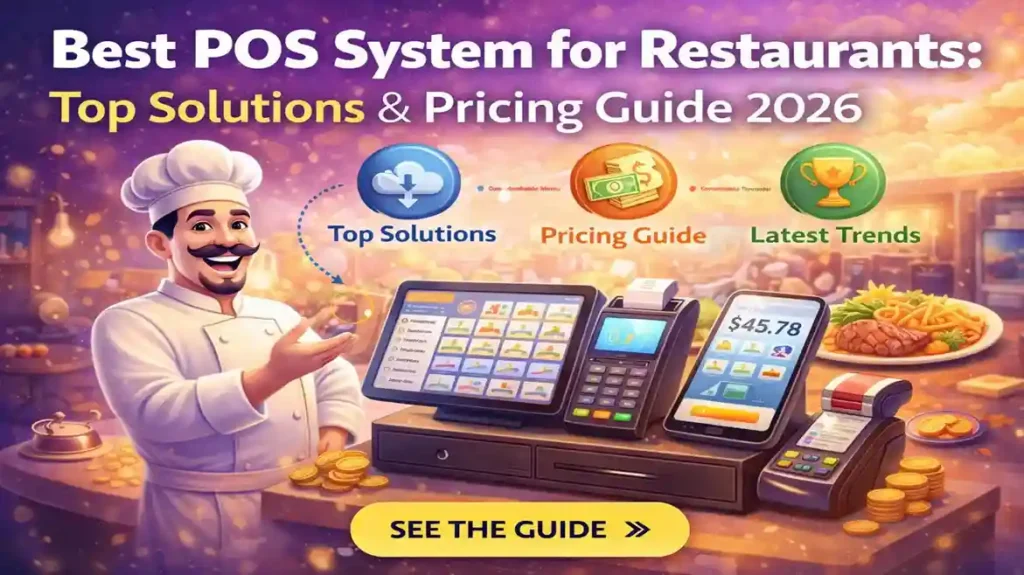
Best POS System for Restaurants: Top Solutions & Pricing Guide 2026
Compare the top restaurant POS systems in 2026 – features, pricing, integrations, and real-world performance from fine dining to quick service. Find the perfect solution for your restaurant type and budget. Your restaurant POS system isn’t just a cash register – it’s the operational backbone of your entire business. It processes every order, tracks every dollar, manages your staff, controls your inventory, and shapes your customer experience. Choose the wrong one, and you’ll fight it every day. Choose the right one, and it becomes your competitive advantage. The restaurant POS market in 2026 is crowded with options: cloud-based tablets, legacy on-premise systems, industry-specific platforms, and everything in between. Pricing ranges from $0/month (Square, Toast free plans) to $10,000+ for enterprise installations. Features vary wildly. And every vendor claims to be “the best.” This guide cuts through the noise. Whether you’re running a quick-service restaurant, full-service dining, food truck, bar, café, or multi-location chain, you’ll learn exactly what to look for, which systems dominate each category, and how to choose the solution that fits your operation and budget. 1. What Is a Restaurant POS System? (And Why It Matters) A restaurant point-of-sale (POS) system is the technology hub where orders are taken, payments are processed, and operational data is collected. Modern restaurant POS systems do far more than just ring up sales – they’re comprehensive management platforms that run your entire operation. What Modern Restaurant POS Systems Actually Do Order Management Take orders on tablets, handhelds, or stationary terminals. Send orders directly to kitchen display systems (KDS) or printers by station. Payment Processing Accept credit cards, mobile wallets, contactless payments, and split bills. Handle tips, gift cards, and loyalty rewards. Inventory Tracking Monitor stock levels in real-time, set reorder alerts, track ingredient costs, and integrate with purchasing systems. Staff Management Time clock, shift scheduling, tip pooling, performance tracking, and labor cost optimization. Menu Management Update pricing, add seasonal items, manage modifiers, create combo meals, and sync across all ordering channels. Analytics & Reporting Sales reports, labor costs, food cost percentages, bestsellers, peak hours, and profitability analysis. Table Management Floor plans, reservations, waitlists, table status tracking, and server section assignment. Online Ordering Integrate with delivery platforms (DoorDash, Uber Eats) or run your own online ordering website. Why Your POS Choice Matters Your POS system touches every transaction, employee, and customer. A slow, unreliable, or feature-poor POS creates: longer wait times (customer frustration), order errors (kitchen chaos), payment processing delays (lost revenue), poor reporting (bad decisions), and staff frustration (turnover). Choose wisely – you’ll live with this decision for 3-5+ years. 2. Must-Have Features Every Restaurant POS Needs in 2026 Not all POS systems are created equal. Here are the non-negotiable features any modern restaurant POS must include: ✓ Core Features Checklist Advanced Features (Nice to Have) 3. Top 10 Restaurant POS Systems: Detailed Comparison Here are the leading restaurant POS systems in 2026, ranked by market share and customer satisfaction: Toast POS Best for Full-Service & QSR $69 per terminal/month Square for Restaurants Best for Small Cafés & Casual $60 per terminal/month Clover Best for Quick Service $14.95 per terminal/month Lightspeed Restaurant Best for Multi-Location $69 per terminal/month LS Central Hospitality Best for Enterprise & Chains Custom enterprise pricing Revel Systems Best for QSR Franchises $99 per terminal/month Other Notable Systems 4. Best POS by Restaurant Type Different restaurant types have different needs. Here’s what works best for each: Quick Service Restaurant (QSR) / Fast Casual Best Choice: Toast POS, Square, Clover Why: Need fast order entry, kitchen routing, self-service kiosks, and high transaction volume support. Mobile ordering and delivery integration critical. Full-Service / Fine Dining Best Choice: Toast, TouchBistro, Lightspeed, LS Central Why: Need tableside ordering, complex menu modifiers, split checks, course timing, and sommelier/wine list management. Bar / Nightclub Best Choice: Toast, Square, Lightspeed Why: Need fast bartender workflow, tab management, age verification, and inventory tracking for high-cost liquor. Café / Coffee Shop / Bakery Best Choice: Square, Clover, Toast Why: Need simple, fast checkout, tip prompts, loyalty programs, and low monthly costs. Multi-Location Chain (10+ Locations) Best Choice: LS Central, Toast, Lightspeed, Revel Why: Need centralized reporting, menu management across locations, franchisee portals, and enterprise-grade support. Food Truck / Pop-Up Best Choice: Square, Clover Why: Need mobile hardware, cellular connectivity, battery operation, and low upfront cost. 5. Pricing Models: What You’ll Actually Pay Restaurant POS pricing varies by deployment model, feature set, and processing. Here’s the real breakdown: Monthly Software Costs Payment Processing Fees (The Real Cost) This is where vendors make their money. Don’t just look at software fees – factor in processing: Example: $100,000/month in credit card sales at 2.5% = $2,500/month in processing fees. A 0.3% difference in rates = $300/month = $3,600/year. Processing fees dwarf software costs. Hardware Costs (One-Time) Total hardware for a single POS station: $1,500-$4,000 Hidden Costs to Budget For Total Cost of Ownership (TCO) Example Single-location restaurant (average $50K/month sales): Software $70/month, Processing $1,250/month (2.5% of sales), Hardware $3,000 one-time = $18,840 first year, $15,840 annually thereafter. Always calculate TCO over 3 years, not just monthly software fees. 6. Microsoft Solutions: LS Central for Hospitality & Dynamics 365 For enterprise restaurant operations, Microsoft-powered solutions offer unmatched integration with business systems: LS Central for Hospitality (Recommended for Chains) Best for: Multi-location restaurant chains, hotel restaurants, QSR franchises, central kitchen operations Key Capabilities: Pricing: Implementation: $50,000-$200,000+ (varies by size and complexity) Licensing: $200-$500/user/month (typically 5-20 users per location) Best for: 10+ location chains with $10M+ annual revenue When to Choose LS Central Over Traditional POS Why Choose Microsoft Over Competitors? LS Central integrates seamlessly with tools your corporate team already uses – Excel, Teams, Power BI, Outlook. No learning curve for back-office staff. Plus, it’s built on a unified platform (Dynamics 365 Business Central), so you can add finance, HR, or supply chain modules later without replacing your system. 7. How to Choose: 8-Step Evaluation Framework Step 1: Define Your Restaurant Type & Requirements QSR, full-service, bar, café, multi-location? List must-have features vs. nice-to-haves. Step 2: Calculate Your Budget (TCO, Not Just Monthly Fees) Include software, processing fees, hardware, setup, and 3-year total cost. Step 3:
Best POS System for Restaurants: Top Solutions & Pricing Guide 2026 Read More »