
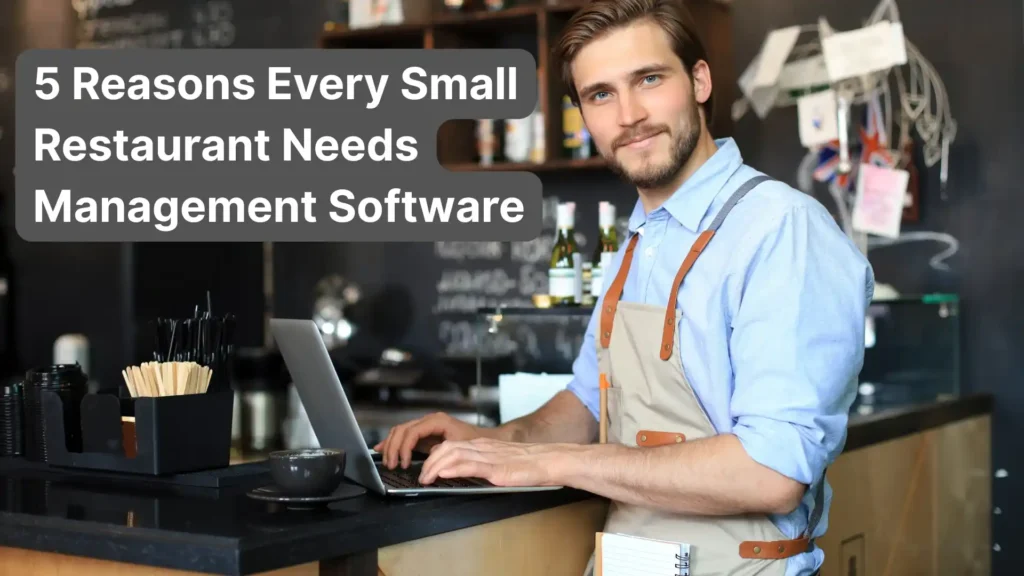
If your restaurant is still managing inventory on a spreadsheet, tracking supplier orders on paper, and reconciling food costs at month-end — you are not just working harder than you need to. You are operating with a structural disadvantage that restaurant management software eliminates entirely.
The restaurant industry operates on notoriously thin margins — typically between 3 and 9 percent — where every percentage point of food waste, every supplier order error, and every hour of manual administrative work directly impacts profitability. In this environment, the restaurants that grow consistently are not necessarily the ones with the best chefs or the best locations. They are the ones that operate with the most efficiency, the most accurate data, and the tightest cost control.
Restaurant management software brings all of this — inventory automation, supplier order management, food cost tracking, multi-location visibility, and integrated accounting — into a single, connected platform that replaces the manual processes consuming your team’s time and your business’s margin.
Despite the clear business case, a significant proportion of small restaurants, bars, and food trucks still operate without dedicated management software — relying on spreadsheets, paper records, and manual processes that were outdated a decade ago. For every restaurant operator still managing this way, there are five concrete, immediately actionable reasons to reconsider.
Why Most Small Restaurants Are Still Running on Manual Systems
The Hidden Cost of Spreadsheets and Paper in Restaurant Operations
The decision to continue managing a restaurant manually is usually not a deliberate strategic choice — it is an inertia problem. The spreadsheet that worked when you had one location and 20 covers a night becomes progressively less adequate as the business grows, but the pain builds gradually rather than arriving as a single obvious crisis.
The hidden costs accumulate in ways that are easy to miss because they are distributed across dozens of daily processes:
- Inventory inaccuracy — manual stock counts are time-consuming, prone to error, and always behind real-time reality. By the time you know you are out of a key ingredient, you are already in the middle of a service.
- Supplier order errors — handwritten or verbal orders to suppliers introduce transcription errors that result in wrong quantities, wrong products, and unexpected costs. A simple misread of a number can turn an order for 9 units into a delivery of 90.
- Food cost uncertainty — without automated dish cost calculation, knowing whether your menu is actually profitable requires manual analysis that most operators simply do not have time to perform consistently.
- Administrative time waste — the hours spent manually reconciling invoices, compiling sales reports, and updating spreadsheet inventory could be redirected to the customer experience, staff development, or business growth.
- Multi-location management chaos — managing two or more locations on separate manual systems is not twice the work — it is exponentially more complex, with no reliable way to compare performance or consolidate data.
What Changes When You Switch to Restaurant Management Software
Restaurant management software does not just make existing processes faster — it fundamentally changes the operational model. Manual processes that required human attention at every step become automated. Data that previously required compilation becomes available in real time. Decisions that were previously made on instinct become supported by accurate, current information.
The result is a restaurant that operates with the efficiency, accuracy, and cost discipline of a much larger operation — regardless of size.
5 Reasons Your Restaurant Needs Management Software Now
Reason 1: Simplify Inventory Management and Eliminate Stockouts
Inventory management is the operational function most immediately transformed by restaurant management software — and the one where the ROI is most immediately visible.
Manual inventory management in a restaurant is a constant battle against imprecision. Count sheets completed at the beginning of the shift do not reflect what was actually used during service. Waste goes unrecorded. Deliveries are received without proper checking. By the end of the week, the theoretical inventory and the actual inventory have diverged — and nobody knows by how much until it becomes a problem.
How restaurant management software transforms inventory:
- Real-time stock deduction — every order entered into the POS system automatically deducts the required ingredients from the live inventory. The moment a dish is sold, the components used to make it are removed from stock — giving you an accurate, continuously updated picture of what you have.
- Automated low-stock alerts — when an ingredient falls below a defined minimum level, the system notifies the relevant person automatically — preventing stockouts before they affect service quality or guest experience.
- Waste tracking — record wastage, spoilage, and over-production systematically — building the data needed to reduce waste over time and protect margins.
- Supplier order generation — when stock reaches reorder thresholds, the system can generate supplier purchase orders automatically — with the correct quantities based on actual consumption patterns rather than guesswork.
- Recipe-level inventory deduction — for restaurants using a full recipe management module, every dish sold deducts the exact quantities of every ingredient used — providing ingredient-level inventory accuracy across every product on the menu.
For a small restaurant operator spending hours every week on manual stock counts, this single capability alone typically justifies the investment in management software.
Reason 2: Reduce Human Error in Supply Orders and Purchasing
Every restaurant that places supplier orders manually — by phone, email, handwritten form, or fax — is exposed to a category of error that is entirely preventable with the right technology.
Supplier order errors are more costly than they appear. A decimal point in the wrong place can result in a delivery ten times larger than intended. An illegible handwritten order can arrive as the wrong product entirely. A verbal order communicated under pressure during a busy service can be misheard and misprocessed. Each of these errors has direct cost implications — either the cost of the unwanted delivery or the cost of being without a critical ingredient during service.
How restaurant management software reduces ordering errors:
- Digital purchase orders — orders are generated in the system and transmitted electronically — eliminating the transcription errors inherent in handwritten or verbal ordering
- Automated quantity calculation — order quantities are calculated based on current stock levels, par levels, and consumption history — removing the guesswork that leads to over-ordering or under-ordering
- Order tracking and confirmation — every purchase order has a digital audit trail — tracking submission, supplier confirmation, expected delivery date, and actual receipt against order — giving your team visibility into the entire procurement process
- Supplier integration — advanced restaurant management platforms integrate directly with supplier systems — enabling electronic order submission and confirmation without manual communication
The simple shift from paper-based to digital ordering consistently reduces supplier order errors by a significant margin — protecting both your costs and your service quality.
Reason 3: Simplify Accounting and Invoice Management
Restaurant accounting is notoriously paper-intensive — invoices arriving from dozens of suppliers across multiple delivery frequencies, requiring manual data entry, filing, and reconciliation before payment. For small restaurant operators without dedicated accounting staff, this administrative burden consumes hours that could be spent more productively.
Restaurant management software transforms the invoice management process:
- Digital invoice capture — capture invoices instantly by photographing them with a mobile device. The software uploads the image, extracts the relevant data, and files it automatically in the digital accounting system.
- Automated reconciliation — invoices are matched against purchase orders and goods receipts automatically — flagging discrepancies for human review rather than requiring manual comparison of every document
- Payment due date management — the system tracks payment due dates for every outstanding invoice and alerts the relevant person before due dates are missed — protecting supplier relationships and avoiding late payment penalties
- Financial reporting — consolidated financial reports — cost of goods sold, gross margin by menu category, period-over-period comparisons — are available in real time rather than after a manual monthly reconciliation
For a restaurant operator currently managing accounting with a box of paper invoices and a spreadsheet, this transformation is one of the most immediately impactful changes that management software delivers.
Reason 4: Gain Real-Time Insight Into Food Costs and Margins
Restaurant profitability lives and dies in the detail of food costs — and most small restaurant operators do not have accurate, current visibility into what each dish on their menu is actually costing them.
Ingredient prices change constantly. Supplier costs fluctuate with season and demand. Portion sizes vary between kitchen staff. Waste levels affect effective cost. Without a system that tracks all of these variables in real time and calculates dish-level profitability continuously, menu pricing decisions are made on outdated assumptions — with profit margins eroding silently.
How restaurant management software delivers food cost visibility:
- Dish cost calculation — the system calculates the current cost of every dish on the menu based on the latest ingredient prices — updated automatically when supplier invoice prices change
- Profit margin tracking — for every menu item, the software shows current cost, selling price, and gross margin — giving you the data to make informed pricing decisions
- Price change alerts — when the cost of a key ingredient changes significantly — onion prices spike, protein costs rise — the system flags the impact on dish margins automatically
- Menu engineering analysis — identify which dishes are your most profitable (high margin, high volume), which are stars that need promotion, and which are draining margin without delivering sufficient volume
- Theoretical vs actual food cost — compare what your food should have cost (based on sales volume and recipes) with what you actually spent — identifying waste, over-portioning, and theft
For a restaurant operator making menu pricing decisions without this data, the difference in profitability can be significant — multiple percentage points of margin that are currently invisible and unmanaged.
Reason 5: Manage Multiple Locations From a Single Dashboard
For restaurant operators managing two or more locations, the manual management challenge does not scale linearly — it multiplies. Separate systems, separate data, separate reporting, and no reliable way to compare performance or consolidate purchasing across locations creates an administrative overhead that grows faster than the revenue that justifies it.
Restaurant management software built for multi-location operations transforms this challenge:
- Unified dashboard — see sales, inventory, food cost, and operational data across all locations simultaneously from a single management interface — without logging into separate systems
- Consolidated purchasing — place supplier orders for all locations centrally, with the volume to negotiate better pricing and the efficiency of a single procurement process
- Menu consistency management — ensure menu items, pricing, and recipes are consistent across all locations — with centrally managed changes deploying to every site simultaneously
- Location performance comparison — identify which menu items perform best at each location, which locations are most profitable, and which are underperforming — with the data to understand why and act on it
- Cross-location inventory management — transfer stock between locations when one site is overstocked and another is running low — reducing waste and preventing stockouts
For any operator managing more than one location, centralized restaurant management software is not a luxury — it is an operational necessity.
Additional Benefits of Restaurant Management Software
POS Integration: Connecting Sales to Operations in Real Time
The real power of restaurant management software is realized when it is fully integrated with your POS system — creating a single, connected operational platform where every sale automatically updates inventory, food cost, and financial reporting in real time.
With POS integration, the data your front-of-house team generates every service becomes instantly available to your back-of-house and management team — without any manual data transfer, reconciliation, or reporting delay.
Staff Scheduling and Labour Cost Management
Labour is typically the largest controllable cost in any restaurant — and most small operators manage scheduling manually, without visibility into the labour cost implications of each scheduling decision. Restaurant management software with integrated staff scheduling gives operators:
- Demand-based scheduling — align staffing levels to forecast sales rather than fixed patterns
- Labour cost visibility — see the cost of each shift schedule before finalizing it
- Overtime alerts — automatic notification when scheduled hours will trigger overtime costs
- Time and attendance integration — connect scheduled hours to actual hours worked for accurate payroll processing
Customer Loyalty and CRM Built Into Your Restaurant System
Customer loyalty programs are one of the highest-ROI marketing investments available to restaurant operators — but only when the loyalty data is connected to the operational system and used to personalize the guest experience. Integrated CRM and loyalty management within your restaurant management software enables:
- Automatic loyalty point accrual with every qualifying transaction
- Personalized offers based on individual visit frequency and menu preferences
- Birthday and anniversary recognition — driving visits during key personal moments
- Lapsed guest re-engagement campaigns — targeted outreach to customers who have not visited in a defined period
Real-Time Reporting and Business Analytics
Without management software, restaurant reporting is a retrospective exercise — compiling last week’s data to understand what happened last week. With restaurant management software, reporting is continuous and real-time:
- Hourly sales performance against targets — during service, not after it
- Food cost percentage — updated with every order, every delivery, every waste record
- Table turnover and cover count — by service, day, and period
- Menu item performance — identifying top sellers and underperformers in real time
What to Look for When Choosing Restaurant Management Software
All-in-One vs Best-of-Breed: Which Approach Works for Restaurants?
The fundamental technology decision for restaurant operators is whether to adopt an all-in-one platform that covers every function — POS, inventory, accounting, loyalty, scheduling, and analytics — or to combine specialist “best-of-breed” tools for each function.
For most small and mid-size restaurant businesses, the all-in-one approach consistently delivers better outcomes — because the value of restaurant management software is maximized when every function shares the same data in real time, without integration overhead, reconciliation delays, or multiple subscription costs.
Cloud vs On-Premises Restaurant Management Systems
Cloud-based restaurant management software offers significant advantages for most small and mid-size operators:
- Access from any device, anywhere — manage your restaurant from home, on mobile, or across multiple locations without being physically present
- Automatic updates — new features, security patches, and regulatory updates deployed without manual intervention
- Lower upfront cost — subscription-based pricing eliminates the capital investment of on-premises software
- Scalability — add locations, users, and modules as your business grows without infrastructure investment
Restaurant Management Software for Different Business Formats
| Restaurant Format | Key Software Requirements |
|---|---|
| Independent restaurant | POS, inventory, food cost, basic reporting |
| Small chain (2–5 locations) | Multi-site management, centralized purchasing, consolidated reporting |
| Quick service / fast casual | High-speed POS, kiosk ordering, rapid kitchen throughput |
| Café and coffee shop | Mobile ordering, loyalty, seasonal menu management |
| Bar and pub | Tab management, beverage cost control, staff scheduling |
| Food truck | Mobile POS, simplified inventory, offline capability |
| Catering and events | Event management, pre-production planning, client billing |
The ROI of Restaurant Management Software: What to Expect
Restaurant operators implementing management software consistently report measurable improvements across their key operational metrics:
| Metric | Typical Improvement |
|---|---|
| Food cost reduction | 2–5 percentage points through better tracking and waste reduction |
| Supplier order error reduction | 80–90% through digital ordering and automated quantity calculation |
| Administrative time saving | 5–10 hours per week through automated inventory, invoicing, and reporting |
| Stock accuracy improvement | Real-time vs end-of-period accuracy |
| Margin visibility | Dish-level cost and profit visible in real time vs monthly estimation |
How LS Central on Microsoft Dynamics 365 Delivers All 5 Benefits
LS Central for Restaurants — built on Microsoft Dynamics 365 Business Central — is the all-in-one restaurant management platform that delivers every capability covered in this guide within a single, unified system.
From the POS terminal on the counter to the head office management dashboard, LS Central connects every operational function — inventory management, supplier purchasing, recipe and menu management, food cost tracking, customer loyalty, staff scheduling, and financial reporting — in a single platform that is both powerful enough for multi-site chains and accessible enough for independent restaurants.
Key capabilities that address each of the five reasons:
- Inventory — real-time POS-integrated stock deduction, automated replenishment, waste tracking
- Supplier orders — digital purchase order generation with automated quantity calculation and supplier integration
- Accounting — direct integration with Dynamics 365 Business Central financial management — the most robust accounting engine available in any restaurant management platform
- Food cost — recipe-level cost calculation, margin tracking, and menu engineering analytics updated in real time
- Multi-location — single platform for unlimited locations — centralized menu management, purchasing, and reporting
Why Trident Is India’s Trusted Restaurant Management Software Partner
Trident Information Systems is a trusted consulting and technology services partner with deep expertise in driving digital transformation across Manufacturing, Retail, Hospitality, Logistics, Services, and more. With a strong presence in India, the U.S., UK, UAE, Africa, and a rapidly expanding footprint in Southeast Asia, Trident has successfully delivered over 250+ customer engagements. These include smart manufacturing with intelligent shop floor automation, retail digitalization spanning 3,000+ stores, and IoT-driven asset management covering 400+ assets across 150+ locations.
Beyond infrastructure and operations, Trident excels in business applications (Microsoft Dynamics 365 ERP, CRM, O365, Azure, Power BI, Power Platform, Salesforce) and Data & AI services in collaboration with Microsoft and IBM. What truly sets them apart is their exclusive Managed Talent Services unit, designed to help organizations jumpstart digital transformation engagements quickly and effectively—bridging the gap between strategy and execution with the right skills at the right time.
As a certified LS Central and Microsoft Dynamics 365 Business Central implementation partner, Trident Information Systems has helped restaurants, cafés, quick-service chains, and multi-site hospitality groups across India implement and maximize the value of restaurant management software — from initial needs assessment and system configuration through staff training, go-live support, and ongoing optimization.
Ready to move your restaurant from spreadsheets to a unified management platform? Book a free restaurant software assessment with Trident today — and discover exactly how quickly your operation can eliminate the manual processes that are costing you time and margin. For more insightful content and industry updates, follow our LinkedIn page.

