
Welcome to Trident Information Systems!
Write us to - info@tridentinfo.com
Let's Socialize

ERP data migration

Cloud ERP migration from AX/NAV to D365 F&O with cost and timeline insights.

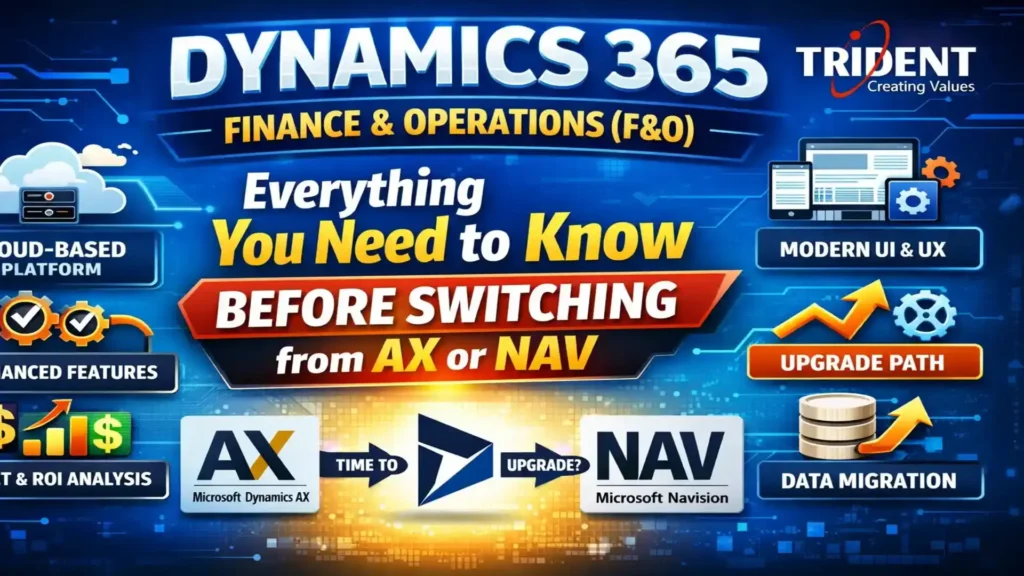
Dynamics 365 Finance & Operations (F&O):Everything You Need to Know Before Switching from AX or NAV

What Is Dynamics 365 Finance & Operations? Dynamics 365 Finance & Operations (F&O) — often referred to as D365 F&O or simply Dynamics 365 for Finance & Operation — is Microsoft’s flagship cloud-based enterprise resource planning (ERP) platform. It’s the modern successor to Microsoft Dynamics AX and represents a complete reimagining of how ERP systems should work in the cloud-first era. At its core, D365 F&O is designed to handle the full spectrum of financial management, supply chain operations, manufacturing, retail, and business intelligence for mid-market and enterprise organisations. Unlike its predecessors, it’s built entirely on Microsoft Azure, which means automatic updates, global scalability, and seamless integration with the broader Microsoft ecosystem — including Office 365, Power BI, and other Dynamics 365 modules like CRM. The platform is modular. You can deploy just Finance (financial management and accounting) or just Supply Chain Management (inventory, procurement, warehousing) — or combine both for a complete ERP solution. This flexibility is one of its biggest strengths, especially for businesses transitioning from older systems. Quick Definition Dynamics 365 F&O is Microsoft’s cloud-native ERP solution that replaces legacy on-premise systems like Dynamics AX and Dynamics NAV. It unifies financial management, supply chain operations, and manufacturing into a single, continuously updated platform. For businesses currently running Microsoft Dynamics AX (2009, 2012, or AX 7) or Microsoft Dynamics NAV, D365 F&O isn’t just an upgrade — it’s a strategic platform shift that brings AI, automation, and real-time analytics into every corner of your operations. The Legacy: Understanding AX, NAV & Their Limitations Before diving into why you should migrate, it’s important to understand what Dynamics AX and Dynamics NAV were — and why Microsoft built D365 F&O to replace them. Microsoft Dynamics AX (Axapta) Originally released in 1998 as Axapta, Microsoft Dynamics AX became one of the most widely deployed ERP systems for mid-to-large enterprises. It was particularly strong in manufacturing, distribution, and financial services. The most recent on-premise version, AX 2012, is still in use by thousands of companies globally — but its days are numbered. AX 2012’s limitations: Microsoft Dynamics NAV (Navision) Dynamics NAV was Microsoft’s ERP solution for small-to-midsize businesses. It offered solid financial management, inventory control, and light manufacturing capabilities. Like AX, NAV was on-premise and required significant IT resources to maintain. NAV’s limitations: Support Timeline Alert AX 2012 extended support ends in October 2027. After this date, you will no longer receive security updates, compliance fixes, or technical support from Microsoft. Running unsupported software exposes your business to significant operational and security risks. Why Businesses Are Migrating to D365 F&O Now The migration from Dynamics AX or NAV to D365 F&O isn’t just about keeping up with technology trends. There are concrete, measurable business reasons why thousands of companies are making the move — and why waiting is becoming increasingly risky. 1. End of Support = End of Security When Microsoft stops supporting AX 2012 in 2027, you’ll no longer receive security patches. This makes your ERP system — which contains your most sensitive financial and operational data — a sitting target for cyberattacks. For regulated industries (finance, healthcare, government), running unsupported software can result in compliance violations and hefty fines. 2. The Cloud Delivers Real Cost Savings On-premise ERP systems are expensive to run. You need physical servers, backup systems, IT staff to maintain them, and costly upgrade cycles every few years. D365 F&O eliminates most of this. Microsoft handles infrastructure, security, updates, and scaling. Your IT team can focus on strategy instead of server maintenance. 3. AI & Automation Are Built In D365 F&O includes AI-powered features that weren’t even possible in AX or NAV — things like intelligent cash flow forecasting, predictive maintenance for equipment, and automated expense categorisation. These aren’t add-ons; they’re woven into the platform and get better with every update. 4. Continuous Innovation Without Disruption Unlike AX, where you had to plan (and budget) for major upgrades every 3–5 years, D365 F&O receives continuous updates from Microsoft — new features, security enhancements, and performance improvements roll out automatically, twice a year. You stay current without the pain of traditional ERP upgrades. 5. Real-Time Insights, Anywhere AX and NAV were designed for desktop users sitting in an office. D365 F&O is cloud-native, which means your finance team, warehouse managers, and executives can access live data from anywhere — on their phone, tablet, or laptop. Power BI dashboards provide real-time visibility into cash flow, inventory levels, and operational performance. Key Differences: AX vs. NAV vs. D365 F&O If you’re evaluating whether to migrate, understanding the core differences between the legacy platforms and D365 F&O is critical. Here’s a side-by-side comparison to make the decision clearer. Capability Dynamics AX 2012 Dynamics NAV D365 F&O Deployment On-premise On-premise Cloud (Azure) Updates & Upgrades Manual (every 3-5 yrs) Manual Automatic (2x per year) AI & Machine Learning Not available Not available Built-in (Copilot, forecasting) Mobile Access Limited Limited Full native support Power BI Integration Via add-ons Via add-ons Native Multi-currency / Multi-entity Supported Basic Advanced Real-time Analytics No No Yes Total Cost of Ownership High (infrastructure + IT) Medium-high Lower (SaaS model) Support Status (2025) Extended only (ends 2027) Ended Active & ongoing As the table shows, D365 F&O isn’t just a newer version of AX — it’s a fundamentally different platform built for the cloud era. The shift from on-premise to cloud changes how you deploy, maintain, and evolve your ERP system. Core Capabilities of Dynamics 365 F&O D365 F&O is a comprehensive ERP platform that covers virtually every aspect of enterprise operations. Here’s what it brings to the table — and why it matters for businesses migrating from AX or NAV. Financial Management General ledger, accounts payable/receivable, budgeting, fixed assets, cash flow forecasting, multi-currency support, and real-time financial reporting. Supply Chain Management Procurement, inventory management, warehouse operations, demand forecasting, order fulfillment, and vendor collaboration — all in real time. Manufacturing Production planning, shop floor control, lean manufacturing, quality management, and IoT-connected equipment monitoring. Business Intelligence Native Power BI dashboards, embedded analytics, KPI tracking, and AI-driven insights — accessible from any device, anywhere. Retail & Commerce Point-of-sale, e-commerce integration, omnichannel customer experience, and unified inventory across physical and digital channels.
Dynamics 365 Finance & Operations (F&O):Everything You Need to Know Before Switching from AX or NAV Read More »

Cloud ERP migration checklist ensuring data integrity for SMBs.

Cloud ERP Migration Checklist: 10 Steps to Ensure Data Integrity for SMBs

Introduction: Why Data Integrity Is the Backbone of Cloud ERP Migration Moving to a cloud ERP system feels a bit like relocating your entire business to a new city. You’re excited about better infrastructure, lower costs, and room to grow—but there’s also anxiety. What if something important gets lost during the move? For small and medium-sized businesses (SMBs), that “something” is usually data. Customer records, financial transactions, inventory details, supplier contracts—this information is the lifeblood of daily operations. If data integrity breaks during migration, everything downstream suffers. Data integrity isn’t just about preventing data loss. It’s about ensuring that information remains accurate, consistent, complete, and trustworthy throughout the migration process and beyond. A single duplicated invoice or mismatched customer record can ripple through accounting, reporting, and decision-making. SMBs often operate with lean teams and tight margins, so even small data errors can become expensive problems. Cloud ERP migration adds another layer of complexity. Unlike traditional on-premise systems, cloud platforms involve data transfers over networks, integrations with third-party tools, and new security models. Without a structured checklist, migrations can quickly turn chaotic. That’s why a step-by-step approach is critical. Think of it as a flight checklist—pilots don’t skip steps, no matter how experienced they are. This guide walks you through a practical, SMB-friendly cloud ERP migration checklist with a sharp focus on data integrity. These ten steps are designed to help you move confidently, avoid common pitfalls, and come out the other side with clean, reliable data that actually supports growth rather than slowing it down. Step 1: Define Clear Migration Goals and Data Integrity Standards Before touching a single database or exporting any files, you need clarity. Many ERP migrations fail not because of technology, but because of fuzzy goals. SMBs often jump into migration driven by urgency—legacy systems are slow, expensive, or unsupported. But urgency without direction is risky. Start by defining why you’re migrating to a cloud ERP. Are you aiming for real-time reporting? Better inventory accuracy? Easier scalability? Lower IT overhead? Each goal influences how data should be handled. For example, if real-time analytics is a priority, historical data accuracy becomes non-negotiable. Once goals are clear, translate them into data integrity standards. This means defining what “good data” looks like for your business. Accuracy ensures data reflects reality. Consistency means the same data tells the same story across modules. Completeness ensures no critical fields are missing. Timeliness ensures data is up to date. These standards act like guardrails throughout the migration. Document these expectations and share them with stakeholders, vendors, and internal teams. When everyone agrees on what success looks like, decisions become easier. You’ll know which data is worth migrating, which needs cleaning, and which can be archived. This upfront alignment saves time, money, and frustration later in the process. Step 2: Conduct a Comprehensive Data Audit Before Migration A cloud ERP migration is not the time to carry digital clutter into a shiny new system. Yet many SMBs do exactly that, migrating years of unused, outdated, or incorrect data simply because “it’s always been there.” A data audit helps you avoid this trap. Begin by identifying all data sources feeding into your current ERP environment. These may include accounting systems, CRM platforms, inventory tools, spreadsheets, and even manual databases maintained by departments. You might be surprised how much shadow data exists outside the core system. Next, categorize data into what’s essential, what’s useful, and what’s unnecessary. Redundant, obsolete, and trivial (ROT) data adds risk without value. Old vendor records, inactive customers, or discontinued product lines often don’t need to make the journey. Removing them reduces migration complexity and improves performance in the new system. A thorough audit also uncovers data quality issues—duplicates, missing fields, inconsistent formats, and outdated values. Treat this step like a health check. The goal isn’t perfection, but awareness. When you know what you’re working with, you can plan cleaning, mapping, and validation more effectively. This audit sets the foundation for a successful, integrity-driven migration. Step 3: Cleanse and Standardize Data for Cloud Readiness If your data were a house, cleansing would be the deep clean before moving day. It’s not glamorous, but it’s essential. Dirty data migrated into a cloud ERP doesn’t magically improve—it usually becomes more visible and more damaging. Start with deduplication. Duplicate customer records, suppliers, or SKUs can distort reports and confuse users. Use automated tools where possible, but don’t underestimate the value of human review for critical records. Accuracy matters more than speed here. Next, correct errors and fill in missing values. Inconsistent addresses, incorrect tax codes, or incomplete product descriptions can break workflows in the new system. Standardization is equally important. Decide on naming conventions, date formats, units of measure, and currency representations. Cloud ERP systems thrive on uniformity, and standardized data ensures smoother automation and reporting. This step can feel time-consuming, especially for SMBs with limited resources. But think of it as an investment. Clean, standardized data improves user adoption, system performance, and decision-making from day one. Skipping this step is like pouring clean water into a dirty glass—you’ll never get the clarity you expect. Step 4: Choose the Right Cloud ERP Platform for SMB Needs Not all cloud ERP platforms are created equal, especially when it comes to data integrity. SMBs need solutions that balance robustness with simplicity. Choosing the wrong platform can introduce unnecessary complexity and risk. Evaluate vendors based on their data security measures, compliance certifications, and track record with SMBs. Look for built-in validation rules, audit trails, and data governance features. These tools act as safety nets, preventing bad data from entering or spreading within the system. Scalability and integration capabilities also matter. Your cloud ERP should integrate smoothly with CRM, e-commerce, payroll, and analytics tools. Poor integrations often lead to manual workarounds, which increase the risk of data errors. Finally, consider vendor support and migration assistance. A provider experienced in SMB migrations understands common pitfalls and can guide you through best practices. The right platform doesn’t just store your

Cloud ERP Migration Checklist: 10 Steps to Ensure Data Integrity for SMBs Read More »