Every physical object in your business — every machine, vehicle, sensor, package, and piece of equipment — is generating data. The question is whether your organization is capturing it, analyzing it, and acting on it.
The Internet of Things (IoT) is the technology infrastructure that makes this possible. By embedding sensors, connectivity, and software into physical devices and environments, IoT creates a continuous stream of real-world data that organizations can use to operate more efficiently, respond faster to problems, serve customers better, and make decisions based on what is actually happening — not what someone reported happening yesterday.
The business case for IoT is no longer theoretical. Organizations across agriculture, e-commerce, healthcare, manufacturing, transportation, and enterprise operations are deploying IoT applications to solve specific operational problems — and achieving measurable, documented results. Farmers are optimizing water usage through soil moisture sensors. Manufacturers are predicting equipment failures before they happen. Transport operators are tracking goods in real time across global supply chains.
This guide covers the practical reality of IoT applications for business — what IoT is, how it works, where it is delivering the most significant value across six major industries, and how Microsoft Azure IoT provides the enterprise-grade platform that makes business IoT scalable and secure.
What Is IoT and Why Does It Matter for Business?
The Internet of Things refers to the network of physical devices — machines, vehicles, sensors, appliances, wearables, and infrastructure — that are embedded with software, sensors, and connectivity to collect and exchange data over the internet or a private network.
In practical terms, IoT is about closing the gap between the physical world and the digital world. In a traditional business environment, data about physical operations — machine performance, vehicle location, inventory levels, environmental conditions — had to be collected manually, which meant it was always delayed, often inaccurate, and expensive to gather at scale.
IoT eliminates this gap by making physical assets continuously self-reporting — feeding real-time operational data into business systems automatically, without human intervention.
The Core Components of an IoT System
Every IoT deployment, regardless of industry or application, consists of four fundamental components:
1. Devices and sensors — the physical layer that collects data from the real world. Temperature sensors, motion detectors, GPS trackers, RFID readers, smart meters, industrial monitoring equipment, and thousands of other device types.
2. Connectivity — the communication layer that transmits data from devices to processing systems. Wi-Fi, cellular (4G/5G), Bluetooth, LoRaWAN, Zigbee, and satellite connectivity are all used depending on the application’s range, power, and bandwidth requirements.
3. Data processing and analytics — the intelligence layer that receives raw sensor data, processes it, applies business rules and analytical models, and generates actionable insights. Cloud platforms like Microsoft Azure IoT Hub provide this capability at enterprise scale.
4. Applications and interfaces — the user layer where insights and controls are made accessible to the people and systems that need them. Mobile applications, dashboards, automated alerts, and integration with ERP and CRM systems like Microsoft Dynamics 365 all operate at this layer.
How IoT Creates Competitive Advantage for Organizations
Organizations that deploy IoT effectively gain advantages that compound over time — because the data generated by IoT systems becomes progressively more valuable as it accumulates and as analytical models are refined:
- Operational visibility — see what is actually happening across your operations in real time, rather than relying on periodic reports
- Proactive management — detect anomalies, failures, and inefficiencies before they cause disruption — rather than responding after the fact
- Automation of routine decisions — IoT systems can trigger automated responses to defined conditions, eliminating the human bottleneck in high-frequency operational decisions
- Evidence-based strategy — accumulate rich operational data that informs product development, process improvement, and strategic planning with a level of evidence that was previously unavailable
IoT Business Applications Across 6 Major Industries
1. IoT in Agriculture: Precision Farming and Resource Optimization
Agriculture is one of the sectors most profoundly transformed by IoT — moving from experience-based farming practices to data-driven precision agriculture that optimizes every input for maximum yield and minimum waste.
Key IoT applications in agriculture:
- Soil moisture monitoring — sensors embedded in fields transmit real-time moisture data, enabling irrigation systems to activate only when soil moisture falls below optimal levels — reducing water consumption by 30 to 50 percent compared to scheduled irrigation
- Crop health monitoring — aerial drones equipped with multispectral cameras and on-ground sensors detect early signs of disease, pest infestation, or nutrient deficiency — allowing targeted intervention before yield loss becomes significant
- Microclimate monitoring — weather stations distributed across a farm capture hyper-local temperature, humidity, and wind data — enabling farmers to make more accurate decisions about planting timing, frost protection, and disease prevention
- Automated equipment management — IoT-connected tractors and harvesters transmit location, fuel consumption, and performance data — optimizing fleet utilization and maintenance scheduling
- Livestock monitoring — wearable sensors track animal health, location, and behavior — detecting illness earlier and improving breeding management
For a sector historically characterized by low technology adoption, IoT is delivering some of the most dramatic productivity and sustainability gains of any industry — with direct implications for food security at a global scale.
2. IoT in E-Commerce: Smarter Inventory, Logistics, and Customer Insights
E-commerce businesses compete on speed, accuracy, and the quality of the customer experience — and IoT is a critical enabler of all three at scale.
Key IoT applications in e-commerce:
- Smart inventory management — RFID tags and shelf sensors track inventory levels in real time, automatically triggering replenishment orders when stock falls below defined thresholds — eliminating both stockouts and the overstock that ties up working capital
- Connected warehousing — IoT-enabled warehouse systems guide picking operations, optimize storage utilization, and track every item’s movement from receiving through dispatch — with error rates dramatically lower than manual processes
- Last-mile delivery tracking — GPS and IoT sensors on delivery vehicles provide real-time location data — enabling accurate delivery window predictions, proactive delay notifications, and route optimization that reduces delivery cost
- Customer behavior intelligence — IoT data from in-store sensors, smart fitting rooms, and connected retail environments provides insight into how customers interact with products — informing merchandising decisions, layout optimization, and personalization strategies
- Supply chain visibility — IoT sensors on shipments track condition (temperature, humidity, shock) and location throughout the supply chain — critical for perishable goods and high-value items
3. IoT in Healthcare: Remote Patient Monitoring and Equipment Management
Healthcare is one of the highest-impact domains for IoT — where connected devices can directly improve patient outcomes, reduce the cost of care, and enable healthcare delivery models that were previously impossible.
Key IoT applications in healthcare:
- Remote patient monitoring — wearable devices and home monitoring equipment continuously track vital signs (heart rate, blood pressure, glucose levels, oxygen saturation) and transmit data to clinical teams — enabling early intervention before conditions deteriorate and reducing hospital readmissions
- Medical equipment monitoring — IoT sensors on critical equipment track performance, usage, and maintenance requirements — ensuring equipment is available when needed and detecting faults before they cause clinical incidents
- Asset tracking — RFID and IoT systems track the location of mobile equipment (wheelchairs, infusion pumps, portable monitors) across hospital facilities — reducing time spent searching for equipment and improving utilization
- Environmental monitoring — sensors in operating theaters, ICUs, and pharmaceutical storage monitor temperature, humidity, air quality, and contamination levels — maintaining the controlled environments that patient safety requires
- Medication management — smart dispensing systems track medication inventory, monitor adherence, and alert clinical staff to potential errors — reducing medication-related adverse events
The growing market for IoT-based healthcare applications reflects both the scale of the opportunity and the maturity of the technology — with remote patient monitoring alone projected to be one of the fastest-growing segments of digital health investment globally.
4. IoT in Enterprise Operations: Connected Workforce and Process Intelligence
For enterprises across every sector, IoT provides the visibility and automation capability to optimize operations, reduce costs, and improve employee productivity through connected workplace technologies.
Key IoT applications in enterprise operations:
- Smart building management — IoT sensors control HVAC, lighting, access control, and energy systems based on occupancy patterns and environmental conditions — reducing energy consumption by 20 to 40 percent in commercial buildings
- Employee safety monitoring — wearable IoT devices in industrial environments monitor worker location, movement, and physiological indicators — alerting supervisors to potential safety incidents before they occur
- Asset and equipment tracking — IoT systems track the location and utilization of every significant asset — from manufacturing equipment and vehicles to computing hardware and tools — optimizing maintenance scheduling and reducing loss
- Predictive maintenance — IoT sensors on machinery collect vibration, temperature, current, and acoustic data that AI models analyze to predict failures — enabling maintenance to be scheduled proactively rather than reactively
- Process monitoring and optimization — continuous IoT monitoring of operational processes generates the data needed to identify inefficiencies, model improvements, and validate the impact of process changes
5. IoT in Transportation and Logistics: Real-Time Tracking and Fleet Management
Transportation and logistics is one of the earliest and most mature IoT application domains — with GPS tracking and telematics predating the broader IoT movement. Modern IoT capabilities have dramatically extended what is possible.
Key IoT applications in transportation and logistics:
- Fleet telematics — GPS, accelerometer, and engine diagnostic data from connected vehicles gives fleet managers real-time visibility into vehicle location, speed, driving behavior, fuel consumption, and maintenance requirements — enabling cost reduction and safety improvement simultaneously
- Cold chain monitoring — IoT sensors on refrigerated vehicles and storage facilities continuously monitor temperature and humidity — ensuring the integrity of temperature-sensitive cargo (food, pharmaceuticals, chemicals) throughout the supply chain
- Cargo condition monitoring — sensors track shock, tilt, humidity, and temperature for sensitive shipments — providing evidence of condition throughout transit and enabling rapid response when conditions deviate from specification
- Port and terminal management — IoT systems in ports and logistics terminals track container locations, equipment utilization, and traffic flows — optimizing throughput and reducing dwell times
- Predictive maintenance for fleets — IoT diagnostic data enables maintenance to be scheduled based on actual vehicle condition rather than mileage intervals — reducing unexpected breakdowns and extending vehicle lifespans
6. IoT in Manufacturing: Industry 4.0, AI, and Machine Learning
Manufacturing is the industry where IoT delivers the most direct and measurable ROI — and where the convergence of IoT with artificial intelligence and machine learning is creating the most transformative operational improvements.
Key IoT applications in manufacturing:
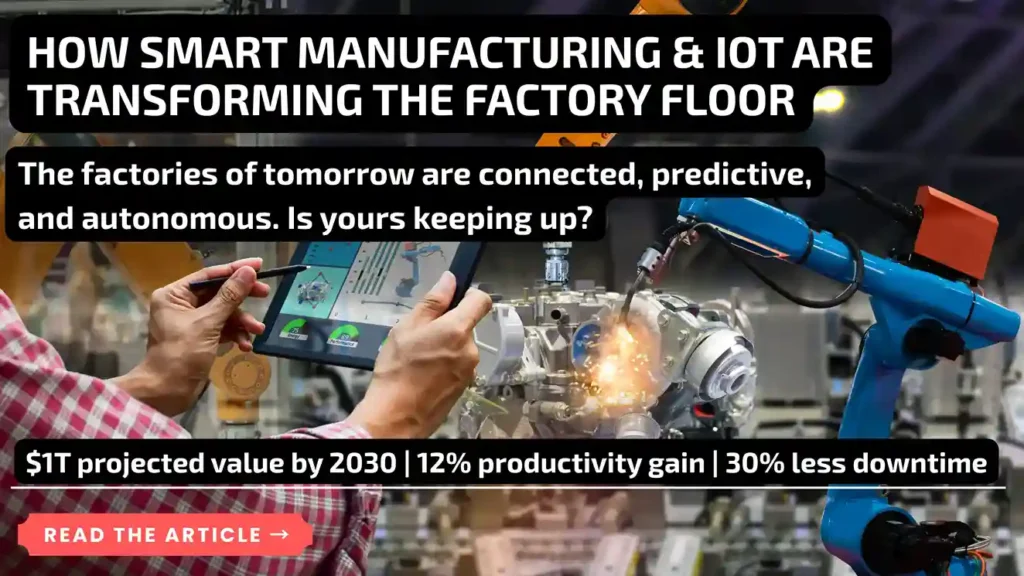
- Predictive maintenance — IoT sensors on production equipment continuously monitor vibration, temperature, current draw, acoustic signatures, and other condition indicators. AI models trained on historical failure data analyze these signals in real time — predicting failures hours or days before they occur and enabling proactive intervention that prevents unplanned downtime
- Quality control automation — IoT-connected vision systems and measurement sensors inspect every unit in production — detecting defects, dimensional variations, and assembly errors at speeds and accuracy levels that human inspection cannot match
- OEE (Overall Equipment Effectiveness) monitoring — IoT systems track availability, performance, and quality for every machine — providing the real-time OEE data that drives continuous improvement programs
- Energy management — IoT monitoring of energy consumption by machine, production line, and facility identifies waste and enables optimization — with energy cost savings of 10 to 25 percent common in manufacturing IoT deployments
- Digital twins — IoT data from physical production assets feeds digital twin models — virtual replicas of physical systems — enabling simulation, optimization, and scenario planning without interrupting production
- Supply chain integration — IoT data from the production floor feeds directly into supply chain planning systems — enabling dynamic adjustment of procurement and production plans based on actual production performance
IoT and Mobile Applications: How They Work Together
The relationship between IoT and mobile applications is increasingly central to how both technologies deliver value — particularly in enterprise and field service contexts.
Mobile as the Interface for IoT Data and Control
For many IoT deployments, the mobile application is the primary user interface — the means by which workers, managers, and customers interact with the data and control capabilities that IoT sensors and systems generate:
- Field service mobile apps connected to IoT asset monitoring systems give technicians real-time diagnostic data before they arrive on site — enabling first-time-fix rates to increase dramatically
- Fleet management mobile apps provide drivers and dispatchers with real-time vehicle tracking, navigation, and communication tools powered by IoT telematics data
- Smart building control apps allow facility managers to monitor and adjust building systems from their mobile devices — responding to environmental data in real time from any location
- Industrial monitoring apps give plant managers visibility into production line performance, energy consumption, and equipment health from mobile devices — enabling rapid response to operational issues without being physically present on the floor
Enterprise Mobile IoT Applications in Practice
The convergence of IoT and mobile is particularly powerful in enterprise environments where workers are mobile and operations are distributed across large physical spaces:
- Warehouse mobile picking — IoT-connected mobile devices guide warehouse pickers to the right location, confirm the right item through barcode or RFID scanning, and update inventory systems in real time
- Field maintenance management — mobile apps connected to IoT monitoring systems enable field technicians to receive work orders, access asset history, capture maintenance records, and close work orders — all in real time, from any location
- Retail staff mobile tools — IoT-connected mobile devices give retail staff real-time inventory visibility, customer loyalty information, and product knowledge at the point of customer interaction
The Business Benefits of IoT Adoption
Speed and Operational Efficiency
IoT eliminates the information latency that slows operational decision-making. When every relevant asset, process, and condition is continuously self-reporting, the time between an event occurring and the right person knowing about it — and being able to act on it — shrinks from hours or days to seconds.
Remote Operability and Asset Visibility
IoT enables organizations to monitor and manage physical assets, operations, and environments from anywhere — reducing the need for physical presence in routine monitoring scenarios and enabling rapid remote response when issues arise. This capability is particularly valuable for organizations managing distributed assets across multiple sites or geographies.
Predictive Intelligence Through IoT Data
The cumulative value of IoT data grows over time as analytical models are trained and refined on historical patterns. Organizations that invest in IoT infrastructure today are building the data foundation for predictive intelligence capabilities — demand forecasting, predictive maintenance, customer behavior modeling — that will deliver compounding competitive advantage as AI capabilities continue to advance.
Microsoft Azure IoT: The Enterprise Platform for Business IoT
For organizations implementing IoT at enterprise scale, Microsoft Azure provides the cloud infrastructure, security framework, and analytics capabilities that production IoT deployments require.
Azure IoT Hub and Azure IoT Central
Azure IoT Hub is Microsoft’s enterprise-grade IoT connectivity platform — enabling secure, bidirectional communication between millions of IoT devices and cloud-based applications. It provides device management, message routing, and the security framework for production IoT deployments.
Azure IoT Central is a fully managed IoT application platform that reduces the complexity of building and managing IoT solutions — providing pre-built industry templates, device management tools, and analytics capabilities that enable faster IoT deployment without deep cloud expertise.
Together, these platforms provide the foundation for every enterprise IoT use case — from predictive maintenance in manufacturing through cold chain monitoring in logistics to remote patient monitoring in healthcare.
IoT Integration With Microsoft Dynamics 365
One of the most powerful aspects of Microsoft’s IoT platform is its native integration with Microsoft Dynamics 365 — enabling IoT data to flow directly into business processes managed in the ERP and CRM:
- Connected Field Service — IoT alerts from connected assets automatically trigger work orders in Dynamics 365 Field Service — enabling proactive maintenance before customers experience disruption
- Supply chain intelligence — IoT data from production equipment and warehouse systems feeds directly into Dynamics 365 Supply Chain Management — enabling dynamic adjustment of production and procurement plans
- Customer service integration — IoT condition data is accessible within Dynamics 365 Customer Service — giving service agents the asset context they need to resolve issues faster
Challenges to Consider Before Implementing IoT in Your Business
Data Security and Privacy
IoT deployments introduce new security challenges — every connected device is a potential entry point for unauthorized access. Enterprise IoT security requires:
- Device authentication and access control at every endpoint
- End-to-end encryption for data in transit and at rest
- Regular firmware and software updates across the device fleet
- Compliance with applicable data protection regulations — including India’s DPDP Act 2023 for organizations handling personal data through IoT systems
Integration With Existing Systems
IoT data is only valuable when it flows into the business systems where decisions are made. Ensuring that IoT platforms are properly integrated with ERP, CRM, supply chain, and analytics systems requires careful architecture planning — and the right integration partner.
Scalability and Infrastructure Planning
IoT deployments that work well at pilot scale often face significant challenges when scaled to production. The data volumes, connectivity requirements, and processing demands of a full-scale enterprise IoT deployment require infrastructure planning that anticipates growth from the outset.
IoT Implementation: How Trident Helps Businesses Deploy and Scale
Trident Information Systems is a trusted consulting and technology services partner with deep expertise in driving digital transformation across Manufacturing, Retail, Hospitality, Logistics, Services, and more. With a strong presence in India, the U.S., UK, UAE, Africa, and a rapidly expanding footprint in Southeast Asia, Trident has successfully delivered over 250+ customer engagements. These include smart manufacturing with intelligent shop floor automation, retail digitalization spanning 3,000+ stores, and IoT-driven asset management covering 400+ assets across 150+ locations.
Beyond infrastructure and operations, Trident excels in business applications (Microsoft Dynamics 365 ERP, CRM, O365, Azure, Power BI, Power Platform, Salesforce) and Data & AI services in collaboration with Microsoft and IBM. What truly sets them apart is their exclusive Managed Talent Services unit, designed to help organizations jumpstart digital transformation engagements quickly and effectively—bridging the gap between strategy and execution with the right skills at the right time.
Trident Information Systems helps organizations across manufacturing, logistics, retail, healthcare, and enterprise operations design, deploy, and scale IoT solutions built on Microsoft Azure — integrating IoT data directly with Microsoft Dynamics 365 to create genuinely connected, intelligent business operations.
Our IoT implementation services cover everything from initial use case assessment and architecture design through device deployment, Azure IoT configuration, Dynamics 365 integration, and ongoing monitoring and optimization — ensuring your IoT investment delivers measurable business outcomes from day one.
Ready to explore how IoT can transform your business operations? Book a free IoT assessment with Trident today — and discover exactly where connected intelligence can deliver the most immediate and sustainable value for your organization. For more insightful content and industry updates, follow our LinkedIn page.
The Future of IoT in Business: What to Expect Beyond 2026
The IoT landscape is evolving rapidly — and the organizations investing in IoT infrastructure now are positioning themselves to capture the full value of several converging technology trends:
- 5G connectivity — the rollout of 5G networks is dramatically expanding the range, speed, and reliability of IoT connectivity — enabling new use cases in remote monitoring, real-time video analytics, and ultra-low-latency industrial control
- Edge computing — processing IoT data at the device or local network level — rather than sending everything to the cloud — is enabling faster response times and reducing bandwidth costs for high-frequency industrial IoT applications
- AI and machine learning integration — as AI capabilities advance, IoT data becomes progressively more valuable as the training foundation for predictive models that anticipate failures, optimize processes, and personalize customer experiences
- Digital twin maturity — digital twin technology — virtual replicas of physical systems fed by real-time IoT data — is moving from specialist manufacturing applications toward mainstream enterprise adoption across industries
- Generative AI for IoT analytics — Microsoft Copilot and generative AI capabilities are being integrated with IoT platforms — enabling natural language queries of operational data, automated anomaly explanation, and AI-generated maintenance recommendations