
INTRODUCTION
Contactless payments, curbside pickup, QR code menus—none of these options were commonplace in restaurants just a few years ago. Today, they are standard expectations. The restaurants that adapted most successfully weren’t necessarily the ones that adopted the most technology, but rather those that managed it through a single, integrated platform instead of a disjointed array of tools. This distinction separates operators who achieved lasting resilience from those who implemented stopgap solutions that didn’t stand the test of time.
Design the entire experience, not just a stopgap solution
A payment terminal wrapped in plastic is a patch, not a solution; in fact, it often negates the very contactless functionality it was meant to protect. The shift toward contactless payments, delivery, drive-thru service, and curbside pickup is here to stay; therefore, it pays to build a robust infrastructure around these practices rather than relying on makeshift fixes. QR code menus are a prime example: they are useful right now for hygiene reasons, but they offer long-term value by allowing restaurants to instantly update prices or menu items without incurring reprinting costs. Table management software follows the same logic: it is useful today for maintaining social distancing and facilitating contact tracing, and it will remain valuable indefinitely for optimizing occupancy and speeding up table turnover.
Take your POS system mobile
When a server relies on a fixed terminal, customers are kept waiting, staff waste time walking back and forth, and lines form at the register. A mobile POS system allows servers to take orders, process payments, and close out checks without leaving the dining area; this results in faster service, less unnecessary movement, and the elimination of shared terminals among staff.
The greatest advantage arises when the mobile POS connects directly to kitchen display systems: an order taken at the table is automatically sent to the appropriate kitchen station, eliminating the back-and-forth between the dining area and the kitchen that slows down service and leads to order errors.
Opt for a single platform rather than multiple disconnected solutions
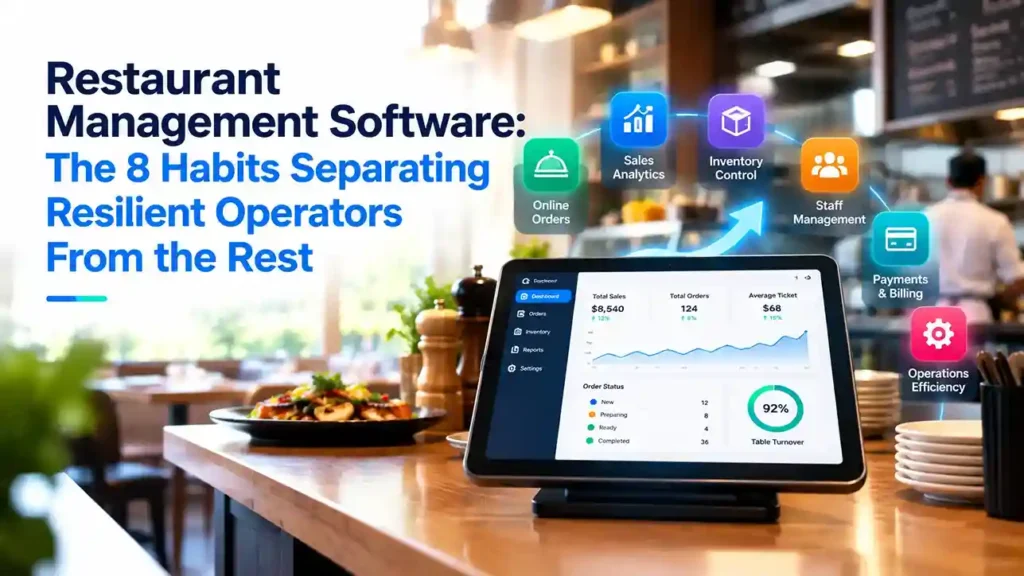
Fragmented systems—standalone tools for point-of-sale (POS), inventory management, and reporting—entail higher integration and maintenance costs while offering managers only a partial view of the business. A unified platform provides a comprehensive, real-time view of operations and customer data, enables faster access to actionable reports, and lowers total costs by eliminating the need for ongoing integration work.
Cloud-based implementation proved crucial during times of rapid change: restaurants without legacy on-premise infrastructure could quickly roll out delivery, pickup, and curbside services, whereas those reliant on local systems moved much more slowly. Furthermore, software-hardware compatibility is just as important as the individual components themselves; a system that looks good on paper but fails to integrate properly with existing hardware will fail in practice, regardless of its features.
Analyze how customer behavior is actually changing
Consumption patterns shift—new customers arrive, and regulars visit at different times or with different needs—and a restaurant that fails to collect this data lacks a solid foundation for designing a loyalty strategy. Reliable, up-to-date data enables actionable decisions, such as creating predictive cost models to set menu prices when ingredient sourcing becomes difficult, or redistributing inventory among locations based on foot traffic.
Rethink which metrics truly matter
A metric like table turnover rate is meaningless if there aren’t enough customers to fill the tables. Traditional key performance indicators (KPIs) should be reviewed periodically—not just once—since current customer behavior cannot reliably predict what the situation will look like a few months down the line. The goal is not to discard metrics, but to ensure that the ones being monitored continue to reflect the reality of the business.
Use predictive analytics, not just historical reports
Most restaurant analytics still look to the past: what happened and why. The real value lies in predictive analytics—finding correlations across large, disparate datasets that reveal where the business is heading before it gets there. Combining internal data with external context—local events, weather patterns, general market trends—refines that insight; even a small process adjustment based on this type of information can yield disproportionately large results.
Technology is no substitute for the human touch
Social distancing and digital ordering changed the dining-out experience, but customers still seek warm, personal service—and it is empowered staff with decision-making authority who truly deliver that. Genuine loyalty stems from a real connection, not just a points program: knowing a customer well enough to offer something relevant is what keeps them coming back, and that starts with how the restaurant treats its own staff.
View technology as infrastructure, not a reaction
Curbside delivery wasn’t the industry norm until, suddenly, it was. Investing in restaurant management technology requires the same long-term vision as investing in essential kitchen equipment: it is infrastructure that should be implemented before demand forces action, not after. A feature that doesn’t offer an immediate return on investment (ROI) can still be valuable simply because it prepares the business to respond quickly when conditions shift again—and conditions will keep changing.
Are you ready to move beyond fragmented systems and adopt a unified platform? Contact Trident to discuss what this transition would look like for your restaurant.

