Retail shrinkage hit USD 112 billion in 2025 — and traditional cameras caught fewer than 2% of the people responsible. AI-powered retail video analytics changes that equation entirely, turning every camera in your store into a real-time intelligence asset that increases sales, prevents theft, and elevates customer experience.
Your store cameras are recording everything. But are they actually doing anything? Most retail security cameras are passive — they document what happened after it is already too late. A theft is captured on footage. A queue builds unnoticed until customers walk out. A high-value display sits in a low-traffic aisle because nobody tracked footfall patterns.
In 2026, that is no longer good enough — and the numbers make that clear.
Global retail shrinkage reached USD 112.1 billion in 2024. Fewer than 2% of shoplifters are ever caught. And retailers still relying on traditional CCTV are losing money daily to theft, missed sales opportunities, and poor store layouts — without knowing it.
AI-powered retail video analytics changes every one of these outcomes. Here is exactly how.
What Is Retail Video Analytics?
Retail video analytics applies artificial intelligence and computer vision to your existing camera infrastructure — transforming passive footage into real-time, actionable business intelligence. It does not just record. It analyses, detects, alerts, and gives managers a live view of what is happening on the floor so they can act in the moment.
In 2026, AI video analytics is no longer reserved for enterprise retailers — mid-size chains, supermarkets, and pharmacy chains are all deploying it because the ROI is measurable and fast.
1. Increase Sales Through Smarter Store Intelligence
Every square metre of your retail floor has revenue potential. The question is whether you are maximising it — or guessing.
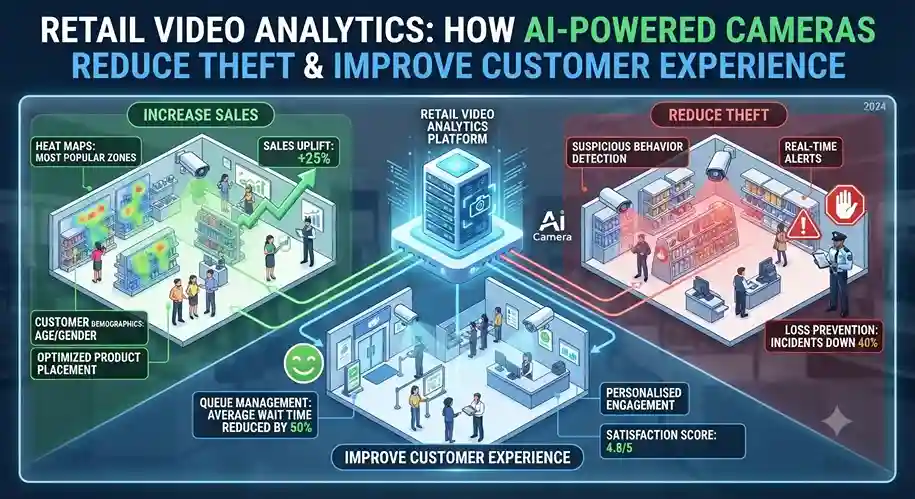
AI-powered cameras track customer movement patterns in real time, generating heat maps that show exactly where shoppers spend time, which zones they avoid, and where traffic naturally flows. This data reveals:
- Which product displays are getting attention and which are being ignored
- Where high-margin products should be repositioned to capture more footfall
- Which queue lengths are causing customers to abandon purchases
- What times of day specific zones experience peak and low traffic
Armed with this intelligence, retailers optimise layouts, reposition displays, and staff the right areas at the right times — directly lifting conversion rates and basket values.
Retail video analytics also calculates your conversion rate accurately — foot traffic counted at the door versus transactions at the POS — giving you a metric that is impossible to track without camera-based counting. If 500 people enter your store and only 80 buy, video analytics tells you where the other 420 left without purchasing — and why.
2. Reduce Theft and Shrinkage in Real Time
Retail shrinkage costs the industry over USD 120 billion annually across North America alone — more than double pre-2020 levels. External theft accounts for 37% of losses, employee theft 29%, and process errors 21%.
Traditional cameras record theft after it happens. AI video analytics detects it before merchandise leaves the store.
Key capabilities that make this possible in 2026:
Behavioural detection — AI identifies suspicious patterns in real time: loitering near high-value merchandise, unusual concealment movements, and extended dwell times in restricted areas — triggering instant alerts to security staff.
Self-checkout loss prevention — self-checkout lanes run 2–7 times higher loss rates than staffed lanes. AI cameras at the bagging area monitor items in real time, flagging scan-skip attempts and item substitution before the transaction completes.
POS transaction correlation — video footage is matched to POS data automatically, detecting employee fraud patterns, void abuse, and sweethearting that manual monitoring consistently misses.
Organised retail crime detection — AI systems identify repeat offenders and coordinated group behaviour across camera feeds simultaneously — a capability no human monitor team can replicate at scale.
A well-implemented AI video analytics system can take 0.2–0.4 percentage points off a retailer’s shrinkage rate — which for a 200-store chain running at 1.8% shrinkage translates to hundreds of thousands in recovered revenue annually.
3. Improve Customer Experience Through Operational Intelligence
The customer experience begins the moment someone enters your store — and AI-powered cameras track every touchpoint of that journey.
Queue management — AI monitors checkout queue lengths in real time and alerts managers when thresholds are crossed. Customers who abandon queues represent direct lost revenue. Real-time queue intelligence allows staffing decisions to be made in minutes, not after post-day reports.
Staff deployment — heat map data aligned with historical footfall patterns allows store managers to position staff where customers are — not where instinct suggests they should be.
Demographic and behaviour insights — anonymised customer flow data reveals how different customer groups navigate the store, how long they engage with specific displays, and what layout changes improve dwell time and purchase intent.
Out-of-shelf detection — AI cameras flag empty shelves automatically, enabling faster replenishment during peak trading hours and preventing the lost sales that empty shelves create.
Every one of these improvements lifts customer satisfaction, basket size, and repeat visit rates — the metrics that drive long-term retail profitability.
Why Retailers Are Deploying AI Video Analytics Now
In 2026, anonymised skeleton and keypoint-based analytics deliver full behavioural intelligence without facial recognition — addressing regulatory concerns while maintaining complete operational capability. Retailers deploying this now are building a competitive advantage their competitors simply cannot replicate with traditional cameras.
Your cameras are already installed. AI video analytics makes them work. Trident Information Systems integrates AI-powered retail video analytics with Microsoft Dynamics 365 and LS Retail solutions — giving retail chains real-time store intelligence across all locations. Talk to our experts at tridentinfo.com/contact.