
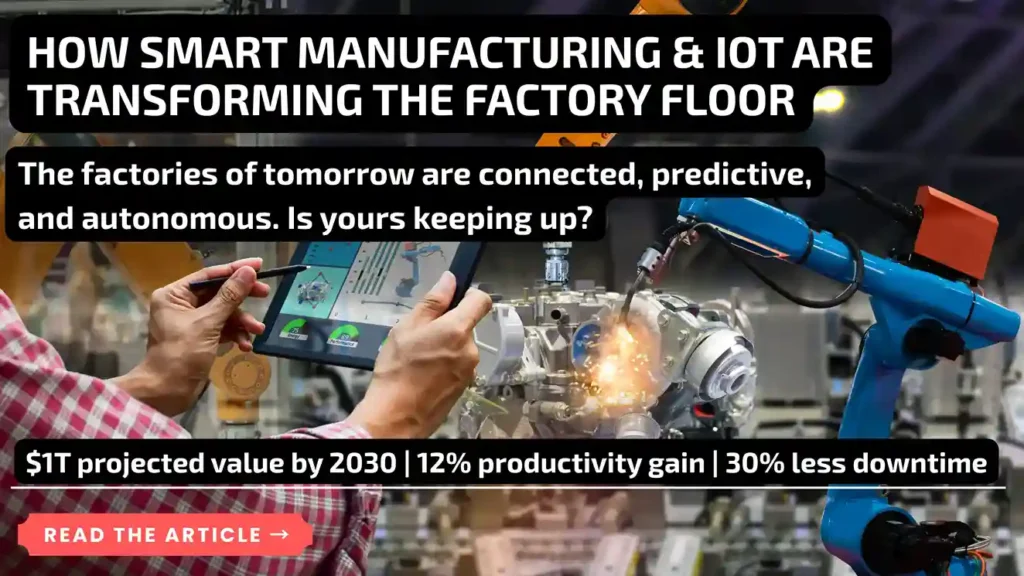
How Smart Manufacturing and IoT Are Transforming the Factory Floor
Introduction Every unplanned machine breakdown costs a manufacturer time, money, and customer trust. Every quality defect that slips through costs even more. The hard truth is that most of these losses are preventable — if you have the right data at the right time. That is exactly what Smart Manufacturing and the Industrial Internet of Things (IIoT) are built to deliver. When machines, sensors, and systems are connected and sharing data in real time, manufacturers stop reacting to problems and start preventing them. Production lines run leaner. Quality becomes consistent. And the gap between what the factory floor produces and what management can actually see shrinks to almost nothing. This article breaks down how that works in practice — and why manufacturers who are not already investing in connected systems are falling behind those who are. What Is Smart Manufacturing? (And Why the Definition Matters) The term “IoT” was coined by Peter T. Lewis to describe “the integration of people, processes, and technology with connectable devices and sensors to enable remote monitoring, real-time control, and data-driven decision-making.” But here is the part most explainers skip: smart manufacturing is not about adding technology for its own sake. It is about closing the gap between what is happening on the shop floor and what decision-makers know about it. In a traditional factory, that gap is wide. A machine can be underperforming for weeks before a supervisor notices. A quality issue can affect hundreds of units before it is caught. A maintenance window gets scheduled on gut instinct, not data. In a smart factory, that gap is nearly zero. The Core Engine: Sensors, Connectivity, and Real-Time Data Smart manufacturing is built on three layers that work together: 1. Sensors — the factory’s nervous system Sensors attached to machines, conveyor belts, assembly stations, and environmental systems continuously collect data — temperature, vibration, pressure, speed, output rate, energy consumption, and dozens of other variables. They do this 24/7, without human involvement. The moment a reading drifts outside a set parameter, the system knows. Even if no one is watching. 2. Connectivity — getting data where it needs to go Raw sensor data is useless if it stays on the machine. Connectivity — whether via Wi-Fi, MQTT protocols, edge gateways, or cloud pipelines — moves data from individual devices to a central system where it can be processed and analysed. Every connected device on the floor contributes to a shared, factory-wide picture. Every disconnected device is a blind spot. For manufacturers managing sensitive production data, this also raises a critical question: where does the data live? On-premises, in a private cloud, or a hybrid setup? The answer depends on your security requirements, your IT infrastructure, and how quickly you need to act on the data. There is no universal right answer — but there is definitely a wrong one, which is not thinking about it at all. 3. Data analysis — where the value actually lives Collected data means nothing without interpretation. Modern smart manufacturing platforms apply analytics — and increasingly, machine learning — to turn streams of sensor readings into actionable intelligence: This is the shift from descriptive reporting (“here is what happened”) to predictive and prescriptive intelligence (“here is what will happen, and here is what to do about it”). Key Benefits of Smart Manufacturing — What Manufacturers Actually Gain Predictive maintenance that prevents unplanned downtime Unplanned downtime is one of the most expensive problems in manufacturing. Industry estimates put the average cost at thousands of dollars per hour — and in some sectors, far more. Smart manufacturing flips the model. Instead of waiting for a machine to break and then fixing it (reactive), or scheduling maintenance on a fixed calendar (preventive), predictive maintenance uses real-time sensor data to detect the early warning signs of failure — unusual vibration patterns, rising temperatures, changes in motor current — and flags them before they cause a breakdown. The result: maintenance teams intervene exactly when they need to, not before (wasted resource) and not after (costly downtime). Consistent quality and fewer defects Every production process has variables. Raw material variations, temperature fluctuations, operator differences, tool wear — any of these can push output outside acceptable tolerances. In a smart factory, quality monitoring happens continuously, at every stage of production. Statistical process control systems track output quality in real time and alert operators the moment a process starts drifting. Defects get caught at the source, not at final inspection — or worse, at the customer. For manufacturers in precision-sensitive sectors like automotive components, medical devices, or electronics, this is not a nice-to-have. It is a competitive requirement. End-to-end production visibility Smart manufacturing gives plant managers, production supervisors, and customers something that has historically been surprisingly difficult to obtain: an accurate, real-time picture of what is actually happening. When this information is available instantly — on a dashboard, on a mobile device, from anywhere — decision-making speeds up dramatically. Problems get escalated in minutes, not hours. Smart Manufacturing in Automotive Component Manufacturing Automotive component manufacturing deserves specific attention. It is one of the largest and most demanding sectors in global manufacturing, and it illustrates the value of smart manufacturing particularly well. Automotive components are complex, high-precision, and produced at scale. Tolerances are tight. Quality requirements are strict. And the supply chain consequences of a defect reaching an OEM can be severe. Smart manufacturing addresses this in two directions: For the manufacturer: Connected sensors and real-time analytics ensure maximum process consistency. Predictive maintenance reduces the risk of unplanned stoppages mid-production run. Data on machine performance, cycle times, and output quality gives plant managers the visibility to optimise continuously rather than periodically. For the customer: Real-time production data means customers are no longer in the dark about order status. Production milestones, completion estimates, and quality sign-offs can be communicated proactively, not reactively. That visibility strengthens the commercial relationship. What Needs to Be in Place Before You Connect the Factory Smart manufacturing does not require ripping out existing infrastructure and starting
How Smart Manufacturing and IoT Are Transforming the Factory Floor Read More »