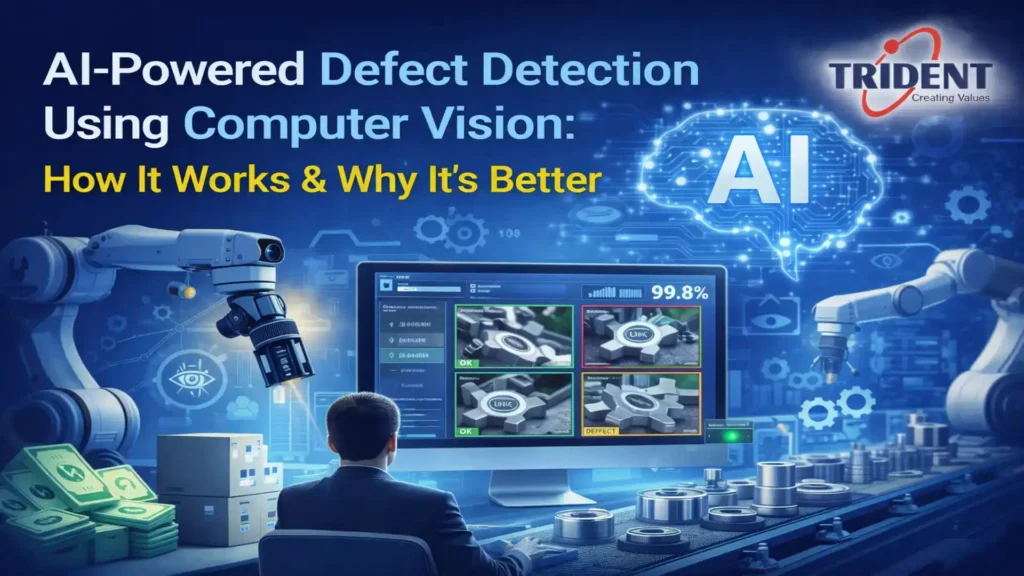
A comprehensive guide to computer vision defect detection for manufacturing quality control — how the technology works, why it outperforms human inspection, and what results you can expect.
Manual quality inspection is slow, expensive, and inconsistent. A trained inspector can check 300-500 parts per hour. They get tired. They miss defects. And when your production line runs 24/7, you need multiple inspection shifts — each with their own interpretation of what counts as a defect.
AI-powered defect detection using computer vision changes this equation completely. One camera system can inspect 3,000-10,000 parts per hour with 99%+ accuracy. It never gets tired. It never has a bad day. And it applies the exact same quality standard to every single part, every hour, every shift.
But here’s what manufacturing leaders really want to know: How does it actually work? Is it really better than experienced inspectors? What’s the ROI? And what’s required to implement it?
This guide explains the technology in practical terms — how computer vision detects defects, why AI makes it more accurate than traditional machine vision, and the business case for replacing manual inspection with automated systems.
How AI-Powered Computer Vision Defect Detection Works
At its core, computer vision defect detection uses cameras and AI algorithms to automatically identify flaws in manufactured products. Here’s the step-by-step process:
Image Capture
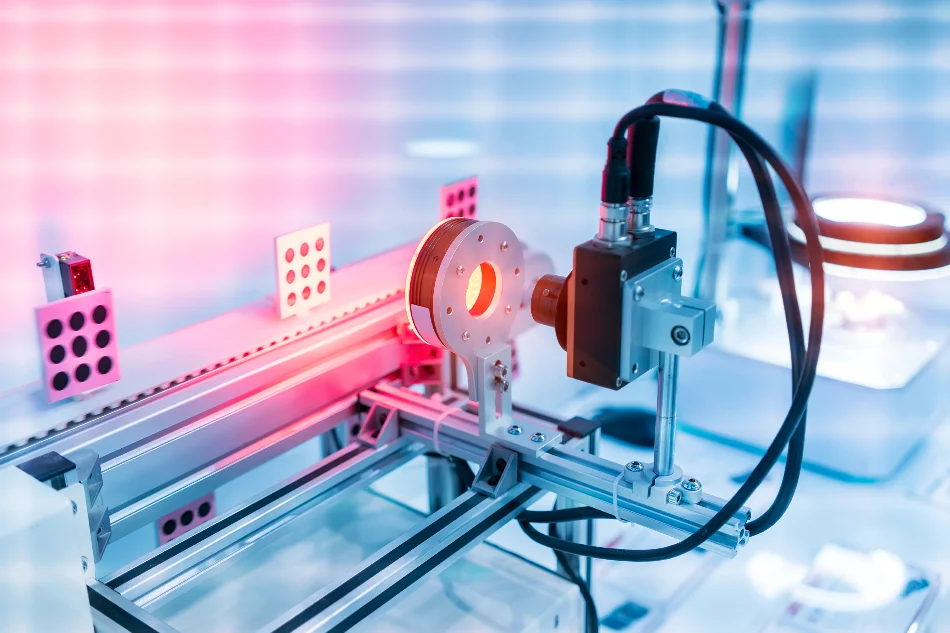
High-resolution cameras (often multiple cameras at different angles) capture images of each part as it moves down the production line. Typical capture speed: 0.1-0.5 seconds per part.
Preprocessing
The AI system preprocesses the image — adjusting for lighting variations, enhancing contrast, removing noise, and isolating the part from the background.
Feature Extraction
The computer vision algorithm identifies key features in the image: edges, surfaces, textures, colors, patterns. This is where deep learning neural networks excel — they automatically learn which features matter for defect detection.
Defect Classification
The AI model compares the extracted features against its trained database of “good” and “defective” examples. It classifies the part as pass/fail and identifies specific defect types (scratch, dent, misalignment, color variation, etc.).
Action & Logging
If a defect is detected, the system triggers an action: reject the part (pneumatic kicker, diverter gate), alert an operator, or log the defect for analysis. All inspections are timestamped and stored for traceability.
This entire process happens in milliseconds — fast enough to inspect parts on high-speed production lines running 100+ parts per minute.
What Makes It “AI-Powered”?
Traditional machine vision uses rule-based algorithms (if X pixels differ from template, reject). AI-powered systems use deep learning — they learn what defects look like by analyzing thousands of examples. This makes them far more accurate at detecting subtle or variable defects that rule-based systems miss.
Computer Vision vs. Manual Inspection: The Reality
Let’s compare computer vision defect detection against manual human inspection across the metrics that actually matter to manufacturers:
| Metric | Manual Inspection | Computer Vision + AI |
|---|---|---|
| Inspection Speed | 300-500 parts/hour | 3,000-10,000 parts/hour |
| Accuracy | 80-95% (varies by fatigue, experience) | 95-99.9% (consistent) |
| Consistency | Decreases over shift, varies by inspector | Identical standard applied 24/7 |
| Cost (per year) | $45K-$75K per inspector × 3 shifts = $135K-$225K | $50K-$150K (amortized system cost + maintenance) |
| Scalability | Requires hiring/training for increased volume | Add cameras as needed, no retraining |
| Data & Traceability | Limited logging, manual records | 100% inspections logged with images and timestamps |
| Defect Types | Surface defects, obvious flaws | Microscopic defects, color variations, dimensional accuracy |
| Implementation Time | Immediate (hire + 1-2 weeks training) | 2-6 months (system design, training, integration) |
The Bottom Line
Computer vision is 20-30x faster, 15-30% more accurate, and 40-60% cheaper than manual inspection at scale. The tradeoff is upfront investment and implementation complexity.
20x Faster inspection speed vs. manual
99%+ Accuracy rate (vs. 80-95% manual)
50% Lower cost per inspection at high volumes
100% Inspection traceability with timestamped data
Types of Defects Computer Vision Can Detect
Modern AI-powered computer vision systems can detect a wide range of defect types — some that human inspectors struggle to catch consistently:
Surface Defects
Scratches, dents, pits, burrs, cracks, contamination, rust, corrosion, discoloration
Dimensional Defects
Size variations, incorrect measurements, misalignment, warping, thickness deviations
Color & Texture Defects
Uneven coating, color inconsistency, texture variations, gloss differences, paint defects
Assembly Defects
Missing components, incorrect parts, misaligned assemblies, inverted components, wrong orientation
Print & Label Defects
Smudged printing, incorrect text, barcode errors, missing labels, misaligned graphics
Packaging Defects
Seal integrity, fill level, torn packaging, label placement, wrong product in package
Microscopic Defects
One major advantage of computer vision: it can detect defects invisible to the naked eye. With high-resolution cameras and magnification, systems can identify:
- Hairline cracks in electronics or metal parts
- Microscopic contamination in pharmaceutical manufacturing
- Pixel-level defects in displays and screens
- Circuit board soldering defects smaller than 0.1mm
Real-World Example
An automotive supplier implemented computer vision for brake pad inspection. The system detects surface cracks as small as 0.05mm — defects human inspectors only caught 60% of the time. Result: 98% defect detection rate and zero customer warranty claims from missed defects in the first year.
The Technology Behind It: AI, Deep Learning & Neural Networks
Understanding the technology helps explain why AI-powered systems outperform traditional machine vision and manual inspection.
Traditional Machine Vision vs. AI Computer Vision
Traditional Machine Vision (Rules-Based)
Uses predefined algorithms and templates. Example: “If more than 50 pixels differ from the reference image by more than 10% brightness, flag as defect.”
Limitation: Works well for simple, predictable defects. Struggles with variable defects, complex parts, or lighting changes.
AI-Powered Computer Vision (Learning-Based)
Uses deep learning neural networks trained on thousands of images. The AI learns what “good” and “defective” look like without explicit programming.
Advantage: Handles complex, variable defects. Adapts to new defect types. Works across different lighting and part variations.
How the AI Training Process Works
- Data Collection: Capture 1,000-10,000 images of both good parts and defective parts (with various defect types)
- Labeling: Human experts label each defect in the training images (e.g., “scratch here,” “dent here”)
- Model Training: Feed labeled images into a neural network. The AI learns patterns that distinguish good from bad
- Validation: Test the trained model on new images it hasn’t seen. Adjust parameters until accuracy is 95%+
- Deployment: Deploy the trained model to production. It now inspects parts in real-time
- Continuous Learning: As new defect types appear, add them to training data and retrain the model
Training Data Is Critical
The quality of your defect detection system depends on the quality and quantity of training data. Systems trained on 10,000 diverse examples outperform those trained on 1,000. Budget time and resources for proper data collection — it’s the most important step.
Key Technologies Used
- Convolutional Neural Networks (CNNs): The backbone of image recognition, excellent for visual defect detection
- Transfer Learning: Starting with pre-trained models (trained on millions of images) and fine-tuning for specific defects — reduces training time
- Edge Computing: Running AI models directly on cameras or local servers for millisecond response times
- Computer Vision Libraries: OpenCV, TensorFlow, PyTorch — industry-standard frameworks for building vision systems
Implementation: What You Actually Need
Implementing computer vision defect detection isn’t plug-and-play, but it’s not rocket science either. Here’s what’s required:
Hardware Requirements
Industrial Cameras
High-resolution cameras (2MP-12MP+) with proper lenses for your part size and inspection distance. Budget: $500-$5,000 per camera depending on resolution and features.
Lighting System
Consistent, high-quality lighting is critical. LED ring lights, backlighting, or dome lighting depending on defect type. Budget: $200-$2,000 per station.
Processing Hardware
Edge computer (PC or industrial controller) with GPU for AI inference. Budget: $2,000-$10,000 depending on performance needs.
Integration Hardware
Triggers, encoders, reject mechanisms (pneumatic kickers, diverters), PLC integration. Budget: $1,000-$5,000.
Software & AI Models
- Vision Software Platform: Commercial platforms (Cognex, Keyence) or open-source frameworks (TensorFlow, PyTorch)
- AI Model Training: Either train models yourself (requires ML expertise) or work with a vision integrator
- Integration Software: Connect vision system to your MES, ERP, or data logging systems
Professional Services
- System design & integration: 2-6 months depending on complexity
- Data collection & model training: 1-2 months
- Installation & commissioning: 1-2 weeks
- Operator training: 1-2 days
Total Investment Range
Single inspection station: $25K-$100K (hardware + software + integration)
Multi-station production line: $150K-$500K+
Start Small, Scale Later
Most manufacturers start with a pilot deployment on one production line or one defect type. Prove ROI on the pilot (typically 6-12 months), then expand to other lines. This de-risks the investment and builds internal expertise.
Industries Using Computer Vision Defect Detection
Computer vision defect detection is deployed across virtually every manufacturing vertical. Here are the most common applications:
Automotive
Paint defects, weld inspection, assembly verification, part presence detection, brake pad inspection
Electronics
PCB inspection, soldering defects, component placement, display panel defects, connector inspection
Pharmaceutical
Tablet inspection (cracks, chips), fill level verification, label inspection, packaging integrity, contamination detection
Food & Beverage
Product quality (shape, color, size), contamination detection, packaging inspection, label verification, fill level
Metal Fabrication
Surface defects, dimensional accuracy, weld quality, corrosion detection, edge quality
Textiles
Fabric defects, weaving errors, color consistency, print quality, hole detection
Limitations & When Human Inspection Is Still Better
Computer vision isn’t perfect. Here’s where it struggles and where human inspection still has advantages:
Where Computer Vision Struggles
- Subjective defects: “Acceptable” vs. “defective” can be subjective (e.g., aesthetic issues that depend on customer taste)
- Rare, novel defects: If a new defect type appears that wasn’t in training data, the AI may miss it until retrained
- Complex 3D inspection: Inspecting internal structures or complex geometries may require X-ray or CT scanning, not just cameras
- Small batch, high variability: If you produce 50 different products in small batches, training AI for each may not be cost-effective
- Tactile defects: Defects that require touch (surface roughness, flexibility) can’t be detected by vision alone
When to Stick With Manual Inspection
- Low-volume, highly variable production (fewer than 1,000 parts/month of the same type)
- Prototyping or custom one-off parts
- When the cost of defect escape is very low (non-critical cosmetic defects on low-value products)
- Inspection requires disassembly, tactile testing, or destructive testing
Hybrid Approach Often Works Best
Many manufacturers use computer vision for high-speed, repetitive defect screening (surface defects, dimensional checks) and keep human inspectors for final quality verification or subjective assessments. This combines the speed of automation with the judgment of experienced inspectors.
The Future of AI-Powered Quality Control
The technology is evolving rapidly. Here’s where computer vision defect detection is headed:
Emerging Trends
1. Self-Learning Systems
Next-generation systems will automatically retrain themselves as new defects appear — no manual retraining required. They’ll learn from every inspection and continuously improve accuracy.
2. Predictive Quality Analytics
Instead of just detecting defects, AI will predict when defects are likely to occur based on patterns (e.g., “Tool wear is causing more burrs — replace tool in next 2 hours before defect rate increases”).
3. 3D Vision & Depth Sensing
Combining 2D cameras with 3D scanning (structured light, laser profiling) enables inspection of complex geometries and internal structures that traditional cameras can’t see.
4. Edge AI & Real-Time Processing
AI models running directly on cameras (edge computing) eliminate latency and enable inspection at even higher speeds — 1,000+ parts per minute.
5. Integration with Digital Twins
Vision systems feeding data into digital twin models of production lines — enabling simulation and optimization of quality control processes before physical changes.
The trajectory is clear: AI-powered computer vision will become the standard for quality control in manufacturing, with human inspectors focused on exception handling, subjective quality assessments, and continuous improvement.
Ready to Implement AI-Powered Defect Detection?
Talk to our computer vision specialists about deploying AI-powered quality control in your manufacturing operation. We’ll assess your use case, estimate ROI, and design a pilot system tailored to your production line. Schedule Your Free Consultation