
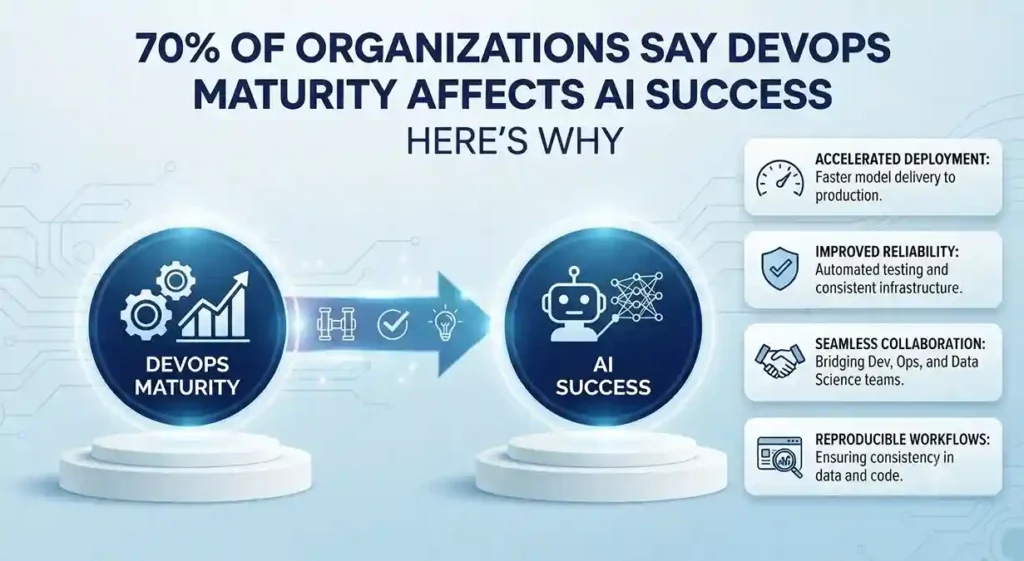
The question isn’t whether AI will replace DevOps. The question is whether your DevOps practice is mature enough to succeed with AI.
That’s not a rhetorical line — it’s a data point. Seventy percent of organizations report that their DevOps maturity materially affects how successful their AI initiatives turn out. Not the size of their AI budget. Not which model they picked. Their DevOps maturity. For anyone treating AI adoption as a tooling decision, that number is worth sitting with. Mature DevOps isn’t just about shipping faster. It’s turning out to be the prerequisite for AI actually working.
The Data Doesn’t Leave Much Room for Debate
The gap between mature and immature organizations isn’t subtle. Seventy-two percent of high-maturity organizations have embedded AI into their engineering workflows. Among low-maturity organizations, that number drops to 18%. That’s a four-fold difference, and it isn’t explained by budget or ambition — both groups want AI working for them. What separates them is whether the underlying engineering practice can actually support it.
There’s a useful way to frame why: DevOps has not failed; incomplete DevOps has. Organizations that stalled halfway through their DevOps transformation — partial automation, inconsistent pipelines, manual gates mixed with automated ones — aren’t just running DevOps inefficiently. They’re building AI on a foundation that was never finished, and AI has a way of exposing exactly where that foundation is weak.
Why Maturity Matters More Than the AI Tool You Pick
AI doesn’t fix inconsistent processes — it scales them. If your deployment pipeline depends on someone manually checking a dashboard before every release, adding AI to that pipeline just means an AI-assisted version of the same manual bottleneck. Disciplined engineering practices — standardized pipelines, consistent testing, infrastructure as code — are what let AI actually operate at scale instead of automating chaos faster.
The same logic applies to governance. AI systems making decisions about deployments, testing, or infrastructure need to be auditable and controllable, the same way any production system does. Organizations with mature DevOps already have the control and audit trails AI needs to operate safely. Organizations without it are building AI oversight from scratch, under pressure, after the fact — which is a much harder position to work from than building it in from day one.
The Role Shift Nobody’s Talking About Enough
Here’s what mature organizations are already seeing: 87% believe AI will shift engineers away from routine scripting and toward system design. That’s not a minor adjustment to job descriptions — it’s a redefinition of where engineering time goes. When AI can generate and maintain routine code, the value an engineer adds shifts upstream, to designing the systems, guardrails, and architecture that AI operates within.
The same shift is happening in quality. QA teams are evolving into Quality Engineering (QE) teams — moving from manually executing test cases to designing the automated, AI-assisted quality systems that catch problems continuously, not just at a testing checkpoint before release. In both cases, the pattern is the same: AI doesn’t remove the need for skilled engineers, it moves their focus from execution to design. Organizations that haven’t started that shift yet are going to feel it as a skills gap the moment AI adoption accelerates.
What IBM Is Telling Its Customers
IBM has been direct about where this is heading. At IBM Think 2026, the message to enterprise leaders was blunt: without an AI operating model, you cannot survive. Not “you’ll fall behind” — survive. That’s the language of a genuine inflection point, not incremental change.
IBM’s answer is IBM DevOps Automation 2026.06, built specifically to close the gap between where most organizations’ DevOps maturity sits today and where it needs to be for AI to actually deliver. The point isn’t that a single product solves organizational maturity — no tool does that on its own. It’s that IBM is treating DevOps maturity and AI readiness as the same problem, because the data says they are.
Where This Leaves You
If your organization is somewhere in the 82% that hasn’t embedded AI successfully, the instinct is often to look for a better model or a bigger AI budget. The data suggests looking somewhere else first: at whether your engineering practice — your pipelines, your testing, your governance, your team structure — is mature enough to support what you’re trying to build on top of it. AI adoption that outruns DevOps maturity doesn’t fail quietly. It scales the exact problems you haven’t fixed yet, faster than you can catch them.
The organizations succeeding with AI right now aren’t the ones with the newest tools. They’re the ones who did the unglamorous work of maturing their DevOps practice first.
Ready to assess your DevOps maturity for the AI era? Contact us for a DevOps Assessment.

