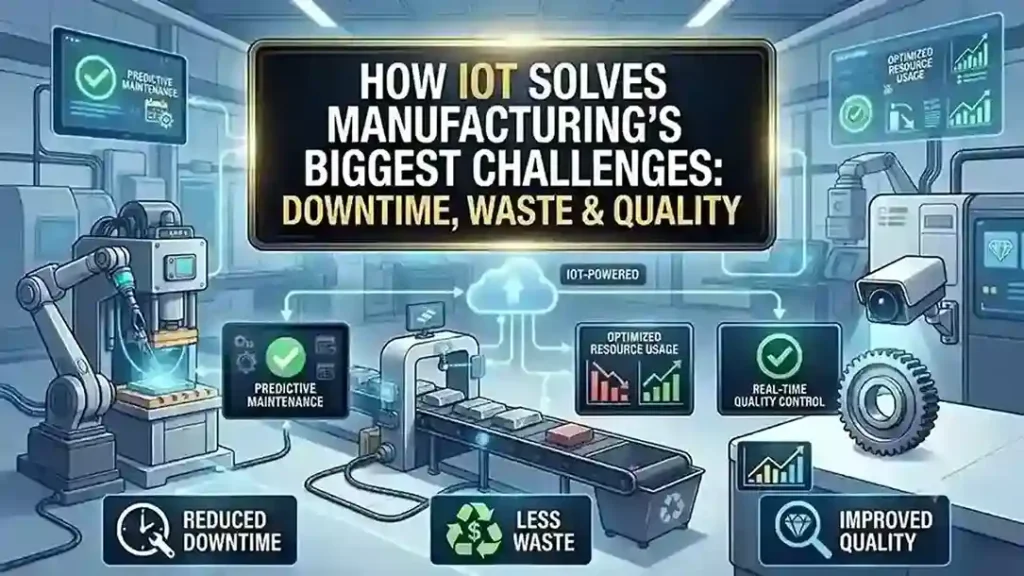
Ask any plant manager to name their three biggest headaches, and you’ll hear the same answer almost every time: unplanned downtime, wasted material, and quality slips that show up too late to fix cheaply. These aren’t separate problems — they’re symptoms of the same root cause. Most manufacturers still run on data that’s hours or days old by the time anyone acts on it, which means every decision is a reaction to something that already happened.
The Internet of Things changes that timeline. Sensors on machines, materials, and production lines turn the factory floor into a live data source instead of a black box you inspect once a shift. But IoT on its own is just visibility — the real payoff comes from connecting that data to the systems that actually run your business. Here’s how IoT addresses each of manufacturing’s three biggest challenges, and why the manufacturers seeing real ROI are the ones pairing IoT with a connected ERP, not running it as a standalone project.
The Real Cost of Doing Nothing
Unplanned downtime alone costs large manufacturing plants millions of dollars a year in idle production lines, and the average large facility loses dozens of hours a month to unplanned stoppages. Add in scrap from process variability, energy wasted on inefficient runs, and the labor cost of reworking defective product, and the three problems compound each other: downtime disrupts schedules, disrupted schedules force rushed production, and rushed production is where quality slips happen. Solve one in isolation and the other two often get worse. This is why IoT strategies aimed at just one of these three problems tend to underdeliver.
How IoT Solves Downtime: From Reactive to Predictive
Traditional maintenance is either reactive (fix it when it breaks) or scheduled (fix it whether it needs it or not) — both waste money in different directions. IoT enables a third option: predictive maintenance.
Sensors monitoring vibration, temperature, pressure, and electrical load on critical equipment feed continuous data into machine learning models that learn what “normal” looks like for that specific machine. When a bearing starts drifting outside its normal vibration pattern weeks before it would visibly fail, the system flags it — giving maintenance teams time to schedule a repair during planned downtime instead of losing a shift to an emergency breakdown. Plants that implement predictive maintenance typically see meaningfully fewer breakdowns and lower spare-parts consumption, because parts get replaced based on actual wear rather than a fixed calendar.
The catch: a predictive alert is only useful if it reaches someone who can act on it, and if that action is scheduled around real production and inventory constraints — which means the alert needs to reach your maintenance and planning systems, not just a dashboard someone has to remember to check.
How IoT Solves Waste: Real-Time Process Control
Material waste in manufacturing rarely comes from one dramatic failure — it comes from hundreds of small process deviations that nobody catches until the batch is already scrapped. IoT closes that gap by monitoring process parameters continuously instead of at periodic checkpoints:
- Process optimization — Real-time sensor data lets systems fine-tune parameters like temperature, pressure, and feed rates as conditions drift, instead of waiting for a batch to fail spec.
- Energy monitoring — Connected meters identify equipment running inefficiently or idling when it shouldn’t be, directly cutting utility waste.
- Demand-linked production — When IoT data on actual consumption and throughput feeds into demand forecasting, manufacturers overproduce less, cutting the inventory waste that comes from making product nobody ordered yet.
None of this waste reduction happens from the sensor data alone — it happens when that data adjusts production plans, purchase quantities, and schedules in the system that actually generates work orders and purchase orders.
How IoT Solves Quality: Catching Defects Before They Compound
Quality problems are the most expensive of the three when they’re caught late, because a defect that reaches a customer costs far more than one caught on the line. IoT-enabled quality control shifts inspection from sampling to continuous monitoring:
- Vision systems connected via IoT can catch microscopic defects on every unit passing a station, far more consistently than periodic manual inspection.
- In-process sensors catch the process drift that causes defects — like a temperature or pressure excursion — before an entire batch is affected, not after.
- Full traceability links every finished unit back to the exact machine settings, material lot, and operator involved in producing it, so if a defect does surface, the root cause and every affected unit are identifiable in minutes instead of days.
That last point matters as much for compliance and recall management as it does for quality itself — traceability data only has value if it’s connected to your inventory and order records, not sitting in a separate monitoring tool.
The Missing Piece: Why IoT Needs to Connect to Your ERP
This is where most IoT initiatives quietly underperform. A sensor that detects an anomaly, a vibration pattern that predicts a failure, or a vision system that flags a defect only creates value once that signal triggers an action — a maintenance work order, a purchase requisition, a quality hold, a schedule change. If IoT data lives in a standalone monitoring dashboard, someone still has to notice it, interpret it, and manually act on it in a separate system. That gap is exactly where the ROI leaks out.
As a Microsoft Solutions Partner, we implement IoT within the Microsoft ecosystem specifically to close that gap:
- Dynamics 365 Supply Chain Management connects Azure IoT data directly to production orders, maintenance schedules, and inventory — so a predictive maintenance alert can automatically trigger a work order, and a quality anomaly can automatically place a batch on hold, without manual handoffs.
- Dynamics 365 Business Central brings the same connected approach to mid-size manufacturers, linking shop-floor data to production and inventory records without enterprise-scale complexity.
- Power BI turns IoT and ERP data together into real-time dashboards for plant managers and executives, so downtime, waste, and quality trends are visible in one place instead of three.
- Azure IoT provides the secure, scalable backbone for connecting machines and sensors to these business systems in the first place.
The manufacturers seeing measurable downtime, waste, and quality improvement from IoT are consistently the ones who scoped it as a business systems project connected to their ERP, not a sensors-and-dashboard project run alongside it.
Getting Started: A Practical First Step
You don’t need to instrument the entire plant on day one. Start with the equipment or process step causing the most downtime, waste, or quality cost today, and pilot IoT monitoring connected to your existing ERP workflow for that single area. A focused pilot that demonstrably closes the loop — sensor to alert to action — builds the case, and the budget, for expanding to the rest of the plant.
Trident Information Systems implements Dynamics 365 Supply Chain Management, Business Central, and Power BI for manufacturers looking to connect IoT data to real operational decisions. If downtime, waste, or quality issues are costing your plant money today, talk to our team about where a connected IoT pilot would have the fastest payback.
FAQs
How does IoT reduce downtime in manufacturing?
IoT sensors monitor equipment health in real time, feeding data into predictive maintenance systems that flag developing failures weeks before a breakdown, allowing repairs to be scheduled during planned downtime instead of causing an unplanned stoppage.
Can IoT really reduce material waste on the factory floor?
Yes. Continuous process monitoring catches deviations in temperature, pressure, or other parameters before they cause an entire batch to fail specification, and IoT-informed demand forecasting reduces the overproduction that drives inventory waste.
Do I need to replace my ERP to use IoT for quality control?
No. IoT platforms like Azure IoT are designed to integrate with existing systems including Dynamics 365 Business Central and Supply Chain Management, so IoT data flows into your current production and quality workflows rather than requiring a system replacement.
What’s the difference between IoT monitoring and a connected IoT-ERP approach?
Standalone IoT monitoring shows you a problem on a dashboard that someone still has to notice and act on manually. A connected approach routes that same signal directly into your ERP to automatically trigger a work order, purchase requisition, or quality hold — which is where most of the actual time and cost savings come from.
How long does it take to see ROI from an IoT manufacturing pilot?
It varies by scope, but a focused pilot on a single high-cost equipment line or process step, connected to existing ERP workflows, typically shows measurable downtime or waste reduction within a few months — faster than a plant-wide rollout, and with a clearer business case for expansion.