India’s sweet and namkeen brands have outgrown the ledger book and the single-shop billing counter. Many now run central manufacturing units, regional warehouses, and dozens of retail outlets — and that growth exposes a problem most traditional players were never built to solve: keeping taste, cost, and compliance consistent when you can no longer see every batch yourself.
That’s the gap an ERP is meant to close. But the category is crowded, ranging from lightweight billing-and-inventory tools built for a single sweet shop to full enterprise platforms built for multi-plant manufacturers. Pick the wrong tier and you either outgrow your software fast, or overpay for capability you don’t need yet. Here’s what matters when evaluating ERP software for sweet and namkeen manufacturing in 2026 — and where Microsoft Dynamics 365 fits.
Why This Industry Needs a Different Kind of ERP
Generic manufacturing ERPs are built for discrete, bill-of-materials assembly. Sweet and namkeen production is process manufacturing, with its own demands:
- Recipe-driven, variable-yield production — a single base like khoya or besan feeds dozens of SKUs, with yield shifting by ingredient quality and season
- Short shelf life, often measured in hours or days, requiring production tightly linked to real demand
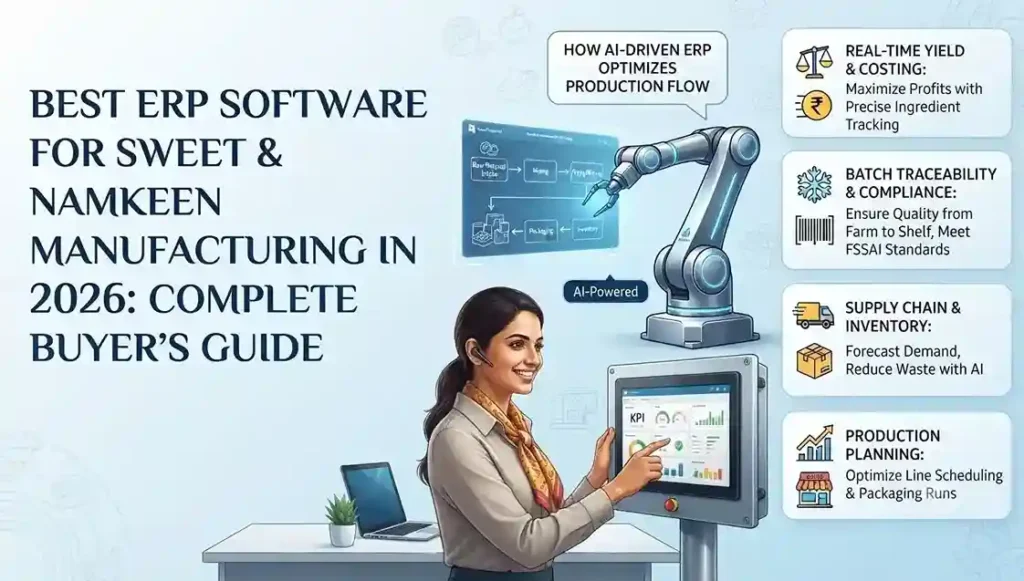
- Batch and lot traceability, so an off-spec batch can be traced to every outlet it reached in minutes
- True batch costing that accounts for yield loss and by-products, not just raw material totals
- Seasonal spikes — Diwali or wedding season can multiply order volumes for a few weeks a year
- A dual business model, where the same brand manufactures centrally and retails through its own stores
- FSSAI, GST, and export documentation generated from system data, not assembled manually at audit time
Any ERP that doesn’t natively handle these will need heavy customization — and every customization becomes a future upgrade headache.
What to Evaluate
| Criteria | What to look for |
|---|---|
| Recipe & formula management | Native yield/by-product calculation, not bolt-on BOM workarounds |
| Batch & lot traceability | Full raw-material-to-shelf tracing with one-click recall reporting |
| Multi-location & multi-entity | Central kitchen, plants, and outlets on one system, across states or entities |
| Retail & POS integration | Production and store sales genuinely connected, not nightly file exports |
| Costing accuracy | True batch cost including yield loss and wastage |
| Scalability | Grows from one plant to national/international without a platform change |
| Compliance | FSSAI, GST, and export documentation from system data |
| Total cost of ownership | License + implementation + inevitable customization, evaluated together |
The ERP Landscape, in Three Tiers
Tier 1 — Sweet-shop POS-plus-inventory tools. India-focused vendors bundling GST billing, basic recipe linking, and multi-outlet stock. Good for a small regional chain; thin on financial consolidation and true process costing.
Tier 2 — Vertical food/process ERPs. Global process-manufacturing specialists with formula management and traceability, often layered on platforms like SAP Business One. More depth than Tier 1, but usually built for general food processing, not Indian sweets and namkeen specifically.
Tier 3 — Enterprise platforms (Microsoft Dynamics 365). Manufacturing sits alongside finance, supply chain, and retail on one platform. This is where scaling brands land once they need more depth than Tier 1 or 2 offer without heavy customization.
Why Dynamics 365 Leads for Scaling Manufacturers
As a Microsoft Solutions Partner working with food manufacturing and retail clients across India, the UAE, and East Africa, we see the same pattern repeatedly: brands outgrow lightweight retail software and need real process costing, financial consolidation, and a retail experience connected to the factory floor — together.
- Dynamics 365 Business Central fits manufacturers running one to a handful of plants: recipe-based production BOMs, full batch/lot genealogy, integrated GST and multi-entity finance, cloud pricing that scales with the business, and a structured upgrade path for anyone still on legacy Dynamics NAV.
- LS Central, layered on Business Central, unifies production, inventory, and POS for brands that manufacture and retail under one roof — one real-time dataset instead of three systems reconciled at month-end.
- Dynamics 365 Finance & Supply Chain Management suits large, multi-plant or exporting manufacturers, adding advanced scheduling, demand forecasting, and deeper multi-entity consolidation.
The advantage isn’t one feature — it’s manufacturing, inventory, finance, retail, and Power BI reporting on a single platform, instead of five tools stitched together by hand.
Before You Sign
Ask any vendor: Can you calculate true batch cost after yield loss? Can I trace one raw material lot to every product and outlet in one report? Is multi-entity support native or custom-built? Is POS genuinely integrated with production? What does year-three total cost look like, including customization?
Final Recommendation
A small, single-city retail chain may do fine on a Tier 1 tool. But if you’re manufacturing at real scale — batch traceability, yield-based costing, multiple locations, or manufacturing plus retail together — Dynamics 365 is built to grow with you rather than become the system you outgrow next.
Trident Information Systems implements Dynamics 365 Business Central, LS Central, and Dynamics 365 Finance & Supply Chain Management for food manufacturers and retailers across India, the UAE, and East Africa. Talk to our team for a needs assessment specific to your production setup and growth plans.