
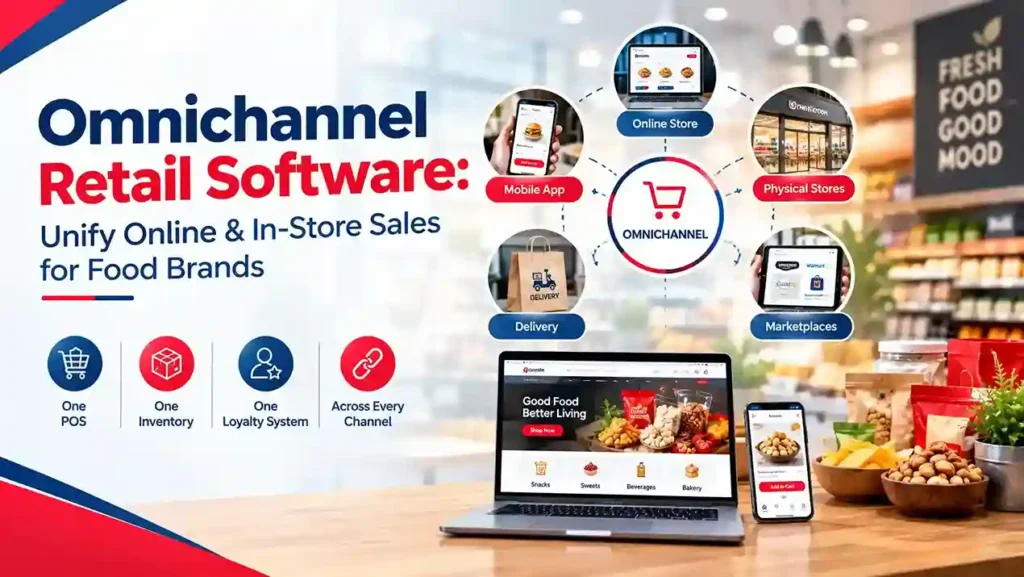
Food brands in 2026 are not selling through one channel. They are selling through five — and most of their technology was built for one.
A bakery chain running an in-store POS disconnected from its online ordering system. A mithai brand managing Swiggy, Zomato, and walk-in sales on three separate platforms. A packaged food brand whose retail outlets have no visibility into e-commerce inventory and whose e-commerce team has no visibility into store-level sales data.
The customer does not see these silos. They see one brand. And when the experience is inconsistent — different pricing, loyalty points that don’t transfer, a product showing online that is out of stock in store — they move on.
The global omnichannel retail market is projected to reach USD 11.01 billion by 2029 at a 13.1% CAGR. Customers who engage across multiple channels spend 30% more than single-channel buyers. And LS Retail has already reported 30%+ greater customer loyalty through omnichannel retail processes — across more than 110,000 stores in 157 countries, including thousands of food and grocery operations.
For food brands ready to unify their operations, LS Central built on Microsoft Dynamics 365 Business Central is the platform that makes it possible.
Why Food Brands Specifically Need Omnichannel Software
Food retail has a specific challenge that generic omnichannel platforms underestimate: the combination of perishable inventory, variable weight products, recipe-based production, multi-format ordering, and delivery fulfilment creates operational complexity that standard retail software cannot handle.
A food brand needs to manage:
- Walk-in store sales with weight-based billing and fast checkout
- Online orders from its own website and food delivery aggregators
- Central kitchen production feeding multiple retail outlets
- Real-time stock visibility across production, store, and online
- Festival season demand spikes that affect both manufacturing and retail simultaneously
- Customer loyalty that works across every channel and every outlet
When each of these operates on a different system, the result is not omnichannel retail — it is multichannel chaos. LS Central resolves this by running everything on one data model, one database, and one platform.
What LS Central + D365 Business Central Delivers for Food Brands
LS Central is a unified commerce platform built as a native extension of Microsoft Dynamics 365 Business Central. It is not an integration between two products — it is one application on one database, combining Business Central’s ERP capabilities with LS Retail’s industry-leading retail functionality.
In 2026, LS Retail was named a Major Player in the IDC MarketScape for worldwide point-of-sale software in grocery and food store retail — the clearest external confirmation that LS Central is purpose-built for food retail at scale.
Here is what food brands get from the combined platform:
Unified POS Across All Outlets
LS Central’s POS handles the specific requirements of food retail — weight-based billing for loose products, modifier-based ordering for customised items, split payments, UPI and card integration, and rapid checkout for high-volume service. Every transaction flows into the same Business Central financial database in real time.
The POS also runs offline — billing and selling continue without interruption when internet connectivity drops. When connection is restored, data syncs automatically. For food brands in markets with unreliable connectivity, this is not a nice-to-have — it is operationally essential.
Real-Time Inventory Across Production and Retail
LS Central maintains a single inventory layer across the central kitchen, warehouse, and every retail outlet simultaneously. When a product sells at one outlet, stock updates across the network instantly. When production dispatches finished goods, outlet inventory reflects the delivery automatically.
Food brands using LS Central eliminate the manual reconciliation between production records and retail stock that causes over-ordering, dead stock, and stockouts on high-demand SKUs.
Omnichannel Order Management
LS Central connects in-store POS, e-commerce, mobile ordering, and food delivery platform orders into one unified order management system. Orders from Swiggy, Zomato, and the brand’s own online channel flow into the same fulfilment queue as in-store orders — with inventory drawn from the same real-time stock pool.
This eliminates the over-selling problem that disconnected systems create when an online order is accepted for an item that was already sold in-store minutes earlier.
Integrated Customer Loyalty and CRM
LS Central’s loyalty module creates one customer profile that works across every channel and outlet. Points earned on an in-store purchase are visible and redeemable online. A customer’s purchase history from the website informs the recommendation at the in-store counter. Festival promotions run centrally and apply consistently across every touchpoint.
Food brands using LS Central’s integrated loyalty consistently report higher repeat visit rates and basket values compared to disconnected loyalty programmes that only work in one channel.
Financial Consolidation Through D365 Business Central
Because LS Central is built on Business Central, every sale, every inventory movement, every purchase order, and every loyalty redemption flows directly into the financial ledger without integration or manual entry. Financial reporting across all outlets, channels, and entities is consolidated in real time — with Power BI dashboards giving management live visibility into revenue, margins, and profitability by product, outlet, or channel.
The Technology Stack That Makes It Work
| Component | What It Does for Food Brands |
|---|---|
| LS Central POS | Unified in-store billing — weight-based, offline-capable, fast |
| D365 Business Central | Financial backbone — one ledger for all channels and outlets |
| LS Central Inventory | Real-time stock across production, store, and online |
| LS Central Loyalty | Single customer profile across all channels |
| LS Central eCommerce connector | Online orders into the same fulfilment system |
| Power BI for LS Central | Live dashboards — sales, margins, loyalty by channel |
| LS Central offline mode | POS continues operating without internet |
Who This Is Built For
LS Central + D365 Business Central is the right omnichannel platform for:
- Sweet and mithai brands managing central production and multi-outlet retail
- Bakery chains running in-store and online ordering simultaneously
- Packaged food brands with both modern trade and direct-to-consumer channels
- QSR and fast food chains needing unified POS, loyalty, and kitchen management
- Grocery and food retail chains managing high SKU counts across multiple locations
The United Company for Central Markets consolidated four legacy systems into a single LS Central deployment across 43+ stores across Makhazen, COOP, and Freshway Supermarkets brands — a real-world example of what unified food retail operations look like on this platform.
Why Trident for LS Central Implementation
Trident Information Systems is a certified LS Central and Microsoft Dynamics 365 Business Central implementation partner with over 250 successful customer engagements across India, UAE, UK, Africa, and Southeast Asia — including specific expertise in food brands, sweet manufacturing, and food retail.
Trident configures LS Central to match your food brand’s specific workflows — production-to-retail inventory, weight-based POS, delivery platform integration, festival demand planning, and customer loyalty — not a generic retail template adapted after the fact.
One platform. Every channel. Every outlet. Every customer. That is what LS Central + D365 Business Central delivers for food brands — and what Trident makes happen. Ready to unify your food brand’s online and in-store operations? Talk to Trident’s LS Central team for a demonstration and scoped implementation plan at tridentinfo.com/contact.

