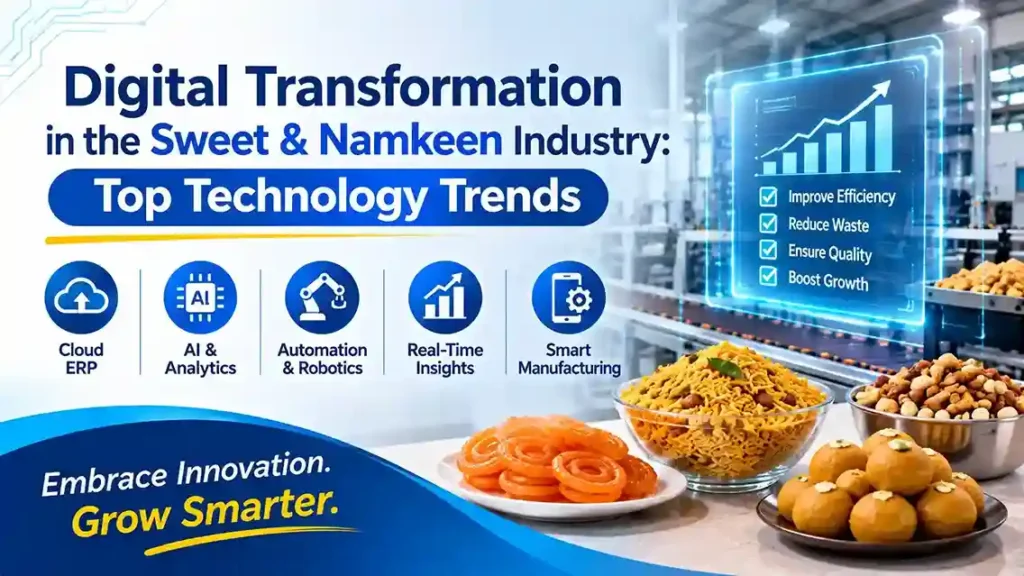
Digital transformation in India’s ₹1.5 lakh-crore mithai and namkeen market is being driven by three Microsoft-based technology shifts: recipe-driven ERP on Dynamics 365 Business Central for batch consistency and traceability, LS Central POS for unified retail and production control across outlets, and AI-powered quality and demand forecasting integrated through Power Platform. Early adopters report 90% reduction in operational errors and 96% recipe accuracy .
India’s sweet and namkeen industry faces a paradox. Demand is surging—exports are growing at over 10% annually, with gulab jamun now among the most popular desserts in the UK . Yet most manufacturers still run production on paper recipes and manage multi-outlet operations through disconnected systems. The gap between market opportunity and operational capability is where digital transformation becomes urgent.
This guide covers the technology trends reshaping the industry, focused specifically on Microsoft-based solutions that sweet and namkeen businesses can deploy today.
Trend 1: Recipe-Driven ERP for Batch Consistency
The defining challenge for sweet manufacturers is consistency. A slightly different texture in kaju katli or a denser batch of barfi erodes customer trust built over decades. Manual recipe management—notebooks, head chef memory, undocumented substitutions—cannot scale.
Microsoft Dynamics 365 Business Central, extended with food-industry modules, addresses this through recipe-based production management. Each product is tied to a structured bill of materials with exact ingredient quantities, yield factors, and expected loss percentages. Production orders enforce the recipe rather than suggesting it.
Prashant Corner, a Maharashtra-based sweet and namkeen brand operating 17 stores, implemented a purpose-built ERP for the industry and reported 96% recipe-based production accuracy and 90% reduction in operational errors . The system now connects production planning, recipe management, warehouse operations, batch traceability, and stock transfers through one platform.
For Microsoft-based deployments, LS Central extends Business Central with recipe and ingredient control specifically for food retail. The system tracks ingredient usage from POS through back office, manages perishable stock by batch, and uses historical sales data for demand forecasting .
Trend 2: LS Central POS for Unified Retail and Production
Sweet and namkeen businesses rarely operate a single store. Multi-outlet chains face a recurring problem: inventory visibility across locations, consistent pricing, and production planning that matches actual demand.
LS Central on Dynamics 365 Business Central provides a unified commerce platform where POS, inventory, finance, and kitchen operations share one database. For sweet retailers, the relevant capabilities include:
Real-time inventory across outlets. Stock levels sync automatically, enabling inter-store transfers and centralized replenishment. When a product runs low at one location, the system reflects it immediately.
Recipe sync with POS. Every sale automatically deducts ingredients from inventory based on the recipe, keeping stock levels accurate without manual reconciliation .
Batch and expiry management. Perishable stock is tracked by batch, with automated alerts for approaching expiry—critical for milk-based sweets with short shelf lives.
Self-service and kiosk integration. For high-volume retail environments, self-order kiosks reduce queue pressure and free staff for customer service.
The practical value is operational control. A sweet chain running LS Central knows what sold at each outlet, what ingredients remain, and what production is needed tomorrow—without spreadsheet reconciliation.
Trend 3: AI-Powered Quality and Demand Forecasting
Artificial intelligence is moving from research labs to production floors in food manufacturing. For sweet and namkeen producers, the most immediately applicable AI capabilities are quality inspection and demand forecasting.
Computer vision systems equipped with deep learning algorithms can detect surface defects, contamination, or packaging irregularities faster and more consistently than human inspectors . For namkeen, this means identifying uneven seasoning or burnt pieces at line speed. For sweets, it means catching texture or color deviations before packaging.
Demand forecasting uses historical sales data, seasonal patterns, and promotional calendars to predict production requirements. The Godrej Food Trends Report 2026 notes that “mindful indulgence” and mood-driven snacking are reshaping consumer behavior , making forecast accuracy more valuable—and more difficult—than ever.
Microsoft’s ecosystem supports these capabilities through Azure AI services and Power BI integration. Food manufacturers using Dynamics 365 Supply Chain Management can connect production data to analytics dashboards, enabling teams to make decisions from real-time information rather than weekly reports .
Trend 4: Cloud ERP for Multi-Outlet Scalability
The shift from on-premise or manual systems to cloud ERP is foundational to every other trend. Cloud deployment eliminates server maintenance, enables automatic regulatory updates, and provides the scalability that growing sweet chains require.
For sweet and namkeen manufacturers, the relevant Microsoft path is Dynamics 365 Business Central, either configured directly or extended through LS Central for retail-specific functionality. The key advantages for this industry:
- GST and regulatory compliance configured for Indian tax requirements
- Multi-entity consolidation for businesses operating multiple production units or legal entities
- Power BI reporting for sales, inventory, and production visibility
- Scalability from single-outlet operations to national chains without platform migration
A Japanese food manufacturer in Singapore, producing confectionery and snack products, implemented Dynamics 365 Supply Chain Management to replace fragmented systems. The result: stronger governance, improved operational efficiency, and better insights through Power BI integration .
Trend 5: Export Readiness Through Traceability
With Indian mithai exports growing at over 10% annually , manufacturers targeting international markets face stricter traceability and quality documentation requirements. Importing countries demand evidence of batch-level tracking, allergen controls, and shelf-life verification.
Digital systems provide this evidence automatically. Batch traceability from raw material receipt through finished goods dispatch—executed in minutes rather than days—becomes a competitive advantage when entering regulated export markets. Manufacturers without this capability face delays, rejections, or exclusion from high-value opportunities.
Implementation Priorities for Sweet & Namkeen Businesses
For businesses evaluating digital transformation, the practical sequence is:
First: Recipe and batch management. Digitize your top-selling products before anything else. Consistency failures on high-volume items are the most visible and costly.
Second: Unified POS and inventory. If you operate multiple outlets, connect them on a single platform. LS Central or Business Central with retail extensions eliminates the reconciliation work that consumes management time.
Third: Production planning and demand forecasting. Once sales and inventory data flow through one system, use it to plan production. Even basic forecasting reduces overproduction of perishables.
Fourth: Quality and traceability extensions. Add AI-assisted inspection and export-grade traceability as volume and market reach justify the investment.
The Bottom Line
Digital transformation in the sweet and namkeen industry is not about replacing tradition—it is about preserving it at scale. The recipes that built these brands remain the foundation. What changes is the system that ensures every batch, every outlet, and every export shipment meets the standard those recipes demand.
Microsoft-based solutions—Dynamics 365 Business Central, LS Central, Power Platform, and Azure AI—provide an integrated path from manual operations to data-driven control. The businesses adopting these tools now are building the operational infrastructure to compete domestically and internationally.
Evaluating technology for your sweet or namkeen business? Start with a recipe audit and a multi-outlet inventory assessment. The gaps you find will define your implementation priorities.