
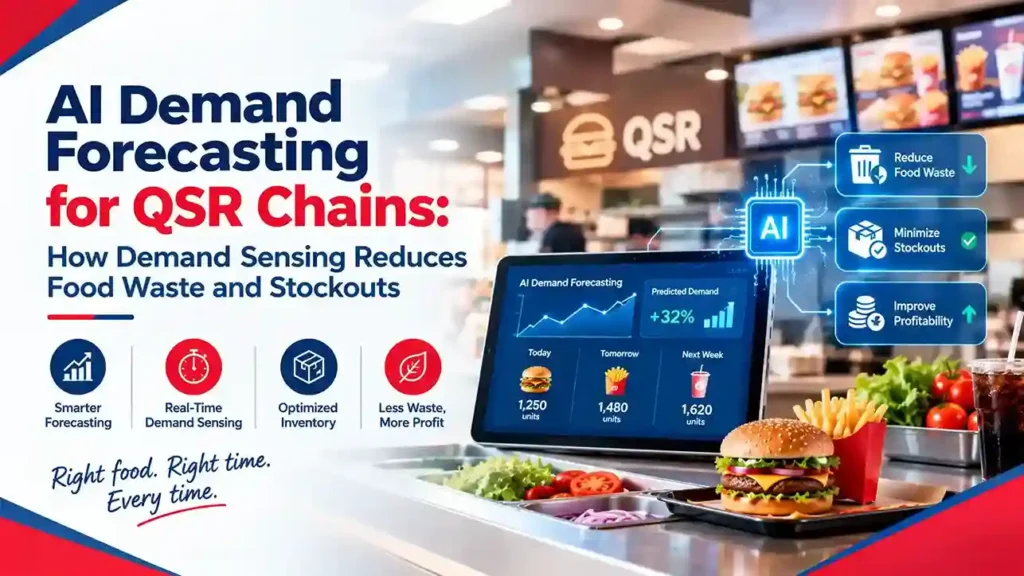
Quick-service restaurants run on thin margins, short shelf lives and demand that can change by the hour. Yet most QSR forecasting systems are built to answer one question: what happened yesterday? Your stores need to know what will happen today.
Why traditional QSR forecasting falls short
Historical averages, manager experience and yesterday’s numbers can’t keep up when demand is driven by:
- Weather
- Local events
- Day of the week
- Promotions
- New product launches
- Delivery-app trends
Some QSRs still operate with 20–30% forecast error at SKU-store-day level. When the forecast is wrong, the kitchen, procurement team and inventory all react — and the cost shows up in two places: waste and stockouts.
The waste problem starts with the forecast
Food waste doesn’t start in the kitchen. It can start with a wrong demand forecast. Forecast too high and you buy more, prepare more, stock more, sell less — and eventually waste more. Estimates point to 4–10% of food purchased being wasted across global QSR chains, with 5–8% of inventory typically expiring before use.
So the question shouldn’t simply be “How do we reduce food waste?” It should be: “How early can we detect the demand signal that creates the waste?”
The stockout trap
Order too little and you create stockouts — which affect customer experience, revenue, brand perception and repeat visits. Stockouts and poor demand sensing can erode 2–3% of revenue, and even leading QSRs can experience 3–5% line-item stockouts weekly.
The answer isn’t to carry more inventory. The objective is maximum availability with minimum waste — knowing what each store will need before it needs it.
From historical forecasting to real-time demand sensing
Traditional forecasting asks “What happened before?” AI demand sensing asks “What’s changing right now?” QSR Sense AI considers signals such as weather, promotions, seasonality, day of week, local events, new product launches and delivery-app trends, and continuously refines the forecast. Because sometimes tomorrow doesn’t look anything like yesterday.
Your kitchen shouldn’t guess
How much should your kitchen prepare for the next meal period? Too much means waste; too little means lost sales. With Agentic AI, the system doesn’t just report that demand is higher than expected. It says: “Demand is changing. Adjust preparation by store, SKU and meal period.” Opportunities include auto-adjusting prep volumes across dayparts, batch-size optimization and responding to real-time demand shifts.
From prediction to action
The evolution is Dashboard → Prediction → Recommendation → Autonomous Action. For a QSR, that can mean:
- Adjusting preparation volumes
- Optimizing batch sizes
- Reallocating inventory between outlets
- Identifying items approaching expiry and enforcing FEFO
- Optimizing menu/SKU decisions
- Triggering waste-reduction actions
QSR Sense AI: the connected chain of decisions
Customer demand changes → AI senses the signal → the forecast changes → inventory requirements change → procurement adjusts → preparation quantities change → waste reduces → availability improves → customer experience improves.
QSR Sense AI brings together demand planning, demand sensing and optimization, with models spanning forecasting, inventory, logistics, menu/SKU rationalization and sustainability. Not another dashboard. Not another static forecast. An AI-driven demand and supply optimization engine built for QSRs.
Book a free 1:1 QSR demand forecasting session
Trident is running complimentary 1:1 sessions on Microsoft Teams to show how AI-powered demand forecasting can help your QSR chain predict demand accurately, optimize stock levels, reduce food waste and improve operational efficiency. Register now.

