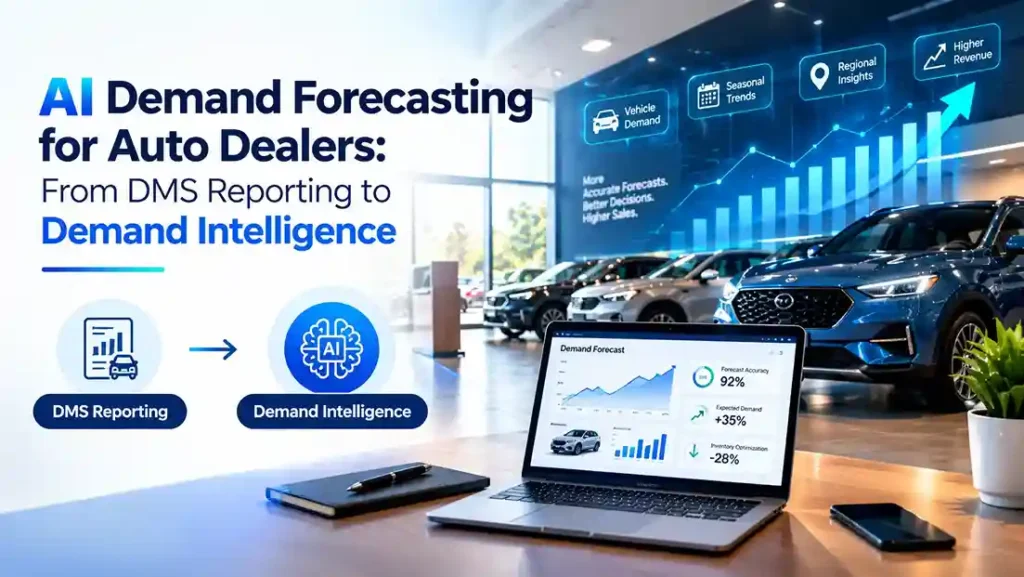
AI Demand Forecasting for Auto Dealers: From DMS Reporting to Demand Intelligence
Dealership systems are excellent at reporting the past. But dealership profitability depends on anticipating the future. That gap — between what your DMS knows and what you need to decide — is where demand intelligence comes in. The limits of DMS reporting Every dealership has mountains of data: sales, inventory, leads, website traffic, customer history and aftersales. But most of that data tells you what happened yesterday. It doesn’t tell you what will sell next, where it will sell, or when demand will change. Problem 1: the right car in the wrong location The car you need to sell may already be sitting on your lot — just in the wrong location. One dealership has ageing inventory. Another is losing customers because the right variant isn’t available. The problem isn’t always inventory shortage. Sometimes it’s inventory visibility. Problem 2: toxic inventory Your most expensive inventory may be the car that isn’t selling. Every additional day a vehicle sits on the lot impacts working capital, floor-plan costs, discounting and margins. The question isn’t “How much inventory do we have?” It’s “Which inventory is likely to become a problem — and what should we do about it?” Problem 3: the model sells, the variant doesn’t Demand doesn’t stop at the model level. Customers care about trim, engine, transmission, colour, features and price. Yet many inventory decisions are still made at a much broader level. AutoSense AI helps forecast demand at the model, variant and location level. Problem 4: the lost sale you never see How many customers did you lose because you didn’t have the right car? You may never see those lost sales in your DMS — the customer simply goes somewhere else. That’s the hidden cost of poor demand forecasting. Dealer inventory is a capital issue Every vehicle sitting unsold represents capital tied up in inventory. So instead of asking “How many vehicles should we stock?”, dealer groups should be asking “Where should we put our next dollar of inventory?” AutoSense AI helps turn demand forecasts into smarter inventory allocation decisions. From forecasting to agentic demand intelligence Traditional forecasting: Data → Forecast → Dashboard → Human decision. Agentic AI: Data → Sense → Predict → Recommend → Act. AutoSense AI isn’t just about predicting vehicle demand. It helps dealers answer: From reactive to predictive dealership management AutoSense AI works alongside your dealership ecosystem, with Microsoft Dynamics 365 F&O as the operational backbone, so demand intelligence flows into real inventory decisions. Book a free AutoSense AI assessment Trident offers a complimentary assessment for dealer groups to review how demand and inventory decisions are made today, and where AI-powered demand forecasting could reduce ageing stock and lost sales. [Book your session →]
AI Demand Forecasting for Auto Dealers: From DMS Reporting to Demand Intelligence Read More »