
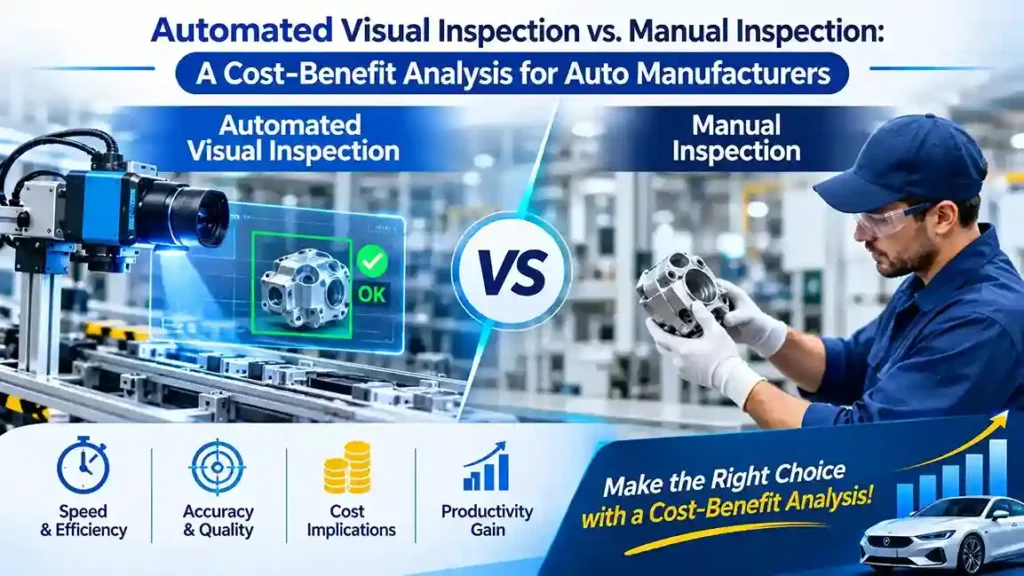
Automated visual inspection in automotive manufacturing delivers measurable cost advantages over manual methods. Real-world deployments show a 50% reduction in inspection labor, 20% higher defect detection rates, and return on investment within 18 months—primarily through eliminated rework, reduced scrap, and redeployed operators to higher-value tasks.
The Hidden Cost of Manual Inspection
Manual visual inspection has been the backbone of automotive quality control for decades. Skilled operators examine painted body panels, weld points, and interior trim under controlled lighting, relying on experience and attention to detail.
The problem is not skill. It is human limitation.
Research consistently identifies operator fatigue and subjective decision-making as primary sources of inconsistency in manual inspection . An operator inspecting hundreds of parts per shift cannot maintain identical attention on the first unit and the five-hundredth. Defects that appear obvious at 8 AM may slip through at 3 PM.
The cost compounds quietly. A missed paint defect reaches final assembly. The vehicle requires rework. If it ships, warranty claims follow. If it reaches a customer, brand reputation suffers.
What Automated Visual Inspection Delivers
Automated visual inspection (AVI) uses high-resolution cameras and deep learning models to evaluate every part at machine speed, without fatigue or variability. Unlike traditional rule-based vision systems that require hand-crafted algorithms, modern AI-driven systems adapt to new defect types and detect subtle flaws—hairline cracks, paint runs, missing clips—that manual inspection often misses .
The technology is not theoretical. It is operating on production lines today.
The Numbers: Real Deployment Results
Paint Shop: 50% Labor Reduction, 18-Month ROI
A documented implementation in an automotive paint shop provides the clearest cost picture. Before automation, operators spent 70% of their time locating defects and only 30% repairing them. Machine vision inverted this dynamic: defect searching dropped to 10% of operator time, freeing the majority for actual repair work .
The workforce impact was substantial. The plant reduced paint inspection operators from 72 to 36—a 50% reduction—while increasing detection rates by 20% and eliminating fatigue-related variation. Estimated annual economic impact: €600,000, with return on investment in approximately 1.5 years .
Door Trim: Cycle Time Halved, Labor Cut 50%
For aesthetic components like interior door trim, manual inspection consumed 20–25 seconds per part. A robotic cell using AI imaging reduced cycle time to 8–14 seconds while cutting the inspection team from four operators to two. False acceptance rate dropped to 0.1%, and false rejection stayed below 5% .
The system paid for itself through direct labor savings and throughput improvement—the inspection station’s capacity effectively doubled without adding floor space.
Weld Inspection: From Detection to Remediation
At Audi’s Neckarsulm plant, automated weld splatter detection now analyzes 1.5 million weld points across 300 vehicles per shift. Previously, technicians spent 80% of their work cycle searching for defects. With AI identifying defects automatically, specialists now spend the majority of their time on correction—higher-value work that directly improves quality .
Chinese OEM Welding Line: 99.9% Accuracy, 0.4 Seconds Per Unit
A Chinese automotive manufacturer deployed AI visual inspection for weld nut and rivet verification. Manual inspection required 10 seconds per unit with approximately 1% error rate. The AI system achieved 99.9% accuracy at 0.4 seconds per unit. Single-station annual savings reached approximately ¥210,000, with zero detection errors since November 2023 deployment .
Cost-Benefit Comparison
| Factor | Manual Inspection | Automated Visual Inspection |
|---|---|---|
| Detection consistency | Declines with fatigue; subjective | Consistent 24/7; objective |
| Cycle time (per part) | 10–25 seconds typical | 0.4–14 seconds depending on complexity |
| Error rate | ~1% (manual weld check) | 0.1% false acceptance |
| Labor scaling | Linear with volume | Fixed; scales without headcount |
| Data output | None or manual logs | Full traceability, defect patterns |
| ROI timeline | N/A | 18 months documented |
When Manual Inspection Still Makes Sense
A balanced analysis requires acknowledging where automation struggles.
Low-volume, high-variety production may not justify the capital investment. If a plant runs ten different models on one line with frequent changeovers, camera positioning and model training become complex.
Complex geometries with significant appearance variation challenge computer vision algorithms, requiring specialized development and data augmentation . Manual inspectors can recognize “something looks wrong” in ways that trained models may not generalize.
Initial data requirements are substantial. Deep learning models need labeled images of both defective and non-defective samples. Collecting and curating this dataset is resource-intensive, and systems may fail to detect unknown defect types not present in training data .
The pragmatic approach for most manufacturers is hybrid deployment: automate high-volume, standardized inspection tasks where ROI is proven, while retaining skilled inspectors for complex judgment calls and final verification.
Implementation Considerations
Start with a defined scope. Paint inspection and weld verification have the most documented ROI cases. Door trim and aesthetic components also show strong returns .
Plan for data infrastructure. Automated inspection generates continuous image streams. Systems need storage, processing power, and integration with existing MES or quality databases to capture full traceability value.
Address workforce transition honestly. The paint shop case did not eliminate 36 operators—it redeployed them. Six transitioned to machine operation and supervision roles . Training programs for new roles determine whether automation is experienced as opportunity or threat.
Measure before and after. Establish baseline metrics for defect escape rate, cycle time, rework hours, and scrap cost. Without baselines, ROI claims remain theoretical.
The Bottom Line
For automotive manufacturers evaluating inspection automation, the cost-benefit equation favors automated visual inspection in high-volume, standardized processes. Documented deployments show 50% labor reduction, 20% higher detection rates, and 18-month ROI—driven primarily by eliminating the hidden costs of manual inconsistency.
The technology is mature. The question is not whether automation outperforms manual inspection on repeatable tasks—it does. The question is which inspection stations in your plant offer the fastest path to that return, and how to redeploy the human expertise that manual inspection consumed.
Evaluating inspection automation for your production line? Start with a single high-volume station where defect escape costs are highest. Measure baseline performance for three months. Then decide whether the ROI case justifies scaling.