
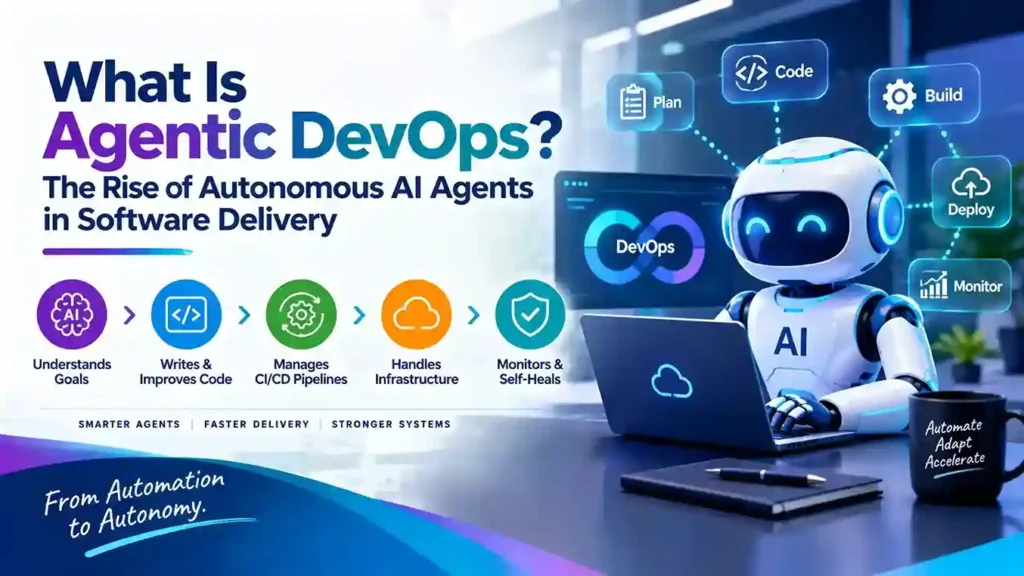
Software delivery has spent a decade automating the predictable. Pipelines trigger on push, scripts rotate credentials on schedule, and policies block non-compliant resources at the control plane. These automations are deterministic: same input, same output, every time.
Agentic DevOps introduces something fundamentally different. Instead of executing rigid scripts, AI agents reason about a goal, gather context from multiple sources, decide which tools to invoke, and adapt their approach based on what they observe. This reasoning loop—observe, reason, act—is what separates an agent from automation .
Microsoft defines Agentic DevOps as “the practice of using AI agents to automate and orchestrate operational workflows that traditionally required manual coordination” . The AI is not a coding assistant responding to prompts. It is an active participant in the workflow, with a defined role, access to specific tools, and domain knowledge that shapes its outputs.
From Assistant to Autonomy: The Three Waves
The shift did not happen overnight. It followed a recognizable progression.
Wave 1: Copilots. Passive IDE plugins offering code snippets and inline suggestions upon prompt. Useful, but reactive—the human drives every action.
Wave 2: Agentic SDLC. Active agents that read project structures, open pull requests, author tests, and execute multi-step workflows. Microsoft’s own tooling reflects this progression: GitHub Copilot evolved from code completion to chat assistant to agent mode that reads full codebase context, invokes terminal and filesystem tools, and iterates on assigned tasks .
Wave 3: Hybrid Teams. Collaborative ecosystems where human engineers manage fleets of autonomous agents rather than writing repetitive pipeline YAML. Research published in IEEE Xplore describes this transformation as a shift of human roles “from execution to strategic governance,” eliminating linear headcount scaling while preventing errors in critical environments .
The Multi-Agent Pattern: Specialization Over Generalization
The most consequential architectural decision in Agentic DevOps is moving from single-agent to multi-agent patterns. A single agent handling an entire workflow breaks down when steps are interconnected and require different domain expertise.
Microsoft’s documentation describes a multi-agent pattern where specialized agents each focus on a distinct domain: a Requirements Agent parses natural language into structured specifications, an Architecture Agent recommends services and trade-offs, an IaC Generation Agent produces Bicep or Terraform templates, a Deployment Agent executes and validates, and a Documentation Agent produces operational runbooks .
A conductor agent coordinates the sequence—receiving the initial request, delegating steps to specialized agents, verifying completion before moving forward, and handling errors and retries. The conductor does not perform the actual work. It orchestrates, like a project manager coordinating engineers .
Agents communicate through artifacts—files written to a shared location—rather than direct messages. Each agent reads prior artifacts and writes its own outputs for downstream consumption. This approach provides transparency (every intermediate result is readable), reproducibility (fix an artifact and rerun only downstream agents), version control (artifacts work with Git), and isolation (each agent runs in its own context window, avoiding accumulated error drift) .
How Agentic DevOps Works in Practice
The multi-agent pattern applies across operational workflows beyond infrastructure provisioning. Microsoft’s documentation identifies four recurring scenarios :
Compliance auditing. A scanning agent discovers resource configurations. A policy agent evaluates them against organizational standards. A reporting agent generates remediation recommendations.
Incident response. A monitoring agent detects anomalies. A diagnostic agent gathers logs and metrics. A remediation agent proposes or applies fixes.
Environment lifecycle management. A provisioning agent creates environments. A monitoring agent tracks usage. A cleanup agent identifies and decommissions unused resources.
Configuration drift detection. A baseline agent defines expected state. A scanning agent compares actual state. A correction agent generates changes to restore compliance.
The measured impact is significant. The IEEE study reported a 65% reduction in deployment cycle time, 40% reduction in operational toil, and 90% faster incident MTTR through autonomous self-healing .
Tool Orchestration and MCP
Agents connect to external developer infrastructure—Jenkins, GitHub Actions, Terraform, Kubernetes, Jira—through standards like the Model Context Protocol (MCP). Microsoft’s Azure DevOps MCP Server exposes tools for pipeline operations (list builds, get build logs, queue runs), repository operations (list branches, create pull requests, update reviewers), and search across code and work items .
This orchestration is what enables agents to do more than generate text. They fetch telemetry, issue commands, and verify outcomes—acting within scoped permissions rather than operating on general knowledge.
Human-in-the-Loop Governance
Autonomy does not mean absence of control. The dominant design pattern in current systems is constrained autonomy, where agents operate within defined boundaries and safety is achieved through surrounding governance infrastructure rather than intrinsic agent guarantees .
Research distinguishes between data-plane authority (localized interventions like patch generation and test reruns) and control-plane authority (modifications to pipeline configuration, deployment policies, and approval gates). Current systems operate mainly at the data plane, with control-plane safety remaining “the most urgent open problem” .
Practical governance includes policy checks, scoped permissions, and approval gates for critical actions. Platforms like Cline enforce step-by-step permission gating for every file edit and terminal command, with checkpoint snapshots for rollback . Claude Code offers configurable autonomy with sandboxed permissions and git worktree isolation per agent .
The Bottom Line
Agentic DevOps represents a genuine architectural shift: from deterministic scripts that execute fixed instructions to probabilistic agents that reason about goals, adapt to unexpected conditions, and coordinate across specialized roles. The technology is available today through Microsoft’s tooling, open-source agents like Cline, and orchestration frameworks like LangGraph.
The open question is not whether agents can perform operational tasks—research and vendor implementations demonstrate they can. The question is how much authority to delegate, and where control should reside. Organizations adopting Agentic DevOps must design authority transfer deliberately: what agents can do autonomously, what requires approval, and how failures are contained and reversed.
The engineers who thrive in this shift will not write better YAML. They will manage agent fleets, curate golden paths, and design the governance frameworks that make autonomy safe.

