Every food manufacturer knows the pain. You overproduce and write off finished goods. You underproduce and disappoint your biggest customer. You order too much raw material and watch it expire on the shelf. You order too little and halt a production line.
This is not a management failure. It is a forecasting failure. And in 2026, AI demand forecasting software is the tool that eliminates it.
The global AI food demand forecasting market has grown to USD 1.6 billion in 2025 and is projected to reach USD 5 billion by 2033 — growing at a 34.50% CAGR. The food manufacturers driving that growth are not the largest companies in the world. They are mid-size producers who got tired of losing margin to inventory problems they could finally afford to solve.
This is your guide to how AI demand forecasting works, what it delivers, and why 2026 is the year to stop running production on gut feel.
Why Traditional Demand Forecasting Is Failing Food Manufacturers
Most food manufacturers still forecast demand the same way they did a decade ago — historical averages, spreadsheet models, and the instinct of experienced production managers.
This approach has three fatal flaws in 2026.
First, it ignores external signals. Demand for food products is influenced by weather, local events, festivals, social media trends, and economic conditions — none of which a spreadsheet can process automatically or at scale.
Second, it is always looking backward. Historical sales data tells you what happened. It does not tell you what is about to happen — especially in volatile markets where consumer preferences shift faster than quarterly review cycles.
Third, it cannot operate at SKU level. A mid-size food manufacturer may manage hundreds of SKUs across multiple production lines, pack sizes, and customer channels. Manual forecasting at this level of granularity is simply not possible without sacrificing accuracy.
The result: overproduction, waste, stockouts, and the working capital pressure that comes from carrying excess inventory.
What AI Demand Forecasting Software Actually Does
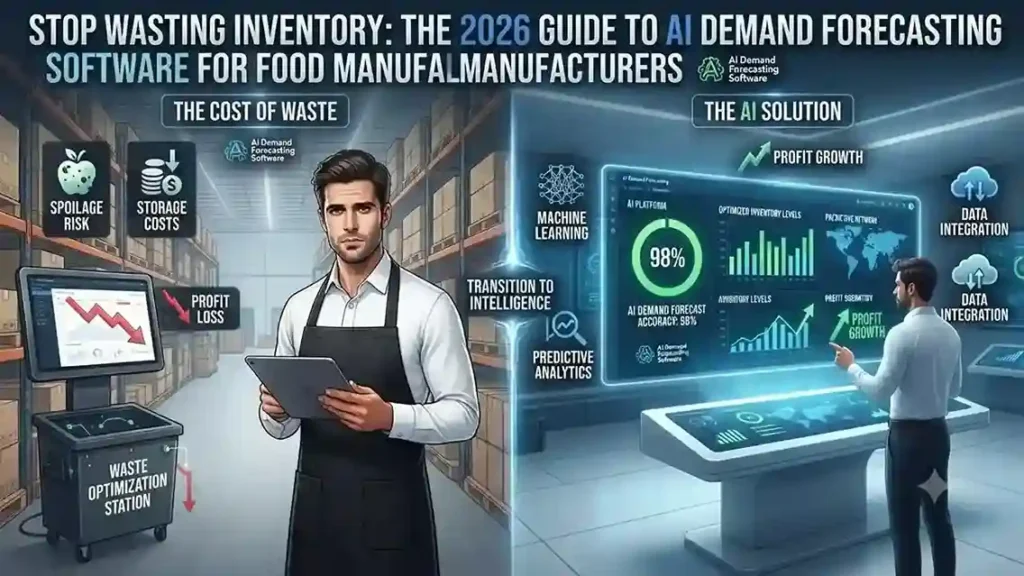
AI demand forecasting software replaces guesswork with machine learning models that analyse multiple data streams simultaneously — and continuously improve their predictions over time.
Here is what a modern AI forecasting system processes:
Historical sales data — but analysed at granular SKU, customer, and channel level, not just in aggregate.
Seasonality and festival patterns — automatically identifying demand spikes tied to Diwali, Holi, Eid, wedding season, and regional festivals without manual adjustment.
Weather and external signals — integrating temperature, rainfall, and local event data that influence demand for perishable food products.
Production and inventory data — connecting actual stock levels, batch production records, and purchase orders to close the loop between forecast and execution.
Supplier lead times — factoring procurement timelines into raw material planning so you are never caught short on critical ingredients.
The result is a forecast that is not a static weekly number — it is a continuously updated, multi-variable prediction that gets more accurate every production cycle.
The Business Impact: What Food Manufacturers Are Achieving
The numbers from real-world AI forecasting deployments in the food industry are compelling.
McKinsey research shows AI-driven demand forecasting improves service levels by up to 65% while reducing inventory costs by 20–30%. Kraft Heinz improved forecast accuracy by 8%, cut excess inventory by 25%, and reduced food waste by 10% using AI forecasting tools. Walmart’s AI-powered fresh product forecasting platform cut food waste by USD 86 million in a single year.
For mid-size food manufacturers — sweet producers, namkeen manufacturers, bakeries, dairy processors, and packaged food brands — the scale is smaller but the impact is proportionally just as significant:
- Raw material waste reduced by 20–35% through demand-matched purchasing
- Production overruns cut by 30% through accurate batch planning
- Stockout incidents reduced by up to 60% through real-time demand signals
- Working capital freed up as excess inventory carrying costs fall
- Supplier relationships improved through more consistent, predictable purchase orders
Machine learning models have been shown to reduce forecast error rates from 35% down to 15% in food manufacturing environments — a difference that translates directly into recovered margin on every production run.
Key Features to Look for in AI Demand Forecasting Software
Not all demand forecasting tools are created equal. For food manufacturers specifically, here is what matters:
SKU-level forecasting — the ability to forecast demand at individual product, pack size, and customer level — not just category or brand.
ERP and production system integration — your forecasting tool must connect directly to your inventory, purchase orders, and production planning system to close the loop between prediction and execution.
Festival and seasonality intelligence — built-in recognition of India’s complex demand calendar, including regional festivals that affect different markets at different times.
Perishable goods handling — shelf-life awareness that factors expiry dates into both raw material planning and finished goods production scheduling.
What-if scenario planning — the ability to model the impact of a new customer order, a raw material price spike, or a production line outage on your demand and supply position.
Mobile and dashboard access — production managers and procurement teams need forecasting insights at their fingertips, not buried in a weekly report.
AI Forecasting + ERP: The Combination That Closes the Loop
AI demand forecasting software delivers its maximum value when it is connected to your ERP system.
Standalone forecasting tools tell you what demand will look like. ERP systems manage raw material procurement, batch production, inventory, and sales. When the two work together — with AI forecasting feeding directly into ERP production planning — you get a closed-loop system that automatically adjusts purchasing, production scheduling, and inventory allocation based on the latest demand signal.
This is exactly what Trident’s Microsoft Dynamics 365-based food manufacturing ERP solution enables. With AI-powered demand forecasting integrated directly into production planning, procurement, and inventory management — food manufacturers get a single platform where the forecast drives action automatically, without manual intervention.
The Bottom Line for Food Manufacturers in 2026
Inventory waste is not inevitable. Stockouts are not unavoidable. Overproduction is not just “the cost of doing business.”
They are the predictable results of forecasting methods that were never designed for the complexity, speed, and data volume of modern food manufacturing.
AI demand forecasting software, integrated with your ERP, changes the equation permanently. The manufacturers who adopt it in 2026 will produce smarter, waste less, and serve customers better — every single week.
Stop running production on yesterday’s data. Start forecasting with AI. Trident Information Systems delivers AI-integrated demand forecasting as part of its Microsoft Dynamics 365 food manufacturing ERP solution — configured for sweet, namkeen, bakery, and packaged food producers. Talk to our experts at tridentinfo.com/contact