
With hundreds of CRM options in the market and a global CRM industry projected to reach USD 126 billion in 2026 — choosing the right one for your organisation has never been more important, or more confusing.
57% of CRM users say their CRM is critical to their organisation. Yet 90% of organisations admit that less than half of their CRM data is accurate and complete. That gap between potential and reality almost always comes down to one thing: the wrong CRM was chosen in the first place.
Selecting a CRM is not just a software decision. It is a strategic commitment that affects your sales team, marketing function, customer service operations, and ultimately your revenue. Get it right and your CRM becomes the engine of growth. Get it wrong and it becomes an expensive system nobody uses.
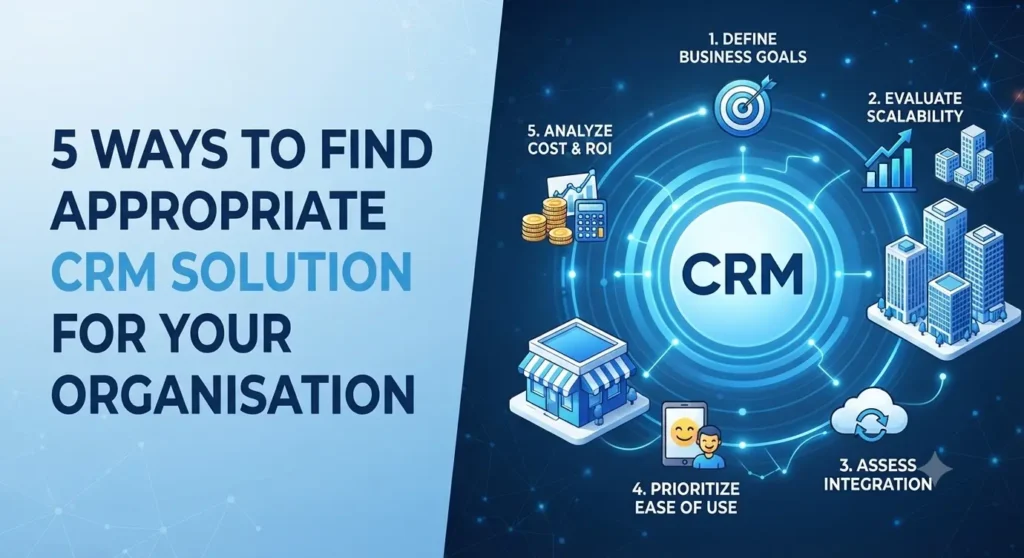
Here are 5 proven ways to find the right CRM solution for your organisation in 2026 — and avoid the mistakes that derail most selection processes.
1. Start With Your Business Processes — Not the Software Features
The single most common CRM selection mistake is leading with features. Teams get dazzled by AI dashboards, automation workflows, and integration capabilities — and forget to ask the most important question first: how does our organisation actually sell, market, and serve customers today?
Before you open a single vendor website, map your current processes:
- How does a lead enter your pipeline and move to a closed deal?
- Which teams need to see customer data and at what stage?
- What does your follow-up process look like after a sale?
- Where are the biggest bottlenecks in your current customer management?
Your CRM needs to match these workflows — not force your team to adapt to a new way of working from day one. By 2026, 70% of new enterprise CRM applications are being built using low-code or no-code tools precisely because organisations need systems that flex to their processes, not the other way around.
Document your current process before you evaluate a single vendor. This becomes your requirements benchmark.
2. Define Your Must-Have vs Nice-to-Have Features
Once you understand your processes, translate them into a structured feature list — split into two categories: must-have and nice-to-have.
Must-haves are non-negotiable. A CRM without them fails your organisation regardless of how impressive its other capabilities are. Common examples include:
- Contact and account management at the scale your team operates
- Pipeline visibility and deal tracking
- Integration with your existing email, ERP, or marketing tools
- Mobile access for field sales teams
- Reporting and forecasting at the level your management needs
Nice-to-haves are features that would add value but are not deal-breakers. AI-powered lead scoring, advanced territory management, social listening integration, or built-in configure-price-quote tools might fall here depending on your maturity level.
This two-tier list prevents you from paying for capability you will never use — and stops you from choosing a CRM that looks impressive in a demo but cannot do the three things your team does every day.
In 2026, 90% of buyers say they are more likely to choose software with AI capabilities — but AI is only valuable if the core CRM function is solid first.
3. Evaluate Integration Capability With Your Existing Tech Stack
A CRM does not operate in isolation. It lives alongside your ERP system, email platform, marketing automation tools, customer support software, and financial reporting stack. If it cannot talk to these systems fluently, you will end up with more data silos than you had before.
68% of organisations integrate their CRM with marketing automation tools. 74% use CRM to improve customer retention and automate sales management. Both of these use cases only work when the CRM is connected — not isolated.
Before shortlisting any CRM, audit your existing technology stack and ask every vendor the same questions:
- Does it integrate natively with our ERP system?
- How does it connect with our email and calendar platforms?
- What does the API look like for custom integrations?
- Is there a pre-built connector for the tools we already use?
For organisations running Microsoft Dynamics 365, ERP, or other Microsoft products — Microsoft Dynamics 365 CRM offers a native, deeply integrated ecosystem that eliminates the integration complexity that plagues mixed-vendor technology stacks. Everything from Outlook and Teams to Power BI and Azure connects out of the box.
4. Assess Total Cost of Ownership — Not Just the Licence Fee
The licence fee is the number vendors put in the headline. The total cost of ownership is the number that actually matters — and it is almost always higher.
When evaluating CRM solutions, calculate the full cost picture:
Implementation and configuration — customising the CRM to match your processes, migrating existing data, and configuring integrations all carry cost beyond the licence.
Training and adoption — a CRM your team does not use is worth nothing. Budget for structured onboarding, training programmes, and change management support.
Ongoing support and maintenance — who supports the system when something breaks? What does a support contract cost? How frequently does the vendor release updates and what do upgrades involve?
Scalability costs — what happens to your licence fee when you add 50 more users? When you open a new market? When you add a new business unit?
84% of companies looking for CRM software have under 1,000 employees — meaning most organisations are making this decision without enterprise-level IT resources. Choosing a vendor with a clear, transparent pricing model and a strong implementation partner makes the difference between a smooth rollout and a costly failure.
5. Prioritise Vendor Stability and Implementation Partner Quality
The CRM vendor you choose will be a long-term partner in your business — not just a software subscription. Their stability, roadmap, support quality, and implementation ecosystem matter as much as the product itself.
In 2026, the three dominant CRM platforms — Salesforce, Microsoft Dynamics 365, and HubSpot — continue to extend their capabilities at pace. Each has a strong partner ecosystem and a proven enterprise track record. But the platform alone is not enough.
The quality of your implementation partner determines whether your CRM goes live on time, whether it is configured correctly for your industry, and whether your team actually adopts it.
When evaluating implementation partners, look for:
- Proven experience in your specific industry vertical
- Certified expertise on the platform you are selecting
- A structured implementation methodology with defined milestones
- References from similar organisations with similar use cases
- Post-implementation support and training capability
Autonomous AI agents are projected to handle 60% of routine CRM tasks by 2026 — but only in implementations that are properly configured and adopted. A poor implementation of a great CRM platform will underperform a well-implemented mid-tier solution every single time.
Choosing the Right CRM in 2026: The Summary
| Step | What to Do |
|---|---|
| Map your processes | Understand how you sell and serve before evaluating software |
| Build a feature list | Separate must-haves from nice-to-haves |
| Audit your tech stack | Ensure seamless integration with existing systems |
| Calculate total cost | Look beyond the licence fee to full ownership cost |
| Vet your partner | Implementation quality determines adoption success |
The right CRM for your organisation is not the one with the most features or the biggest brand name. It is the one that fits your processes, integrates with your systems, is adopted by your team, and grows with your business.
Trident Information Systems is a Microsoft-certified Dynamics 365 CRM implementation partner with over 250+ successful customer engagements across India, UAE, UK, Africa, and Southeast Asia. Talk to our CRM experts at tridentinfo.com/contact.