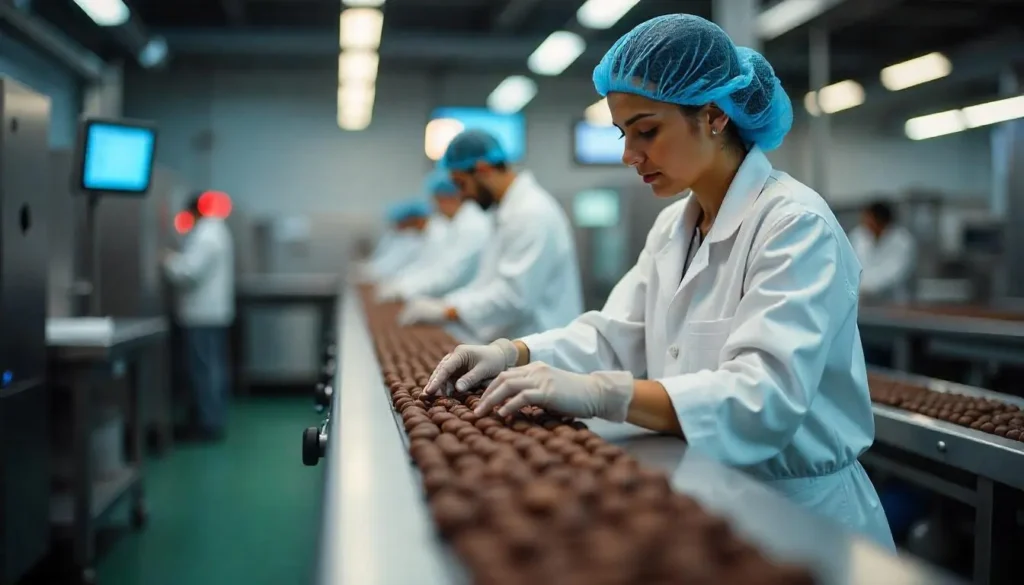
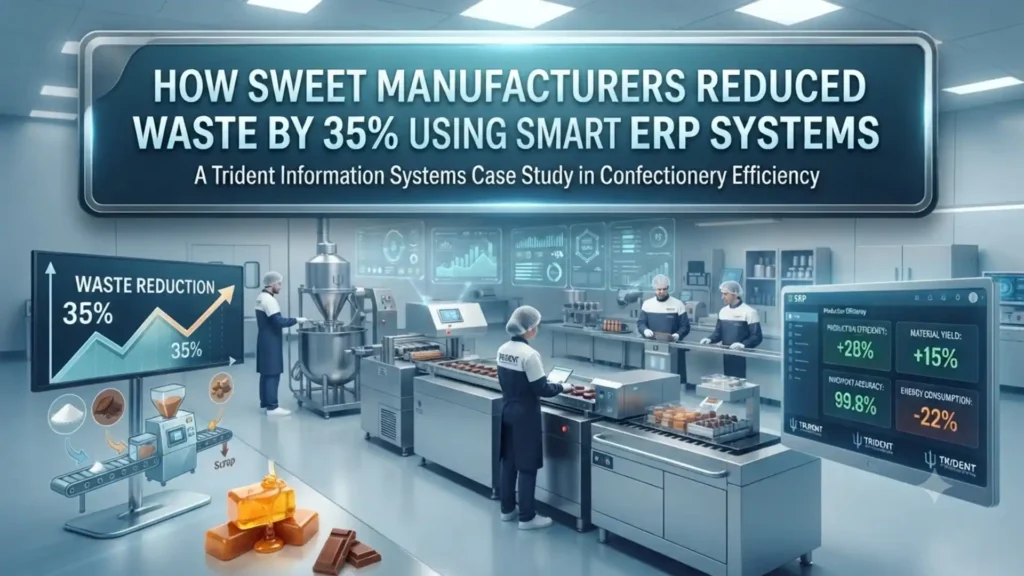
Waste is the silent profit killer in every sweet manufacturing business. For sweet manufacturers in India, the Middle East, and beyond, implementing robust ERP systems for sweet manufacturing has become the single most effective strategy to reduce raw material spoilage, prevent overproduction, and recover margins that were previously lost to inefficiency.
The good news? Sweet manufacturers who have implemented smart ERP systems are consistently reporting waste reductions of 30–35% within the first year. Here is exactly how they are doing it — and what it means for your business.
The Real Cost of Waste in Sweet Manufacturing
Food waste is not just an operational inconvenience. It is a direct hit to your bottom line.
20–30% of the world’s food is wasted every year — and confectionery and sweet production is no exception. For sweet manufacturers specifically, waste occurs at multiple points: raw material spoilage, overproduction, inaccurate recipe scaling, expired finished goods, and poor demand forecasting. Each of these failure points is preventable — with the right system in place.
The food manufacturing software market is growing from USD 5.82 billion in 2025 to USD 6.34 billion in 2026, driven largely by manufacturers who can no longer afford the cost of running without intelligent production management. Around 54% of food manufacturers are now actively investing in tools specifically to reduce waste and track production efficiency.
How Smart ERP Systems Eliminate Waste at Every Stage
1. Recipe Management That Enforces Precision Every Time
The single biggest source of waste in sweet manufacturing is inconsistent recipe execution.
When production staff measure ingredients manually — or rely on memory and handwritten notes — variations creep in with every batch. Too much mawa in one run. Too little sugar in the next. These deviations don’t just affect quality — they directly increase raw material consumption beyond what the recipe requires.
Smart ERP systems store standardized digital recipes with exact ingredient quantities for every product. When a production order is raised, the system automatically calculates precise material requirements and issues them to the floor — eliminating guesswork, reducing over-usage, and ensuring every batch is consistent.
Operations with real-time recipe tracking consistently identify 2–6% improvement opportunities in ingredient yield within the first six months alone. On a mid-scale sweet manufacturing operation, recovering even 3% in yield translates directly into lakhs of rupees in recovered margin every year.
2. Demand Forecasting That Prevents Overproduction
Festival season demand for sweets can spike dramatically — Diwali, Holi, Eid, and wedding season all create production surges that are notoriously difficult to plan for manually.
Without data-driven forecasting, most sweet manufacturers overproduce to avoid stockouts — then write off unsold finished goods as waste. Or they underproduce, miss the demand window, and lose revenue. Neither outcome is acceptable.
ERP systems use historical sales data, seasonal patterns, and live order information to generate accurate production forecasts. Production is planned to match real demand — not estimates. The result is a dramatic reduction in finished goods waste and a significant improvement in working capital efficiency.
Accurate demand forecasting through ERP reduces safety stock requirements by 15–30% — freeing up capital that was previously tied up in excess inventory.
3. Raw Material Expiry and FIFO Management
Perishable raw materials are the backbone of sweet manufacturing — and they are also the biggest source of silent waste. Ghee, mawa, milk solids, dry fruits, and flavouring agents all have limited shelf lives. Without a system tracking expiry dates at batch level, older stock gets buried behind newer deliveries and expires before use.
Smart ERP systems enforce FIFO (First In First Out) rules automatically. Every raw material batch is tracked from the moment it enters your store — with expiry alerts triggered well before the critical date. Slow-moving materials near expiry are flagged for prioritized use or returned to the supplier — turning potential write-offs into managed outcomes.
4. Production Waste Identification and Root Cause Analysis
ERP systems do something manual processes simply cannot: they capture actual vs. expected yield data for every production run.
When actual output falls below standard yield, the system flags the variance immediately. Was it equipment inefficiency? Incorrect ingredient proportions? A process deviation on the floor? ERP gives production managers the data to identify the exact cause — and fix it before the next batch.
This closed feedback loop is what drives the 30–35% waste reduction that smart manufacturers are achieving. It is not a one-time improvement — it compounds over time as production processes get tighter with every data cycle.
5. Real-Time Inventory Visibility Across Raw Materials and Finished Goods
One of the most common — and costly — forms of waste in sweet manufacturing is purchasing raw materials that are already in stock because nobody had an accurate inventory count.
Smart ERP systems provide real-time inventory visibility across every raw material, packaging component, and finished product. Purchase orders are triggered automatically only when stock genuinely falls below minimum levels. Purchasing decisions are data-driven, not reactive.
Around 52% of mid-sized food manufacturers now use smart inventory tracking specifically to reduce losses — and the results speak for themselves.
The Competitive Advantage of Going Smart
Sweet manufacturers who have implemented ERP are not just reducing waste. They are building a structural cost advantage over competitors still running on spreadsheets and manual processes.
Lower waste means lower cost of production. Lower cost of production means better pricing power. Better pricing power means stronger margins and the ability to grow — whether that is expanding into modern trade, launching new SKUs, or scaling production capacity.
The 35% waste reduction is not a promise. It is a result that smart ERP deliver — consistently, measurably, and permanently.
Trident Information Systems offers a Microsoft Dynamics 365-based food manufacturing ERP solution specifically configured for sweet and namkeen producers. Talk to our experts at tridentinfo.com/contact.