Your organisation is not short of data. It is short of action. Dashboards get built. Reports get published. KPIs get tracked. And then — nothing changes. The same problems show up in next month’s review. The same questions get asked. The same decisions get delayed.
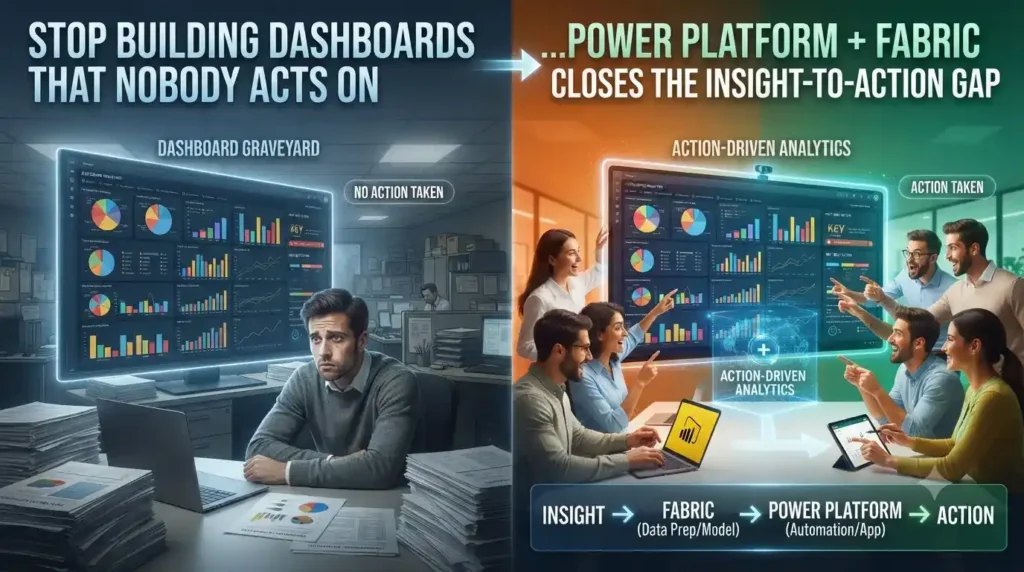
This is the insight-to-action gap. And in 2026, it is the single biggest reason analytics investments fail to deliver business value. The good news: Microsoft Power Platform combined with Microsoft Fabric was purpose-built to close it.
Why Most Dashboards Fail to Drive Action
Here is an uncomfortable truth that most BI teams already know: building a beautiful dashboard is not the same as solving a business problem.
The traditional analytics model works like this — data teams collect data, engineers build pipelines, analysts create reports, and dashboards get shared with decision-makers who read them, nod, and move on. The insight sits in a chart. The action never happens.
In today’s landscape, organisations can no longer treat business intelligence as a standalone function. The conversation has fundamentally shifted from “What reports do we need?” to “How do we turn data into decisions — automatically, in real time?”
Microsoft recognised this gap and built the answer: a unified platform where data, analytics, and automated action live together. That platform is Microsoft Fabric, powered by the Microsoft Power Platform.
What Is the Insight-to-Action Gap?
The insight-to-action gap is the distance between seeing something important in your data and actually doing something about it. It sounds simple to close. In practice, it rarely is. Here is why:
Data lives in silos. Sales data is in one system. Finance in another. Operations in a third. By the time anyone reconciles them into a single report, the moment to act has passed.
Dashboards are passive. A Power BI chart showing a revenue dip is useful. But it does not send an alert, trigger a workflow, or notify the right person automatically. It just sits there waiting for someone to notice.
Action requires humans in the loop. When a metric crosses a threshold, someone needs to see it, interpret it, decide what to do, and manually execute a response. Every handoff introduces delay and the risk of inaction. This is exactly the problem that Power Platform and Microsoft Fabric solve — together.
How Power Platform + Microsoft Fabric Closes the Gap
Microsoft Fabric: One Platform, One Source of Truth
Microsoft Fabric is Microsoft’s unified, end-to-end data and analytics platform. It brings data engineering, data warehousing, real-time analytics, data science, and Power BI together into a single experience — built on OneLake, a single data lake that spans your entire organisation.
In 2026, Microsoft Fabric is the fastest growing advanced analytics certification in Microsoft history, with over 30,000 organisations now running Fabric in production. Microsoft has been positioned as a Leader in the Gartner Magic Quadrant for Analytics and BI Platforms for eighteen consecutive years — and Fabric is the platform cementing that position for the AI era.
What Fabric does is eliminate the data silos that make dashboards passive. When all your data — from ERP, CRM, finance, operations, and supply chain — flows into OneLake automatically, every dashboard, every report, and every automated workflow draws from the same real-time, governed source of truth.
No more reconciliation. No more stale data. No more “which number is correct?”
Power Platform: Turning Insight Into Instant Action
Where Fabric unifies your data, the Microsoft Power Platform turns it into action — automatically.
Power Automate monitors your data in real time and triggers workflows the moment a condition is met. A sales order drops below margin threshold — an alert fires to the sales manager instantly. A supplier invoice is flagged as anomalous — an approval workflow launches automatically. Stock falls below minimum level — a purchase order is raised without human intervention.
Power Apps puts the action directly into the hands of the people who need it. Instead of a dashboard that a manager reads on a laptop, a Power App surfaces the exact insight a field technician, warehouse supervisor, or store manager needs — on their phone, in the moment, with a button to act on it.
Data Activator, Microsoft Fabric’s built-in trigger engine, monitors data continuously and fires alerts or Power Automate flows the moment predefined thresholds are crossed — without anyone needing to check a dashboard at all.
Microsoft’s own announcement at Build 2026 called this the next frontier: translytical task flows that blend transactional and analytical systems, allowing users to act on insights directly from dashboards and streamlining decision-to-action cycles. The gap between seeing and doing is closing — and closing fast.
What This Looks Like in Practice
Retail: Power BI flags a stock anomaly in a specific store. Data Activator triggers a Power Automate flow that notifies the regional manager and raises a transfer order — all before the store opens.
Finance: Fabric detects a budget variance above 10%. Power Automate routes it for approval, notifies the CFO, and logs the exception — without anyone running a report.
Manufacturing: A production yield drops below target mid-shift. A Power App on the floor supervisor’s phone shows the deviation with a one-tap escalation button — no email chain, no delay.
Logistics: A delivery SLA is at risk based on real-time tracking data. An automated alert fires to the account manager and a contingency workflow launches — while the shipment is still in transit.
The 2026 Shift: From Reporting to Acting
Microsoft Fabric IQ, now generally available, represents the next step — natural language data exploration where business users ask questions in plain English and get instant answers from their data, without writing a query or opening a dashboard.
Combined with Copilot in Power BI, which can now generate DAX calculations, summarise reports, and build visuals through natural language — the barrier between data and decision has never been lower.
Organisations that adopt Power Platform and Fabric together are not just getting better dashboards. They are building intelligence infrastructure — where every threshold crossed triggers an action, every anomaly surfaces an alert, and every decision is supported by the right data at the right moment.
The era of passive dashboards is over. The insight-to-action gap is closeable. Power Platform and Microsoft Fabric close it.
Trident Information Systems implements Microsoft Fabric and Power Platform solutions integrated with Dynamics 365, helping organisations across India, UAE, and Africa move from data visibility to real business action. Talk to our team at tridentinfo.com/contact