
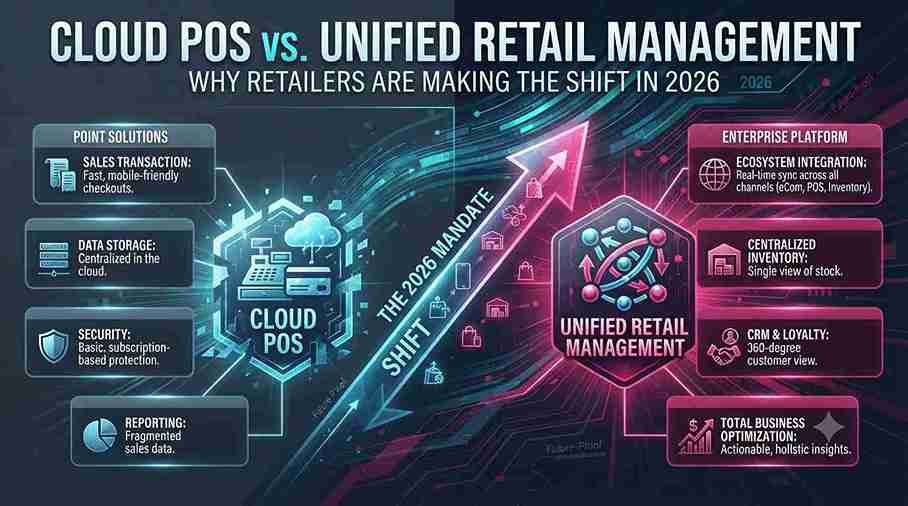
“Cloud POS” and “unified retail management” get used almost interchangeably in retail tech marketing — and that’s causing real buying mistakes. A retailer moves their checkout system to the cloud, expects it to solve their inventory-sync and omnichannel headaches, and finds out six months later that they’re still running separate systems for POS, inventory, and e-commerce that just happen to each live in the cloud now.
Here’s the actual difference, and why more retailers are moving toward genuinely unified platforms rather than just cloud-hosted point solutions in 2026.
What Cloud POS Actually Is
Cloud POS means your point-of-sale software runs on cloud infrastructure instead of a local server in the back office. That gets you real benefits on its own — no server hardware to maintain, updates that happen automatically, and the ability to check sales data from anywhere.
What it doesn’t automatically get you is a connected view of your business. A cloud-hosted POS can still be one system among several — a separate inventory tool, a separate accounting package, a separate e-commerce platform — each with its own login and its own version of the truth. Stock counts drift between your webshop and your store. A return processed online doesn’t reflect in your financials until someone manually reconciles it. Moving the POS to the cloud didn’t remove the disconnection — it just made the disconnected pieces individually more modern.
What Unified Retail Management Actually Means
Unified retail management means POS, inventory, purchasing, loyalty, e-commerce, and financial management run as one connected system rather than several systems stitched together with integrations. There’s a single source of truth: a sale at the till updates inventory in real time, which updates what’s available online, which flows straight into your financials — without a nightly batch job or a manual reconciliation step in between.
LS Central is the concrete example of this done natively on Microsoft Dynamics 365 Business Central — POS, inventory, merchandising, loyalty, e-commerce, and financials all running inside one platform rather than integrated between separate ones. Because it’s built on Business Central rather than connected to it via API, data doesn’t need to sync between systems — it’s already in the same place.
The Real Difference, Side by Side
| Cloud POS (standalone) | Unified Retail Management (e.g. LS Central) | |
|---|---|---|
| Where it runs | Cloud-hosted | Cloud-hosted or on-premise |
| Inventory | Often a separate system, synced periodically | Native, real-time, single source of truth |
| E-commerce | Usually integrated separately | Synchronized automatically within the platform |
| Financials | Separate accounting system | Native — sales post directly to the general ledger |
| Offline resilience | Varies by vendor | Store operations continue during connectivity loss |
| Reporting | Requires combining data from multiple systems | Single real-time view across the business |
Why Retailers Are Making the Shift in 2026
A few pressures are converging that make “cloud POS plus a handful of integrations” harder to justify than it used to be:
Omnichannel is now the baseline expectation, not a differentiator. Buy-online-pickup-in-store, unified returns, and real-time stock visibility across channels only work reliably when inventory data isn’t being synced between separate systems with any lag.
Disconnected tools compound as businesses grow. A single-location retailer can often get by with a standalone cloud POS. The moment a second location, an online store, or a loyalty program gets added, each new disconnected tool adds its own reconciliation overhead — and that overhead scales faster than the business does.
AI and analytics need a single data source to be useful. Copilot-assisted workflows, demand forecasting, and real-time reporting all depend on having one connected dataset to work from. Layering AI on top of five disconnected systems means layering it on top of five different partial pictures of the business.
Offline resilience is a genuine operational risk, not an edge case. A pure cloud POS can go dark when connectivity drops. Platforms like LS Central are built to keep store operations running during an outage and sync back up once connectivity returns — which matters more the more a business depends on that till not stopping.
How to Evaluate Which Fits Your Business
If you’re a single-location retailer with simple operations, a standalone cloud POS may genuinely be enough — the unified platform is solving a problem you don’t have yet. The shift toward unified retail management tends to make sense once you’re managing more than one channel, more than one location, or once inventory accuracy and reconciliation overhead have become a visible daily problem rather than a theoretical one.
Considering a Move to Unified Retail Management?
If your current POS setup is technically “in the cloud” but you’re still reconciling inventory and sales across multiple systems by hand, that’s usually the sign the shift is overdue rather than optional.
Contact Trident to talk through whether LS Central on Business Central is the right fit for your retail or hospitality operation.

