If you’re a food or beverage manufacturer, processor, or distributor evaluating Business Central, you’ll run into the same wall most food businesses do: standard BC handles finance, inventory, and general operations well, but it wasn’t built for lot traceability, allergen tracking, catch weight, or the batch-and-recipe logic that food production actually runs on. Aptean Food & Beverage ERP closes that gap by extending Business Central with functionality purpose-built for the industry — without asking you to leave the Microsoft ecosystem.
This guide covers what it actually includes, which edition and modules apply to your business, and what implementation involves.
What Aptean Food & Beverage ERP Actually Is
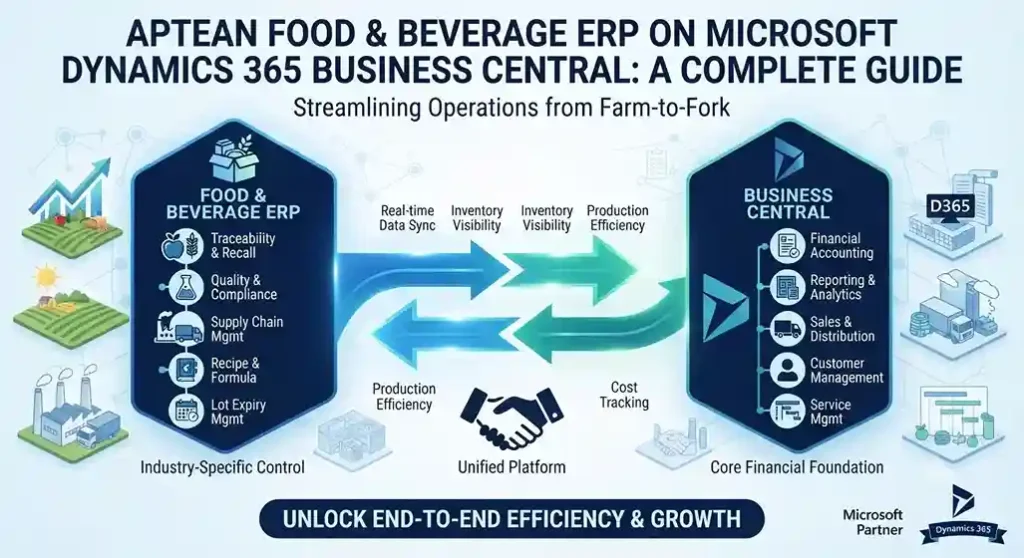
Aptean Food & Beverage ERP is an embedded, industry-specific extension of Business Central — not a bolt-on third-party system running alongside it. The functionality lives inside BC itself, organized around five control points Aptean calls Store, Control, Produce, Test, and Track and Trace: managing raw material storage, quality control gates, production/batch processes, testing, and full lot traceability from raw material to finished shipment.
Because it’s embedded rather than integrated, your team works in one system rather than switching between BC and a separate food-specific application — and licensing follows the same logic: in the cloud, your Aptean license includes the underlying Business Central license. On-premise deployments require the BC license purchased separately.
Which Edition Is Right for Your Business
This is the point most comparison pages skip past, and it’s the first decision that matters:
Aptean Food & Beverage ERP (Business Central) — the product this guide covers, built for mid-size food and beverage operations that want industry-specific functionality without the complexity of a full enterprise ERP rollout.
Aptean Food & Beverage ERP Enterprise Edition (Dynamics 365 F&O) — a separate product, formed from the consolidation of Aptean’s LINKFRESH and Foodware365 platforms, built for larger, multi-site, multi-entity food and beverage enterprises that need F&O’s deeper manufacturing and global operations capability.
If you’re a single-site or small multi-site operation evaluating your first real ERP, the Business Central edition is almost certainly the right starting conversation. If you’re already running (or need) complex multi-entity, multi-currency global operations at scale, the F&O Enterprise Edition deserves a separate evaluation — the two aren’t interchangeable, and picking the wrong platform early is expensive to unwind later.
Key Modules and What They’re Actually For
Aptean’s Business Central offering isn’t one monolithic package — it’s modular, and which pieces you need depends on your segment:
- Process Manufacturing for Food and Beverage — handles batch sizing, lot-tracked backflushing, and consolidated picking across production orders scheduled for the same date or work center — a real gap in standard BC, where production picking only works per individual order.
- Product Specification — centralizes ingredient declarations, allergen data, and nutritional values against your bill of materials, so this information is entered once and stays linked to every product built from it, instead of living in a spreadsheet outside the ERP.
- Shop Floor Production — a paperless, floor-level interface for operators to log machine time, labor time, consumption, and output directly into BC.
- Quality Control — quality check activity tied directly into shop floor and production workflows.
- Fresh Bundle — built for fresh produce operations needing grade-out, pack-out, and account-sales pricing methodologies, plus license plating and weighbridge receiving.
- Beverage-specific modules (Drink-IT, Beverage Advanced Manufacturing) — cover excise tax calculation, deposit and returnable-container management, bonded location tracking, and event/contract management for breweries, distilleries, and beverage distributors.
Most implementations start with Process Manufacturing and Product Specification as the core, then add the segment-specific modules (Fresh, Beverage, etc.) that match the actual product lines you run.
What Implementation Actually Involves
Because Aptean’s functionality is embedded in BC rather than bolted on, implementation follows a similar path to a standard Business Central rollout, with food-specific considerations layered in:
- Module scoping — deciding which Aptean bundles your operation actually needs, based on your product lines and existing pain points (traceability gaps, allergen management, batch complexity).
- Data migration — item masters, BOMs, lot/allergen data, and specifications need to be structured correctly from day one, since traceability depends on this data being accurate from the first transaction.
- Production and quality workflow configuration — mapping your actual batch, backflushing, and quality-hold processes into the system.
- Compliance and regulatory setup — configuring allergen labeling, catch weight handling, and traceability reporting to match the regulatory requirements of the markets you sell into.
- Shop floor rollout — getting the paperless shop floor tools into operators’ hands, which is as much a change-management effort as a technical one.
The traceability and compliance pieces are where most food ERP projects either succeed cleanly or run into trouble — getting master data and lot tracking right early avoids a much more painful cleanup after go-live.
Why This Matters Beyond the Feature List
The honest version of the pitch isn’t “Aptean has more features than generic Business Central” — it’s that food and beverage operations have compliance and traceability requirements that generic ERP configuration wasn’t built to handle cleanly, and building that logic yourself on top of standard BC is slower and riskier than starting from functionality that already understands how lots, allergens, and batch production actually work.
Considering Aptean Food & Beverage ERP for Your Business?
Choosing the right edition, scoping the modules that match your product lines, and getting master data and traceability configured correctly from day one is where a food and beverage ERP implementation actually succeeds or stalls.
Contact Trident to talk through whether Aptean Food & Beverage ERP on Business Central is the right fit for your operation.