Most IoT conversations stall at the sensor. A device reports a temperature, a location, a vibration reading — and then what? The real value of Azure IoT isn’t the data collection layer; it’s what happens when that data reaches a system that can act on it — triggering a work order, adjusting a reorder point, flagging a quality issue before it reaches a customer. That’s where Azure IoT stops being an interesting dashboard and starts changing how a business runs.
Here’s how that plays out across the industries where we do this work most.
The Azure IoT Building Blocks, Briefly
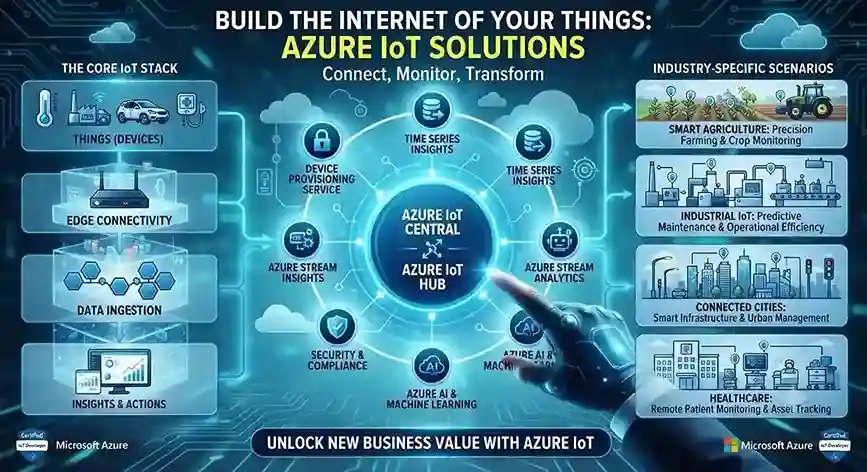
Before the industry examples, a quick map of what’s actually available today — because the terminology has shifted:
- Azure IoT Hub — the core cloud gateway that connects, monitors, and manages devices at scale.
- Azure IoT Central — a low-code SaaS layer on top of IoT Hub, for teams that want dashboards and device management without building custom cloud infrastructure.
- Azure IoT Operations — Microsoft’s current Arc-enabled, Kubernetes-based platform for industrial and factory-floor scenarios, built around open standards like MQTT and OPC UA so it works across mixed-vendor equipment.
- Azure Digital Twins — models physical spaces and assets so you can simulate and monitor a facility, not just a single device.
Microsoft was named a Leader in the 2026 Gartner Magic Quadrant for Global Industrial IoT Platforms — which matters less as a badge and more because it reflects genuine investment in the industrial-grade side of this stack (Azure IoT Operations in particular), not just the consumer-adjacent tooling.
Retail: From Store Sensors to Inventory Accuracy
Retailers use IoT for footfall and congestion monitoring, cold-chain temperature tracking, and shelf-level stock sensing. The gap most retailers hit isn’t the sensor data — it’s that the insight lives in a separate dashboard from the system that actually manages inventory and replenishment.
Where this becomes useful: a cold-chain sensor flags a temperature excursion, and instead of an alert someone has to notice, it creates a quality hold directly against the affected inventory lot in your ERP — stopping it from being sold before a human ever looks at the dashboard.
Manufacturing: Predictive Maintenance That Actually Prevents Downtime
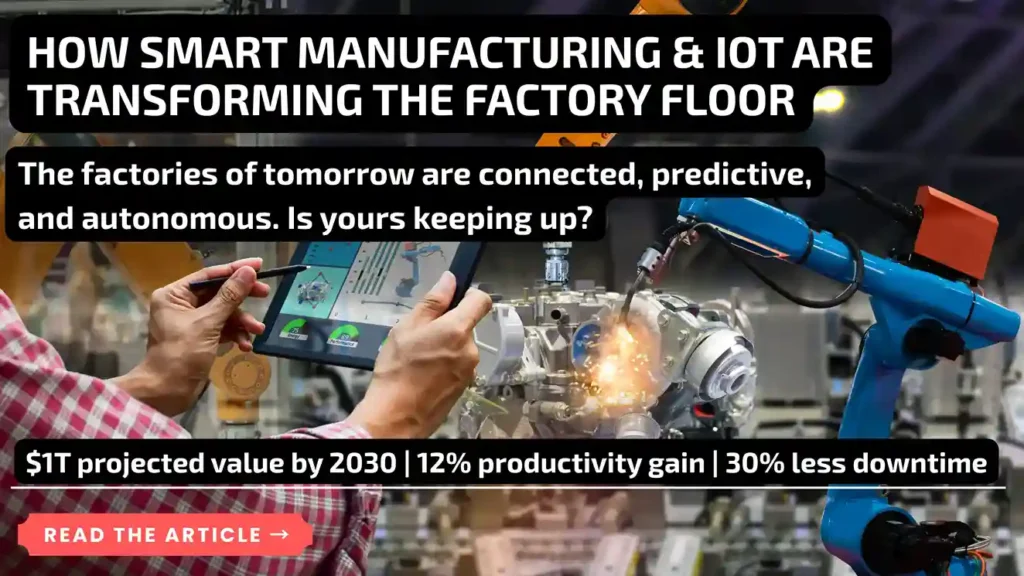
Manufacturing is where Azure IoT Operations is built to work — connecting OT equipment across mixed vendors on the plant floor via OPC UA, without needing every machine on the same protocol. Vibration, temperature, and runtime data flowing off equipment can reduce unplanned downtime by 20–25% when it’s used for genuine predictive maintenance rather than just historical reporting.
The difference between a predictive-maintenance dashboard and predictive maintenance that works is whether an anomaly reading can generate a maintenance work order in your ERP automatically — with the right parts already checked against inventory — instead of waiting for someone to review a chart and then separately open a ticket.
Logistics & Supply Chain: Asset Tracking That Closes the Loop
Asset tracking — pallets, containers, reusable shipping racks — is one of the more immediately measurable IoT use cases; a manufacturer with beacon-tracked racks can go from writing off half a million dollars a year in lost assets to knowing exactly where they are. The same pattern applies to cold-chain shipment visibility and fleet monitoring.
The value compounds when that location and condition data updates the shipment status your finance and operations teams already see, instead of living in a separate tracking portal nobody but the logistics team opens.
Construction: Job Site Safety and Progress in Real Time
Job-site IoT — combining spatial data with safety and progress monitoring — is increasingly built on Azure Digital Twins, modeling the physical site so project teams get a live view of schedule and safety status rather than a weekly report compiled after the fact.
Hospitality & Automotive: Where Trident Sees the Most Immediate Wins
Across our hospitality and automotive client base, the fastest wins tend to be narrower than a full industrial IoT rollout: equipment monitoring tied to service scheduling, or connected retail displays feeding directly into demand planning. You don’t need a plant-wide Azure IoT Operations deployment to get value — sometimes it’s IoT Central and a handful of sensors connected to the right business process.
Why the ERP Connection Is the Part Most IoT Projects Skip
The pattern across every industry above is the same: IoT gets genuinely valuable the moment it stops being a dashboard and starts being an input to a business process someone already trusts — a work order, a stock hold, a maintenance ticket. That connection is where a lot of IoT pilots die, because the team that builds the sensor network and the team that owns the ERP rarely talk to each other early enough.
As a Microsoft Solutions Partner working across Dynamics 365 (F&O and Business Central) and Azure, that connection is exactly where Trident’s implementations start — designing the IoT data flow with the ERP process it’s meant to trigger in mind from day one, not bolted on afterward.
Ready to Connect IoT Data to a Process That Actually Uses It?
If you’re evaluating Azure IoT for your business, the question worth answering first isn’t “which sensors” — it’s which decision or workflow you want that data to drive, and whether your current systems can act on it automatically once it arrives. Contact Trident to talk through an Azure IoT solution built around your existing Dynamics 365 environment.