A single undetected defect in pharmaceutical manufacturing — a contaminated vial, an incorrect dosage unit, a mislabelled blister pack — can cause patient harm, trigger a Class I FDA recall, and permanently damage a manufacturer’s regulatory standing.
Traditional quality inspection built on manual visual checks and statistical sampling cannot prevent this. It never could. Human inspectors miss defects. Sampling by definition leaves units unchecked. And as production volumes reach hundreds of thousands of units per day, manual inspection becomes both impractical and regulatory inadequate.
In 2026, automated vision inspection is the standard pharmaceutical manufacturers are adopting — not just to improve efficiency, but to meet the increasingly demanding regulatory expectations of the FDA, EU GMP Annex 1, and global GMP frameworks.
The global pharmaceutical inspection machines market reached USD 1.18 billion in 2025 and is projected to reach USD 2.81 billion by 2034 at a 10.15% CAGR. Vision inspection already commands a 40.4% market share — the largest of any inspection technology category. The shift is accelerating.
Why Manual Inspection Fails GMP Requirements
The fundamental problem with manual pharmaceutical inspection is structural, not operational. No matter how skilled or motivated an inspector is, human visual inspection is:
Inconsistent — inspection accuracy degrades with fatigue, lighting variation, and shift changes. An inspector detecting 95% of defects in the first hour may detect significantly fewer in the sixth.
Unverifiable — manual inspection cannot generate the objective, time-stamped, audit-ready evidence that FDA 21 CFR Part 11, EU GMP Annex 1, and current GMP requirements demand as proof of effective inspection on every production batch.
Incomplete by design — statistical sampling inspects a fraction of production. Defective units within the uninspected population reach patients.
The FDA conducted 1,248 drug quality assurance inspections in FY2025 — nearly 28% more than the previous year. The regulatory message for 2026 is unambiguous: manufacturers must demonstrate that their processes and systems are inspection-ready and data-integrity compliant at all times.
Manual inspection programmes cannot reliably satisfy this standard. Automated vision inspection can.
What Automated Vision Inspection Delivers
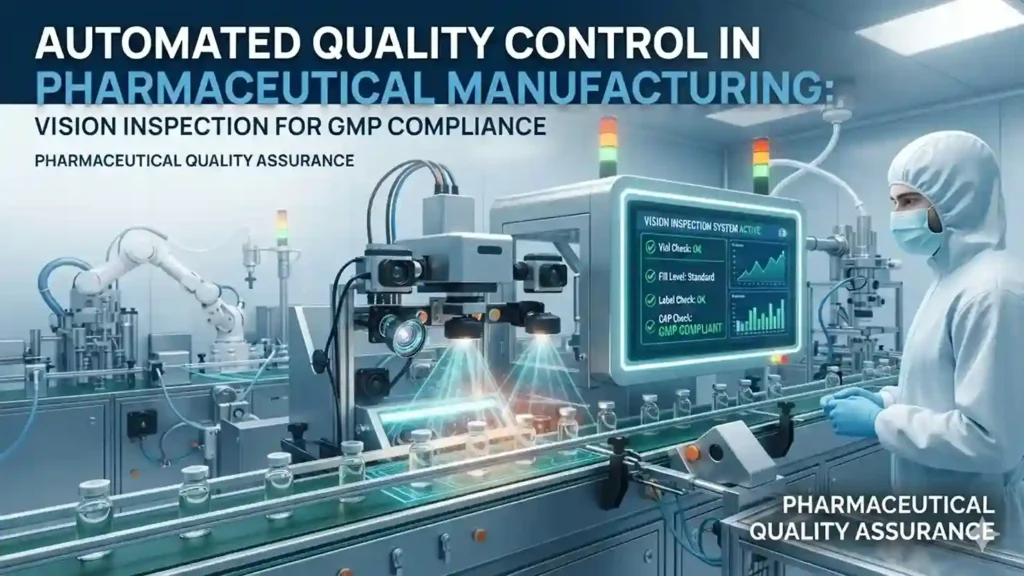
Modern pharmaceutical vision inspection systems use high-resolution cameras combined with AI-powered image analysis to inspect 100% of production units at full line speed — with defect detection accuracy that consistently outperforms human inspection.
What vision inspection detects across pharmaceutical dosage forms:
- Injectable vials and ampoules — visible particulates, glass cracks, container integrity, fill level, and stopper positioning
- Tablets and capsules — surface defects, chips, coating irregularities, colour deviations, shape anomalies, and print verification
- Blister packs — seal integrity, cavity fill verification, missing tablets, foil damage
- Labels and packaging — barcode verification, text OCR, label placement, serialisation code compliance
- Syringes and prefilled devices — glass defects, particulate contamination, plunger positioning, tip cap integrity
Stevanato Group’s AI-based vial and syringe inspection platform — deployed across production lines in 2025–2026 — cuts reject rates by approximately one-third while eliminating operator fatigue as a quality variable. Deep learning CNN models applied to film-coated tablet inspection achieve reliable defect detection without requiring precise tablet fixturing — a critical operational advantage at high production volumes.
GMP Compliance: What Vision Inspection Systems Must Satisfy
Regulatory expectations for automated inspection in pharmaceutical manufacturing have become substantially more demanding in 2025–2026.
EU GMP Annex 1 (Sterile Medicinal Products) — the updated Annex 1 explicitly encourages automated inspection for sterile products, requiring manufacturers to demonstrate that inspection systems provide objective evidence of effective defect detection with documented validation and performance verification.
FDA 21 CFR Part 11 — electronic records and audit trails generated by automated inspection systems must be accurate, attributable, legible, contemporaneous, and original. Vision inspection platforms must produce time-stamped inspection records that satisfy these requirements as an inherent output of operation — not a separate documentation exercise.
EMA Annex 22 on Artificial Intelligence — published in draft in July 2025, this new annex establishes requirements specifically for AI and machine learning use in GMP manufacturing environments — creating the regulatory framework within which AI-powered vision inspection systems must be validated and operated.
FDA DSCSA serialisation compliance — machine vision systems must verify GS1 DataMatrix 2D barcodes at production line speed, confirming code quality and readability for every unit as required by the Drug Supply Chain Security Act.
The 2026 Shift: From Rule-Based to AI-Powered Vision Inspection
The pharmaceutical inspection market is mid-transition between two generations of technology.
Rule-based machine vision — which detects defects by comparing images against fixed parameters — remains appropriate for simple, well-defined inspection tasks with predictable defect profiles. But it requires extensive reprogramming when products or defect types change and struggles with the variability inherent in biological and complex formulation manufacturing.
AI-powered vision inspection — using deep learning models trained on production images — generalises across defect variation, adapts to new products faster, and achieves significantly higher detection accuracy on complex inspection tasks. Industry analysts predict that by 2026, AI’s role in pharma will shift from delivering insights to carrying out intelligent actions — the agentic shift in manufacturing quality control.
Payback and ROI
Facilities with prior recall history in quality-sensitive dosage forms or sterile products typically achieve payback on AI vision inspection investment within 6–10 months based on recall cost avoidance alone. Beyond recall prevention, the operational benefits compound:
- 100% inspection coverage replacing statistical sampling
- Reduced false reject rates recovering good product previously discarded
- Elimination of inspection labour costs from quality budgets
- Audit-ready digital records generated automatically on every batch
- Faster regulatory submission with objective inspection evidence
How Trident Supports Pharmaceutical Manufacturing Compliance
Trident Information Systems integrates automated quality control and vision inspection solutions with Microsoft Dynamics 365 Supply Chain Management — connecting real-time quality data from the production line directly into batch records, supplier quality management, regulatory documentation, and ERP-driven production planning.
With over 250+ successful manufacturing and healthcare engagements across India, UAE, UK, Africa, and Southeast Asia, Trident helps pharmaceutical manufacturers build the connected, inspection-ready quality infrastructure that GMP compliance demands in 2026.
In an industry where a single quality failure can cost a manufacturer its licence — automated vision inspection is not a competitive advantage. It is a compliance requirement. Talk to Trident’s pharmaceutical manufacturing experts about automated quality control and GMP compliance solutions. Visit tridentinfo.com/contact.