Be honest with yourself for a moment: is your field service operation running the way it should be in 2026 — or is it running the way it has always run? Because there is a significant difference. Field service businesses that have modernized their operations — replacing manual processes with intelligent automation, paper forms with mobile apps, and siloed systems with a single connected platform — are consistently outperforming those that have not. They are completing more jobs per technician per day. They are meeting more SLAs. They are receiving better customer reviews. And they are doing it with less administrative overhead, not more.
The gap between a modern field service operation and an outdated one is not primarily about the technology. It is about the practices — the daily habits, workflows, and management approaches that have been in place for years, often unchallenged, because “that’s how we do things here.”
Some of those practices need to go.
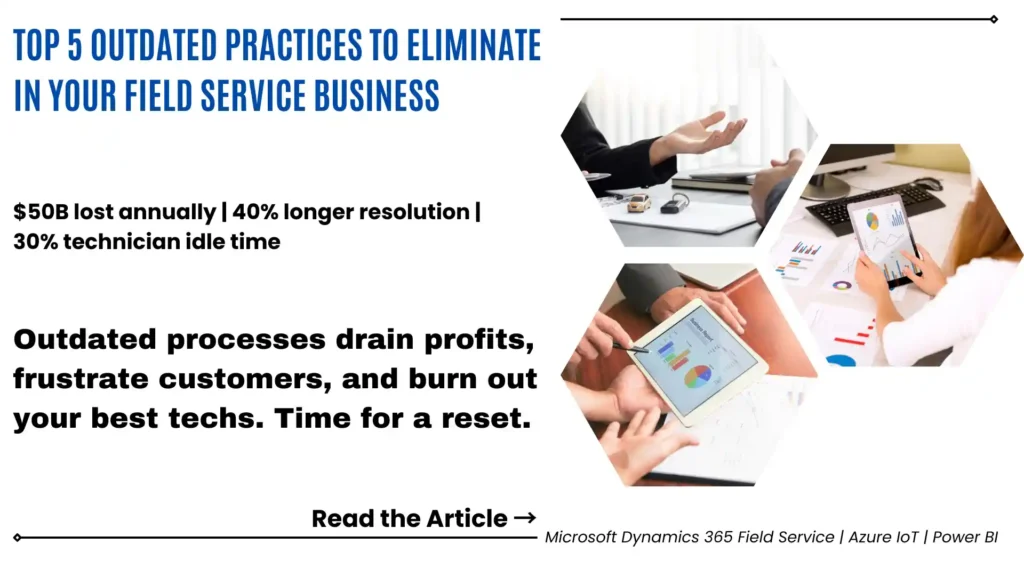
This article covers the five outdated field service management practices that are most commonly holding service businesses back in 2025 — why each one is costing you more than you realize, and what replacing them actually looks like in a modern, well-run service operation.
Why Your Field Service Business Cannot Afford to Stay Stuck in Old Habits
The Cost of Outdated Field Service Practices in 2026
Here is the challenge with outdated field service practices: they rarely announce themselves as problems. They just quietly consume capacity, erode margins, and push customers toward competitors who have figured out a better way.
Manual scheduling that takes a dispatcher an hour could be done by an intelligent system in seconds — and the system’s answer will be more optimized. Paper forms that a technician fills out at the end of a job represent data that could have been captured automatically throughout the day. Delayed service updates that leave dispatchers guessing about job status could be real-time with a mobile app already in most technicians’ pockets.
None of these are edge cases. They are systemic inefficiencies — and in a field service business where technician time, vehicle costs, and SLA penalties are your primary operational variables, systematic inefficiency compounds fast.
What Modern Field Service Operations Actually Look Like
The best-run field service businesses in 2026 share common characteristics. Their dispatchers spend their time managing exceptions — not manually assigning every job. Their technicians arrive on site already knowing the customer’s history, the asset’s service record, and the most likely diagnosis. Their customers book appointments through whichever channel they prefer and receive automatic updates throughout the service day. And their management team has real-time visibility into every job, every technician, and every SLA commitment — without anyone having to compile a morning report.
That is not a vision of the distant future. It is what the right field service management technology makes possible today. And the gap between that reality and a business still running on manual scheduling and paper forms is, quite simply, the competitive gap.
The 5 Outdated Field Service Practices You Need to Leave Behind
Practice 1: Manual Scheduling — The Bottleneck at the Heart of Your Operation
Let us start with the one that affects everything else: manual scheduling.
If your dispatchers are still assigning jobs by hand — looking at a whiteboard, a spreadsheet, or a basic calendar — they are making scheduling decisions without access to the full picture. They cannot simultaneously optimize for travel time, technician skill match, equipment availability, parts inventory, SLA priority, and real-time traffic conditions. Nobody can — not without software specifically designed to do exactly that.
The result is a scheduling process that is slower than it needs to be, less optimized than it could be, and highly dependent on the knowledge and availability of one or two experienced dispatchers. When those people are sick, on holiday, or simply overwhelmed during a busy period, the quality of scheduling decisions deteriorates immediately.
What a modern field service operation does instead:
Intelligent automated scheduling software — like the Resource Scheduling Optimization (RSO) capability in Microsoft Dynamics 365 Field Service — continuously optimizes the entire schedule in real time. It assigns the right technician to every job based on their skills, location, and availability. It adjusts when jobs run over, when new urgent work comes in, or when traffic changes the optimal routing. And it does all of this automatically — freeing your dispatchers to focus on customer communication and exception management rather than manual job allocation.
The business impact is immediate and measurable: more jobs completed per technician per day, lower travel costs, higher first-time fix rates, and SLA compliance rates that are built into the scheduling model rather than hoped for.
Ask yourself honestly: how many hours per week does your team spend on manual scheduling — and how often does that scheduling fall apart when something unexpected happens?
Practice 2: Paper-Based Forms — The Productivity Drain Nobody Talks About
Research from Aberdeen Group and multiple field service industry surveys consistently finds the same thing: field technicians report that paperwork and administrative tasks are the most frustrating and unexpected part of their working day.
Think about what that means. You are employing skilled engineers, mechanics, or technicians — people whose value to your business lies in their technical expertise — and you are having them spend significant portions of their working day filling out paper forms, completing job sheets by hand, and processing paperwork that will then need to be re-entered into a digital system by someone in the office.
It is not just the time that is wasted. It is the errors. Paper forms get damaged, lost, or illegible. Information that should have been captured at the point of service gets reconstructed from memory hours later. Job data that should be in your system in real time sits in someone’s van overnight and gets entered the following morning — or not at all.
What a modern field service operation does instead:
Mobile digital forms — accessed through a field service app on a phone or tablet — replace every paper process in the technician’s workflow. Job sheets are pre-populated with customer information, asset history, and known parameters from the central system. Technicians complete fields in the field, photograph evidence, capture customer signatures, and submit reports the moment the job is finished.
The data is in your system in real time. There is no re-entry. There is no legibility problem. And there is no pile of paper job sheets waiting to be processed at month-end.
Beyond the operational efficiency, this also improves the customer experience. A technician who can email a completed job report and invoice before they have even left the customer’s driveway is delivering a service quality that customers notice and remember.
Practice 3: Delayed Service Updates — The Visibility Problem Costing You SLAs
Here is a scenario that plays out in field service businesses every single day.
A customer calls to ask when their engineer will arrive. The dispatcher does not know — they have not heard from the engineer since they left for the previous job. They call the engineer, who is mid-job and cannot answer. The customer is left waiting. If the engineer is running late and the SLA is about to breach, nobody knows until it already has.
This is the delayed service update problem — and it is not primarily a people problem. It is a systems problem. When technicians have no easy, fast way to update their status from the field, they do not do it consistently. And when dispatchers and management are operating without real-time job status, they are managing blind.
What a modern field service operation does instead:
A mobile field service app makes status updates effortless — technicians tap to update their status at each stage of the job: en route, arrived, job started, job completed. These updates are automatic triggers in the system — sending customer notifications, updating dispatcher dashboards, and flagging SLA risk in real time.
Dispatchers see every job’s current status at a glance. Management sees SLA compliance across the entire operation in real time. Customers receive proactive updates without calling the office. And when something is running late, the alert comes early enough to act — not after the SLA has already been breached.
The shift from reactive management to proactive management — enabled by real-time field updates — is one of the most transformative changes a field service business can make. It reduces inbound customer calls, improves SLA compliance, and gives management the visibility they need to make good decisions during the service day.
Practice 4: Complicated Appointment Booking — The Customer Experience Failure You Might Not Know About
Your customers experience your service business before a single technician arrives — through the booking process. And for too many field service businesses, that first experience is a frustrating one.
A customer who has to call a central number during business hours, wait on hold, speak to someone who does not have real-time diary visibility, and then receive a four-hour appointment window — for a service they are paying for — is a customer who is already forming a negative impression of your business before the job even starts.
Research consistently shows that ease of booking is one of the top priorities for service customers. They want to book in the way that is most convenient for them — whether that is an online portal at 11pm, a mobile app, a phone call, or even a chat message — and they want to receive an appointment time that respects their schedule rather than asking them to rearrange their day around a vague window.
What a modern field service operation does instead:
A modern field service platform offers multi-channel appointment booking — web portal, mobile app, phone, and email — with real-time diary visibility so that available slots are accurate, not estimates. Confirmation emails and SMS messages are sent automatically. Reminder notifications go out before the appointment. And when the technician is en route, the customer receives a notification with an accurate ETA.
This is not extraordinary service — it is the service standard that customers now expect, set by the best consumer experiences in every other industry. Field service businesses that deliver it retain customers. Those that do not are giving their customers a reason to look for alternatives at every renewal.
Practice 5: Siloed Systems — The Root Cause of Every Other Problem
Look back at the four practices we have covered — and notice the common thread. Manual scheduling is a symptom of not having an intelligent, connected scheduling system. Paper forms persist when the field and the office are not connected. Delayed updates happen when technicians do not have a frictionless way to communicate status in real time. Booking complications arise when scheduling systems do not have live data to work with.
Every one of these problems traces back to the same root cause: siloed, disconnected systems that do not share data in real time.
Many field service businesses are running their operations across a patchwork of tools — a scheduling tool here, a job management system there, a separate CRM, a standalone invoicing platform, and a mobile app that does not quite talk to any of them properly. Each tool does its specific job reasonably well. But the gaps between them are where the value leaks out.
What a modern field service operation does instead:
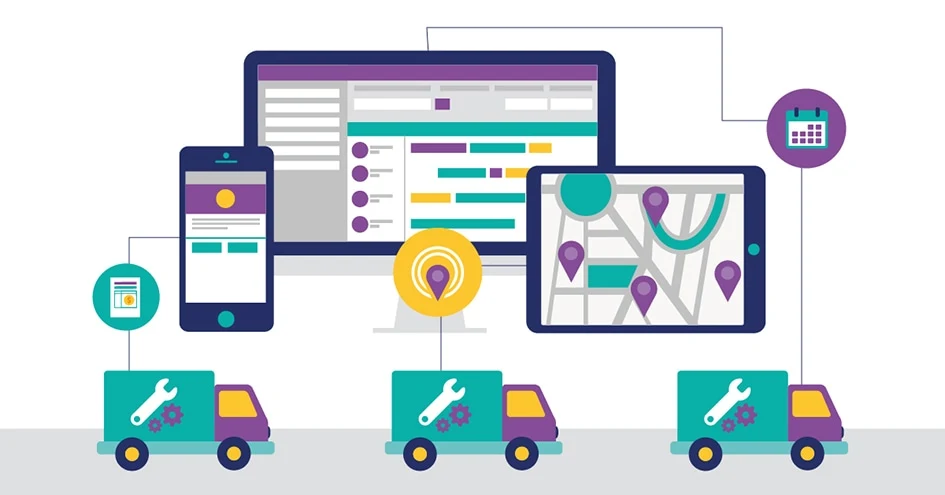
A single, unified field service management platform — like Microsoft Dynamics 365 Field Service or Trident’s FieldServ solution — manages every aspect of the service operation from one connected system:
- Customer records and asset history
- Intelligent job scheduling and resource optimization
- Mobile access for technicians — forms, job details, customer history, parts availability
- Real-time status updates and dispatcher dashboards
- Customer communication and appointment management
- Invoicing and financial integration
- SLA tracking and compliance reporting
- IoT integration for connected asset monitoring
When every function runs on the same platform and the same data, the inefficiencies that siloed systems create disappear. Dispatchers see everything. Technicians have everything. Management can measure everything. And customers experience the coherent, professional service that a truly connected operation delivers.
What Replacing These Practices Actually Looks Like in Practice
Automated Scheduling: From Chaos to Optimized Dispatch
The moment a new job comes in, an intelligent scheduling system evaluates every available technician — their current location, their skill set, their remaining capacity, the priority of the new job, and the impact of adding it to their route — and assigns the optimal resource in seconds.
When a job runs over and the next appointment is at risk, the system flags it immediately and suggests the best resolution — reassigning the following job, updating the customer, or adjusting the route for another technician. This happens continuously throughout the day, without dispatcher intervention for routine decisions.
Mobile Field Service Apps: Everything Your Technician Needs, On One Screen
A technician using a modern field service mobile app arrives on site already knowing:
- The customer’s complete service history with your organization
- The asset’s maintenance history, warranty status, and known issues
- The diagnosis reported at booking and any preliminary information
- The parts likely to be needed — already confirmed as available in their van stock
- The SLA requirements for this job and the time remaining
They complete the job, capture the required information digitally, photograph any evidence, take the customer’s signature, and close the job — with the data in your system in real time before they have reached their next appointment.
The Business Impact of Modernizing Your Field Service Operation
Measurable Improvements You Can Expect
Organizations that modernize their field service operations through connected platforms consistently achieve measurable improvements across every key metric:
| Metric | Typical Improvement |
|---|---|
| Jobs completed per technician per day | 15–25% increase through optimized scheduling |
| First-time fix rate | Significant improvement through better pre-job information |
| SLA compliance rate | Improvement through real-time monitoring and proactive management |
| Technician admin time | 30–50% reduction through mobile forms and automated processes |
| Customer satisfaction score | Measurable improvement through better communication and booking |
| Dispatcher to technician ratio | Improvement through scheduling automation |
| Fuel and travel costs | Reduction through route optimization |
How Microsoft Dynamics 365 Field Service Eliminates All 5 Problems
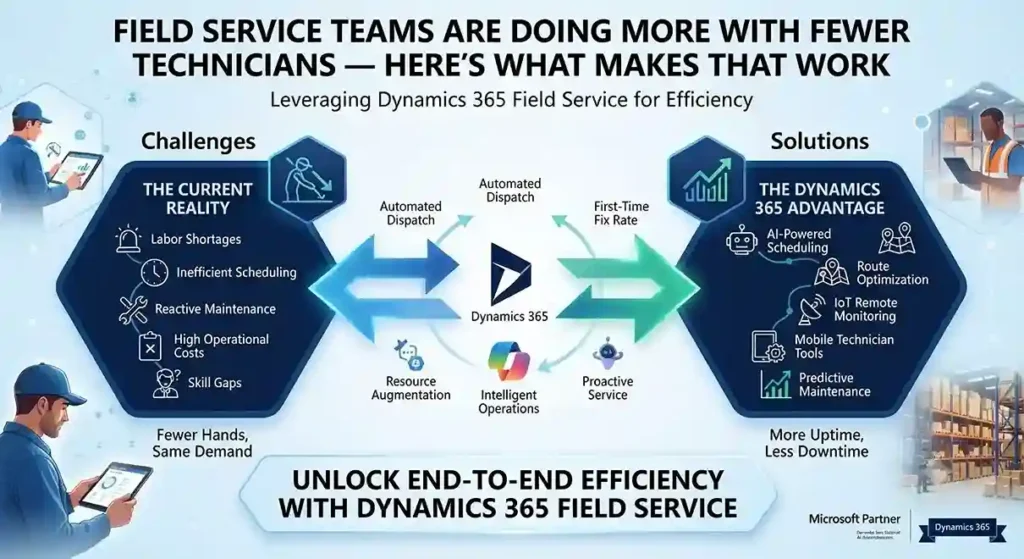
Microsoft Dynamics 365 Field Service is the enterprise field service management platform that addresses every outdated practice covered in this article — within a single connected system that integrates with the full Microsoft ecosystem.
Resource Scheduling Optimization
Dynamics 365’s built-in Resource Scheduling Optimization (RSO) automatically schedules and optimizes the entire field service operation — matching technician skills to job requirements, minimizing travel time and cost, respecting SLA priorities, and continuously re-optimizing as the service day evolves. Dispatchers focus on exceptions and customer relationships — not manual job allocation.
Mobile App for Field Technicians
The Dynamics 365 Field Service mobile app gives technicians everything they need — job details, customer history, asset records, parts availability, mobile forms, and status updates — on a single app that works on any device, including in offline mode when connectivity is unavailable.
Connected Field Service With IoT
Dynamics 365 Connected Field Service integrates IoT sensor data from customer assets — automatically detecting potential failures and creating work orders proactively, before the customer experiences a problem. This is the highest evolution of field service modernization: moving from reactive to truly predictive service.
How Trident’s FieldServ Solution Powers Modern Field Service Teams
Trident’s FieldServ solution — built on Microsoft Dynamics 365 Field Service — delivers advanced activity scheduling, resource optimization, and full mobile enablement for field service delivery teams across India.
With FieldServ, your field service teams can:
- Track, monitor, and report service activities in real time — from any location, on any device
- Access complete job and customer information before arriving on site
- Complete digital job forms, capture evidence, and close jobs without returning to the office
- Receive optimized schedules that maximize productive field time and minimize travel
- Provide customers with accurate booking windows, automated reminders, and real-time ETA updates
Trident Information Systems is a trusted consulting and technology services partner with deep expertise in driving digital transformation across Manufacturing, Retail, Hospitality, Logistics, Services, and more. With a strong presence in India, the U.S., UK, UAE, Africa, and a rapidly expanding footprint in Southeast Asia, Trident has successfully delivered over 250+ customer engagements. These include smart manufacturing with intelligent shop floor automation, retail digitalization spanning 3,000+ stores, and IoT-driven asset management covering 400+ assets across 150+ locations.
Beyond infrastructure and operations, Trident excels in business applications (Microsoft Dynamics 365 ERP, CRM, O365, Azure, Power BI, Power Platform, Salesforce) and Data & AI services in collaboration with Microsoft and IBM. What truly sets them apart is their exclusive Managed Talent Services unit, designed to help organizations jumpstart digital transformation engagements quickly and effectively—bridging the gap between strategy and execution with the right skills at the right time.
Ready to modernize your field service operation? Book a free FieldServ assessment with Trident today — and see exactly which of these five outdated practices are costing you the most in your specific business context. For more insights follow our LinkedIn page and stay updated on the latest innovations!
Your Field Service Modernization Action Plan
Modernizing a field service operation does not have to mean changing everything overnight. Here is a practical approach that delivers quick wins while building toward a fully connected operation:
Immediate (Week 1–2) — Audit your current practices Walk through each of the five practices honestly. Which ones apply to your business? Rank them by the impact they are having on your technician productivity, SLA compliance, and customer satisfaction scores.
Short-term (Month 1) — Address the highest-impact practice first For most field service businesses, the highest-impact first step is scheduling automation — because improvements here create capacity that makes every other change easier to implement. If your technicians are spending significant time on paperwork, mobile forms may be the better starting point.
Medium-term (Months 2–3) — Connect your systems The biggest leverage in field service modernization comes from connecting your scheduling, job management, mobile, and customer communication on a single platform. This is the change that makes all the individual improvements compound.
Ongoing — Measure and optimize Establish KPI baselines before each change and measure outcomes after. First-time fix rate, jobs per technician per day, SLA compliance rate, and customer satisfaction score should all be monitored continuously — giving you the data to demonstrate ROI and identify the next area for improvement.