Welcome to Trident Information Systems!
Write us to - info@tridentinfo.com
Let's Socialize

Cloud as a Service

Reimagining Healthcare with Azure IoT

[vc_row][vc_column][vc_column_text]Providers, payors, pharmaceuticals, and life sciences companies are leading the next wave of healthcare innovation by utilizing connected devices. From continuous patient monitoring, to optimizing operations for manufacturers and cold-chain supply tracking for the pharmaceutical industry, the healthcare industry has embraced IoT technology to improve patient outcomes and operations. In our latest IoT Signals for Healthcare research, we spoke with over 150 health organizations about the role that IoT will play in helping them deliver better health outcomes in the years to come. Across the ecosystem, 85 percent see IoT as “critical” to their success, with 78 percent planning to increase their investment in IoT technologies over the next few years. Real-time data from connected devices and sensors provides benefits across the health ecosystem, from manufacturers and pharmaceuticals to health providers and patients. For health providers, IoT unlocks efficiencies for clinical staff and equipment: Reduces human error. Ensures regulatory compliance when exchanging patient health data across systems. Coordinates the productivity of medical professionals across clinical facilities. For manufacturers, IoT creates new digital feedback loops connecting their employees, facilities, products, and end customers. Real-time data can help: Reduce costly downtime with predictive maintenance. Improve sustainable practices by reducing waste and ensuring worker safety. Contribute to improved product quality and quantity. For the pharmaceutical industry, IoT provides greater traceability for inventory along a supply chain: Improved visibility into environmental conditions. Reduced costly inventory spoilage. Increased control against theft or counterfeiting. For end patients, IoT can improve health outcomes with continuous patient monitoring: Reduces the need for unnecessary readmissions. Improves treatment success rates by providing continuous data to care professionals. Personalizes care based on patient needs. In this blog, we’ll cover how our portfolio can support different IoT solution needs for software developers, hardware developers, and healthcare customers. Building healthcare IoT solutions with Azure IoT As Microsoft and its global partners continue to build solutions that empower healthcare organizations around the world, a key question continues to face IoT decision makers: whether to build a solution from scratch or buy an existing solution that fits their needs. From ensuring device-to-cloud security with Azure Sphere to providing multiple approaches for device management and connectivity with Platform as a Service (PaaS) options or a managed app platform, Azure IoT provides the most comprehensive IoT and Edge product portfolio on the market, designed to meet the diverse needs of healthcare solution builders. Solution builders who want to invest their resources in designing, maintaining, and customizing IoT systems from the ground up can do so with our growing portfolio of IoT platform services, leveraging Azure IoT Hub as a starting point. While this approach may be tempting for many, often solution builders struggle when growing their pilot into a globally scalable IoT solution. This process introduces significant complexity to an IoT architecture, requiring expertise across cloud and device security, DevOps, compliance, and more. For this reason, many solution builders might be better suited for starting with a managed platform approach with Azure IoT Central. Using more than two dozen Azure services, Azure IoT Central is designed to continually evolve with the latest service updates and seamlessly accompany solution builders along their IoT journey from pilot to production. With predictable pricing, white labeling, healthcare-specific application templates, and extensibility, solution builders can focus their time on how their device insights can improve outcomes, instead of common infrastructure questions like ingesting device data or ensuring disaster recovery. New tools to accelerate building a healthcare IoT solution Over the past year, we’ve been working hard to create new tools to make IoT solution development easier for our healthcare partners and customers: Azure IoT Central app templates. Internet of Medical Things (IoMT) Fast Healthcare Interoperability Resource (FHIR) Connector for Azure. To help you put all of these tools together, we’ve also published a reference architecture diagram for continuous patient monitoring solutions. Continuous patient monitoring reference architecture IoMT FHIR Connector for Azure Interoperability continues to be a huge challenge and critical for most healthcare organizations looking to use healthcare data in innovative ways. Microsoft proudly announced the general availability of our own FHIR server offering, Azure API for FHIR, in October 2019. We are now further enriching the FHIR ecosystem with the IoMT FHIR Connector for Azure, a connector designed to ingest, transform, and store IoT protected health information (PHI) data in FHIR compatible format. Innovative healthcare companies share their IoT stories In addition to rich industry insights like those found in IoT Signals for Healthcare and our previously published stories from Stryker, Gojo, and Wipro, we are releasing two new case stories. They detail the decisions, trade-offs, processes, and results of top healthcare organizations investing in IoT solutions, as well as the healthcare solution builders supporting them. These case studies showcase different approaches to building an IoT solution, based on the unique needs of their business. Read more about how these companies are implementing and winning with their IoT investments. ThoughtWire and Schneider Electric leverage IoT for hospital operations Clinical environments are managed by traditionally disconnected systems (facility management, clinical operations, inventory management, and more), operated by entirely separate teams. This makes it difficult to holistically manage and optimize clinical operations. Schneider Electric, a global expert in facilities management, partnered with ThoughtWire, a specialist in operations management systems, to deliver an end-to-end solution for facilities and clinical operations management. The joint Smart Hospital solution uses Azure’s IoT platform to help hospitals and clinics reduce costs, minimize their carbon footprint, and promote better staff satisfaction, patient experiences and health outcomes. “We don’t just want to understand how the facility operates, we want to understand how patients and clinical staff interact with that infrastructure,” says Chris Roberts, Healthcare Solution Architect at Schneider Electric. “That includes everything to do with patient experience and patient safety. And when you talk about those things, the clinical world and the infrastructure world start to merge and connect. Working with ThoughtWire, we bridge the gap between those two worlds and drive performance improvements.” To learn more, read the case study here. Sensoria Health creates a new gold standard

Reimagining Healthcare with Azure IoT Read More »
Why Microsoft Azure became Most Secured & Reliable Cloud Platform

[vc_row][vc_column][vc_column_text]In a recent survey, according to 28 percent of surveyed, Microsoft Azure was recognized as the most-used cloud platform, and the one most commonly to be bought or renewed— the largest percentage for any cloud computing provider. With results like this, it’s no surprise the number of businesses deeply invested in Azure keeps climbing. If you are searching for more details about Azure, including how your business could profit from it and make the best use of its services, you are in the correct place. This comprehensive guide covers the basics and beyond, from “What is Microsoft Azure?  How Microsoft Azure is different?? Whenever anyone questioned what Microsoft Azure is, the simplest explanation is this: Azure is a cloud computing system that can deliver everything that industry needs to digitally manage all or part of its computer processes — such as servers, storage, databases, networking, analytics and much more. The only available option to organizations has generally been to create and run the specific hardware required for computation, comprising servers, disk storage, and Ethernet switches. However now, businesses can use a public cloud computing platform like Azure that buys and manages all of the equipment in computation. This means businesses can “lease” hardware resources efficiently, as required. You can select and choose between Azure’s offerings to get the help you need to develop, deliver and manage software for your business processes. And since you’re leasing cloud infrastructure, you don’t have the expenses and shortfalls (like a dedicated IT department) involved with the actual infrastructure that goes with those operations. There are also many advantages above the cost and efficiency we will discuss further. Today, many businesses choose to use a mix of cloud services and on-premise data centres. Some even using different cloud services platforms, based on their needs and concerns. So, don’t worry if you’re interested in making a drastic change to your computer environment or think like you’re lifelong committing to a single business supplier. You’ll want to concentrate rather on deciding the feasibility of cloud technology in parallel to the requirements of your business. Often the simplest way to get the process started is to build a hybrid of the cloud with an established on-premises system.  Who makes use of Microsoft Azure adequately? Firms of all scales take interest in the use of the public cloud platform and many prefer Microsoft Azure. In practice, 85 percent of Fortune 500 businesses are using Azure. Azure appeals to several SMBs enterprises, too. One possible explanation behind this is that it enables SMBs to prevent the large expenditure of resources for facilities; it also eliminates the strain of improvements and maintenance, since they may not have readily available in-house experts to assist. And also because Azure makes it much easier to dynamically resize computing resources in moments, it gives greater versatility that enterprises simply would not have with a conventional on-premise cloud platform. Microsoft Azure Storage If you do cloud hosting, your information will not be processed on your servers anymore. Where exactly is it kept, then? Microsoft intends Azure users ‘ physical data backups, meaning it will be placed at one or more of Microsoft’s 100 + data centres across the world. You can generally determine the country you would like to deposit your information in. Generally speaking, it is suggested that your information be placed near where your customers are. The further away from your consumers, your information is stored, the more connectivity issues they will encounter. Azure will hold and run multiple duplicates of your information, using the process known replication, to ensure that your data is easily accessible. You can choose how to manage duplication — for instance, do you want two duplicates at the same area, or multiple versions processed across multiple locations? Security Standards of Microsoft Azure All major public cloud services, especially Microsoft Azure, have priority over security. With the latest expansion of its Azure Security Center, Microsoft has been particularly concentrated on this topic with a total focus. Azure Security Center is a monitoring tool that helps you to track security flaws and attacks to your Azure assets. This allows identify potentially malicious behavior throughout the hybrid cloud workloads using advanced analytics and suggests alternative remediation measures. Then you can assess those actions and take appropriate steps. Data Encryption at Rest is also provided by Azure, which is the cryptographic encoding of data when it persists. This uses an encryption algorithm for swift encryption and decryption of vast amounts of data. Now that Microsoft Azure has been implemented, we will shift on to the next phase — recognizing what Azure can do for you and your industry. There are various reasons, in my experience, why businesses end up making the move of having Microsoft Azure. Azure has so many functionalities that describing all of them in a single blog post will be practically impossible. Below are six functionalities most important to many enterprises. 1) Disaster Recovery  With Azure, your business gains a strong disaster recovery solution—one that also comes with a more affordable price tag than those associated with traditional computing environments. With Azure, you get access to: Various data storage data centers that enable you to distribute a cloud service to various places around the world. Azure Site Recovery, a service that helps guarantee that your critical business systems remain online by duplicating certain tasks from a host site to a secondary location during an interruption or disturbance. Azure Traffic Manager, which in case of an area-specific failure streamlines traffic routing to multiple locations (determined by the user) 3x Replication of information, ensuring all information you hold in Azure is replicated three stages, either to a single data center or to a second one. 2) Flexibility   The extra capacity to allow high volume tasks needs to be developed into the device. This is particularly true for an on-premise data center that involves purchasing and managing a lot of extra hardware year-round. You can instantly increase your industrial base with the cloud, and then reduce it easily when you’re finished. Besides, you

Why Microsoft Azure became Most Secured & Reliable Cloud Platform Read More »

IoT device management dashboard monitoring software updates, device status, and security in real time.

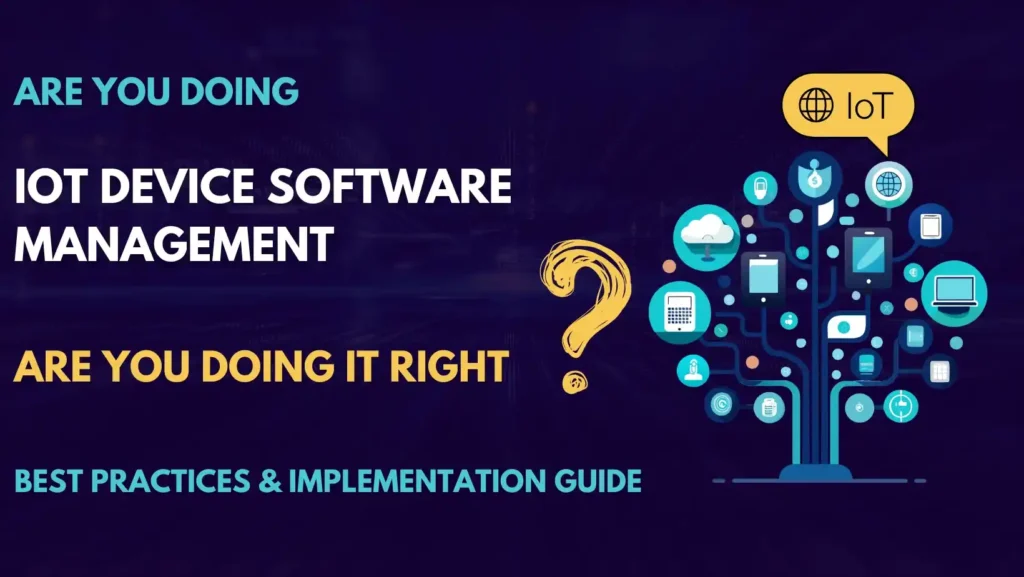
IoT Device Software Management: Are You Doing It Right?

Every enterprise today runs on software – and nowhere is that pressure more intense than in IoT device software management. As connected devices multiply across factories, hospitals, logistics networks, and smart infrastructure, the stakes for getting software delivery right have never been higher. Yet most organizations are still managing IoT device software the way they managed desktop applications a decade ago – slow release cycles, siloed teams, reactive testing, and little visibility across the device lifecycle. That approach no longer works. Industry disruptors are not waiting. They are shipping faster, patching smarter, and scaling IoT fleets without proportional cost increases. Meanwhile, enterprises clinging to outdated development practices face a widening gap – in speed, in quality, and in customer satisfaction. The choice is now binary: modernize your IoT device software management strategy, or watch competitors who already have pull further ahead. Organizations that embrace lean, agile, and DevOps-driven approaches to IoT software delivery are not just keeping up – they are setting the new benchmark. What Is IoT Device Software Management? IoT device software management refers to the processes, tools, and strategies used to deploy, monitor, update, and maintain software across a fleet of connected devices – from sensors and edge nodes to industrial controllers. Unlike traditional software environments, IoT ecosystems introduce unique challenges: devices operate in remote locations, run on constrained hardware, and require Over-the-Air (OTA) update capabilities to stay secure and functional. Without a structured management approach, enterprises risk firmware drift, security vulnerabilities, and costly manual interventions at scale. As it pertains to the “new normal” DevOps standards, organizations now face many challenges such as cost overruns, software development projects that don’t scale in line with the enterprise growth, and increased market demands for speed. On top of that, the available outdated testing tools don’t offer visibility to ensure the right specifications get tested in the right time. How Lean and Agile Principles Transform IoT Software Delivery So, how can you make sure your organization is ready to manage unexpected changes, and deal with any dependencies that you already have under the hood? How do you ensure a strong balance between the existing business and the new development? Many of you may already be familiar with lean and agile principles and have probably even tried applying them in smaller teams. But what we’ve seen so far in the market is that many of you struggle to apply these principles across the entire organization. Lean and agile principles can help you reach your goals in today’s hyper-competitive world of digital product delivery. By becoming a lean and agile enterprise your organization will be able to adapt faster to the needs of the market by improving internal collaboration and communication. You will be able to learn in real-time from your clients to ensure that you are producing the prioritized set of features that drive economic value. By managing test labs, test planning, and ensuring the tight linkage between product demand and delivery, your organization will be able to reduce waste (time, effort, resources), while ensuring that your business strategy is aligned with the investment and development goals. The Numbers Don’t Lie: Agile IoT Transformation Results Let’s have a look at a few examples of what some of the industry leaders have achieved, using lean and agile processes. Nationwide achieved 50 percent improvement in code quality and 70 percent reduction in system downtime by applying lean principles to transform the software delivery lifecycle. Diagnostic Grifols, a world-leading healthcare enterprise headquartered in Barcelona Spain, increased the efficiency of development documentation by 30 percent-facilitating compliance, ensuring consistency of records across all product lines, and reducing operational costs. IoT Software Security: The Risk You Can’t Ignore A lean and agile development lifecycle isn’t just about speed – it’s about building security into every release cycle. According to industry research, over 57% of IoT devices are vulnerable to medium- or high-severity attacks due to unpatched firmware. Integrating automated security testing within your DevOps pipeline ensures vulnerabilities are caught before deployment, not after a breach. If your current IoT software management process doesn’t include continuous security validation, it’s time to close that gap. Start Managing IoT Software the Right Way — Here’s How It’s time to transform your organization into a lean and agile enterprise. It’s time to ensure that your firm can adjust to any market change, predict the unpredictable, keep costs low, deliver new features and offerings faster, and never lose a beat with your customers. If you would like to learn more, let’s get connected! Our IBM solution enables companies to improve visibility and transparency across the product delivery lifecycle by providing a single source of truth. It also enables enterprises to define a process custom to each organization, and it ensures quality and compliance. All using lean and agile processes.

IoT Device Software Management: Are You Doing It Right? Read More »