INTRO
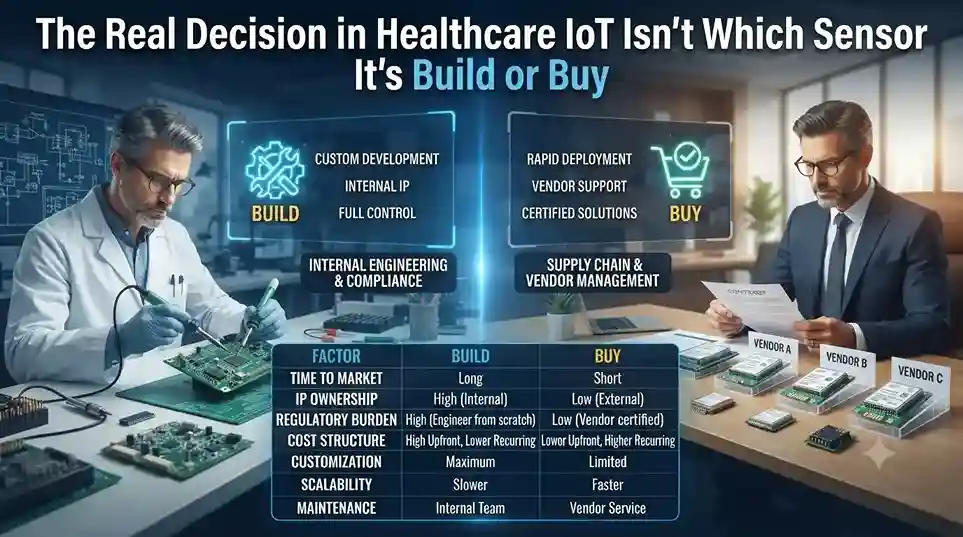
A hospital piloting a patient-monitoring device rarely fails on the hardware. It fails when the pilot tries to scale — and the team discovers they’ve quietly taken on a cloud security, compliance, and DevOps project they never budgeted for. That’s the real fork in the road for Azure IoT healthcare solutions: build the infrastructure from scratch, or buy a managed platform built for exactly this.
Healthcare organizations are moving fast toward IoT regardless of which path they pick — the vast majority now consider it critical to their operations, with most planning to increase investment further.
Why IoT Matters Differently Across the Healthcare Ecosystem
IoT doesn’t solve one problem in healthcare — it solves a different problem for each part of the chain:
- Providers get fewer manual errors, easier regulatory compliance when exchanging patient data across systems, and better-coordinated clinical staff scheduling.
- Manufacturers use real-time device data to catch equipment failures before they cause downtime, and to improve product quality through continuous feedback loops.
- Pharmaceutical companies get supply chain traceability — environmental condition tracking that reduces spoilage and adds a real deterrent against theft or counterfeiting.
- Patients get continuous monitoring that reduces unnecessary hospital readmissions and lets care plans adjust to actual patient data instead of periodic checkups.
The Build Option — Full Control, Full Complexity
Building from Azure IoT Hub gives a solution builder maximum flexibility to design, customize, and own every layer of the architecture, including device-to-cloud security through Azure Sphere. The tradeoff shows up later, not at the pilot stage: scaling a working pilot into a globally deployable solution demands deep expertise in cloud security, device security, DevOps, and healthcare compliance simultaneously — expertise most healthcare organizations don’t have in-house and don’t want to hire for a single project.
The Buy Option — Azure IoT Central for Healthcare
Azure IoT Central is Microsoft’s managed IoT platform, built specifically to remove the infrastructure questions — data ingestion, disaster recovery, ongoing security patching — that consume most of a build-from-scratch timeline. For healthcare specifically, it includes healthcare application templates, predictable pricing, and white-labeling, letting a solution builder focus on what the device data actually reveals about patient outcomes rather than on keeping the underlying platform running.
Interoperability: The IoMT FHIR Connector
Healthcare data interoperability remains one of the hardest problems in the industry — most systems still don’t speak the same format. The IoMT FHIR Connector for Azure addresses this directly, ingesting IoT-generated protected health information and converting it into FHIR-compatible format automatically, which is what makes device data usable across otherwise siloed clinical systems.
How This Plays Out in Practice
Two examples from Microsoft’s healthcare IoT ecosystem illustrate the difference between the two approaches:
Schneider Electric partnered with operations-management specialist ThoughtWire to unify facilities management and clinical operations data — systems that are traditionally run by entirely separate teams — into Azure’s IoT platform. The result connects how patients and clinical staff interact with hospital infrastructure to facility performance, an integration point that’s historically been invisible to hospital operations teams.
Sensoria Health took the buy path, building its Motus Smart diabetic foot ulcer monitoring solution on the Azure IoT Central Continuous Patient Monitoring template. Diabetic foot ulcers carry a treatment failure rate over 75%, and remote compliance tracking — knowing whether a patient is actually wearing their offloading device as prescribed — is central to improving that number. Using a managed platform let Sensoria launch an enterprise-grade, HIPAA-compliant application for both clinicians and patients in a fraction of the time a from-scratch build would have required.
What This Means for Your IoT Roadmap
The build-versus-buy decision isn’t really about technical capability — most healthcare organizations could build from scratch given enough time and budget. It’s about where that time and budget are best spent: on infrastructure plumbing, or on the clinical insight the data is supposed to generate in the first place.
Weighing build vs. buy for a healthcare IoT initiative? Talk to Trident about your Azure IoT options.
FAQ
Should a healthcare organization build or buy an IoT solution?
It depends on scale and in-house expertise: building offers full customization but requires deep cloud security and DevOps capability to scale; buying via a managed platform like Azure IoT Central trades some flexibility for faster deployment and built-in compliance.
What is the IoMT FHIR Connector for Azure?
It’s a connector that ingests IoT-generated patient health data and converts it into FHIR-compatible format, solving a major interoperability barrier between IoT devices and clinical systems.
Is Azure IoT Central HIPAA-compliant?
Azure IoT Central is built with healthcare compliance requirements in mind, including secure, compliant storage and sharing of patient data — organizations should confirm specific compliance requirements for their use case during implementation.