
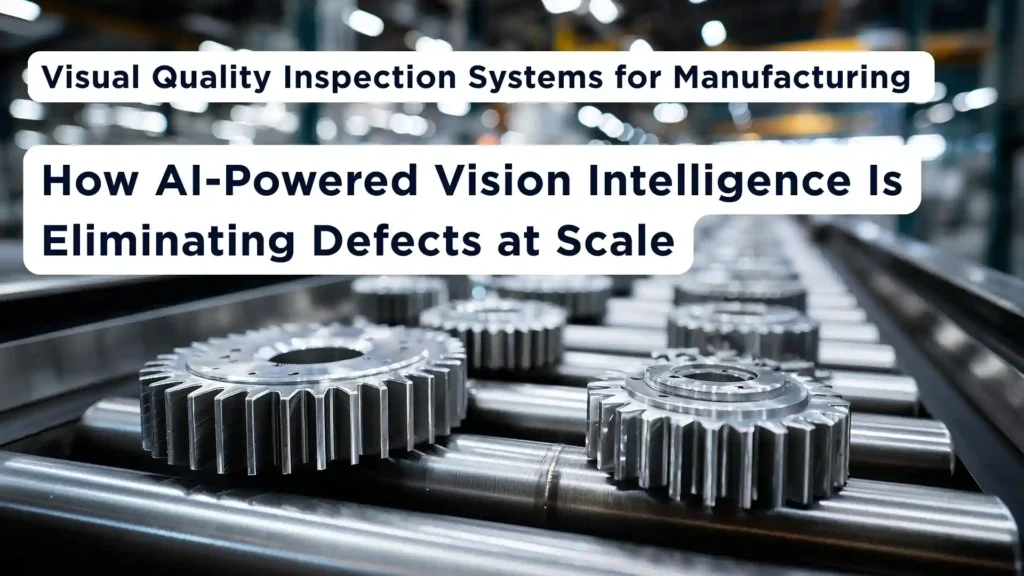
Visual Quality Inspection Systems for Manufacturing: How AI-Powered Vision Intelligence Is Eliminating Defects at Scale
In manufacturing, quality is not just a standard — it is a commercial obligation. A defective product that reaches the customer costs far more than the product itself: warranty claims, returns, reputation damage, regulatory penalties, and in industries like pharmaceuticals and automotive, potential safety liability. For decades, quality control in manufacturing depended almost entirely on human visual inspection — trained inspectors examining products at the end of the production line, relying on their eyes, experience, and concentration to detect defects before they reached the customer. The problem is that human inspection has fundamental, irreducible limitations. Attention lapses. Fatigue accumulates. Lighting conditions vary. And no matter how experienced the inspector, the error rate in human visual inspection means that some proportion of defective products will always pass through. Visual quality inspection systems — powered by digital imaging, optical sensors, AI, and machine learning — eliminate these limitations entirely. By replacing or augmenting human inspection with automated machine vision, manufacturers across automotive, pharmaceutical, FMCG, tobacco, and consumer goods industries are achieving inspection accuracy and throughput levels that human-only quality control simply cannot match. Trident’s Vision Intelligence System (VIS) platform brings industry-specific visual inspection solutions to manufacturers across India — with dedicated configurations for automotive, pharma, retail and FMCG, tobacco manufacturing, and safety compliance applications including face mask detection. This guide covers everything you need to know about visual quality inspection systems — how they work, what they deliver, and how Trident’s VIS platform addresses the specific inspection requirements of your industry. Why Manual Quality Inspection Is No Longer Enough The Real Cost of Human Error in Manufacturing Quality Control Manual visual inspection has served manufacturing quality control for generations — but its limitations have always been present. The critical question is not whether human inspectors make errors — they do, consistently and predictably — but whether those errors are acceptable given the commercial and safety stakes involved. In most modern manufacturing environments, they are not: What Modern Visual Quality Inspection Systems Replace Visual quality inspection systems do not just make existing inspection processes faster — they replace the fundamental dependency on human judgment for defect detection with objective, measurable, consistently applied machine vision criteria. The result is a quality control function that operates at production speed, maintains consistent accuracy across every shift and every unit, generates quantitative defect data for process improvement, and enables real-time corrective action before defective products progress further down the production line. What Is a Visual Quality Inspection System and How Does It Work? A visual quality inspection system is an automated quality control solution that uses digital cameras, optical sensors, and computer vision software to capture images of products during or after production — and then analyzes those images against defined quality parameters to accept or reject each unit. The Core Components of a Machine Vision Inspection System Every visual quality inspection system — regardless of industry application — consists of four fundamental components working together: 1. Imaging hardware — high-resolution digital cameras, line scan cameras, or 3D imaging systems capture images of every product as it moves through the production or inspection station. The choice of imaging hardware depends on the product type, production speed, and the nature of the defects being detected. Lighting systems — LED ring lights, backlit panels, structured light projectors — are configured to maximize defect visibility for the specific inspection application. 2. Sensor integration — RFID tags, QR codes, barcode readers, and proximity sensors provide product identification and triggering signals — ensuring the imaging system captures each unit at precisely the right moment and associates inspection results with specific product batches and serial numbers. 3. Image processing and AI analysis — captured images are processed in real time by computer vision algorithms — including deep learning models trained on examples of acceptable and defective products. The system measures specific characteristics: dimensions, surface finish, color consistency, label placement, fill levels, seal integrity, and hundreds of other parameters depending on the application. AI-powered systems continuously improve their detection accuracy as they accumulate inspection data. 4. Decision and action layer — based on the analysis results, the system makes an accept or reject decision for each unit — and triggers appropriate actions: pass-through for accepted units, diversion or rejection for non-conforming units, and alert generation for systematic defect patterns that indicate a production process issue requiring investigation. How Visual Inspection Systems Make Decisions Modern visual quality inspection systems make inspection decisions through a combination of traditional machine vision techniques and AI-powered deep learning: 5 Key Benefits of Visual Quality Inspection in Manufacturing 1. Faster Inspection Without Sacrificing Accuracy The most immediate and measurable benefit of automated visual inspection is the combination of inspection speed and accuracy that no human inspection process can match. A machine vision system can inspect hundreds or thousands of units per minute — at full production line speed — without the accuracy degradation that accompanies high-speed human inspection. For high-volume manufacturers, this means quality control no longer constrains production throughput — the inspection system keeps pace with production, not the other way around. The time savings extend beyond the inspection process itself. Automated inspection systems generate instant, quantitative results — eliminating the documentation, reporting, and data compilation time associated with manual inspection processes. 2. Elimination of Human Error From Quality Control Human inspection error is not a management or training problem — it is a physiological reality. The human visual system has limitations in resolution, consistency, and sustained attention that cannot be overcome through training or motivation. Visual quality inspection systems have no such limitations: The practical result is a dramatically lower defect escape rate — the proportion of defective products that pass inspection and reach the customer or the next production stage. 3. Adaptable to Every Production Process and Use Case One of the most commercially significant characteristics of modern visual quality inspection systems is their adaptability. When production parameters change — new product variants, modified specifications, updated packaging, new defect types — the inspection system can be