Welcome to Trident Information Systems!
Write us to - info@tridentinfo.com
Let's Socialize

visual quality inspection

visual quality inspection

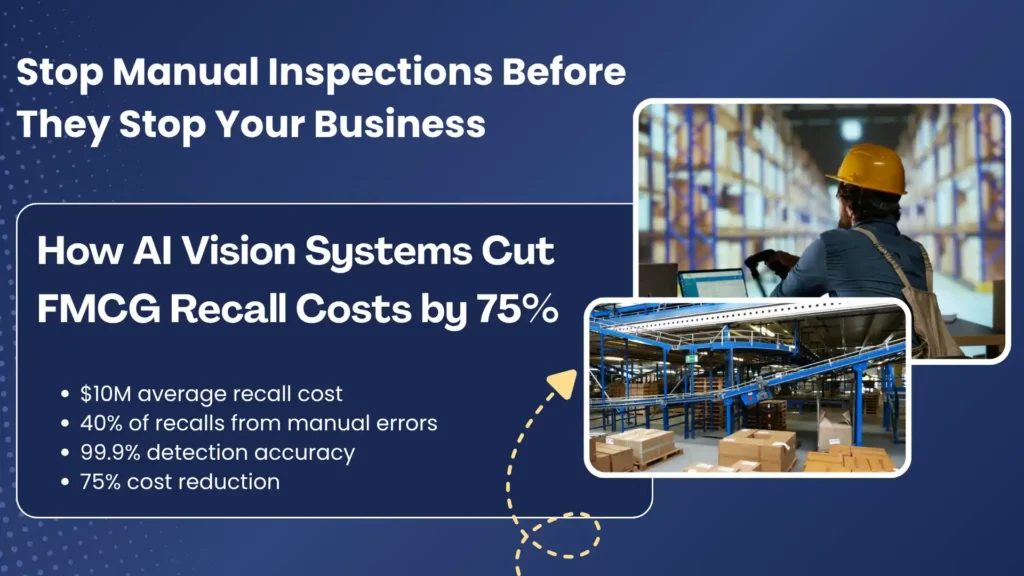
AI vision system inspecting FMCG products on a production line to detect defects automatically.

Stop Manual Inspections: How AI Vision Systems Cut FMCG Recall Costs by 75%

A single product recall in the FMCG sector costs an average of $10 million — and that is before factoring in brand damage, lost shelf space, and the regulatory fallout that follows. For most manufacturers, the painful irony is that the defects triggering those recalls were visible to someone on the production line. They just were not caught in time. Manual quality inspection has been the industry standard for decades. It is also, by now, a well-documented liability. Human inspectors tire, lose focus, and cannot process the volume or speed of a modern FMCG production line. AI-powered vision systems are changing that equation — and the results are not incremental. Manufacturers deploying these systems are reporting recall cost reductions of up to 75%, with defect detection rates that no team of human inspectors can match. Why Manual Inspection Is Failing FMCG Manufacturers Walk into any high-speed packaging facility and you will find the same setup: workers stationed at conveyor lines, eyes scanning products as they blur past at hundreds of units per minute. It is an approach built for a different era of production. The problems are structural, not personal. Human visual attention degrades significantly after 20 minutes of repetitive tasks — a phenomenon well-documented in industrial ergonomics research. Miss rates for subtle defects like micro-cracks, label misalignment, or underfill conditions routinely run between 15% and 25% on manual lines. At production speeds of 500 to 1,000 units per minute, even a 5% miss rate means thousands of potentially defective products entering the supply chain every hour. The downstream costs compound quickly. A contaminated batch that clears inspection does not just create a recall — it creates a crisis. Regulatory agencies are notified, retailers pull stock, consumers lose confidence, and legal exposure mounts. The UK Food Standards Agency reported that food recalls increased by 18% between 2019 and 2023, with packaging and labelling failures accounting for nearly a third of all incidents. Manual inspection is not just unreliable. At modern line speeds, it is functionally inadequate. What AI Vision Systems Actually Do The term “AI vision” covers a spectrum of technologies, but in FMCG quality control the core system is a combination of high-resolution industrial cameras, edge computing hardware, and deep learning models trained on thousands of defect and non-defect images. The cameras capture every unit on the line — continuously, without fatigue, at full production speed. The AI model processes each image in milliseconds, comparing it against learned parameters for fill levels, seal integrity, label placement, colour consistency, and surface defects. Units that fall outside acceptable tolerances are flagged and automatically ejected before they reach downstream packaging. What separates modern AI vision from earlier rule-based machine vision is adaptability. Traditional systems required engineers to manually define every defect condition — a rigid approach that struggled with natural product variation. Deep learning models, by contrast, are trained on real production data. They learn what a good product looks like, and they identify deviations that no one thought to programme in advance. A biscuit manufacturer in the Netherlands, for example, deployed an AI vision system that reduced breakage-related waste by 40% and cut labelling non-conformances by 82% within six months of installation. The system identified a recurring seal defect pattern during night shifts — something that had been present for years but never surfaced through manual inspection records. The 75% Recall Cost Reduction: Where the Savings Come From Recall costs are not a single line item. They are an accumulation of expenses that most finance teams only fully quantify after the event. AI vision systems attack this problem at multiple points simultaneously. Prevention at source. The most significant saving comes simply from catching defective products before they leave the facility. A defect identified on the line costs a fraction of a defect identified after distribution. AI systems operating at 99.5% or higher accuracy rates effectively eliminate the cohort of products that would otherwise generate field failures. Reduced inspection labour. Manufacturers typically redeploy, rather than eliminate, inspection staff when AI vision is introduced. But the labour cost per unit of quality assurance drops substantially — often by 60% or more — as human oversight shifts from frontline scanning to exception management and system monitoring. Lower regulatory exposure. Regulatory bodies including the FDA, EFSA, and the UK FSA place increasing weight on documented quality control processes during recall investigations. Manufacturers with AI vision systems can produce granular, time-stamped inspection records for every unit produced. That audit trail reduces both the scope of recalls and the severity of regulatory penalties. Faster containment. When a quality event does occur, AI systems provide precise data on when the defect window opened and closed. Instead of recalling an entire production run, manufacturers can identify and withdraw a specific 40-minute production window. That precision alone can reduce recall volume — and therefore recall cost — by 60% to 70%. Taken together across a mid-size FMCG operation running three or four product lines, these savings consistently produce the 75% recall cost reduction that early adopters are reporting. Implementation Realities: What to Expect AI vision systems are not plug-and-play. The technology is mature, but successful deployment requires groundwork that many manufacturers underestimate. Training data quality is the most critical variable. A model trained on insufficient images will produce high false-positive rates — flagging good products as defective — and erode line efficiency. Leading vendors now offer pre-trained models for common product categories, which reduces this burden, but site-specific fine-tuning is almost always necessary. Integration with existing line control systems — PLCs, SCADA, MES — requires engineering effort upfront. Manufacturers who treat this as a bolt-on rather than a systems integration project tend to struggle. Those who involve their operations technology team from the outset see faster time-to-value. Typical payback periods for AI vision deployments in FMCG range from 14 to 24 months, depending on line speed, product complexity, and existing recall exposure. For manufacturers who have experienced a major recall in the past three years, that timeline often compresses

Stop Manual Inspections: How AI Vision Systems Cut FMCG Recall Costs by 75% Read More »
Vision Intelligence System,

How Trident’s Vision Intelligence System Helps in Defect Detection for Automotive Manufacturing

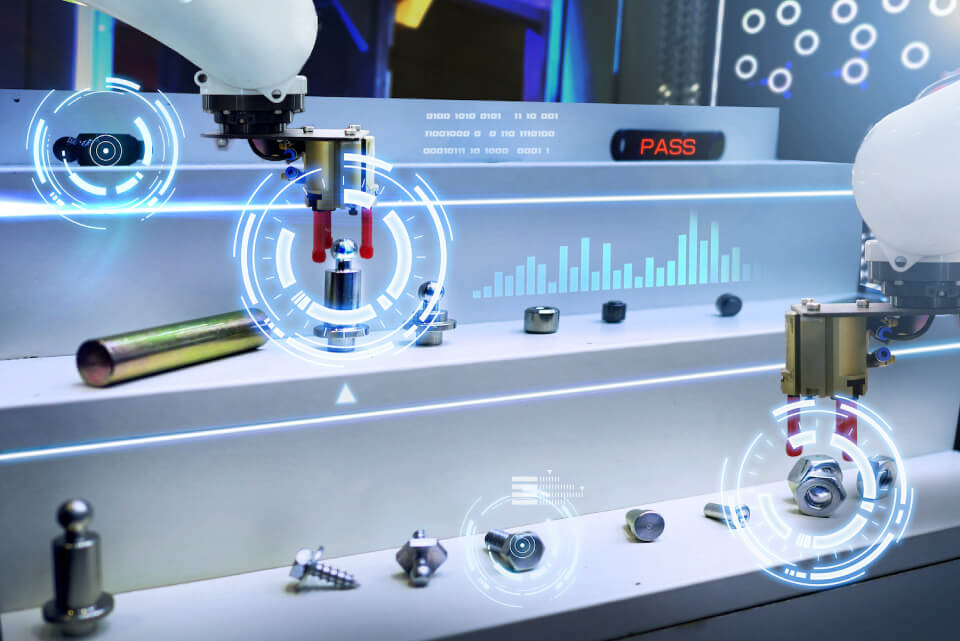
In the automobile manufacturing industry, ensuring the highest level of quality in every product is of utmost importance. Even the slightest defect can have significant consequences, ranging from reduced customer satisfaction to serious safety concerns. Visual quality inspection plays a crucial role in detecting defects in automobile manufacturing, and Trident’s Vision Intelligence System is a game-changer in this aspect. Trident’s Vision Intelligence System is a cutting-edge technology that uses artificial intelligence and machine learning to detect defects in real-time during the manufacturing process. The tool uses high-resolution cameras and advanced algorithms to analyze images and identify defects, such as scratches, dents, and other imperfections that may affect the product’s quality. Here are some ways in which Trident’s visual quality inspection tool helps in detecting defects for automobile manufacturing: High Accuracy and Precision Vision Intelligence System is designed to be highly accurate and precise in detecting defects. The tool uses advanced algorithms that are trained on a vast database of images to identify defects with a high degree of accuracy. The tool can detect even the smallest defects that may be missed by human inspectors, ensuring that the final product is of the highest quality. Real-Time Defect Detection One of the biggest advantages of Trident’s visual quality inspection tool is its ability to detect defects in real-time during the manufacturing process. As soon as the product is manufactured, the tool scans it for defects and provides immediate feedback to the manufacturer. This allows manufacturers to take corrective action quickly, reducing the likelihood of defects in the final product and saving time and money on rework. Reduced Inspection Time Visual quality inspection is a time-consuming process that involves manual inspection by human inspectors. Trident’s visual quality inspection tool eliminates the need for manual inspection, reducing the time it takes to inspect each product. This allows manufacturers to increase their production rates while maintaining the same level of quality, ultimately resulting in higher profits. Consistent Quality Vision Intelligence System ensures consistent quality in every product manufactured. The tool follows a strict set of guidelines and algorithms to detect defects, which eliminates the possibility of human error. This results in consistent quality across all products, ensuring customer satisfaction and building a strong reputation for the manufacturer. Cost-Effective Trident’s Vision Intelligence System is cost-effective in the long run. While the initial investment may be high, the tool pays for itself in the long run by reducing the likelihood of defects, increasing production rates, and ensuring customer satisfaction. By reducing the need for manual inspection, manufacturers can also save money on labor costs. Improved Safety Defects in automotive manufacturing can have serious safety consequences. Trident’s visual quality inspection tool ensures that every product is defect-free, reducing the likelihood of safety concerns. This, in turn, can help manufacturers avoid costly recalls and litigation, ultimately saving money and preserving their reputation. In conclusion, Trident’s Vision Intelligence System is a game-changer in the automotive manufacturing industry. The tool’s high accuracy and precision, real-time defect detection, reduced inspection time, consistent quality, cost-effectiveness, and improved safety make it an essential tool for manufacturers who want to ensure the highest level of quality in every product. As the automobile manufacturing industry becomes increasingly competitive, Trident’s Vision Intelligence System can help manufacturers stay ahead of the curve and meet customer demands for high-quality products.

How Trident’s Vision Intelligence System Helps in Defect Detection for Automotive Manufacturing Read More »

Visual Quality Inspection

Cut Defect Detection Costs while Ensuring Employee Safety with Vision Intelligence System

The glass needs to be worked with precision. The material is smooth enough to highlight a single scratch. Sometimes it gets hard for the human eye to catch little defects such as cracks, scratches, discoloration, etc. Moreover, be incredibly careful while working with glass as a single glass particle can make you go blind, damage your lungs, or at least give you cuts. Therefore, employees working in this area must be cautious. In addition to it, human-based inspection demands high investments. That’s why many big manufacturers are now shifting to Visual Quality Inspection.   It is a Machine Vision System that detects even minute defects via cameras and doesn’t even demand human assistance. It is self-sufficient to detect defects on its own. Some Manufacturing Inspection Software, such as Vision Intelligence System developed by Trident Information Systems is AI-based; it can adjust itself in a similar environment without you having to make additional changes. For instance, it can still detect defects accurately if the lightning is different, or the size of an object is different. It can also work just fine even if the item is placed in a different location.   It can easily detect defects such as:  Distortion Detection: any refraction on the windshield, side glass, etc.   Little Defects: Little defects such as dirt, dust particles, little scratches, patch marks, and so on.   Logo Inspection: It checks if all the logos are accurately printed. It also checks the accurate dimensions of any distortion and irregularities.   Check Fixatives: It even checks for the hard glue and gaps appearing in the joints, also, bubbles and anything else.   What Does the Visual Quality Inspection Give to Your Business?  The Vision Intelligence System gets you noticed by your customers due to the excellent quality of your final product. With this technology, many businesses have accomplished an upgraded quality standard and managed to get three times more ROI. This technology helps you to:  Cut Costs: Despite this, many manufacturers still tend to trust old defect detection methods i.e., human-based inspection. It is more costly and time-consuming. Vision Quality Inspection instead, helps cut costs and effort. Having a machine doing all the work at triple speed and half the cost will increase your profit, and profit margin at the same time.   Detect Accurately: Humans only inspect a single sample from a batch, which increases the risk of errors. The Machine Vision System, however, detects each item thoroughly. It checks for every scratch, crack, and fixative on the glass. Many businesses so far have even witnessed an upgraded glass product quality.    Work with Consistency: Your employees can fall sick or stay absent for whatever reason while impacting your productivity, but Visual Quality Inspection will never ditch you. It will work 24/7 with the same enthusiasm and consistency. It detects defects with the same accuracy and without getting tired.   Adjust in a Similar Environment: Human eyes may get confused in different lighting or different product size. However, an AI-based Visual Quality Inspection like Trident’s Vision Intelligence System provides the same results even if the environment is slightly different such as in different lights, different sizes, different shapes, and so on.   Attract More Customers: With decreased costs and greater speed, you are bound to see a whopping profit percentage. You can attract more customers with faster deliveries and enhanced quality glass, and you can even provide attractive offers, deals, and discounts to your regular customers.   Why Vision Intelligence System?  Trident’s Vision Intelligence Systems is an AI-based Visual Quality Inspection Software that is specifically designed for manufacturers. It provides tangible and valuable manufacturing intelligence aid promoting better quality process and production. This Defect Detection System helps:   Interesting upcoming defects and preventing delays.   Finding the cause of an issue while enhancing the output.  Cutting time with the digital defect-reporting process.   Eliminating the need for product sampling.   Analyzing real-time root cause.   If you are looking to implement Vision Intelligence System into your glass manufacturing plant, you can contact Trident Information Systems. We have designed this product to ease the burden of manufacturers in different industries; glass is one of them. You can ensure 24/7 consistent work in your factory as our dedicated team of experts are there for your assistance so you can experience a disturbance-free process. Contact us for further information.  

Cut Defect Detection Costs while Ensuring Employee Safety with Vision Intelligence System Read More »

Machine Vision System

Get Consistent Quality Inspection in Your Automotive Plant  

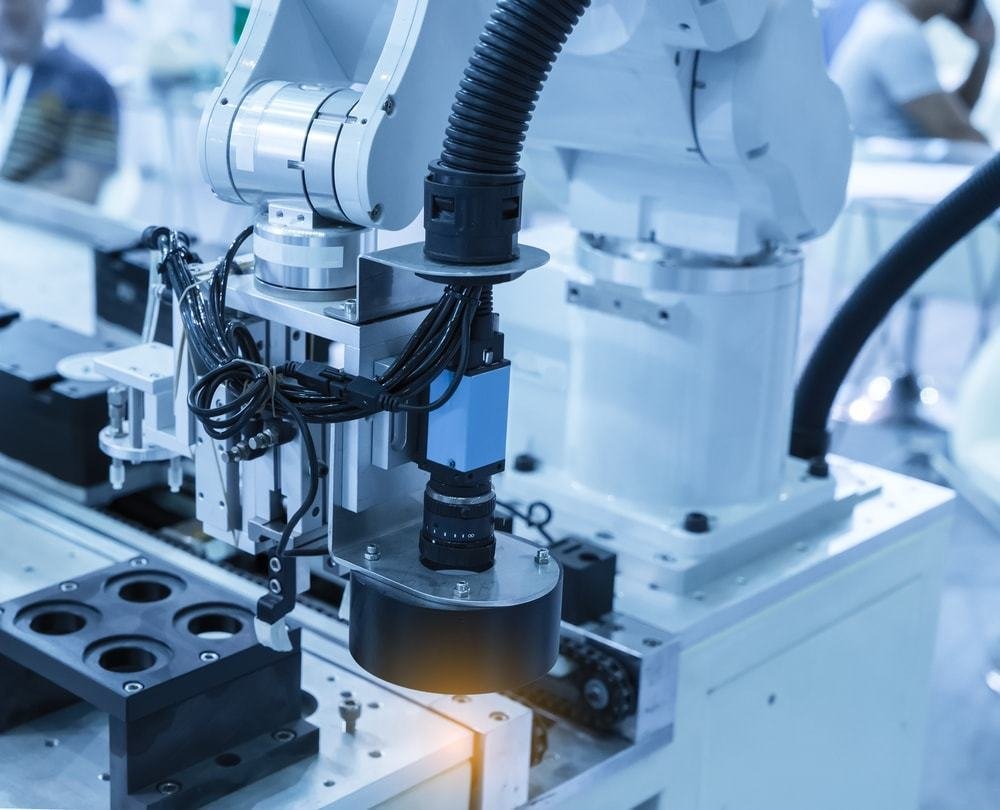
Do you want to know how your competitors are getting ahead of you with fast and good-quality production? Seems like magic but it’s technology instead. Many big industrialists have adopted advanced technology in their automotive plants i.e., Machine Vision System. A technology based on AI (Artificial Intelligence) ensures they get the best production. In contrast to traditional inspection methods, where nothing can be done without human assistance, a Defect Detection System ensures you get consistency of work with no human interference. Traditional inspection methods are prone to various challenges such as:   Inconsistency in inspection due to different perceptions and environmental factors.   Too much floor space coverage which leads to accidental bumping and slow item transfer.   Accidental bumping may cause conflicts among workers.   The absence of workers hampers consistency of work.   Human eyes may miss certain defaults.   Delay in reporting is common in human-based inspection.   Traditional inspection cannot match the efficiency of the machine. The Machine Vision System, on all levels, is better. It ensures more fluency, speed, and quality than the old-school methodologies.   Manufacturing Defect Detection Ensures Threefold ROI  With greater accuracy, consistency, low-to-no human dependency, and greater speed, the Machine Vision System can bring you three times more ROI (Return on Investment).   Consistency of work: One of the major benefits Manufacturing Inspection Software provides is consistency. Even if your staff is absent, the flow of work remains consistent, 24/7. This technology helped during the most unexpected times i.e., the COVID pandemic.   Low risk of errors: The risk of errors declines with a low human interference rate. Hence, you can get speedy and error-free production to provide defect-proof items to the customers.   Free floor space: With less human dependency, the floor space remains free which leads to a smoother flow of moving goods. Furthermore, there are extremely low risks of employees bumping into one another and getting involved in unnecessary fights.   Fast Reporting: The machine flashes an alert as soon as there is a defective product on the conveyor belt. It is much faster than a human-based inspection.   How Does Machine Vision System Work?  A Vision Inspection System relies on digital sensors protected within the industrial camera. It acquires images and specified optics to let the software and computer hardware analyze, process, and calculate different characteristics to support final decisions.   An AI-based Machine Vision Inspection such as the Vision Intelligence System by Trident Information Systems does not need consistent modifications as it can detect defects with accuracy in a similar environment. It successfully eliminates human interference and allows an ongoing, 24/7, and accurate quality inspection.    How Vision Intelligence System Detects Defects with Consistency?   Being one of the most competitive industries, automotive manufacturers require technology that rockets them ahead in the competition. The Machine Vision System can be their knight in shining armor. It can detect:   Visual defect detections: dents, scratches, burr, and chips.   Dimensions: dimensional accuracy i.e., if a product is in the right shape and size.   Spectrum monitoring: it checks if the product is in the right spectrum of color or not.   Labeling: Detects if the labels are present in the right place.   Barcodes: OCR/ DMC/QR/ Barcode reading etc.   Measure, gauge, guide measures the angle of O tips, dimensions of the outer and inner diameters of O rings, as well as the edges and label positions.   Why Vision Intelligence System?  Trident’s Vision Intelligence System ensures a tangible and valuable Manufacturing Intelligence System which helps produce better quality products and processes. The best part is it minimizes waste by providing valuable insights into how you can enhance your quality with the least wastage. Furthermore, you can get a lot of tangible and intangible benefits such as:   Interpretation of upcoming defects and aids in preventing delays   Identifies the cause of an issue and optimizes resources.   Cuts time with digital defect-reporting operations.  Abolishes the need for product sampling.  Real-time core analysis of a defect.   Enhance your quality inspection environment and optimize business operations using Vision Intelligence System. This Machine Vision System guarantees a boost in output in less time. Further, AI technology makes it even more convenient to use. It works perfectly fine in a similar environment without additional effort. If you wish to get a demonstration or are just curious about it, you can contact us anytime. Our team of experts is more than happy to help you.

Get Consistent Quality Inspection in Your Automotive Plant   Read More »

Machine Vision Inspection

Get Three times Better Quality FMCG Production with Vision Inspection System  

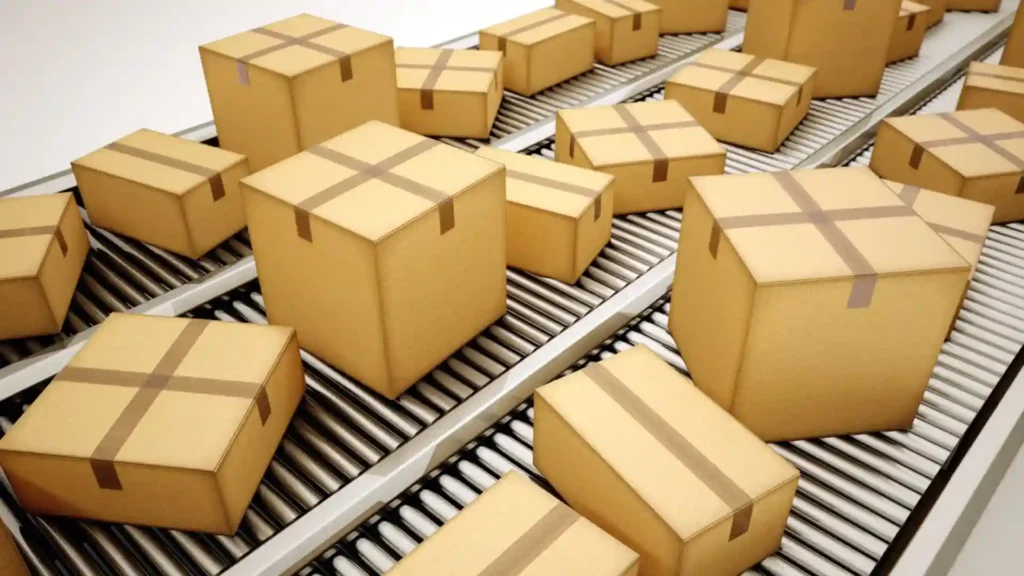
Are you an FMCG manufacturer? How fast can you produce good quality products? If you need a solution that ensures faster production with enhanced quality and greater ROI (Return on Investment), you must get a Machine Vision Inspection. You must be facing tough competition in the market. Fast Moving Consumer Goods are the fastest-selling and low-profit margin covering goods. Hence, you must stand out in the market.   Manufacturers that are still relying on human efficiency to inspect goods need a serious technological shift, or they will fall back into the line. Traditional Defect Detection System may include low digital involvement and high human dependency, whereas, in the case of Manufacturing Inspection Software, there will be low-to-no human interference.   Traditional methods are prone to a good sum of challenges such as:   Human dependency.   Lack of consistency due to different perceptions of humans.  Time-consuming inspection methodologies.   Often a poor-quality product may pass through the conveyor belt.   The production process may be hampered due to the absence of employees.  Conflicts among workers.   Too much rush on the floor space.   There are so many disadvantages to traditional inspection methods, and you will bid farewell to them once a Visual Defect Detection System is installed.   Find a Machine Vision Inspection for Your Business  There is a ton of Machine Inspection System in the market, but you must choose smartly. Look for the one which offers AI (Artificial Intelligence) integration such as Vision Inspection System by Trident Information Systems. Furthermore, various reasons encourage infusing technology with your production environment:   No Human Interference  In Visual Defect Detection, you do not need human interference, as everything is done using machines. With AI technology, you do not even have to make consistent modifications, the system can work perfectly in a similar environment. With no human interference, you can also expect to witness even fewer conflicts among floor space.   Free Floor Space  Handing over everything to the machine, you can free up a lot of floor space and let your staff roam freely when necessary. Employees won’t bump into one another and cause disturbance in the flow. Shifting goods from one space to another becomes even easier.   Consistency of Work   The machine offers consistency in work and encourages a smooth flow. Even if some staff is missing, the operational flow remains smooth. Humans may miss identifying a different spectrum of color, but Machine Vision Inspection can’t miss it. You get the same inspection quality as it is managed by a single software. However, you cannot expect the same from human Manufacturing Defect Detection.  Increased Profit   Expect an impressive return as a Machine Vision Inspection can help you achieve it. With better quality products in half time, you are going to catch fat clients. Become the leading FMCG producer in the market and enjoy a thick profit margin. Producing faster and excellent quality products will grab the buyer’s attention and you will in no time become their first preference.   Faster Reporting   A worker may delay reporting to you about the defective piece, but the machine won’t. It will flash an error in front of the person concerned. With faster reporting, you will only allow the ideal product to move ahead. This is an essential step in creating goodwill.  Competitive Edge   With an AI-integrated Machine Vision Inspection, the user gets a competitive edge. It spots defects straight on the conveyor belt with no human interference. Flexibility is in the genes of AI; it detects defects in a similar environment with no additional modifications. It gives you a competitive edge and ensures you are way ahead in the competition.   How Does Vision Intelligence System Detect Defects?  The Vision Intelligence System will help you detect even the smallest and hard-to-get-at-once defects such as:   Small unwanted components: such as small animals, insects, stones, dust, weed, leaves, plastic, and so on.   Color spectrum: It ensures the product is in the correct spectrum and doesn’t look odd.   Barcodes: It checks if the barcodes are properly printed and if there are no errors.   Labels and logos: It make sure your labels are printed accurately and the logo is situated in the right place.   Adhesion: It will immediately spot any tearing or breakage in the packaging.   Capping: It makes sure all the bottles are capped properly and none of them are loose.   Trident Information Systems have designed Vision Intelligence System considering manufacturer’s grievances and how we can push them ahead in the market competition. With a dedicated team of experts, we have managed to accomplish a robust track of accomplishments. You too can implement this Machine Vision System and see the results for yourself. Contact us for further information or a demonstration.  

Get Three times Better Quality FMCG Production with Vision Inspection System   Read More »