
Welcome to Trident Information Systems!
Write us to - info@tridentinfo.com
Let's Socialize

manufacturing visual quality inspection systems

Why are Manual Inspection Methods Not Effective Nowadays?

Have you been considering manual Defect Detection in Manufacturing so far? Don’t you think it is high time to switch to automation for faster and better-quality products? You are most likely to fall behind in the competition if you keep putting most of your time and resources into manual testing that does not even guarantee accuracy in some cases.   Manual testing might work in some areas, but it is not preferred every time since it comes with various drawbacks such as:   Low Accuracy   Humans are prone to make errors, and manual testing is more likely to make more errors than an automated solution. For example, in the case of glass manufacturing, human eyes might miss dust particles in a hassle, or they miss subtle scratches appearing on the glass surface. As soon as they notice it, there are chances the defective pieces have already found their way ahead.  Mandatory Human Interactions   In current times, where social distancing is the topmost priority, we need to avoid human interactions as much as possible. Batch testing (executing a series of tests) is possible. However, in each test case execution, human interaction becomes inevitable. If you switch to a Defect Detection Computer Version, everything gets automatic and needs no/less human interference.   Demands More Time and Resources  To cover each application area, you need to perform more Manufacturing Defect Detection tests. Creating test cases and their respective execution eats up a great deal of human effort and time. Checking up on each product, and informing the concerned person to take relevant steps, and taking up the same tests, repeatedly, can be exhausting and time-consuming.  Impractical Data Collection   Unnecessary data collection is one of the biggest drawbacks of manual inspections, collecting and comparing substantial amounts of data is impractical without automation. Preparing reports on products and reporting them to the relevant personnel can be time-consuming and prone to errors.   How does an automated intelligent machine system help?  The demand for higher productivity and better-quality output within the manufacturing industry has demanded an upgraded production inspection. A Visual Inspection in Manufacturing is more beneficial; you can assure better and faster defect detection. A Machine Vision Inspection can offer tremendous benefits such as:    Boosts Manufacturing Output   With automatic vision inspection, you can detect defects faster and make necessary modifications, you no longer must put your time and efforts into manual testing and reporting, instead spend it on other productive tasks and get a boosted ROI. The inspection is done in one station and there is no need to set multiple inspection sections.   Minimizes Inspection Time   In visual quality inspection, everything is done by the machine itself so you do not have to fuss on its accuracy and speed. There is no doubt that the machine version surpasses human vision in every level provided by its speed, repeatability, and speed. Machine vision can easily identify small objects and detect defects with lesser errors and reliability. Machine vision can inspect thousands of products and their parts in a minute on a production line.   Better Perception   Machine vision has a high resolution depending upon the technology and hardware that are being used for the object’s illustration. Automatic Defect Detection in Manufacturing has a better spectrum of visual perception. Moreover, the system is more reliable and can be programmed as required.   Anywhere Deployment   Such systems can be deployed anywhere, even in locations that are hazardous for humans. It is best for manufacturing products or solutions that may cause serious health hazards or injuries to humans.   Production Optimization   With this technology, you can easily interpret defects and solve them in the closest time possible. Analyze first output and resolve the core issue of the quality defects. You may as well use the permit fixers to highlight defective components and effectively digitalize the defect reporting process.   Promotes the Desired Outcome   With a Machine Vision Inspection, you can optimize your products and workforce. You can also eliminate the need for sampling products while using this technology. Also, you can revise all the defective products from the data storage and identify the root cause of defeated data in real-time. Automating these activities can make your production goals easier to achieve.   Minimize Future Costs   You can easily cut costs with a digital quality inspection (including rejected or returned items that could be damaged due to shipment-oriented packaging defects). Remove them before getting shipped and improve the end customer’s product quality experience.  Final Words   Manual Defect Data Detection in Manufacturing has become outdated. Automating your quality inspection can eliminate all the issues arising under manual quality inspection. Trident Information Systems is one of the best Vision Quality Inspection service providers.  

Why are Manual Inspection Methods Not Effective Nowadays? Read More »
How smart manufacturing can optimize your factories for the new era

The focus of every industrial revolution has been increasing the productivity of production systems. The fourth industrial revolution is here, and it’s seeking to improve both production and management systems. Digital transformation driven by smart manufacturing (also known as Industry 4.0) is the basis of this latest one – creating opportunities to achieve levels of productivity and specialization not previously possible. Combining data generated through the Industrial Internet of Things (IIoT) and analytics creates a new set of capabilities known as predictive maintenance and quality. Fueled by smart manufacturing, these new capabilities are changing the way we do and see business, helping recognizing patterns and predicting failures or product quality issues before they happen. Introducing the new industrial IoT platform Most factories are composed of operation technology (OT) assets such as machines, equipment lines and robotic devices that aren’t always connected. The current trend is leaning toward smart manufacturing with a more IT-based factory floor to help save time, labor, cost and maintenance and upkeep. With OT and IT converging, the IIoT platform is emerging as a new, innovative concept for smart manufacturing with artificial intelligence (AI)-based technologies, including analytics, big data and cognitive manufacturing. Smart manufacturing can spur a new surge of manufacturing productivity. Targeting the pain points for key manufacturing personnel In order to understand the impact of Industry 4.0 solutions, we must examine the key people involved in all aspects of a factory. True transformation happens when all unique challenges and each pain point is targeted. Transforming your factory with a three-tiered architecture solution from IBM Keeping the needs of different types of workers in mind and using our extensive manufacturing experience, IBM developed a three-tiered distributed architecture to implement smart manufacturing more efficiently. The model addresses the autonomy and self-sufficiency requirements of each production site and balances the workload between the three tiers. Mapping IBM’s three-tiered architecture. Edge level. The most physical part of the factory where product-related activities are performed. Plant or factory level. Where plant and local activities are orchestrated and connected. Enterprise level. Where analysis of all levels of information happens, and information storage for visualization and analytics is provided. Leveraging the three architecture tiers to drive performance IBM offers a suite of enterprise asset management (EAM) solutions to help drive cost savings and operational efficiency across the factory value chain. The portfolio of EAM solutions from IBM analyzes a variety of information from workflows, context and the environment to drive quality and enhance operations and decision making. The portfolio of EAM solutions from IBM helps deliver a smart manufacturing transformation. Production quality insights use IoT and cognitive capabilities to sense, communicate and self- diagnose issues to optimize each factory’s performance and reduce unnecessary downtime. Insights help reduce unplanned downtime.

How smart manufacturing can optimize your factories for the new era Read More »

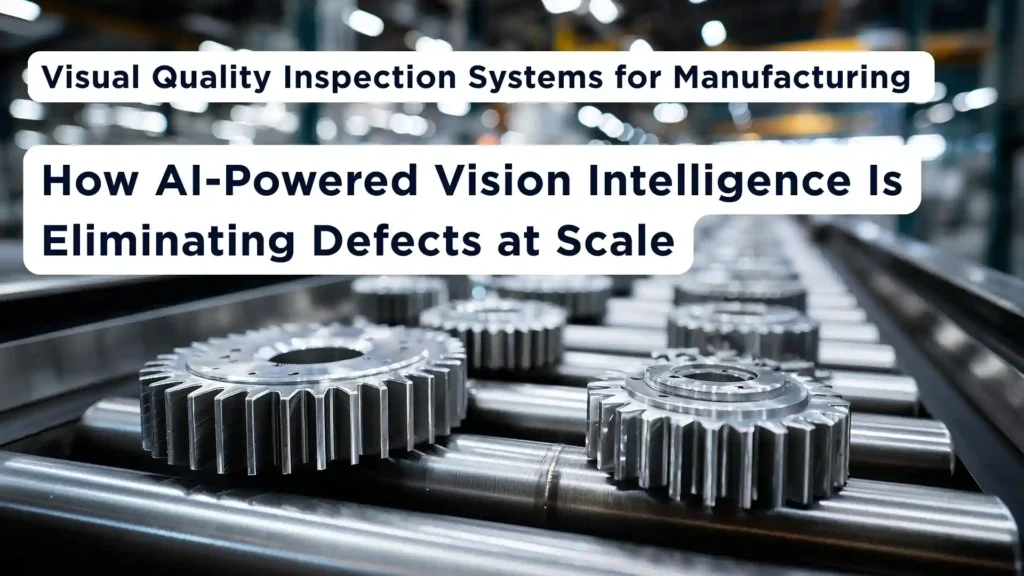
AI-powered visual inspection system detecting product defects on a manufacturing production line.

Visual Quality Inspection Systems for Manufacturing: How AI-Powered Vision Intelligence Is Eliminating Defects at Scale

In manufacturing, quality is not just a standard — it is a commercial obligation. A defective product that reaches the customer costs far more than the product itself: warranty claims, returns, reputation damage, regulatory penalties, and in industries like pharmaceuticals and automotive, potential safety liability. For decades, quality control in manufacturing depended almost entirely on human visual inspection — trained inspectors examining products at the end of the production line, relying on their eyes, experience, and concentration to detect defects before they reached the customer. The problem is that human inspection has fundamental, irreducible limitations. Attention lapses. Fatigue accumulates. Lighting conditions vary. And no matter how experienced the inspector, the error rate in human visual inspection means that some proportion of defective products will always pass through. Visual quality inspection systems — powered by digital imaging, optical sensors, AI, and machine learning — eliminate these limitations entirely. By replacing or augmenting human inspection with automated machine vision, manufacturers across automotive, pharmaceutical, FMCG, tobacco, and consumer goods industries are achieving inspection accuracy and throughput levels that human-only quality control simply cannot match. Trident’s Vision Intelligence System (VIS) platform brings industry-specific visual inspection solutions to manufacturers across India — with dedicated configurations for automotive, pharma, retail and FMCG, tobacco manufacturing, and safety compliance applications including face mask detection. This guide covers everything you need to know about visual quality inspection systems — how they work, what they deliver, and how Trident’s VIS platform addresses the specific inspection requirements of your industry. Why Manual Quality Inspection Is No Longer Enough The Real Cost of Human Error in Manufacturing Quality Control Manual visual inspection has served manufacturing quality control for generations — but its limitations have always been present. The critical question is not whether human inspectors make errors — they do, consistently and predictably — but whether those errors are acceptable given the commercial and safety stakes involved. In most modern manufacturing environments, they are not: What Modern Visual Quality Inspection Systems Replace Visual quality inspection systems do not just make existing inspection processes faster — they replace the fundamental dependency on human judgment for defect detection with objective, measurable, consistently applied machine vision criteria. The result is a quality control function that operates at production speed, maintains consistent accuracy across every shift and every unit, generates quantitative defect data for process improvement, and enables real-time corrective action before defective products progress further down the production line. What Is a Visual Quality Inspection System and How Does It Work? A visual quality inspection system is an automated quality control solution that uses digital cameras, optical sensors, and computer vision software to capture images of products during or after production — and then analyzes those images against defined quality parameters to accept or reject each unit. The Core Components of a Machine Vision Inspection System Every visual quality inspection system — regardless of industry application — consists of four fundamental components working together: 1. Imaging hardware — high-resolution digital cameras, line scan cameras, or 3D imaging systems capture images of every product as it moves through the production or inspection station. The choice of imaging hardware depends on the product type, production speed, and the nature of the defects being detected. Lighting systems — LED ring lights, backlit panels, structured light projectors — are configured to maximize defect visibility for the specific inspection application. 2. Sensor integration — RFID tags, QR codes, barcode readers, and proximity sensors provide product identification and triggering signals — ensuring the imaging system captures each unit at precisely the right moment and associates inspection results with specific product batches and serial numbers. 3. Image processing and AI analysis — captured images are processed in real time by computer vision algorithms — including deep learning models trained on examples of acceptable and defective products. The system measures specific characteristics: dimensions, surface finish, color consistency, label placement, fill levels, seal integrity, and hundreds of other parameters depending on the application. AI-powered systems continuously improve their detection accuracy as they accumulate inspection data. 4. Decision and action layer — based on the analysis results, the system makes an accept or reject decision for each unit — and triggers appropriate actions: pass-through for accepted units, diversion or rejection for non-conforming units, and alert generation for systematic defect patterns that indicate a production process issue requiring investigation. How Visual Inspection Systems Make Decisions Modern visual quality inspection systems make inspection decisions through a combination of traditional machine vision techniques and AI-powered deep learning: 5 Key Benefits of Visual Quality Inspection in Manufacturing 1. Faster Inspection Without Sacrificing Accuracy The most immediate and measurable benefit of automated visual inspection is the combination of inspection speed and accuracy that no human inspection process can match. A machine vision system can inspect hundreds or thousands of units per minute — at full production line speed — without the accuracy degradation that accompanies high-speed human inspection. For high-volume manufacturers, this means quality control no longer constrains production throughput — the inspection system keeps pace with production, not the other way around. The time savings extend beyond the inspection process itself. Automated inspection systems generate instant, quantitative results — eliminating the documentation, reporting, and data compilation time associated with manual inspection processes. 2. Elimination of Human Error From Quality Control Human inspection error is not a management or training problem — it is a physiological reality. The human visual system has limitations in resolution, consistency, and sustained attention that cannot be overcome through training or motivation. Visual quality inspection systems have no such limitations: The practical result is a dramatically lower defect escape rate — the proportion of defective products that pass inspection and reach the customer or the next production stage. 3. Adaptable to Every Production Process and Use Case One of the most commercially significant characteristics of modern visual quality inspection systems is their adaptability. When production parameters change — new product variants, modified specifications, updated packaging, new defect types — the inspection system can be

Visual Quality Inspection Systems for Manufacturing: How AI-Powered Vision Intelligence Is Eliminating Defects at Scale Read More »