Running a sweet manufacturing business in 2026 is more complex than ever — and most owners are managing that complexity with tools that were never built for it.
Handwritten production records. Spreadsheet-based inventory counts. Manual recipe scaling. Gut-feel demand forecasting ahead of Diwali. The result is predictable: wasted raw materials, inconsistent product quality, compliance gaps, and margins that shrink a little more every season.
India’s manufacturing ERP market is growing at a 7.45% CAGR and is projected to reach USD 2.94 billion by 2032. Over 62% of mid to large-scale manufacturers have already implemented ERP — because the sweet manufacturers still running on manual processes are falling behind those who haven’t.
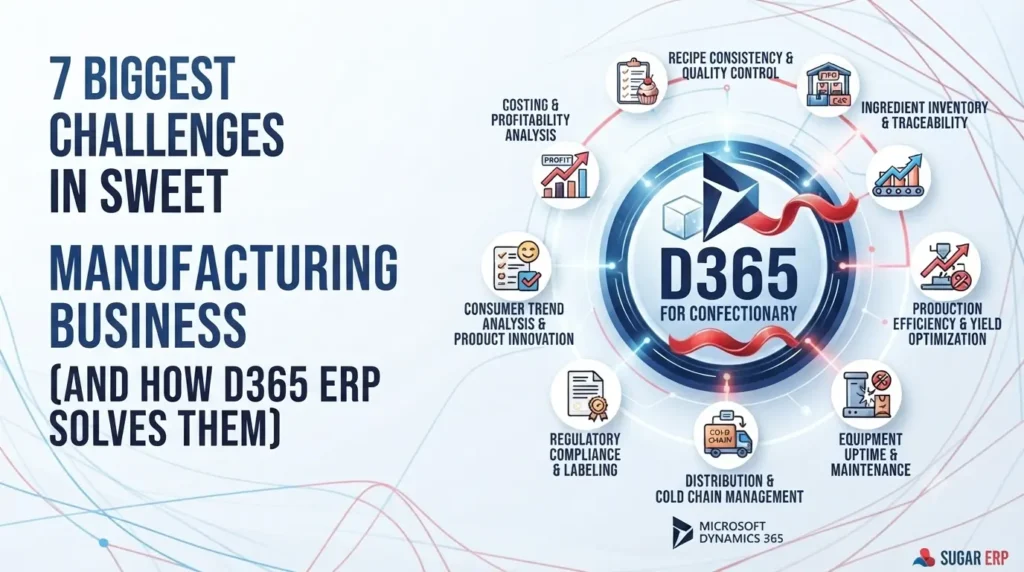
Here are the 7 biggest challenges in sweet manufacturing — and exactly how Microsoft Dynamics 365 ERP solves each one.
Challenge #1: Inconsistent Recipe Execution and Product Quality
The Problem
When production staff measure ingredients manually or rely on memory, variations creep in with every batch. One day’s kaju katli is perfect. The next batch uses 8% more cashew than the recipe requires. Quality suffers, costs rise, and customer trust erodes.
How D365 ERP Solves It
Dynamics 365 stores standardised digital recipes with exact ingredient quantities for every SKU. When a production order is raised, the system calculates precise material requirements automatically — eliminating manual measurement errors and ensuring every batch meets the same quality standard, every time.
Challenge #2: Raw Material Waste and Expiry Losses
The Problem
Perishable raw materials — ghee, mawa, milk solids, dry fruits — have limited shelf lives. Without a system tracking batch-level expiry dates, older stock gets buried behind new deliveries and expires before use. The pharmaceutical and food industry together lose billions annually to this exact problem.
How D365 ERP Solves It
D365 enforces FIFO (First In, First Out) automatically across every raw material. Expiry alerts fire well before the critical date. Slow-moving stock is flagged for prioritised use — turning potential write-offs into recovered margin. Sweet manufacturers using ERP consistently report 20–35% reduction in raw material waste within the first year.
Challenge #3: Seasonal Demand Forecasting Failures
The Problem
Diwali, Holi, Eid, and wedding season create massive, unpredictable demand spikes. Most sweet manufacturers either overproduce — writing off unsold finished goods — or underproduce and lose their biggest revenue window of the year. Manual forecasting simply cannot process the variables involved accurately.
How D365 ERP Solves It
Dynamics 365 uses historical sales data, seasonal patterns, and live order information to generate accurate production forecasts at SKU level. Production is planned to match real demand — not estimates. AI-driven forecasting in D365 reduces forecast error rates significantly, freeing up working capital tied up in excess inventory.
Challenge #4: Uncontrolled Production Costs
The Problem
Most sweet manufacturers do not know the true cost of producing 1 kg of their most popular product. Ingredient costs, labour, packaging, overheads, and wastage are tracked separately — or not at all. Without accurate product costing, pricing decisions are guesswork and margin leaks go undetected.
How D365 ERP Solves It
D365 calculates actual product cost in real time — allocating raw materials, labour, packaging, and overhead to every production batch automatically. Managers see the true cost per kg, per SKU, per batch — and can identify exactly where margin is being lost before it compounds into a serious profitability problem.
Challenge #5: FSSAI Compliance and Audit Readiness
The Problem
Sweet manufacturers face strict FSSAI regulations — ingredient declarations, batch traceability, hygiene standards, and labelling requirements. Managing compliance manually across high-volume production is error-prone and time-consuming. An unexpected inspection with incomplete records can result in penalties, product recalls, or licence suspension.
How D365 ERP Solves It
Dynamics 365 maintains audit-ready documentation automatically — batch records, ingredient logs, supplier traceability, and production quality checks are all captured in real time. FSSAI inspection reports are generated from the system in minutes, not days. Your business stays compliant without your team spending hours on paperwork.
Challenge #6: Inventory Visibility and Procurement Inefficiency
The Problem
Without real-time inventory visibility, sweet manufacturers purchase raw materials that are already in stock — tying up capital unnecessarily. Or they run out of critical ingredients mid-production run because nobody noticed stock dropping below the minimum level. Both scenarios are common. Both are expensive.
How D365 ERP Solves It
D365 provides real-time inventory visibility across every raw material, packaging component, and finished good. Automated purchase orders are triggered when stock falls below minimum levels — based on actual consumption data, not guesswork. Vendor price history and lead times are tracked centrally, giving procurement teams the data to negotiate better and buy smarter.
Challenge #7: No Visibility Into Business Performance
The Problem
When production records, inventory, sales, and finances all live in different systems — or in notebooks — getting an accurate picture of business performance requires days of manual reconciliation. By the time you know how last month went, this month’s decisions are already being made without that information.
How D365 ERP Solves It
Microsoft Dynamics 365 integrates production, inventory, procurement, sales, and finance into a single platform — with live Power BI dashboards that give sweet manufacturers a real-time view of revenue, margins, production costs, and profitability by product, batch, or time period. Decisions that used to take days of data gathering now take seconds.
Why Microsoft Dynamics 365 Is the Right ERP for Sweet Manufacturers
D365 is not a generic ERP adapted for food manufacturing. It is a scalable, cloud-native platform with food-specific capabilities — recipe management, batch production, FSSAI compliance, GST billing, and AI-powered demand forecasting — all configurable to the specific production workflows of sweet and namkeen manufacturers.
The India manufacturing ERP market shows 54% of food manufacturers are now actively investing in ERP tools specifically to reduce waste and track production efficiency. The sweet manufacturers who act now build a cost and quality advantage that compounds with every production cycle.
Seven challenges. One platform. Microsoft Dynamics 365.
Trident Information Systems is a Microsoft-certified Dynamics 365 implementation partner with deep expertise in food and sweet manufacturing ERP. With 250+ successful engagements across India, UAE, UK, and Africa — we configure D365 to match your production workflows from day one. Talk to our experts at tridentinfo.com/contact.