
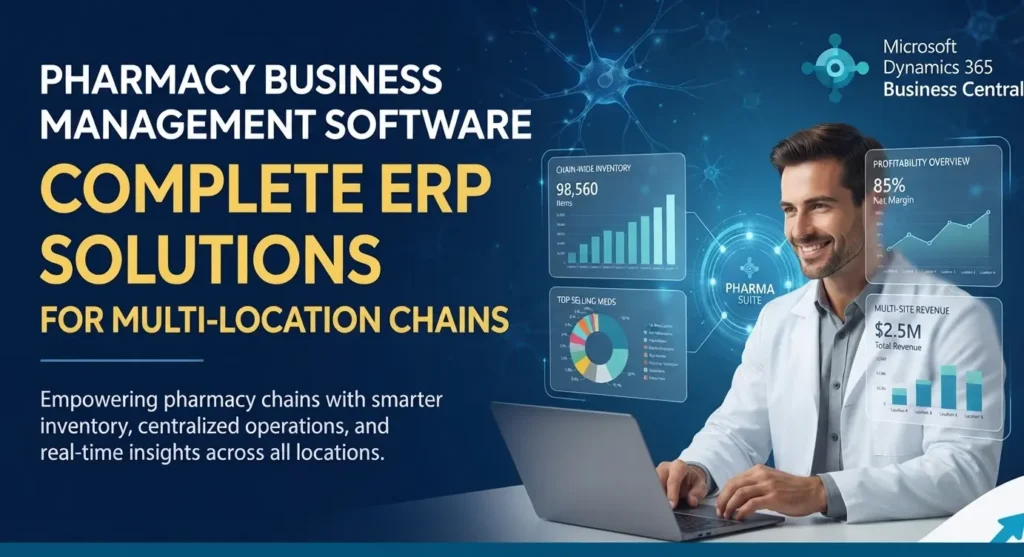
Owning one pharmacy is challenging. Owning a chain of them — without the right software — is a different problem entirely. Disconnected billing systems across branches. Inventory that doesn’t sync in real time. Patient records locked to a single outlet. Compliance documentation scattered across locations. Finance teams reconciling data manually at month-end while decisions wait.
These are not edge cases. They are the daily operational reality for pharmacy chains running without a unified ERP solution — and in 2026, the cost of this gap is measurable and growing.
The global pharmacy management system market grew from USD 30.98 billion in 2025 to USD 35.62 billion in 2026 — a 15% year-on-year jump. Chained pharmacies are the fastest-growing segment, posting a 17.1% CAGR through 2030. The reason is simple: pharmacy chains that invest in complete ERP solutions are pulling ahead operationally, financially, and competitively.
This is your complete guide to pharmacy business management software for multi-location chains in 2026.
What Is Pharmacy Business Management Software?
Pharmacy business management software is an integrated ERP platform that unifies every operational function of a pharmacy chain — inventory, billing, purchasing, patient records, loyalty, compliance, and financial reporting — into a single system accessible across all locations in real time.
It is not just a POS upgrade. It is the operational backbone that allows a pharmacy chain to function as one coherent business — rather than a collection of disconnected outlets making independent decisions on incomplete data.
Why Multi-Location Pharmacy Chains Need a Complete ERP Solution
1. Centralised Inventory Management Across All Branches
The most expensive operational failure in any pharmacy chain is stock imbalance. One branch overstocked with slow-moving SKUs. Another turning away patients due to stockouts of critical medicines. Both problems happening simultaneously — and nobody at head office knowing until it is too late.
A complete pharmacy ERP provides real-time stock visibility across every outlet on one dashboard. Automatic reorder triggers fire when stock falls below minimum levels. Inter-branch transfers are initiated within the system in seconds. Purchasing decisions are made at chain level with full visibility into what every location needs — eliminating duplicate orders and reducing dead stock across the network.
Over 70–80% of pharmacy assets are tied up in drug inventory. Getting this right is not an operational improvement — it is a financial imperative.
2. Unified Patient Records and Prescription Management
In a well-run pharmacy chain, a patient should be able to walk into any branch and receive seamless, informed service — with their full prescription history, chronic medication records, loyalty points, and purchase history instantly available to the pharmacist.
Without a unified ERP, this is impossible. Patient data is trapped in individual branch systems. Each visit to a different outlet starts from zero.
Pharmacy business management software creates a single patient profile accessible across all locations in real time. Prescription refill reminders are automated. Chronic medication tracking follows the patient — not the branch. The result is a personalised, consistent experience that builds the kind of patient loyalty pharmacy chains cannot achieve with disconnected systems.
3. Automated Compliance and Audit Readiness
Multi-location pharmacy chains face compliance requirements that multiply with every new outlet — drug licensing, Schedule H and H1 records, GST invoicing, narcotic registers, and FSSAI documentation. Managing these manually across five, ten, or fifty branches is not just inefficient — it is a regulatory risk.
A complete pharmacy ERP maintains audit-ready compliance documentation automatically across every branch. Every prescription dispensed, every controlled drug transaction, every purchase order and batch record is logged in real time — accessible from a central dashboard and exportable for regulatory inspection in minutes. No manual preparation. No compliance gaps.
4. Centralised Procurement and Vendor Management
Without central procurement, each branch manager orders independently — often from different suppliers at different prices, with no visibility into chain-wide purchasing volumes or negotiated agreements. The result is fragmented buying power, inconsistent pricing, and significant cost leakage.
Pharmacy ERP centralises procurement across the entire chain. Purchase orders are generated automatically based on real consumption data. Preferred vendor lists and centrally negotiated pricing apply across all branches. Supplier performance — delivery accuracy, price consistency, lead times — is tracked centrally, giving chain management the data to negotiate better terms and reduce procurement costs.
5. Real-Time Financial Reporting Across All Locations
When each branch runs separate billing and finance, chain-level profitability requires days of manual reconciliation. Which branch has the best margins? Which product categories are dragging performance? Which location has the highest shrinkage? These questions should have instant answers — not week-old ones.
Pharmacy business management software consolidates financial reporting across all outlets in real time. Revenue, margins, cost of goods, and profitability are visible by branch, by product, by category, or by time period — from a single Power BI dashboard. GST returns and purchase reconciliation are generated automatically. Month-end close that used to take days happens in hours.
6. Scalability for Chain Expansion
Every time a traditional pharmacy chain opens a new branch, it faces the same IT challenge — procuring hardware, installing software, configuring systems, and integrating with existing outlets. This slows expansion and increases upfront investment per location.
Cloud-based pharmacy ERP eliminates this entirely. A new branch connects to the existing platform within hours — with the same inventory system, patient records, compliance documentation, and reporting tools already live. The chain scales without IT complexity standing in the way.
Key Capabilities of a Complete Pharmacy ERP
| Capability | Business Impact |
|---|---|
| Real-time multi-branch inventory | Eliminate stockouts and dead stock |
| Centralised patient profiles | Consistent service across all outlets |
| Automated expiry and FIFO tracking | Reduce medicine wastage |
| GST-compliant billing | Accurate invoicing across all locations |
| Schedule H/H1 compliance | Audit-ready at all times |
| Centralised procurement | Better pricing, lower costs |
| Power BI dashboards | Live chain-wide profitability visibility |
| Cloud scalability | New branches live within hours |
Why Trident’s Pharmacy ERP Solution Stands Apart
Trident Information Systems delivers a Microsoft Dynamics 365-based pharmacy business management solution specifically configured for multi-location pharmacy chains.
With over 250+ successful customer engagements across India, UAE, UK, Africa, and Southeast Asia — and a decade of Microsoft-certified implementation expertise — Trident builds pharmacy ERP solutions that go live on time, configured for your workflows, and supported long after go-live.
From real-time inventory and automated compliance to centralised procurement and live financial dashboards — Trident’s pharmacy ERP gives chain operators the control, visibility, and scalability to run their business like one unified operation.
In 2026, pharmacy chains that run on complete ERP solutions outperform those that don’t — in efficiency, compliance, profitability, and growth. Talk to Trident’s pharmacy ERP specialists today and get a solution roadmap built around your chain’s specific needs. Visit tridentinfo.com/contact.

