Welcome to Trident Information Systems!
Write us to - info@tridentinfo.com
Let's Socialize

BI report

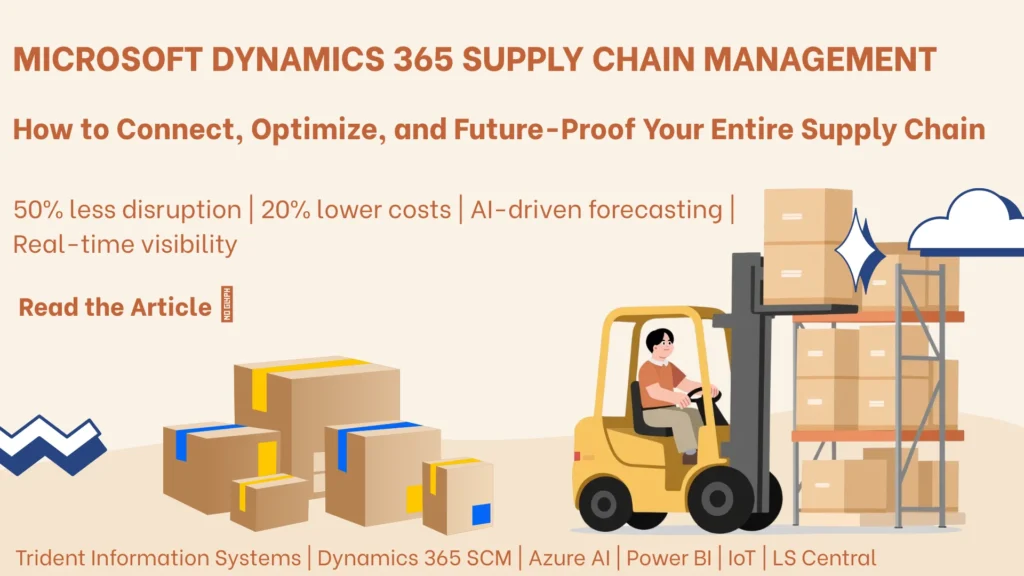
Microsoft Dynamics 365 Supply Chain Management dashboard tracking inventory, logistics, and operations.

Microsoft Dynamics 365 Supply Chain Management: How to Connect, Optimize, and Future-Proof Your Entire Supply Chain

Think about how your supply chain works today. Raw materials arrive — hopefully on time, hopefully in the right quantities. Production is planned — hopefully matching actual demand. Finished goods move to warehouses — hopefully with accurate inventory records. Orders are fulfilled and delivered — hopefully within the window your customers expect. The problem with a supply chain built on “hopefully” is that it becomes visible in the worst possible moments: the stockout that loses you a major order, the warehouse error that sends the wrong product to the wrong customer, the demand spike that catches you under-prepared, or the supplier failure that creates a production shutdown nobody saw coming. Microsoft Dynamics 365 Supply Chain Management replaces “hopefully” with certainty — connecting every function in your supply chain on a single intelligent platform, powered by real-time data, AI-driven forecasting, and automated processes that respond to change faster than any manual system can. From inventory management and demand forecasting through warehouse operations, transportation, procurement, and quality control — Dynamics 365 Supply Chain Management gives organizations the unified visibility and operational control to run a supply chain that is not just efficient today, but resilient and adaptable for whatever tomorrow brings. This guide covers the full scope of what Dynamics 365 Supply Chain Management delivers — the core capabilities, the business benefits, and how Trident Information Systems implements it for organizations across India. What Is Supply Chain Management and Why Does It Need Modernizing? Supply chain management encompasses every process involved in getting a product from raw material to customer — procurement, production planning, inventory management, warehousing, transportation, and order fulfilment. When these processes work together seamlessly, organizations can deliver products faster, at lower cost, with higher quality and greater customer satisfaction. When they do not — when each function operates on its own system, its own data, and its own timeline — the gaps between functions become the primary source of supply chain cost, delay, and risk. The Real Cost of an Outdated Supply Chain in 2026 Supply chain inefficiency is not abstract. It shows up in measurable, bottom-line costs that compound over time: Post-pandemic supply chain disruption has made these vulnerabilities more visible and more costly than ever before. Organizations that invested in supply chain technology before the disruptions were significantly better positioned to adapt — and those that did not are catching up under pressure. What a Modern, Connected Supply Chain Actually Looks Like A modern supply chain does not just move goods from A to B more efficiently. It anticipates, adapts, and learns. It uses AI to predict demand before it becomes obvious. It uses IoT to monitor assets and inventory in real time. It uses automation to execute routine decisions instantly, freeing human judgment for the decisions that actually require it. Microsoft Dynamics 365 Supply Chain Management is the platform that makes this possible — connecting every supply chain function on a single system, with real-time data and embedded intelligence that transforms reactive operations into proactive, resilient ones. How Microsoft Dynamics 365 Supply Chain Management Works A Single Platform Connecting Every Supply Chain Function The foundational design principle of Dynamics 365 Supply Chain Management is unification. Rather than operating inventory management, warehouse management, transportation, and procurement on separate systems that exchange data through scheduled integrations — Dynamics 365 connects all of these functions on a single platform and a single data model. This means: When every function operates from the same data, the decisions made in each function are automatically informed by the context of every other function. That alignment — which manual systems and siloed applications can never reliably achieve — is the foundation of supply chain competitive advantage. Built on Microsoft Azure: Cloud-Native Supply Chain Intelligence Microsoft Dynamics 365 Supply Chain Management is built on Microsoft Azure — providing the cloud infrastructure, data processing, and AI capabilities that modern supply chain intelligence requires: Core Capabilities of Microsoft Dynamics 365 Supply Chain Management 1. Intelligent Inventory Management Inventory management is the function where supply chain technology delivers some of its most immediate and visible business impact — because inventory is both a major cost driver and a direct enabler of customer satisfaction. Microsoft Dynamics 365 Supply Chain Management transforms inventory management from a reactive, manual process into an intelligent, automated one: The business impact of intelligent inventory management is direct and measurable: lower safety stock requirements, fewer stockouts, reduced carrying costs, and better cash flow — all without sacrificing service levels. 2. Advanced Warehouse Management Your warehouse is the operational heartbeat of your supply chain — and how efficiently it operates directly determines your ability to fulfil orders accurately, quickly, and cost-effectively. Microsoft Dynamics 365 Supply Chain Management includes a comprehensive advanced warehouse management system (WMS) that gives operations teams the tools to optimize every movement of goods through the facility: 3. End-to-End Tracking and Traceability In industries where product quality, safety, and regulatory compliance are critical — pharmaceuticals, food and beverage, medical devices, chemicals, electronics — the ability to trace every product through every stage of the supply chain is not a nice-to-have. It is a legal and commercial requirement. Microsoft Dynamics 365 Supply Chain Management provides comprehensive end-to-end tracking and traceability: 4. AI-Powered Demand Forecasting The most expensive supply chain decisions are made in response to demand — how much to produce, how much to stock, what to order from suppliers. When those decisions are based on accurate demand forecasts, costs are minimized and service levels are maximized. When they are based on inaccurate forecasts or gut instinct, the result is either costly overstock or damaging stockouts. Microsoft Dynamics 365 Supply Chain Management integrates with Azure Machine Learning to deliver AI-powered demand forecasting that goes far beyond traditional historical averaging: The business impact of accurate demand forecasting compounds across the supply chain: lower safety stock requirements, better supplier order timing, more efficient production scheduling, and higher service levels — all simultaneously. 5. Warehouse and Material Handling Automation As warehouse operations scale, the efficiency
Microsoft Dynamics 365 Supply Chain Management: How to Connect, Optimize, and Future-Proof Your Entire Supply Chain Read More »

Microsoft Azure security dashboard monitoring cyber threats, cloud protection, and data backup.

Microsoft Azure Enterprise Security: How to Protect Your Business Data Against Cyber Threats, Outages, and Data Loss

Here is a question that should make every IT leader uncomfortable: if your organization suffered a significant cyberattack at 9am tomorrow morning, how confident are you — genuinely confident — in your ability to recover? Not hopeful. Not fairly confident. Genuinely, documentably confident — because you have tested your recovery plan, you know your Recovery Time Objective, and you know that your backup data is clean, current, and accessible even if your primary environment is completely compromised. If that confidence is not there, you are not alone. And the stakes have never been higher. Ransomware attacks on enterprise systems are increasing in frequency, sophistication, and financial impact. Data breaches are exposing sensitive customer and commercial information at a scale that would have seemed extraordinary just five years ago. And regulatory consequences — financial penalties, reputational damage, and operational disruption — are following those incidents with increasing severity. Microsoft Azure enterprise security is the answer to this challenge — providing an integrated, multi-layered security, backup, and disaster recovery architecture that gives organizations the genuine confidence that their data is protected, their systems can recover, and their business can keep running through whatever the threat landscape throws at them. Azure is not simply a cloud platform with security features added. It is a platform that was engineered with security as a foundational design principle — built on customized hardware with security controls embedded at every layer, defended by 8,500 dedicated security professionals globally, and continuously updated by AI systems analyzing trillions of security signals every single day. This guide covers every dimension of Microsoft Azure’s enterprise security capability — backup, disaster recovery, threat protection, identity management, compliance, and the AI-powered intelligence that makes Azure one of the most secure enterprise cloud environments available in 2025. Why Enterprise Data Security Has Never Been More Critical The Evolving Cyber Threat Landscape in 2026 The cybersecurity threat environment that enterprise IT teams face in 2026 is qualitatively different from what it was even three years ago. The combination of increasingly sophisticated threat actors, AI-powered attack tools, and an expanding attack surface — created by hybrid work, IoT proliferation, and multi-cloud environments — means that traditional perimeter-based security is no longer sufficient. The numbers make the challenge concrete: For Indian enterprises specifically, the implementation of the Digital Personal Data Protection (DPDP) Act 2023 adds a regulatory dimension to data security — with penalties for inadequate data protection that create financial risk alongside the operational risk of a breach. The Three Questions Every IT Leader Must Be Able to Answer In a security incident, there are three questions that separate organizations that recover quickly from those that do not: 1. “Is our data safe and intact?” This requires confidence in your backup strategy — that every critical system is backed up, that backups are tested and restorable, and that backup data is isolated from the primary environment so that an attack cannot encrypt both simultaneously. 2. “How long will it take to recover?” This requires a defined, tested Recovery Time Objective (RTO) — the maximum acceptable time between an incident and the restoration of normal operations. Organizations without a tested DR plan frequently discover that their actual recovery time is orders of magnitude longer than their assumed one. 3. “What did we lose?” This requires a defined Recovery Point Objective (RPO) — the maximum acceptable amount of data loss measured in time. An RPO of four hours means you can afford to lose up to four hours of transaction data. An RPO of zero means you need real-time replication to a secondary environment. Microsoft Azure provides the infrastructure, services, and tools to answer all three questions confidently — with documented SLAs backing every commitment. Microsoft Azure: The Enterprise Cloud Security Platform Microsoft Azure is the world’s second-largest cloud platform — serving hundreds of thousands of enterprise organizations globally, including many of the world’s most security-sensitive institutions: government agencies, financial services organizations, healthcare systems, and defense contractors. This trust has been earned through a security architecture that is genuinely different from what most organizations can build independently. How Azure’s Security Architecture Is Different Azure’s security architecture is built on a principle that Microsoft calls assume breach — designing every system on the assumption that a breach may occur, and engineering to minimize the impact, detect it quickly, and recover rapidly. This principle drives every layer of Azure’s security design: Azure’s Global Security Infrastructure: Scale and Expertise The security investment Microsoft makes in Azure is simply not replicable by most organizations building their own security capability: Azure Backup: Never Lose Critical Business Data Again Data loss is one of the most devastating events an organization can experience — and in 2025, it is also one of the most preventable. Azure Backup provides enterprise-grade data protection for on-premises workloads, cloud-based applications, and Azure virtual machines — with the automation, scalability, and reliability that enterprise backup requires. What Azure Backup Protects Azure Backup provides comprehensive protection for virtually every workload in your enterprise environment: Key Azure Backup Capabilities Offload on-premises backup infrastructure Azure Backup eliminates the need for on-premises backup hardware, software, and the ongoing management overhead that comes with it. Your backups go directly to Azure’s cloud storage — with Microsoft managing the infrastructure, the replication, and the retention — while you retain full control over backup policies and recovery operations. For organizations still running tape-based or legacy backup solutions, Azure Backup represents a fundamental simplification — lower cost, lower management overhead, and dramatically better reliability. Automated backup management Configure backup policies once — frequency, retention period, consistency requirements — and Azure Backup executes them automatically. No backup job monitoring, no failed job alerts going to an already-overloaded IT team. Backups happen on schedule, and exceptions are flagged automatically. Pay-as-you-use storage model Azure Backup uses a consumption-based pricing model — you pay for the backup storage you actually consume, not a fixed capacity you have to provision upfront. As your data volumes grow, backup storage scales automatically — with

Microsoft Azure Enterprise Security: How to Protect Your Business Data Against Cyber Threats, Outages, and Data Loss Read More »

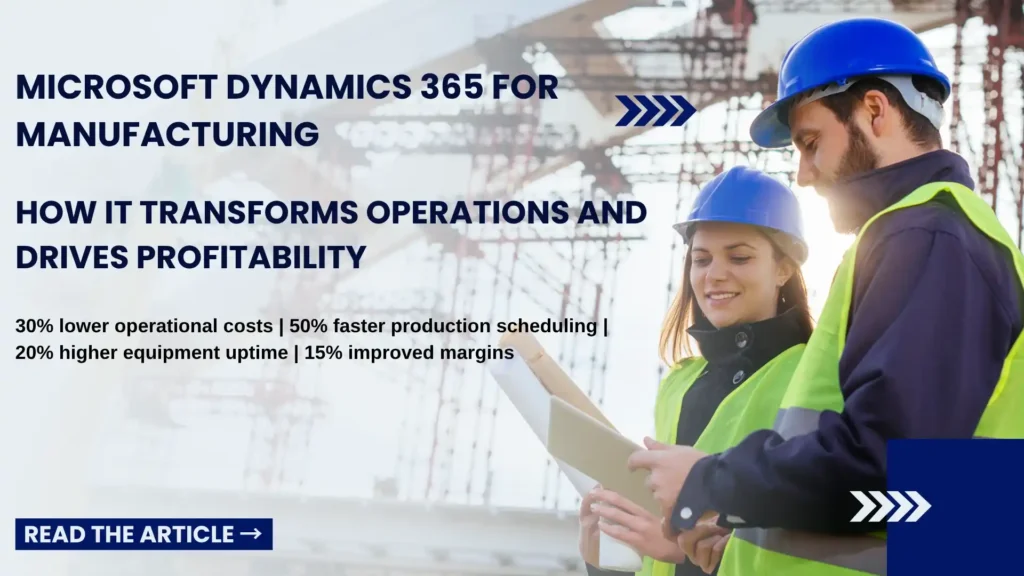
Microsoft Dynamics 365 dashboard managing manufacturing operations, production, and supply chain performance.

Microsoft Dynamics 365 for Manufacturing: How It Transforms Operations and Drives Profitability

Every manufacturer faces the same pressure: produce more, faster, at lower cost — without compromising quality. Meeting that demand with disconnected systems, manual processes, and limited supply chain visibility is not just difficult. It is becoming impossible. The manufacturers pulling ahead in 2025 are those who have replaced fragmented tools with a single, intelligent ERP platform that connects every function of their operation. Microsoft Dynamics 365 for manufacturing is that platform. Built for the complexity of modern manufacturing — from production planning and supply chain management to asset monitoring, quality control, and financial reporting — Dynamics 365 gives manufacturers the real-time visibility, automation depth, and data-driven intelligence to operate at their best. Here are five ways it makes that happen. Why Manufacturing Businesses Need a Modern ERP in 2026 The Real Cost of Outdated Manufacturing Systems Running a manufacturing business on legacy ERP systems — or worse, on spreadsheets and disconnected tools — creates hidden costs that compound over time. Production schedules that do not reflect real material availability. Supply chain decisions made without current data. Asset failures that were not predicted. Quality issues caught too late. Financial reports that take days to compile. Each of these is a cost. Together, they represent the difference between a manufacturing operation that competes effectively and one that is perpetually behind. Microsoft Dynamics 365 addresses all of them — in a single, cloud-native platform that connects every function of the manufacturing business from one unified data model. 5 Ways Microsoft Dynamics 365 Transforms Manufacturing 1. Smarter Supply Chain Operations Supply chain complexity is the defining operational challenge for most manufacturers. Sales data, supplier performance, order fulfilment status, product quality metrics, and logistics information all need to be visible simultaneously — and acted on in real time. Dynamics 365 brings all of this together on one platform. By connecting your business data, supply chain data, and external inputs like demand signals and logistics tracking through built-in artificial intelligence and machine learning, it enables manufacturers to: The result is a supply chain that is proactive rather than reactive — and that is a fundamental competitive shift. 2. Intelligent Asset Management Unplanned equipment downtime is one of the most expensive events in any manufacturing operation. When a critical machine fails without warning, the cost is not just the repair — it is the lost production, the missed delivery commitments, and the knock-on disruption to every downstream process. Dynamics 365 enables manufacturers to move from reactive maintenance to predictive maintenance. By combining the ERP with IoT-connected sensors on production equipment, you can: The business impact is direct: more uptime, lower maintenance costs, and longer asset lifespans. 3. Faster Innovation and Shorter Time to Market In manufacturing, speed to market is a competitive weapon. The faster you can develop a new product, refine a production process, or respond to changing customer requirements — the more market share you can capture before competitors catch up. Dynamics 365 gives product development and operations teams the real-time data visibility they need to innovate faster: Shorter development cycles. Faster process refinement. Quicker response to market changes. These are tangible competitive advantages — and they are built on data visibility that Dynamics 365 makes possible. 4. Turn Business Data Into Competitive Advantage Modern manufacturing generates enormous volumes of data — from production equipment, quality systems, supply chain transactions, and customer interactions. Most of this data is either underused or completely ignored. Dynamics 365 changes that. Its built-in AI and analytics capabilities — powered by Azure Machine Learning and Microsoft Power BI — transform operational data into actionable business intelligence: Manufacturers who use their data effectively make better decisions, faster. Dynamics 365 is the platform that makes this possible — without requiring a dedicated data science team. 5. Increase Profitability Across the Operation Every improvement above contributes to the same outcome: higher profitability. Less downtime means more productive hours. Better supply chain management means lower procurement costs. Faster time to market means more revenue captured. Better quality control means fewer returns and less rework. Smarter use of data means fewer costly mistakes. Dynamics 365 equips manufacturers with the tools to eliminate waste, reduce errors, serve customers better, and operate more efficiently — all of which flow directly to the bottom line. Key Features of Dynamics 365 for Manufacturing Feature What It Delivers MRP and production planning Align materials, capacity, and schedules in real time IoT asset monitoring Predictive maintenance and real-time equipment visibility Quality management In-process checks, batch traceability, compliance documentation Warehouse management Optimised storage, directed picking, real-time inventory Demand forecasting AI-powered planning that anticipates market changes Financial management Real-time cost visibility across every production process Power BI dashboards Live KPI reporting for every level of the organisation Real Results: What Manufacturers Achieve With Dynamics 365 Manufacturers implementing Microsoft Dynamics 365 through Trident consistently report measurable improvements: Why Trident Is India’s Trusted Dynamics 365 Manufacturing Partner As a certified Microsoft Dynamics 365 implementation partner, Trident Information Systems has helped manufacturers across India — spanning discrete manufacturing, process manufacturing, and mixed-mode operations — implement ERP solutions that deliver real, measurable outcomes. Our manufacturing implementations cover everything from production planning and supply chain integration to IoT asset management, quality control, and Power BI analytics — configured for the specific requirements of your operation, not a generic template. Ready to transform your manufacturing operation with Microsoft Dynamics 365? Book a free manufacturing ERP assessment with Trident today — and discover exactly where connected intelligence can deliver the most immediate value for your business. For more insightful content and industry updates, follow our LinkedIn page.

Microsoft Dynamics 365 for Manufacturing: How It Transforms Operations and Drives Profitability Read More »

AID for Retailers : Trident’s Ls Retail Solution

[vc_row][vc_column width=”1/2″][vc_column_text] Problems faced by Retailers With the advance in technology, many retailers are facing mounting pressure to make their business model effective and efficient so that it can stand with the market of intense competition. Nowadays customers have become smarter because of the concept of digitalization, they have endless choices at their fingertips, they have a voice and they can post a review—and one in five consumers do, therefore, with the advancement in technology it is critical for businesses to gain insight into their customers’ needs in order to deliver experiences that build lasting relationships[/vc_column_text][vc_column_text] Solution by Trident’s LS Retail Trident is a global consulting firm that empowers organizations around the world to digitally transform and grow their businesses. Our expert consultants offer strategic consulting, implementation services, support, and managed services and pre-built software solutions that help our clients innovate and reinvigorate customer, employee, partner and supplier experiences and processes using Microsoft Dynamics 365, ERP, CRM, Business Intelligence and related Microsoft cloud solutions and with the help of them it provides Ls retail which can solve almost every problems of retailers. First, we should know what is Ls retail?[/vc_column_text][/vc_column][vc_column width=”1/2″][vc_single_image image=”6950″ img_size=”full”][/vc_column][/vc_row][vc_row][vc_column][vc_column_text]Trident Retail Solutions based on cloud, mobility, social media and analytics provide the means to keep shoppers loyal.  Solutions deliver the flexibility needed to implement new business models; expand private labels; engage buyers online, and better manage transportation and delivery. Store management, inventory, merchandising, demand planning and all the back-office functions that you would expect to find at head office are available in LS Retail. Ls Retail can assist your business with the following: [/vc_column_text][/vc_column][/vc_row][vc_row][vc_column width=”1/2″][vc_column_text] Economical and Efficient Executing LS NAV you get the benefits of having one fully integrated retail platform, creating genuine savings on IT costs including software administration, moreover streamlining the way you manage IT by having a simplified solution that benefits your business: Lessen the time on data cleaning for various sources Lessen errors and inconsistency across your data Boost efficiencies in pricing and stock visibility Expand business and retain customers LS Nav can modify your sales plan and help your marketing strategies by building demand generation from unlike customers and supporting living customers through: Innovative upsell and cross-sell functionalities Customized loyalty programs improving the customer experience Sewn promotions for sales campaigns Automatic coupons, gift card, and promotional offers managements [/vc_column_text][/vc_column][vc_column width=”1/2″][vc_single_image image=”7213″ img_size=”full”][/vc_column][/vc_row][vc_row][vc_column width=”1/2″][vc_single_image image=”7216″ img_size=”full”][/vc_column][vc_column width=”1/2″][vc_column_text] Expand perimeters and guard living sales LS Nav will assist you to get control and optimize operations through a number of modules, which will help you: Magnify staff functions and enhance customer assistance Lessen costs on inventory management Secure your business on loss and fraud Lessen the need for markdowns Manage vendor and supplier performance Multiply your profits and meet targets Optimize your inventory and replenishment By controlling your inventory in an optimal way, LS Nav can help you: Free up working capital Lower inventory levels by up to 35% Lessen workload through automation: Replenishment can be done automatically or manually Diminish markdowns Confront fewer stock-outs Quicker return on investment [/vc_column_text][/vc_column][/vc_row][vc_row][vc_column width=”1/2″][vc_column_text] POS Your consumers require fast register processing, LS Nav’s innovative Point of Sale (POS) system offers them a quick and error-free experience wit. The POS terminals are simple to set up and maintain and support the use of both keyboard and touch screen equipment. You can immediately obtain your transactions and sales events directly through POS because of the real-time data replication system and process. Conscious Design and Online Shopping Make your customers your priority. Today your customers are online shoppers and demand an online app, you need to put them first. Through LS Mobile and Ecommerce you can handle customers with tailored offers, customer loyalty programs, click incentives,  and enticing product information through the omni-channel.[/vc_column_text][/vc_column][vc_column width=”1/2″][vc_single_image image=”7217″ img_size=”full”][/vc_column][/vc_row]

AID for Retailers : Trident’s Ls Retail Solution Read More »

Why Trident is best Microsoft Dynamics Partner in India, UAE & Africa??

[vc_row][vc_column][vc_column_text]Trident is an award-winning, gold-certified Microsoft Dynamics Partner in India, UAE & Africa. For many years, we’ve successfully enabled numerous organizations not only in India but also in South Africa (Microsoft partner in South Africa) and UAE(Microsoft partner in UAE) to digitally transform and grow their businesses. Consumers believe our experienced certified project managers, technology experts, and service experts with their sharpest implementation and migration projects. First, we gain a deep knowledge of your company and then we create and execute a combined solution to fit your different needs. Trident’s expertise and proven project management methodology ensure economical and up-to-date solutions and all that can be possible as we are one of the best Dynamics NAV partner in India & UAE among other Navision Partners in India & UAE. Our clients span several industries, from non-profit organizations and associations to professional service organizations and commercials businesses, including retail, education, logistics, hospitality, E-commerce, real state and contracting and Manufacturing.[/vc_column_text][/vc_column][/vc_row][vc_row][vc_column width=”1/2″][vc_column_text]We deliver ERP, CRM, application development, system integration, application performance management, Audit & GRC, and Business Intelligence solutions that resolve complex things and enhance execution for our customers. As we are Microsoft Dynamics Partner in India and Dynamics NAV Partner in India we can provide the following solutions with the help of Microsoft’s services CRM and Member Management Solutions which is done by Microsoft Dynamics 365, Sales and Marketing (CRM) and member management powered by CRM. Business Intelligence and Productivity Solutions which can be achievable by Microsoft Power BI and Microsoft Office 365. Accounting, Financials, and ERP Solutions which is done by Microsoft Dynamics 365 Business Central and Microsoft Dynamics NAV Implementation Services, Cloud Hosting, and Managed Services Offerings can be done by Azure Cloud Services and Management. [/vc_column_text][/vc_column][vc_column width=”1/2″][vc_single_image image=”7206″ img_size=”full”][/vc_column][/vc_row][vc_row][vc_column][vc_column_text]As a long time Microsoft Dynamics Partner in India, our entire Microsoft portfolio is supported by skilled, highly trained and certified employees with outstanding expertise. Our work has been recognized by Microsoft and that’s why Microsoft has awarded us certifications in many areas – as backed up by our numerous Gold and Silver competencies. Our Credentials Microsoft Dynamics President Club winner from Microsoft, 2011. Gold-certified partner for Microsoft Dynamics, Ongoing. Strategic Partner to Microsoft for Azure IoT. Vertical Add-On development for Logistics and Transport. One of the top 5 strategic partners to Microsoft for Dynamics AX in Retail in India. Expertise in verticals of Retail, Construction & Real Estate, Manufacturing & Logistics. Add-on Developed for HR & Payroll for MBS Dynamics NAV (Dynamics NAV Partner in India). [/vc_column_text][/vc_column][/vc_row]

Why Trident is best Microsoft Dynamics Partner in India, UAE & Africa?? Read More »

Microsoft Azure cloud services dashboard managing business applications, security, and infrastructure.

5 Reasons Your Business Needs Microsoft Azure Cloud Services in 2026

If your business is still running its data, applications, and operations on local servers — you are carrying a competitive disadvantage that compounds every year you wait to address it. The gap between what cloud-based businesses can do and what on-premises operations can do is not shrinking. It is widening. Cloud businesses spin up new capabilities in hours. They scale resources to match demand without capital investment. Their teams access everything they need from any location, on any device, without IT bottlenecks. And when something goes wrong — a server failure, a natural disaster, a cyberattack — they recover in minutes rather than days. Microsoft Azure cloud services deliver all of this — through the world’s most widely trusted enterprise cloud platform, covering infrastructure, data, security, analytics, AI, and seamless integration with Microsoft Dynamics 365, Microsoft 365, and Power Platform. Trident Information Systems is a certified Microsoft Azure partner — helping businesses across India plan, migrate, and maximize the value of Azure cloud services. Whether you are moving your first workload to the cloud or building a comprehensive cloud-first strategy, this guide covers the five business benefits that make the case for Azure — and the additional capabilities that deliver compounding value over time. Why Cloud Services Are No Longer Optional for Growing Businesses The Real Business Cost of Staying on Local Servers Running your business on local servers made sense in a world where everyone worked from the same office, data volumes were manageable, and IT infrastructure had a predictable lifespan. That world no longer exists — and local server infrastructure is now a source of risk as much as a source of capability. The costs of staying on-premises accumulate in ways that are easy to underestimate: What Microsoft Azure Cloud Services Give You That On-Premises Cannot Microsoft Azure is the enterprise cloud platform that addresses every one of these constraints — delivering infrastructure, data, security, and application capabilities that are physically impossible to replicate on local servers at comparable cost. Azure operates through a global network of data centers — including data centers in India — providing the geographic redundancy, compliance infrastructure, and connectivity that enterprise workloads require. With 99.9%+ uptime SLAs across core services, Azure delivers a reliability standard that most on-premises infrastructure cannot match. 5 Business Benefits of Microsoft Azure Cloud Services Reason 1: Access Your Business Data From Anywhere, Anytime This is the benefit that most businesses feel first — and most viscerally — after moving to the cloud. The shift from “I need to be in the office to access that file” to “I can access everything I need from my phone in a coffee shop in Chennai” is a transformation in how work actually happens. With Microsoft Azure cloud services: The practical impact on daily operations is immediate. Sales teams access customer data from client locations. Field engineers retrieve technical documentation from job sites. Finance managers approve transactions from wherever they happen to be. The business keeps moving because the data moves with the people who need it. Reason 2: Empower a Mobile, Distributed Workforce The shift to hybrid and remote work models has accelerated dramatically — and businesses that cannot support their teams working effectively from any location are at a real competitive disadvantage when it comes to attracting and retaining talent, as well as operational continuity. Microsoft Azure cloud services are the infrastructure foundation for genuine workforce mobility: The mobility benefit compounds over time. As your business grows — adding locations, expanding field teams, or extending to new geographies — cloud infrastructure scales instantly, without the capital investment and deployment delay that on-premises expansion requires. Reason 3: Dramatically Increase Team Productivity When your team is not spending time fighting their own technology — hunting for files, waiting for slow VPN connections, dealing with server downtime, or making unnecessary trips to the office to access data — they spend that time doing the work that actually moves your business forward. Microsoft Azure cloud services eliminate the technology friction that silently consumes organizational productivity: The productivity improvement from cloud migration is not just about individual efficiency. It is about organizational velocity — the ability to move faster as a business because your technology infrastructure supports speed rather than constraining it. Reason 4: Get the Reports and Insights You Need in Real Time In a business running on local servers with siloed applications and manual reporting processes, getting the information needed to make a strategic decision can take days. By the time a report is compiled, the opportunity — or the problem — it describes has already moved on. Microsoft Azure changes the data-to-decision timeline entirely: The shift from retrospective reporting to real-time intelligence changes how businesses are managed — from reacting to what happened last month to responding to what is happening right now. Reason 5: Go Paperless and Eliminate Manual Data Entry Every paper-based business process is a source of three compounding costs: the time it takes to complete the physical process, the errors introduced by manual data transcription, and the filing and retrieval overhead that physical document management requires. Microsoft Azure cloud services provide the infrastructure for eliminating paper from every business process: The operational improvement from going paperless is immediately visible — less administration overhead, fewer errors, faster processes, and better compliance documentation. The environmental benefit is an added bonus. Beyond the Basics: Additional Azure Cloud Benefits for Business The five reasons above address the most immediate and tangible benefits of cloud migration. But Microsoft Azure delivers a broader set of capabilities that create compounding value over time. H3: Enterprise-Grade Security and Compliance Microsoft Azure is one of the most secure cloud platforms in the world — with security capabilities that most businesses cannot replicate with their own on-premises infrastructure: Scalability That Grows With Your Business One of the most commercially significant advantages of Azure cloud services is the ability to scale resources — up or down — in response to actual business demand rather than anticipated maximum demand.

5 Reasons Your Business Needs Microsoft Azure Cloud Services in 2026 Read More »

How M-Pos outweigh old conventional customer experience

How Mpos outweigh old conventional customer experience mPOS is the gorilla of Indian payments industry. It is a revolution and has made it convenient for retailers and merchants to accept multiple payment modes in a matter of seconds. All they require is a smartphone and they accept all modes of payments. If you carry a smart phone, you can transfer payments through e-wallets, BHIM UPI etc. But is that all you have? There is a large horizon of payment modes preferred by Indian community. Its mPOS, it is just a mediocre device which helps you accept complex payment modes. And don’t miss the value-added services which can help you grow your business exponentially. It basically opens the opportunity to collect card payments, wallet and online payments, Cash withdrawal etc.[/vc_column_text][/vc_column][vc_column width=”1/2″][vc_single_image image=”7080″ img_size=”full”][/vc_column][/vc_row][vc_row][vc_column][vc_column_text]However, we present five reasons why you NEED an mPOS for your business: Grow your sales: Customers today keep varying preferences, with affinity for card payments, e-wallets, UPI transactions etc. unevenly spread across regions. Allowing customers, the freedom to pay the mode they want, not only improves the experience, but also positively influence their willingness and capacity to pay. Track your customer data: An mPOS lend you track your customer preferences (including mobile numbers which you can save for future references). This can further help you maintain your existing customers by promoting engagement and connecting with your customers with offers, discounts and whatever. Go digitalize: With digital invoice, you can always secure your payments as well as provide text/mail receipts to your customer’s real time. It is simple, automated and does not require your time and training. Fast and convenient to accept payments: Have you ever thought about the convenience that your customer experiences when he is not required to stand in a queue to pay? Or even approach your billing or payment counter? mPOS makes payments as convenient and superb as you want. You can accept any kind of money, ANYTIME, ANYWHERE. A complete and hassle-free solution: Few companies do provide overall solution for payments acceptance along with the mPOS solution. But why does that matter? You need to assure that all your effort – to simplify the processes at your customer’s end – is not rendering those at your part increasingly complex.

How M-Pos outweigh old conventional customer experience Read More »

4 Reasons to choose Retail apps to reshaping customer experience & loyalty programs

[vc_row][vc_column width=”1/2″][vc_column_text]Smartphones are no more a luxury, and the convention means of shopping are not the only means. Research revealed that in the US, sales that occurred via smartphones swelled by 126 percent in 2018’s first quarter. The basis of any mobile app development company is to rebuild the traditional shopping exercise consequently improving the model of mobile marketing. A mobile app, for now, is not just the way to e-commerce but also for retail. For clients to satisfy their gratification as what they want, smartphone apps serve as a personal browsing and comparison tool in their hands. Mobile shopping is increasing its horizon for the convenience it provides. As an outcome, Trident Information Systems Pvt Ltd offer high-quality and cost-effective technology solutions[/vc_column_text][/vc_column][vc_column width=”1/2″][vc_single_image image=”7071″ img_size=”full”][/vc_column][/vc_row][vc_row][vc_column][vc_column_text]It’s m-commerce, not e-commerce. A recently conducted survey, e-commerce carries more of 30 percent of the entire e-commerce and will grow exponentially. Mobile utilization is increasing at a lightning-speed rate than any of Google’s internal forecasts. The most paramount benefit of m-commerce to users is that it takes few seconds in transacting. Also, users can do transactions from remote area and at any time of the day. Users prefer more in swiping the relevant curated images as retailers make several kinds of offers for the business promotion. This is all because mobile app developers recognize the end-user needs and create customized apps that fulfil user expectations. People spend more time on Mobiles Apps than PCs. The m-commerce is thriving at an escape velocity that provides a platform for this kind of technology shift. As per statistic, 90 percent of all buyers spent most of their time on mobile apps. Buyers get access to ample of information about the business products or services quickly. 63% of Americans today like to use a mobile app for the smooth convenience that it offers. More engaging user experience UI-UX are key element of retail app development. User’s value using apps as each of them has their unique features, which often follow industry standards. Research reveals that most of the buyers and customers give an app a chance once or twice. Creating a feature-rich retail app by the developers is growing increasingly successful as it delivers an instant contact on the first-time users. Plethora of apps are available in the play store, but only a few of them make a difference. Mobile App growth is flaming There is a regular switch from mobile web to mobile app-based buying, which means that apps are more accessible and acceptable. The growth is increasing day by day, inspired by a massive ballooning in the number of mobile devices. Buyers use their smartphones to analyse what is around them, and retailers today needs to be smarter on efficient application of mobile app and satisfying the needs of mobile-empowered buyers Conclusion Developing successful and high-traffic mobile apps is the end-purpose of the development companies like Trident Information Systems Pvt Ltd. Numerous buyers still relish the in-store experience as they consider touch, see, and try products that they can’t do online – but that’s a less number of users. Retail app development benefits buyers with up-to-date market era. Mobile retail is entirely replacing the traditional retail as the favoured shopping means.[/vc_column_text][/vc_column][/vc_row]

4 Reasons to choose Retail apps to reshaping customer experience & loyalty programs Read More »

IoT dashboard monitoring connected devices, real-time analytics, and business operations.

IoT Applications for Business: How the Internet of Things Is Transforming Operations Across Every Industry

Every physical object in your business — every machine, vehicle, sensor, package, and piece of equipment — is generating data. The question is whether your organization is capturing it, analyzing it, and acting on it. The Internet of Things (IoT) is the technology infrastructure that makes this possible. By embedding sensors, connectivity, and software into physical devices and environments, IoT creates a continuous stream of real-world data that organizations can use to operate more efficiently, respond faster to problems, serve customers better, and make decisions based on what is actually happening — not what someone reported happening yesterday. The business case for IoT is no longer theoretical. Organizations across agriculture, e-commerce, healthcare, manufacturing, transportation, and enterprise operations are deploying IoT applications to solve specific operational problems — and achieving measurable, documented results. Farmers are optimizing water usage through soil moisture sensors. Manufacturers are predicting equipment failures before they happen. Transport operators are tracking goods in real time across global supply chains. This guide covers the practical reality of IoT applications for business — what IoT is, how it works, where it is delivering the most significant value across six major industries, and how Microsoft Azure IoT provides the enterprise-grade platform that makes business IoT scalable and secure. What Is IoT and Why Does It Matter for Business? The Internet of Things refers to the network of physical devices — machines, vehicles, sensors, appliances, wearables, and infrastructure — that are embedded with software, sensors, and connectivity to collect and exchange data over the internet or a private network. In practical terms, IoT is about closing the gap between the physical world and the digital world. In a traditional business environment, data about physical operations — machine performance, vehicle location, inventory levels, environmental conditions — had to be collected manually, which meant it was always delayed, often inaccurate, and expensive to gather at scale. IoT eliminates this gap by making physical assets continuously self-reporting — feeding real-time operational data into business systems automatically, without human intervention. The Core Components of an IoT System Every IoT deployment, regardless of industry or application, consists of four fundamental components: 1. Devices and sensors — the physical layer that collects data from the real world. Temperature sensors, motion detectors, GPS trackers, RFID readers, smart meters, industrial monitoring equipment, and thousands of other device types. 2. Connectivity — the communication layer that transmits data from devices to processing systems. Wi-Fi, cellular (4G/5G), Bluetooth, LoRaWAN, Zigbee, and satellite connectivity are all used depending on the application’s range, power, and bandwidth requirements. 3. Data processing and analytics — the intelligence layer that receives raw sensor data, processes it, applies business rules and analytical models, and generates actionable insights. Cloud platforms like Microsoft Azure IoT Hub provide this capability at enterprise scale. 4. Applications and interfaces — the user layer where insights and controls are made accessible to the people and systems that need them. Mobile applications, dashboards, automated alerts, and integration with ERP and CRM systems like Microsoft Dynamics 365 all operate at this layer. How IoT Creates Competitive Advantage for Organizations Organizations that deploy IoT effectively gain advantages that compound over time — because the data generated by IoT systems becomes progressively more valuable as it accumulates and as analytical models are refined: IoT Business Applications Across 6 Major Industries 1. IoT in Agriculture: Precision Farming and Resource Optimization Agriculture is one of the sectors most profoundly transformed by IoT — moving from experience-based farming practices to data-driven precision agriculture that optimizes every input for maximum yield and minimum waste. Key IoT applications in agriculture: For a sector historically characterized by low technology adoption, IoT is delivering some of the most dramatic productivity and sustainability gains of any industry — with direct implications for food security at a global scale. 2. IoT in E-Commerce: Smarter Inventory, Logistics, and Customer Insights E-commerce businesses compete on speed, accuracy, and the quality of the customer experience — and IoT is a critical enabler of all three at scale. Key IoT applications in e-commerce: 3. IoT in Healthcare: Remote Patient Monitoring and Equipment Management Healthcare is one of the highest-impact domains for IoT — where connected devices can directly improve patient outcomes, reduce the cost of care, and enable healthcare delivery models that were previously impossible. Key IoT applications in healthcare: The growing market for IoT-based healthcare applications reflects both the scale of the opportunity and the maturity of the technology — with remote patient monitoring alone projected to be one of the fastest-growing segments of digital health investment globally. 4. IoT in Enterprise Operations: Connected Workforce and Process Intelligence For enterprises across every sector, IoT provides the visibility and automation capability to optimize operations, reduce costs, and improve employee productivity through connected workplace technologies. Key IoT applications in enterprise operations: 5. IoT in Transportation and Logistics: Real-Time Tracking and Fleet Management Transportation and logistics is one of the earliest and most mature IoT application domains — with GPS tracking and telematics predating the broader IoT movement. Modern IoT capabilities have dramatically extended what is possible. Key IoT applications in transportation and logistics: 6. IoT in Manufacturing: Industry 4.0, AI, and Machine Learning Manufacturing is the industry where IoT delivers the most direct and measurable ROI — and where the convergence of IoT with artificial intelligence and machine learning is creating the most transformative operational improvements. Key IoT applications in manufacturing: IoT and Mobile Applications: How They Work Together The relationship between IoT and mobile applications is increasingly central to how both technologies deliver value — particularly in enterprise and field service contexts. Mobile as the Interface for IoT Data and Control For many IoT deployments, the mobile application is the primary user interface — the means by which workers, managers, and customers interact with the data and control capabilities that IoT sensors and systems generate: Enterprise Mobile IoT Applications in Practice The convergence of IoT and mobile is particularly powerful in enterprise environments where workers are mobile and operations are

IoT Applications for Business: How the Internet of Things Is Transforming Operations Across Every Industry Read More »

AI-powered visual inspection system detecting product defects on a manufacturing production line.

The Retail Customer Experience Gap Is Costing You Sales — Here’s Exactly How to Close It

Let me ask you something honestly: when did you last have a genuinely great shopping experience in a physical store? Not just a transaction that went smoothly. A genuinely great experience — where a staff member knew their products inside out, where the item you wanted online was available in-store without drama, where the offer you received felt like it was actually meant for you. If you are struggling to remember one, you are not alone. And if you are a retailer, that memory gap is a commercial problem — because it is exactly what your customers are experiencing when they shop in your store. The retail customer experience gap — the distance between what shoppers expect and what most retailers actually deliver — is widening. Not because customers are becoming harder to please, but because the standard has been reset by the best digital experiences, and physical retail has not kept up. The good news? The technology to close this gap is available, proven, and more accessible than most retailers realize. You do not need virtual reality fitting rooms or AI-powered holograms. You need to get three fundamentals right — and this guide covers exactly how. The Uncomfortable Truth About Retail Customer Experience Today Brick-and-Mortar’s Hidden Advantage — and Why Most Retailers Are Wasting It Here is the thing that keeps getting lost in all the “retail is dying” conversation: physical stores have an advantage that no e-commerce operation can fully replicate. Real human connection. The ability to touch, feel, and try a product. The spontaneous discovery of something you did not know you needed. Immediate gratification — you pay, you take it home. These are genuinely powerful experiences. They are the reason that, despite the relentless growth of online retail, physical stores still account for the majority of retail transactions globally. But that advantage only exists if you actually deliver on it. And right now, too many retailers are squandering it — offering an in-store experience that is worse than shopping online, not better. What the Research Actually Says About How Shoppers Feel The statistics on retail customer experience are sobering for anyone running a physical retail operation: These are not statistics about the occasional bad day. They are consistent patterns — describing an industry-wide gap between what customers expect and what most retailers deliver. The question is not whether your retail experience has gaps. The question is which gaps are hurting you most — and what you are going to do about them. The 3 Experience Gaps That Are Driving Your Customers Away Every frustrating retail experience can be traced back to one of three root causes. Get these three things right, and you will deliver an in-store experience that genuinely competes with the convenience of online shopping. Get them wrong, and you will continue losing customers to retailers who have figured them out. Gap 1: Unhelpful Sales Associates — The Trust Problem on Your Shop Floor Picture this: a customer walks into your store looking for running shoes. They find two pairs they like and want to understand the difference — which sole is better for trail running, which has better arch support for high-mileage training. They look around for help. A sales associate approaches. What happens next determines whether you make the sale, earn a loyal customer, and get a five-star Google review — or lose all three. Why Your Staff Think They’re Doing Great (And Why Customers Disagree) Here is a striking disconnect that Forrester research has consistently uncovered: 61% of retailers are confident their store associates deliver great service. But 51% of shoppers disagree — saying that sales associates simply are not knowledgeable enough about the products they sell. That gap between retailer confidence and customer reality is not a training failure in isolation. It is a systems failure. Staff who want to be helpful cannot be helpful if they do not have the information they need — about products, stock levels, specifications, and availability — at the moment the customer needs it. Training: Build the Product Knowledge That Earns Customer Trust Great customer service starts with genuine product knowledge — and genuine product knowledge requires ongoing investment in staff training, not just an onboarding day. Think about what actually earns a customer’s trust in a retail interaction. It is not enthusiasm. It is not a well-memorized sales script. It is the ability to answer specific questions accurately — to say “the trail shoe has a Vibram outsole that grips loose terrain, but if you’re mostly running on tarmac, this one has significantly better cushioning” — and to mean it. Building that level of knowledge takes consistent investment: The retailers whose staff genuinely know their products are the ones whose customers come back — because trust, once earned, is sticky. Mobile POS: The Technology That Turns Every Associate Into an Expert Training builds the foundation. Technology fills the gaps — in real time, on the shop floor, in front of the customer. A mobile Point of Sale system puts a complete product database, live stock visibility, and customer history into the hands of every associate on your shop floor. Instead of retreating to a back-office terminal — or worse, saying “I’ll have to check” and never coming back — your staff can: The mobile POS is not just a technology upgrade. It is a fundamental shift in the service model — from reactive assistance to proactive, informed, personalized engagement. Gap 2: Inconsistent Cross-Channel Experiences — The Biggest Retail Frustration Here is how a customer’s day can go wrong without a single person making a deliberate mistake. They see a product on your Instagram and save it for later. They check your website that evening — it shows as available. They drive to your store on Saturday morning to buy it. The store says it is out of stock. Your website still shows it as available. Nobody can explain the discrepancy. The customer drives home empty-handed, buys it from a competitor online, and

The Retail Customer Experience Gap Is Costing You Sales — Here’s Exactly How to Close It Read More »