Welcome to Trident Information Systems!
Write us to - info@tridentinfo.com
Let's Socialize

dynamics 365 for finance & operation

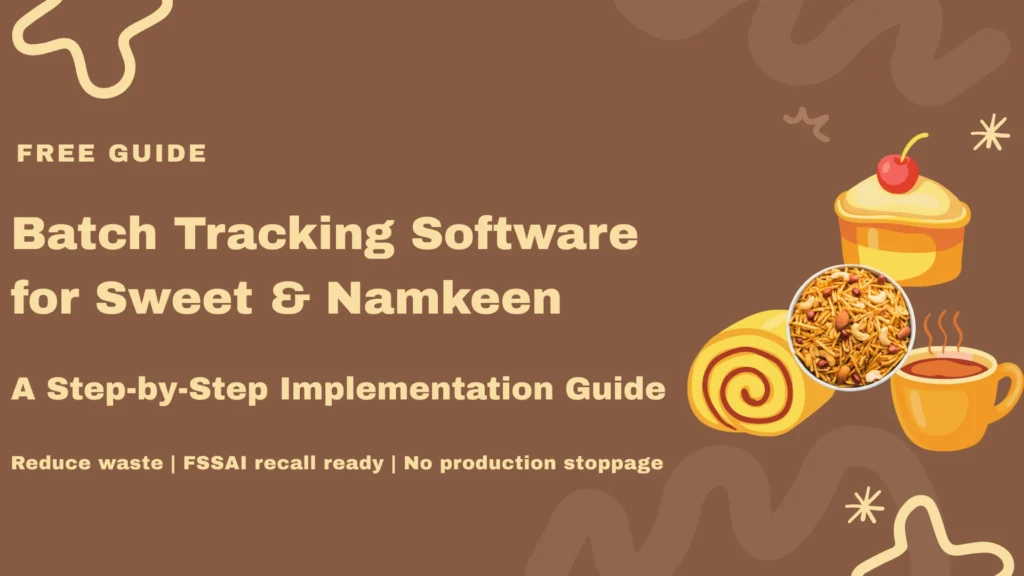
Batch tracking software dashboard managing sweet and namkeen production with real-time traceability.

Batch Tracking Software for Sweet & Namkeen Production: A Step-by-Step Implementation Guide

Complete roadmap to implement batch tracking in your sweet and namkeen manufacturing facility – achieve FSSAI compliance, manage expiry dates, trace ingredients, and prevent costly recalls with Microsoft Business Central. A batch of contaminated ingredients. A customer complaint about stale product. An FSSAI inspector asking for complete traceability records. Any of these scenarios can shut down a sweet or namkeen manufacturing business – unless you have proper batch tracking in place. Yet 70% of small-to-mid size Indian sweet and namkeen manufacturers still track batches using manual registers, Excel sheets, and handwritten labels. The result? Costly recalls, compliance violations, inventory wastage, and zero visibility into which batches are where. This guide provides a complete, step-by-step roadmap to implement batch tracking software specifically designed for sweet and namkeen production. We’ll cover everything from initial setup to daily operations, FSSAI compliance requirements, and real-world implementation timelines. By the end, you’ll know exactly how to implement a system that tracks every batch from raw material receipt through production, packaging, distribution, and final sale – ensuring quality, compliance, and complete traceability. Why It Matters Why Sweet & Namkeen Manufacturers Need Batch Tracking The stakes are higher than you think – here’s what’s at risk without proper batch tracking The Cost of Manual Batch Tracking A mid-size namkeen manufacturer received a customer complaint about a foreign object in a packet. Without batch tracking software: Total impact: ₹18+ lakhs in direct costs + immeasurable brand damage What proper batch tracking would have prevented: Surgical recall of only the affected batch (200 packets, ₹15,000 value). Issue resolved in 24 hours instead of 3 weeks. Critical Requirements for Sweet & Namkeen Production Expiry Date Management Shelf life ranging from 7 days (fresh sweets) to 6 months (packaged namkeen). Track manufacturing date, expiry date, and implement FEFO (First Expiry, First Out). Ingredient Traceability Trace which supplier’s raw materials (flour, oil, ghee, dry fruits) went into which finished goods batches. Critical for quality issues and allergen tracking. Production Batch Records Document who made what, when, using which ingredients, on which equipment. Essential for quality control and troubleshooting. FSSAI Compliance Meet mandatory labeling requirements (batch number, FSSAI license, manufacturing date, expiry date) and maintain traceability records. Recall Management Instantly identify affected batches, where they were shipped, and who bought them. Execute targeted recalls in hours, not weeks. Inventory Accuracy Know exactly which batches are in warehouse, which are near expiry, and which locations hold what. Reduce wastage by 20-30%. FSSAI Batch Tracking Requirements According to FSSAI regulations for packaged food manufacturers: Penalty for non-compliance: ₹5 lakhs fine + potential license suspension Solution Overview What a Batch Tracking Software System Does for Your Business From raw material receipt to final sale – complete visibility and control End-to-End Batch Lifecycle Management A proper batch tracking system (like Microsoft Business Central or LS Central for Food Manufacturing) manages the complete lifecycle: 1. Raw Material Receipt 2. Production Batch Creation 3. Quality Control & Testing 4. Packaging & Labeling 5. Warehouse Storage 6. Sales & Distribution 7. Recall Management (If Needed) Real Business Impact A large sweet manufacturer in Gujarat implemented Business Central batch tracking and achieved: Implementation Roadmap Step-by-Step Implementation Guide Practical, proven approach to go from manual tracking to full automation in 8-12 weeks 1. Assessment & Planning (Week 1-2) Objective: Understand current processes, define requirements, and create implementation plan. Activities: Deliverable: Implementation plan document with timelines, responsibilities, and success metrics 2. System Configuration (Week 3-4) Objective: Set up the software with your specific business rules and data. Key Configuration Tasks: Deliverable: Fully configured system ready for testing 3. Data Migration (Week 5) Objective: Move existing inventory data into the new system. Data Migration Process: Critical Note: For existing inventory without clear batch numbers, consider consuming old stock first before going live with new batches, OR assign retroactive batch numbers based on receipt dates Deliverable: All current inventory loaded in system with accurate batch data 4. Process Training (Week 6-7) Objective: Train all staff on new batch tracking procedures and software usage. Training by Role: Purchase/Receiving Team (4 hours) Production Team (6 hours) Quality Control (4 hours) Packaging Team (3 hours) Warehouse Team (5 hours) Sales/Dispatch (3 hours) Deliverable: All staff trained and certified on their specific batch tracking responsibilities 5. Pilot Run (Week 8-9) Objective: Test the system with live production for 1-2 product lines before full rollout. Pilot Approach: Success Criteria: Deliverable: Validated system ready for full production rollout 6. Full Rollout (Week 10-11) Objective: Extend batch tracking to all products and locations. Rollout Strategy: Critical: Discontinue manual batch tracking once system is proven. Running both in parallel long-term creates confusion. 7. Stabilization & Optimization (Week 12+) Objective: Fine-tune system based on real-world usage and optimize for efficiency. Optimization Activities: Complete Implementation Timeline Total Duration: 12 weeks (3 months) for full implementation Choosing the Right System Batch Tracking Software Options for Sweet & Namkeen Manufacturers Comparing Microsoft Business Central, LS Central, and standalone solutions Feature Microsoft Business Central LS Central (Food) Standalone Batch Software Batch Tracking ✓ Full lot/serial tracking ✓ Food-specific batching ✓ Basic batch tracking Expiry Management ✓ Built-in FEFO logic ✓ Advanced shelf life mgmt ✓ Manual tracking Ingredient Traceability ✓ Full backward/forward trace ✓ Recipe-level traceability ✗ Limited Production Management ✓ Manufacturing module ✓ Food production optimized ✗ Basic Financial Integration ✓ Full ERP (GL, AP, AR) ✓ Integrated financials ✗ Needs separate accounting Retail/Distribution ✓ Sales & inventory ✓ Omnichannel retail ✗ Not included FSSAI Compliance ✓ Configurable ✓ Pre-configured for India ✓ Manual setup Best For Growing manufacturers (₹5Cr+ revenue) Multi-location + retail chains Small single-location units Typical Cost ₹8-15 lakhs (one-time) + ₹1-2L/year ₹12-25 lakhs + ₹2-4L/year ₹2-5 lakhs + ₹50K-1L/year Recommendation For most sweet & namkeen manufacturers: Microsoft Business Central offers the best balance of functionality, scalability, and cost. It provides complete batch tracking, integrates with production and financials, and grows with your business. LS Central is ideal if you also run retail stores or have complex multi-location operations. Standalone batch software only makes sense for very small manufacturers (sub-₹2Cr revenue) with simple operations. Best Practices Critical Success Factors for Batch Tracking Implementation Learn from common mistakes

Batch Tracking Software for Sweet & Namkeen Production: A Step-by-Step Implementation Guide Read More »

7 advanced demand forecasting capabilities in D365 F&O for automotive leaders. Supply chain dashboard with listicle graphic.

7 Advanced Demand Forecasting Capabilities in D365 F&O Every Automotive Leader Should Know

Discover how Microsoft Dynamics 365 Finance & Operations transforms automotive demand planning with AI-driven forecasting, real-time analytics, and supply chain optimization – achieving 85%+ forecast accuracy and 25% inventory cost reduction. Demand forecasting in automotive is broken. Most manufacturers still rely on spreadsheets, historical sales data, and gut instinct to predict what customers will buy next quarter. The result? High-demand models sit on waiting lists for weeks while slow-moving variants pile up on dealer lots, crushing margins. Microsoft Dynamics 365 Finance & Operations (D365 F&O) offers seven advanced demand forecasting capabilities that are transforming how automotive OEMs and multi-location dealers plan inventory, production, and allocation. Companies using these features report 60% to 85%+ forecast accuracy improvements and 20-30% reductions in inventory carrying costs. This guide breaks down each capability, explains when to use it, and shows you exactly how automotive leaders are achieving measurable ROI. 1. AI-Powered Baseline Forecast Generation Let machine learning do the heavy lifting – automatically generate statistically accurate baseline forecasts from historical data What It Is D365 F&O’s demand forecasting module uses Azure Machine Learning to automatically generate baseline forecasts by analyzing historical sales data, seasonal patterns, trends, and cyclical behavior. Instead of manually building forecasting models in Excel, the system applies proven statistical algorithms (ARIMA, exponential smoothing, regression) to your data and selects the best-fit model. How It Works in Automotive The system ingests historical sales data at multiple levels: The AI automatically detects: Automotive Use Case: Monthly Sales Forecasting by Model A major automotive OEM generates baseline forecasts for 40+ models across 250+ dealerships. The AI model analyzes 36 months of historical sales, detects seasonal patterns (festival buying, year-end), and produces variant-level forecasts with 75% accuracy before any manual adjustments. Key Benefits Speed Generate forecasts for thousands of SKUs in minutes, not weeks Consistency Eliminate subjective bias and regional planner variability Scalability Forecast at model, variant, dealer, region, and time-period levels simultaneously Continuous Learning Models retrain automatically as new sales data arrives Best Practice Use AI-generated baseline forecasts as your starting point, then layer in human expertise (upcoming product launches, competitive intelligence, market shifts) for final forecasts. This hybrid approach typically achieves 10-20% better accuracy than pure AI or pure manual methods. 2. Demand Sensing with Real-Time Signal Integration Stop forecasting from the rearview mirror — capture demand signals before they become sales What It Is Demand sensing goes beyond historical sales data to capture leading indicators of future demand — customer inquiries, test drive bookings, website configurator interactions, social media sentiment, and competitor activity. D365 F&O integrates these signals into forecasting models to detect demand shifts weeks or months before they appear in sales numbers. Real-Time Signals D365 F&O Can Integrate Internal Signals (CRM & DMS Integration) External Signals (API Integration) Automotive Use Case: Pre-Festival Demand Spike Detection An automotive dealer network noticed test drive bookings for premium SUVs increasing 40% in September (pre-Diwali season). D365 F&O’s demand sensing flagged this signal and automatically adjusted October-November forecasts upward by 25%. Result: Adequate stock allocation to high-demand dealers, zero lost sales, 15% higher revenue vs. previous year. How It Differs from Traditional Forecasting Traditional Approach D365 F&O Demand Sensing Uses only historical sales (lagging indicator) Uses leading indicators (inquiries, bookings, social sentiment) Detects demand shifts after they happen Predicts demand shifts 4-8 weeks in advance Updates monthly/quarterly Updates daily or real-time Ignores external factors (competitors, macro) Incorporates external signals via API integration Implementation Tip Start with 3-5 high-impact signals (test drive conversion, waitlist length, competitor pricing) rather than trying to integrate 20+ signals at once. Validate signal strength by backtesting: “If we had used this signal last year, would forecasts have improved?” Add more signals incrementally. 4-8 WeeksAverage lead time improvement with demand sensing — detect demand shifts before they hit sales numbers 3. Multi-Dimensional Forecast Modeling (Variant, Dealer, Region) Forecast at the granularity that matters — not just aggregate national demand What It Is Automotive demand isn’t uniform. A compact sedan might sell well in urban metros but struggle in rural markets. Blue is popular in the North, white dominates the South. Premium variants thrive at flagship dealerships but sit unsold at tier-2 locations. D365 F&O’s multi-dimensional forecasting generates predictions across multiple hierarchies simultaneously: Product Dimension Location Dimension Time Dimension Automotive Use Case: Color Preference by Region A manufacturer analyzed D365 F&O forecasts and discovered: Northern dealers sold 40% white vehicles, Southern dealers sold 55% silver, and Western dealers preferred black (35%). Previous “one-size-fits-all” allocation led to 20% regional stock imbalances. New region-specific forecasts reduced dead stock by 18% and stockouts by 25%. Why This Matters for Automotive Aggregate forecasts hide the truth. You might forecast 10,000 units nationally and hit it perfectly – but if you allocated wrong variants to wrong dealers, you still end up with stockouts and excess inventory simultaneously. Multi-dimensional forecasting solves this by answering: Best Practice Start with 2-3 dimensions (model + region + month), validate accuracy, then add more dimensions (color, trim level) incrementally. Too many dimensions too fast creates data sparsity issues. D365 F&O’s hierarchical forecasting handles this by forecasting at aggregate levels and intelligently disaggregating to granular levels. 4. Scenario Planning & What-If Simulation Model the future before it happens — test scenarios and optimize decisions What It Is Automotive leaders face constant “what if” questions: D365 F&O’s scenario planning lets you model these situations before committing resources, simulating how demand, inventory, and profitability change under different conditions. Types of Scenarios You Can Simulate 1. Competitive Response Scenarios 2. Pricing & Promotion Scenarios 3. Supply Chain Disruption Scenarios 4. Macro Economic Scenarios Automotive Use Case: Festival Season Promotion Optimization An OEM used D365 F&O scenario planning to test 5 different Diwali promotion strategies. Simulations showed that a “10% discount + free accessories” bundle generated 22% higher demand lift than “12% straight discount” at the same margin cost. They implemented the winning strategy and achieved 18% YoY sales growth vs. 12% industry average. How to Use Scenario Planning Effectively Common Pitfall Don’t create scenarios in isolation. Involve cross-functional teams (sales, marketing, finance, supply chain) to validate assumptions. A scenario built by planners alone often

7 Advanced Demand Forecasting Capabilities in D365 F&O Every Automotive Leader Should Know Read More »