Welcome to Trident Information Systems!
Write us to - info@tridentinfo.com
Let's Socialize

Microsoft D365 F&O

Microsoft D365 F&O Implementation Partner

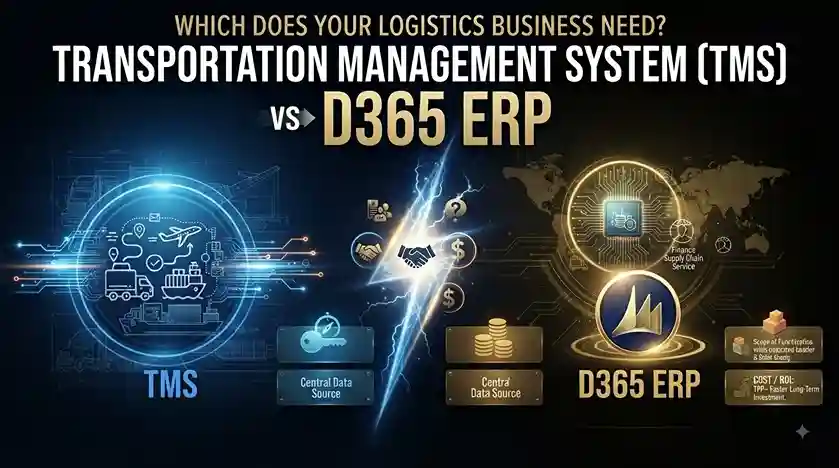
TMS vs D365 ERP comparison showing transportation planning, fleet management, inventory, finance, and logistics operations.

Transportation Management System (TMS) vs D365 ERP: Which Does Your Logistics Business Need?

Every growing logistics business hits the same fork in the road: keep bolting on point solutions, or move to one platform that runs the whole operation. Nowhere is that choice sharper than in the TMS vs ERP decision. A Transportation Management System (TMS) plans and executes freight movement. Dynamics 365 ERP runs the business behind it — finance, inventory, warehousing, and increasingly, transportation itself. Picking the wrong one doesn’t just cost money. It locks you into data silos you’ll spend years untangling. Here’s how the two actually compare, and why logistics businesses scaling past a handful of trucks or a single warehouse increasingly land on Dynamics 365. What a TMS Actually Does A standalone TMS is built for one job: planning, executing, and tracking freight. That typically includes route optimization, carrier selection, load planning, and freight audit. For a business that’s purely a transportation broker or carrier with no inventory or manufacturing to manage, a dedicated TMS can be a reasonable fit. But most logistics businesses aren’t purely transportation. They hold inventory, run warehouses, invoice customers, manage supplier relationships, and need financial visibility across all of it. A TMS wasn’t built to do any of that — it was built to move freight efficiently, full stop. What D365 ERP Does Differently Dynamics 365 approaches the problem from the other direction: it starts with the full business — finance, inventory, warehouse management, procurement, customer orders — and includes transportation planning and execution as a connected part of that same system, not a separate silo. That distinction matters more than it sounds. In a standalone TMS, a shipment is an isolated event: plan it, execute it, close it. In Dynamics 365, that same shipment is tied directly to the sales order that triggered it, the inventory it’s pulling from, the warehouse task that’s picking it, and the invoice that follows once it’s delivered. Nobody is re-entering data between systems, and nobody is reconciling a TMS report against an ERP report at month-end to figure out whether the numbers actually match. Where D365 Pulls Ahead One source of truth. With a standalone TMS bolted onto a separate ERP, freight cost, inventory status, and financial data live in three different places that update on three different schedules. Dynamics 365 keeps all of it in one database, updated in real time, so a dispatcher, a warehouse manager, and a CFO are looking at the same numbers. Real financial visibility into freight cost. Because transportation data flows directly into the general ledger, landed cost, and customer invoicing, Dynamics 365 shows true freight cost per order and per customer — not an estimate reconciled after the fact from a separate TMS export. Warehouse and transportation working together. Dynamics 365’s warehouse management functionality and transportation planning share the same data, so load building, dock scheduling, and picking are coordinated with actual shipment plans instead of guessed at independently. Scalability without a platform change. A standalone TMS that fits a five-truck operation often can’t handle multi-warehouse, multi-entity, or international operations without a separate system change later. Dynamics 365 scales from a regional operation to a multi-country supply chain on the same platform, through Business Central for mid-size operations or Dynamics 365 Supply Chain Management for larger, more complex logistics businesses. One vendor, one roadmap. Integrating a best-of-breed TMS with a separate ERP means depending on two vendors’ release cycles staying compatible indefinitely. With Dynamics 365, transportation, finance, and inventory are built and updated as one product, which means fewer integration failures and fewer surprises after a system update. When a Standalone TMS Still Makes Sense To be fair, a dedicated TMS can be the right call for a pure-play freight brokerage or asset-based carrier with no inventory, warehousing, or manufacturing operations to manage — where transportation genuinely is the entire business, and deep, specialized routing or load-matching features outweigh the benefit of a unified platform. For everyone else — logistics businesses that hold inventory, run warehouses, manage suppliers, or need financial visibility across the full supply chain — that specialization becomes a limitation, not an advantage, the moment freight data needs to talk to the rest of the business. The Bottom Line A standalone TMS optimizes one slice of the operation. Dynamics 365 ERP runs the whole thing — with transportation built in as a connected function, not a system you have to stitch together separately. For logistics businesses planning to grow, add locations, or gain real financial control over freight cost, that’s not a marginal advantage. It’s the difference between managing your business from one system and reconciling three of them every month. Trident Information Systems implements Dynamics 365 Business Central and Dynamics 365 Supply Chain Management for logistics and distribution businesses looking to unify transportation, warehousing, and finance on one platform. Talk to our team about what a connected setup would look like for your operation.


Transportation Management System (TMS) vs D365 ERP: Which Does Your Logistics Business Need? Read More »

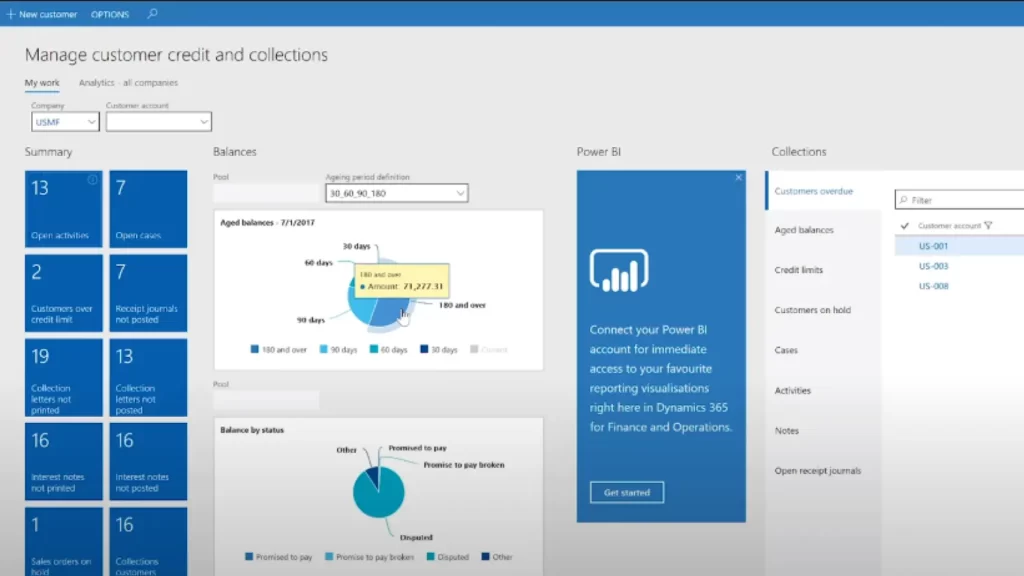
Microsoft Dynamics 365 Finance and Operations dashboard managing finance, supply chain, and enterprise operations.

Microsoft Dynamics 365 Finance and Operations: Elevate Financial Performance, Streamline Operations, and Scale With Confidence

For enterprises still running financial and operational management on legacy ERP systems, the question is no longer whether to modernize — it is how quickly they can afford not to. Disconnected financial systems, manual reporting processes, siloed supply chain data, and compliance frameworks built for a pre-digital regulatory environment are not just inefficient. They are competitive liabilities. Every month a CFO waits days for month-end close, every time an operations director cannot see real-time production capacity, and every time a procurement team manually reconciles purchase orders against invoices — value is being destroyed that a modern ERP platform would have preserved. Microsoft Dynamics 365 Finance and Operations is the evolution of Microsoft Dynamics AX — rebranded, rebuilt for the cloud, and extended with artificial intelligence, embedded analytics, and no-code configurability that legacy AX simply cannot match. It gives finance, operations, manufacturing, supply chain, and procurement teams a single, unified intelligent platform — with the real-time visibility, automation depth, and global compliance capability that modern enterprises require. Whether your organization is evaluating its first enterprise ERP investment, planning an upgrade from Dynamics AX 2012, or looking to consolidate a fragmented mix of financial and operational systems onto a single platform — this guide covers everything you need to know about Microsoft Dynamics 365 Finance and Operations. Why Enterprises Are Upgrading From Dynamics AX to Dynamics 365 What Changed: From On-Premises ERP to Intelligent Cloud Finance Microsoft Dynamics AX was one of the most capable on-premises ERP platforms available for mid-to-large enterprises — particularly in manufacturing and distribution. But the world it was built for no longer exists. Today’s enterprise finance and operations environment demands: Microsoft Dynamics 365 Finance and Operations delivers all of these capabilities natively — on the Microsoft Azure cloud platform, with continuous updates, embedded Microsoft Copilot AI, and deep integration across the Microsoft 365 and Power Platform ecosystems. The Risk of Staying on Legacy Dynamics AX — What You Need to Know Microsoft ended mainstream support for Dynamics AX 2012 in 2021 and extended support in January 2023. Organizations still running AX 2012 are now operating on an unsupported platform — with no security patches, no regulatory updates, and no new feature development. The risks compound over time: The migration path from Dynamics AX to Dynamics 365 Finance and Operations is well-documented — and Trident has guided multiple enterprises through it successfully, preserving existing data, configurations, and business process knowledge while unlocking the full capability of the modern platform. 1. Elevate Your Financial Performance With Dynamics 365 The financial management capabilities of Microsoft Dynamics 365 Finance and Operations are built for the complexity and pace of modern enterprise finance — with real-time intelligence, automated processes, and global compliance tools that enable finance teams to move faster, report more accurately, and contribute more strategically. Increase Profitability With Real-Time Financial Intelligence Profitability management in complex enterprises requires more than periodic financial reporting — it requires continuous, real-time visibility into margin performance across products, customers, geographies, and business units. Microsoft Dynamics 365 Finance delivers: When financial intelligence is available in real time — not compiled once a month — the decisions that protect and grow profitability can be made faster and with greater confidence. Optimize Workforce Productivity Through Role-Based Automation Finance and operations teams lose significant productive capacity to manual, repetitive tasks that intelligent automation can handle faster and more accurately. Dynamics 365 Finance and Operations eliminates this waste through: Reduce Operational Expense Across Every Business Geography For enterprises operating across multiple countries and regions, financial process inconsistency is a hidden cost driver. Different teams using different processes, different tools, and different approval workflows create both inefficiency and compliance risk. Dynamics 365 Finance addresses this through: Adapt Quickly to Changing Financial and Regulatory Requirements The regulatory environment for global enterprises has never been more complex or more rapidly changing — VAT reforms, IFRS updates, digital invoicing mandates, transfer pricing requirements, and ESG reporting obligations are creating continuous compliance pressure that legacy systems were never designed to handle. Microsoft Dynamics 365 Finance is built for this reality: Streamline Asset Management From Acquisition Through Disposal Fixed asset management is one of the most error-prone areas in enterprise finance — particularly when asset registers are maintained in spreadsheets or legacy systems disconnected from the main ERP. Dynamics 365 Finance delivers: 2. Run Smarter Manufacturing Operations With Dynamics 365 Microsoft Dynamics 365 Finance and Operations extends beyond the finance function to deliver deep manufacturing operations capabilities — connecting production planning, scheduling, resource management, and cost control in a single unified system. Select the Best-Fit Manufacturing Process for Every Product Line Modern manufacturing organizations rarely operate on a single production model. A company might run make-to-stock for high-volume standard products, make-to-order for customized variants, and engineer-to-order for complex customer-specific configurations — simultaneously, within the same facility. Dynamics 365 Finance and Operations supports the complete range of manufacturing models in a single unified solution: Improve Operational Procedures With Advanced Production Planning Manufacturing competitiveness is built on the ability to optimize production parameters for every product and every scenario — adjusting quickly to demand changes, supply constraints, and capacity limitations without losing efficiency: Simplify Resource Management With Real-Time Scheduling Visibility Resource scheduling in complex manufacturing environments — balancing machine capacity, labor availability, tooling requirements, and material flow across multiple production lines — is one of the most operationally demanding challenges in enterprise management. Dynamics 365 Finance and Operations simplifies this through: Accelerate Product Delivery Through Advanced Warehouse Management The connection between manufacturing and warehouse management is where delivery performance is won or lost. Dynamics 365 Finance and Operations integrates advanced warehouse management directly with production planning: 3. Automate and Modernize Your Supply Chain A modern, connected supply chain is one of the most significant sources of competitive advantage available to manufacturing and distribution enterprises. Microsoft Dynamics 365 Finance and Operations delivers the tools to transform a fragmented, reactive supply chain into a unified, predictive, cost-optimized operation. Modernize Business Logistics Across Sites, Warehouses, and Transport Modes Supply chain

Microsoft Dynamics 365 Finance and Operations: Elevate Financial Performance, Streamline Operations, and Scale With Confidence Read More »