Welcome to Trident Information Systems!
Write us to - info@tridentinfo.com
Let's Socialize

Microsoft Dynamics 365

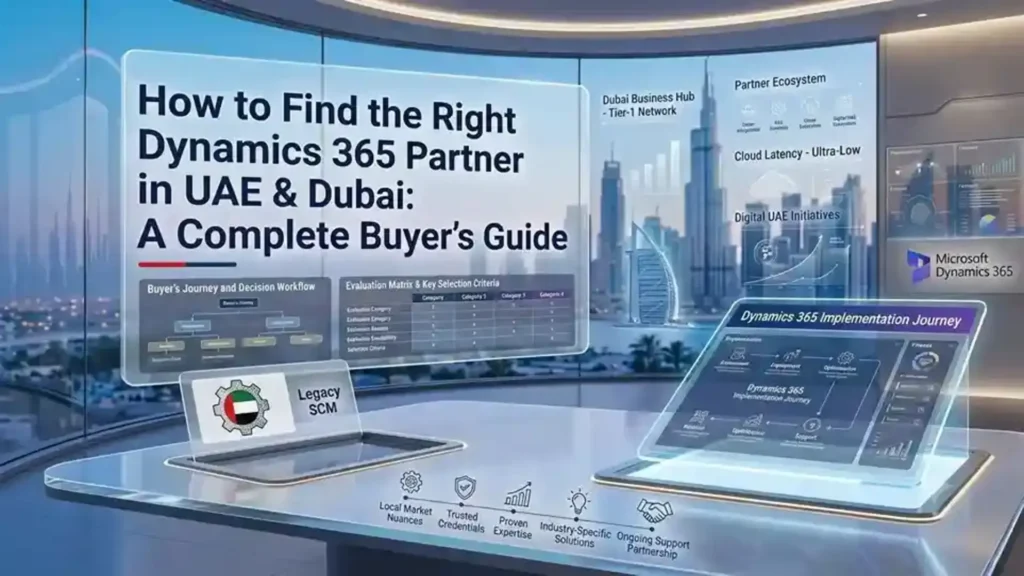
Guide to choosing the right Microsoft Dynamics 365 partner in UAE and Dubai for ERP, CRM, implementation, and support services

How to Find the Right Dynamics 365 Partner in UAE & Dubai: A Complete Buyer’s Guide

Choosing a Dynamics 365 partner in UAE is one of the most important technology decisions your business will make. The right partner accelerates your digital transformation; the wrong one drains budget, delays timelines, and delivers a system your teams resist using. With dozens of Microsoft partners operating across Dubai, Abu Dhabi, and the wider Gulf region, how do you separate genuine expertise from marketing claims? This buyer’s guide gives you a practical framework for evaluating Microsoft Dynamics implementation partners in Dubai, UAE, and Saudi Arabia. Why Partner Selection Matters More in the UAE The UAE business environment presents unique challenges that generic partners struggle to handle: A Dynamics 365 partner in UAE must understand these realities. Partners without regional experience often deliver technically correct implementations that fail operationally. What to Look For in a Dynamics 365 Partner in UAE 1. Microsoft Solutions Partner Designations Verify the partner holds current Microsoft designations—particularly Business Applications for Dynamics 365. Legacy “Gold Partner” status has evolved into Solutions Partner designations, which require verified customer success, certified staff, and performance metrics. Ask directly: Which designations do you hold, and when were they last validated? 2. Proven UAE and GCC Project Experience Request references from businesses operating in the UAE or Saudi Arabia. Ask about: Partners with genuine regional experience will provide specific, verifiable references. 3. Full Dynamics 365 Product Coverage Microsoft Dynamics implementation partners in Dubai should support the complete stack: If your business runs legacy NAV, AX, or GP, confirm the partner has migration experience—not just new implementations. 4. Local Presence with Delivery Capability The best partners maintain offices in Dubai or Abu Dhabi while offering delivery resources across time zones. Local presence ensures responsive support; global delivery keeps costs competitive. 5. Industry-Specific Expertise Dynamics 365 requirements vary significantly by industry. A retail implementation differs fundamentally from manufacturing or financial services. Choose a partner with demonstrated experience in your sector. 6. Transparent Implementation Methodology Ask to see the partner’s methodology before signing. A structured approach should include discovery, solution design, configuration, data migration, testing, training, and hypercare support. Partners who cannot articulate their methodology clearly will likely struggle to execute it. 7. Ongoing Support and Managed Services Implementation is the beginning. Confirm what post-go-live support includes: Evaluating Microsoft Dynamics Implementation Partners in Dubai Dubai’s business landscape demands partners who understand enterprise complexity. When evaluating Microsoft Dynamics implementation partners in Dubai, focus on: Scale Experience: Have they delivered projects for organizations similar to yours in size and complexity? Compliance Knowledge: Can they configure D365 for UAE VAT, corporate tax, and e-invoicing requirements? Integration Capability: Can they connect D365 with local banking systems, government portals, and third-party applications? Change Management: Do they provide user training and adoption support tailored to multicultural teams? Evaluating Microsoft Dynamics Implementation Partners in UAE Beyond Dubai, the wider UAE market includes Abu Dhabi, Sharjah, and free zone businesses with distinct requirements. Microsoft Dynamics implementation partners in UAE should demonstrate: Evaluating Microsoft Dynamics Implementation Partners in Saudi Arabia Saudi Arabia’s Vision 2030 initiatives are driving rapid ERP modernization. Microsoft Dynamics implementation partners in Saudi Arabia must handle: Partners serving both UAE and Saudi Arabia offer efficiency for businesses operating across the GCC. Step-by-Step Buyer’s Process Step 1: Define RequirementsDocument your current systems, pain points, growth plans, and must-have integrations before approaching partners. Step 2: Shortlist PartnersUse the Microsoft Solutions Partner directory to identify partners with relevant designations and UAE presence. Step 3: Request Capability PresentationsAsk each partner to present their experience, methodology, and team credentials specific to your project. Step 4: Check References ThoroughlySpeak with at least two clients per partner. Ask about timeline accuracy, budget adherence, and issue resolution. Step 5: Review Commercial TermsCompare total cost of ownership—not just initial quotes. Confirm training hours, support duration, and customization boundaries. Step 6: Assess Cultural FitImplementation projects last months. Choose a partner whose communication style and availability align with your team. Red Flags to Avoid Questions to Ask Every Partner Final Thoughts Finding the right Dynamics 365 partner in UAE requires diligence, but the effort pays dividends. Prioritize partners with verified Microsoft credentials, proven regional experience, transparent methodologies, and strong support models. The best Microsoft Dynamics implementation partners in Dubai, UAE, and Saudi Arabia will challenge your assumptions, recommend best practices, and deliver a system your teams actually use. That combination of technical skill and business partnership turns ERP investment into competitive advantage. Ready to evaluate your options? Request designations, references, and a discovery session from your shortlisted partners. The diligence you invest now determines your success for years to come.

How to Find the Right Dynamics 365 Partner in UAE & Dubai: A Complete Buyer’s Guide Read More »
Microsoft Dynamics 365 Finance features and benefits for financial management, supply chain visibility, and ERP support

Microsoft Dynamics 365 Finance: Features, Benefits & Support for Supply Chain Management

Microsoft Dynamics 365 Finance is the core financial management application within Microsoft’s ERP suite, designed for mid-market and enterprise organizations that need real-time visibility, global compliance, and intelligent automation. When combined with Supply Chain Management, it becomes a unified platform that connects financial data with operational execution. This guide covers the key features, business benefits, and how to get proper support for supply chain and finance management on D365. What Is Microsoft Dynamics 365 Finance? Microsoft Dynamics 365 Finance is a cloud-based financial management system that handles core accounting, budgeting, invoicing, payments, and financial reporting. It is part of the broader Microsoft Dynamics 365 Finance and Operations platform, which also includes Supply Chain Management, Commerce, and Project Operations. Unlike standalone accounting software, D365 Finance integrates natively with: This integration means financial data reflects operational reality in real time—not weeks later after manual reconciliation. Key Features of Microsoft Dynamics 365 Finance 1. Core Financial Management General ledger, accounts payable, accounts receivable, fixed assets, cash and bank management, and multi-currency accounting. Supports multiple legal entities, consolidation, and intercompany transactions from a single instance. 2. Global Compliance and Localization Built-in localization for 40+ countries covering tax rules, e-invoicing mandates, statutory reporting, and regulatory formats. Essential for multinational organizations operating across jurisdictions. 3. Budgeting and Planning Flexible budgeting with workflow approvals, encumbrance accounting, and budget control. Integrates with Excel and Power BI for planning and variance analysis. 4. Financial Reporting and Analytics Real-time dashboards, Power BI embedded analytics, and configurable financial reports. Supports IFRS, GAAP, and custom reporting frameworks. 5. Revenue Recognition and Subscription Billing Automated revenue recognition compliant with ASC 606 and IFRS 15. Subscription billing for recurring revenue models. 6. Credit and Collections Management Automated credit limits, collection workflows, aging analysis, and customer payment predictions powered by AI. 7. Expense Management Employee expense capture, approval workflows, policy compliance, and reimbursement processing with mobile access. 8. Project Accounting Project budgeting, cost tracking, revenue recognition, and billing for professional services and project-based businesses. How D365 Finance Connects to Supply Chain Management The real power of Microsoft Dynamics 365 Finance emerges when it runs alongside Supply Chain Management. The two applications share a single data model, meaning: This unified approach eliminates the reconciliation work, data errors, and reporting delays that plague disconnected ERP and accounting systems. For businesses that need support for supply chain and finance management, the integrated D365 platform provides one source of truth across procurement, production, logistics, and finance. Benefits of Microsoft Dynamics 365 Finance Faster Financial Close Automated reconciliation, continuous accounting, and real-time data reduce month-end close from weeks to days. Better Decision-Making Embedded analytics and AI-driven insights give finance leaders visibility into cash flow, profitability, and risk without waiting for reports. Lower Compliance Risk Continuous regulatory updates from Microsoft keep your system compliant with changing tax and reporting requirements. Reduced Manual Effort Workflow automation and AI eliminate repetitive tasks like invoice matching, expense processing, and collections follow-up. Scalability Cloud architecture scales with your business—whether you operate one entity or hundreds across multiple countries. Lower Total Cost of Ownership Subscription licensing, reduced infrastructure, and continuous updates lower long-term IT costs compared to on-premise ERP. Support for Supply Chain and Finance Management Implementing D365 Finance and Supply Chain Management is only the beginning. Ongoing support determines whether you continue to get value from the platform. Effective support should include: Proactive System MonitoringMonitoring of integrations, batch jobs, and performance to prevent issues before they impact operations. Functional and Technical SupportAccess to consultants who understand both finance processes and supply chain workflows—not generalist help desks. Regulatory UpdatesAssistance applying Microsoft’s continuous compliance updates for tax and statutory reporting. Optimization ReviewsRegular reviews to identify unused features, automation opportunities, and process improvements. User EnablementRefresher training and documentation as staff change and new modules are adopted. Upgrade and Release ManagementManagement of Microsoft’s twice-yearly release waves with impact assessment and testing. Businesses that invest in structured support consistently report higher user adoption and faster return on their D365 investment. Common Use Cases Manufacturing: Cost accounting, production variance analysis, and inventory valuation integrated with shop floor operations. Distribution: Multi-warehouse inventory, landed cost allocation, and vendor management with real-time margin visibility. Retail: Omnichannel financial consolidation, store-level profitability, and integrated supply chain planning. Professional Services: Project accounting, resource utilization, and revenue recognition for complex engagements. Financial Services: Multi-entity consolidation, regulatory reporting, and automated reconciliation. Final Thoughts Microsoft Dynamics 365 Finance delivers modern financial management that connects directly to supply chain operations, giving organizations real-time visibility and control. Combined with the right implementation and support partner, it becomes a platform for growth—not just accounting. For businesses evaluating ERP modernization, D365 Finance and Operations offers the breadth, compliance coverage, and scalability that legacy systems cannot match. Looking for support with Microsoft Dynamics 365 Finance and Supply Chain Management? Contact a certified Microsoft partner to discuss implementation, optimization, or managed support.

Microsoft Dynamics 365 Finance: Features, Benefits & Support for Supply Chain Management Read More »

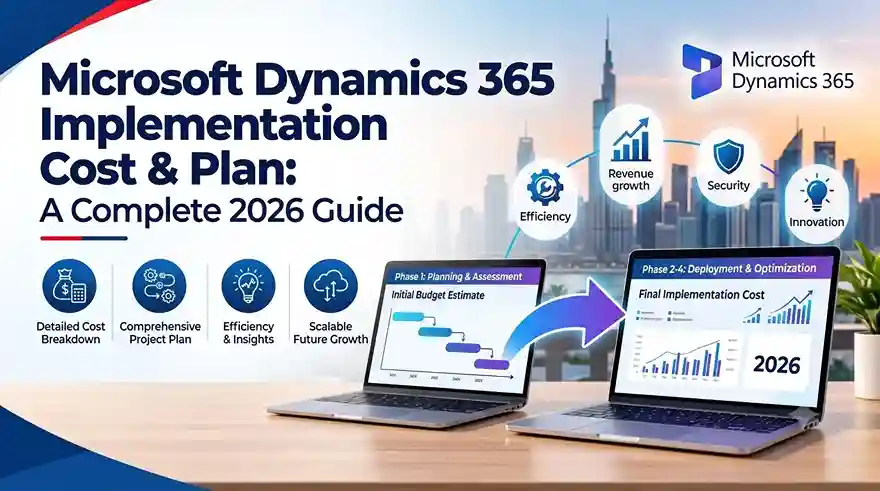
Microsoft Dynamics 365 implementation cost and planning guide covering ERP and CRM budgeting, licensing, timelines, and deployment

Microsoft Dynamics 365 Implementation Cost & Plan: A Complete 2026 Guide

Microsoft Dynamics 365 implementation cost is one of the first questions every business asks—and one of the hardest to answer without context. Quotes range from $30,000 to over $1 million because D365 is not a single product. It is a family of applications, and cost depends entirely on what you deploy, how you deploy it, and who does the work. This guide breaks down real cost drivers, provides a structured implementation plan, and explains how to budget accurately for a Finance & Operations deployment in 2026. Understanding Microsoft Dynamics 365 Implementation Cost There is no standard price for D365 implementation. Costs fall into five categories, each influenced by your specific requirements. 1. Licensing Costs (Annual Subscription) Microsoft licenses Dynamics 365 per user, per month. Approximate 2026 pricing: License Type Approximate Cost Finance & Operations – Full User $180–$210/user/month Finance & Operations – Team Member $60–$70/user/month Business Central – Essentials $70/user/month Business Central – Premium $100/user/month Customer Engagement (Sales/Service) $65–$135/user/month For a 50-user Finance & Operations deployment, expect $110,000–$125,000 annually in licensing alone. 2. Implementation Services This is typically the largest cost. Implementation covers discovery, design, configuration, data migration, testing, training, and go-live support. Industry benchmarks: Implementation cost is driven by module count, customization level, integration complexity, and data volume—not user count alone. 3. Customization and Extensions D365 supports configuration without code, but many businesses need custom extensions. Development typically costs $150–$250 per hour. A moderately customized implementation may add $30,000–$150,000 to the project. 4. Data Migration Migrating from AX, NAV, GP, or SAP requires extraction, cleansing, mapping, and validation. Costs vary by data volume and quality, commonly $20,000–$80,000. 5. Ongoing Support and Maintenance Post-go-live support typically runs 15–20% of implementation cost annually. This covers system monitoring, user support, updates, and optimization. Total Cost Benchmarks for 2026 Business Size Users Estimated First-Year Cost Small 10–25 $80,000–$180,000 Mid-Market 25–100 $200,000–$500,000 Enterprise 100–500 $500,000–$1,500,000 Large Enterprise 500+ $1,500,000+ These figures include licensing, implementation, and first-year support. Multi-country rollouts, heavy customization, and complex integrations push costs toward the upper range. What Drives Cost Up or Down Cost Increases: Cost Decreases: The single biggest cost lever is customization discipline. Businesses that adopt standard D365 processes consistently spend 30–40% less than those that recreate legacy customizations. Building a Dynamics 365 Implementation Plan A well-structured Dynamics 365 implementation plan follows six phases. Phase 1: Discovery and Requirements (4–8 Weeks) Document current processes, pain points, and requirements. Identify which modules are needed and map processes to D365 capabilities. Output: requirements document and preliminary cost estimate. Phase 2: Solution Design (4–6 Weeks) Design the future-state solution: module configuration, integrations, data model, and reporting. Output: functional design document and project plan. Phase 3: Configuration and Development (8–16 Weeks) Configure D365 modules, build necessary extensions, and set up integrations. Output: configured environment ready for testing. Phase 4: Data Migration and Testing (6–10 Weeks) Extract and cleanse legacy data, load into D365, and execute unit, integration, and user acceptance testing. Output: validated system with verified data. Phase 5: Training and Cutover (3–6 Weeks) Train users by role, prepare cutover plan, and execute go-live. Output: live production system with trained users. Phase 6: Hypercare and Optimization (4–12 Weeks Post Go-Live) Provide intensive support, resolve issues, and optimize performance. Output: stable system with confident users. Typical total timeline: 6–12 months for mid-market; 12–24 months for enterprise multi-country rollouts. Implementing Microsoft Dynamics 365 for Finance and Operations Finance & Operations (F&O) is the most complex D365 application and typically the most expensive to implement. Key cost considerations specific to F&O: Businesses implementing F&O should budget $250,000–$600,000 for a mid-market deployment including licensing, services, and first-year support. How to Reduce Implementation Cost Without Compromising Quality 1. Adopt standard processes. Every customization avoided saves $5,000–$20,000 in build, test, and maintenance. 2. Choose the right partner. A partner with your industry experience uses proven templates and avoids costly discovery. 3. Phase your rollout. Go live with core finance first, then add modules. This spreads cost and reduces risk. 4. Invest in data cleansing early. Clean data reduces migration effort and prevents post-go-live issues. 5. Train super-users internally. Reducing reliance on partner training lowers cost and builds internal capability. 6. Negotiate multi-year licensing. Microsoft offers volume discounts for longer commitments. Choosing a Partner Who Controls Cost Implementation cost is heavily influenced by partner efficiency. When evaluating partners, ask: Partners with strong methodology and industry focus consistently deliver lower total cost than generalists. Final Thoughts Microsoft Dynamics 365 implementation cost depends on scope, complexity, and partner choice—not a fixed price list. A 25-user Finance deployment may cost $150,000; a 500-user global rollout may exceed $1.5 million. The most effective cost strategy is disciplined scope management: adopt standard functionality, phase your rollout, invest in data quality, and select a partner with proven industry experience. Businesses that follow this approach achieve faster go-live, lower total cost, and higher user adoption. Planning a D365 implementation? Request a detailed cost estimate and implementation roadmap from a certified Microsoft partner before committing budget.

Microsoft Dynamics 365 Implementation Cost & Plan: A Complete 2026 Guide Read More »

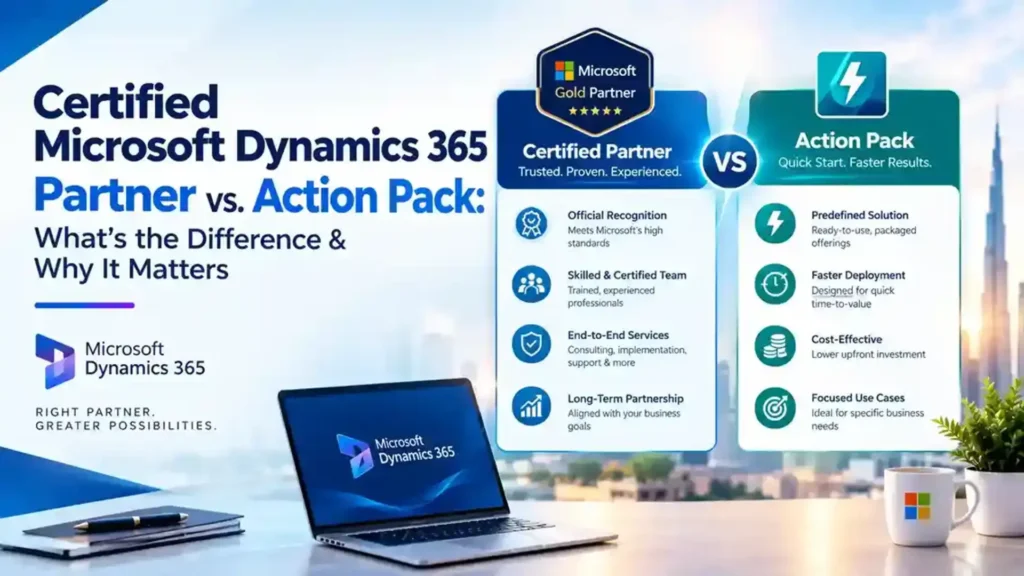
Certified Microsoft Dynamics 365 partner vs. Action Pack comparison highlighting partner expertise and implementation benefits

Certified Microsoft Dynamics 365 Partner vs. Action Pack: What’s the Difference & Why It Matters

When businesses begin searching for a Microsoft Dynamics 365 partner, they quickly encounter a confusing mix of terminology: “Certified Partner,” “Gold Partner,” “Action Pack,” “Solutions Partner,” and more. Each label sounds impressive, but they represent very different levels of capability, commitment, and accountability. Understanding these distinctions is critical. Choosing a partner with the wrong credential level can mean the difference between a smooth, expert-led implementation and a costly learning experience at your expense. This guide breaks down exactly what separates a Certified Microsoft Dynamics 365 Partner from an Action Pack subscriber—and why the difference should influence your decision. What Is the Microsoft Partner Ecosystem? Microsoft works with tens of thousands of companies worldwide that sell, implement, and support its products. To bring order to this vast network, Microsoft maintains a tiered partner program that distinguishes between different levels of capability. Historically, this program included Silver and Gold competencies. Today, Microsoft has evolved the framework into Solutions Partner designations and specializations, while retaining some legacy terminology. Alongside these formal designations exists the Microsoft Action Pack—a subscription designed for companies beginning their Microsoft partner journey. The result is a landscape where a company can call itself a “Microsoft Partner” with very different levels of proven expertise behind that claim. What Is the Microsoft Action Pack? The Microsoft Action Pack is a low-cost subscription that gives small businesses and emerging IT providers access to Microsoft software licenses, cloud service credits, and development tools. It is designed for partners who are starting out—companies that want to build Microsoft-based solutions but have not yet achieved formal designations. What Action Pack includes: What Action Pack does NOT include: In short, the Action Pack is a starter kit, not a credential. Any business can purchase it without proving implementation capability. What Is a Certified Microsoft Dynamics 365 Partner? A Certified Microsoft Dynamics 365 Partner has earned formal recognition from Microsoft by meeting rigorous, audited requirements. These requirements typically include: 1. Technical CertificationsIndividual team members must hold current Microsoft certifications specific to Dynamics 365 modules—Finance, Supply Chain Management, Sales, Customer Service, and more. These certifications require passing exams and are renewed annually. 2. Solutions Partner DesignationsMicrosoft’s modern partner framework awards designations such as Business Applications to partners who demonstrate customer success, skilled staff, and performance metrics. Earning a designation requires meeting thresholds for net customer adds, certifications, and deployment success. 3. Customer EvidencePartners must provide verified customer references and demonstrate successful project outcomes at scale. Microsoft audits these claims. 4. SpecializationsFor deeper expertise, partners can earn specializations in areas like Finance, Supply Chain, or Customer Engagement—each requiring additional certifications and proven delivery experience. A Certified Microsoft Dynamics 365 Partner has, in effect, passed Microsoft’s own quality inspection. Certified Partner vs. Action Pack: The Key Differences Criteria Certified Microsoft Dynamics 365 Partner Microsoft Action Pack Subscriber Verification Audited by Microsoft Self-purchased subscription Certifications Multiple certified staff required Not required Customer Success Proof Verified references required Not required Solutions Partner Designation Eligible and typically held Not eligible Dynamics 365 Expertise Proven through Microsoft audits Unverified Support Capability Enterprise-grade, Microsoft-backed Limited, self-provided Suitability Mid-market to enterprise implementations Startups, small IT providers The gap is significant. An Action Pack subscriber may have talented staff, but they have not been verified by Microsoft. A Certified Partner has met measurable standards that Microsoft itself monitors. Why This Distinction Matters for Your Business 1. Risk Reduction Dynamics 365 implementations are complex, expensive, and business-critical. A failed rollout can disrupt operations for months. Certified Microsoft Dynamics 365 Partners have demonstrated successful delivery patterns, reducing the risk of costly errors. 2. Access to Microsoft Resources Certified partners receive escalated support channels, early access to product updates, and direct collaboration with Microsoft engineering teams. Action Pack subscribers rely on standard support queues. 3. Verified Expertise When a partner holds certifications across Finance, Supply Chain, and Customer Engagement, you know their team has passed standardized exams covering real-world scenarios. This is verifiable, not marketing language. 4. Long-Term Partnership Certified partners must maintain their status annually. This creates ongoing accountability—they cannot rest on past achievements. Action Pack subscribers face no such requirements. 5. Ecosystem Connections Top Microsoft Dynamics Partners leverage their certifications to connect clients with ISV solutions on AppSource, Microsoft-funded migration programs, and co-selling opportunities. These benefits flow only to certified partners. How to Verify a Partner’s Credentials Before signing with any partner, verify their claims: A genuine Certified Microsoft Dynamics 365 Partner will provide this information without hesitation. When Is an Action Pack Subscriber Sufficient? Action Pack partners serve a valid purpose for very small businesses with limited budgets and simple requirements. If you need basic Microsoft 365 setup or minor development work, an Action Pack partner may suffice. However, for any organization implementing Dynamics 365—whether Finance & Operations, Business Central, or CRM—the complexity and cost demand a Certified Partner. The investment difference is minor compared to the risk of a failed implementation. Common Misconceptions About Partner Dynamics “All Microsoft Partners are certified.”False. Anyone can subscribe to Action Pack and call themselves a Microsoft Partner. Certification requires active effort and verification. “Gold Partner and Certified Partner are the same.”Partially true. Gold Competency has evolved into Solutions Partner designations, but the underlying principle remains: certification is earned, not purchased. “Action Pack is enough for ERP implementation.”Incorrect. Action Pack provides licenses and credits, not verified implementation expertise. ERP projects need certified consultants. “Certifications don’t matter if the partner has experience.”Experience matters, but without verification, you cannot confirm its quality or relevance. Certifications provide objective proof. Final Thoughts: Choose Verified Expertise The difference between a Certified Microsoft Dynamics 365 Partner and an Action Pack subscriber is the difference between verified capability and unproven potential. For any serious Dynamics 365 initiative, the choice is clear. When evaluating top Microsoft Dynamics partners, prioritize those who can demonstrate current certifications, audited customer success, and formal Solutions Partner designations. Ask direct questions, verify independently, and do not accept marketing language in place of evidence. Your ERP or CRM system will run your business for

Certified Microsoft Dynamics 365 Partner vs. Action Pack: What’s the Difference & Why It Matters Read More »

Microsoft Dynamics 365 implementation dashboard showing ERP, CRM, finance, supply chain, and business analytics capabilities.

Top Microsoft Dynamics 365 Implementation Partners in 2026: How to Choose the Best Microsoft Gold Partner

Selecting the right Microsoft Dynamics 365 implementation partner is one of the most consequential technology decisions your business will make. The partner you choose will shape how efficiently your ERP or CRM system is deployed, how well it aligns with your operational workflows, and ultimately, whether your investment delivers measurable returns. With thousands of Microsoft partner companies worldwide, the challenge isn’t finding a partner—it’s identifying the one that truly fits your needs. This guide breaks down what to look for, how to evaluate credentials, and why the “Gold Partner” designation matters more than ever. What Makes a Microsoft Dynamics 365 Implementation Partner Different? Not all Microsoft partners are created equal. The Microsoft AI Cloud Partner Program now emphasizes Solutions Partner designations—a shift from the older Gold Competency model that reflects demonstrated capability and customer success. A qualified Dynamics 365 implementation partner should hold designations that directly align with the solutions you need, whether that’s Business Applications, Data & AI, or Digital & App Innovation. The strongest partners combine three elements: Microsoft certifications, verified customer outcomes, and deep industry experience. Without all three, you risk working with a vendor that can install software but cannot solve business problems. Why “Gold Partner” Status Still Signals Quality The term “Gold Partner” remains widely used and understood, even as Microsoft’s program evolves. A Microsoft Gold Partner company has historically met rigorous requirements around certifications, customer references, and demonstrated expertise. Today’s equivalent—Solutions Partner designations—carries forward that legacy of verified capability. When evaluating a Gold Partner, ask directly: Which Solutions Partner designations do you hold? A partner with the Business Applications designation has demonstrated the ability to deliver successful Dynamics 365 implementations across ERP and CRM scenarios. Key Evaluation Criteria for D365 Implementation Partners 1. Relevant Designations and Certifications Look for partners with designations that match your project scope. If you’re implementing Finance & Operations, the partner’s expertise in Business Applications and Data & AI is critical. A partner with broad designations across the Microsoft Cloud is better positioned to integrate your Dynamics 365 environment with Azure, Power Platform, and Microsoft 365. 2. Industry-Specific Experience Generic implementations produce generic results. Top Microsoft Dynamics 365 partners bring vertical expertise—whether in manufacturing, financial services, retail, or professional services. Ask for case studies that mirror your industry and operational complexity. A partner who has consolidated 80+ decentralized ERP systems for a global manufacturer understands the challenges you’ll face. 3. Implementation Methodology A structured, transparent implementation methodology is non-negotiable. The best D365 implementation partners follow a phased approach: discovery and requirements analysis, solution design, configuration, data migration, testing, user acceptance, training, and post-go-live support. Ask to see their project plan template before signing. 4. Global Reach with Local Presence If your business operates across multiple geographies, your partner needs both global delivery capability and local support. Leading partners operate across continents while maintaining regional offices to provide on-the-ground assistance. This balance matters for compliance, language support, and time-zone responsiveness. 5. Ongoing Support and Managed Services Implementation is a beginning, not an end. Microsoft Dynamics Certified Partners offer post-go-live support, optimization, and managed services that protect your investment as your business evolves. Confirm what support tiers are available and whether they include proactive monitoring versus break-fix only. How to Identify the Best Microsoft Gold Partner for Your Business Step 1: Define your requirements clearly. Document your current systems, pain points, growth plans, and must-have integrations before approaching partners. This prevents partners from selling you solutions you don’t need. Step 2: Request partner credentials. Ask for their Microsoft Partner ID, current designations, and certifications for the specific team members who will work on your project. Step 3: Demand customer references. Speak directly with clients whose projects resemble yours in scope and industry. Ask about responsiveness, budget adherence, and post-implementation support quality. Step 4: Assess cultural fit. Implementation projects last months or years. Choose a partner whose communication style, availability, and working approach align with your team’s expectations. Step 5: Review commercial terms carefully. Understand licensing costs, customization charges, and the boundary between included support and billable work. Red Flags to Avoid When Selecting a D365 Implementation Partner Why Partner Selection Determines D365 Success Microsoft Dynamics 365 is a powerful platform, but its value is unlocked through skilled implementation. A partner with strong Microsoft Dynamics 365 implementation credentials will configure the system to match your processes—not force your processes into the software. They will identify opportunities for automation, integration, and AI-driven insights that drive efficiency beyond basic ERP functionality. The best partners also bring ecosystem connections: access to Microsoft AppSource solutions, ISV partnerships for specialized functionality, and relationships with Microsoft’s own technical teams for escalated support. Final Thoughts: Making the Right Choice Choosing among Microsoft Dynamics 365 implementation partners requires looking past marketing claims to verifiable capability. Prioritize partners with current Solutions Partner designations, relevant industry experience, transparent methodologies, and a track record of customer success. The right Microsoft Gold Partner will not just deploy software—they will become a strategic extension of your team, helping you extract maximum value from your Dynamics 365 investment long after go-live. Ready to evaluate your options? Start by requesting designations, references, and a discovery session from your shortlisted partners. The due diligence you invest now will pay dividends throughout your Dynamics 365 journey. FAQ Q: What should I look for in Microsoft Dynamics 365 implementation partners? A: Look for current Microsoft Solutions Partner designations, relevant industry experience, a transparent implementation methodology, verified customer references, and strong post-go-live support. The best D365 implementation partners combine certifications with proven business outcomes. Q: Is a Microsoft Gold Partner better than other Dynamics 365 partners? A: Yes. A Microsoft Gold Partner—now aligned with Solutions Partner designations—has met rigorous Microsoft requirements for certifications, customer success, and technical capability. This verified status reduces implementation risk compared to non-certified partners. Q: How much does it cost to hire a Microsoft Dynamics 365 implementation partner? A: Costs vary based on project scope, modules implemented, customization level, and partner location. Typical D365 implementation projects range

Top Microsoft Dynamics 365 Implementation Partners in 2026: How to Choose the Best Microsoft Gold Partner Read More »

Business leaders evaluating top Microsoft Dynamics 365 partners for ERP and CRM implementation in Abu Dhabi.

Top Dynamics 365 Partners in Abu Dhabi: Who Should You Trust in 2026?

Abu Dhabi is rapidly becoming one of the Middle East’s most advanced digital economies. From sovereign wealth funds and government entities to manufacturing groups, food producers, retail chains, and financial institutions, organizations across the emirate are investing heavily in digital transformation. This shift has significantly increased the demand for Microsoft Dynamics 365, one of the world’s leading ERP and business application platforms. The UAE ERP market is valued at approximately USD 2.1 billion, driven by cloud adoption, digital transformation initiatives, and growing compliance requirements across industries. Abu Dhabi continues to play a major role in this growth due to its concentration of large enterprises and government-backed organizations. The challenge, however, is not selecting Dynamics 365 itself. The real challenge is choosing the right implementation partner. A successful ERP project depends as much on the implementation team as it does on the software. The wrong partner can lead to budget overruns, delayed deployments, and poor user adoption. The right partner can deliver measurable improvements in efficiency, visibility, compliance, and profitability. Why Abu Dhabi Requires Specialized Dynamics 365 Expertise Unlike many other business hubs in the region, Abu Dhabi operates within a highly regulated environment. Organizations often manage multiple legal entities, complex approval structures, and strict governance requirements. Many companies must comply with UAE VAT regulations, Corporate Tax requirements, ADGM frameworks, WPS payroll standards, and Arabic language support requirements. These factors make ERP implementations more complex than standard deployments. A partner that has only worked with small retail businesses may struggle when faced with large holding companies, manufacturing groups, or government-linked organizations. When evaluating a Dynamics 365 partner, businesses should prioritize experience with: Top Global Microsoft Dynamics 365 Partners Serving Abu Dhabi & the Middle East Accenture Accenture is widely recognized as one of the largest Microsoft implementation partners globally. The company brings extensive experience in large-scale enterprise transformations and has delivered complex Dynamics 365 projects across finance, supply chain, customer engagement, and analytics. Accenture is often a preferred choice for government entities, multinational corporations, and large enterprises requiring global delivery capabilities and sophisticated project governance. Avanade Avanade, a joint venture between Microsoft and Accenture, specializes exclusively in Microsoft technologies. The company has earned multiple Microsoft awards and is recognized globally for enterprise Dynamics 365 implementations. Organizations seeking deep Microsoft expertise and global best practices often consider Avanade among the strongest options available. Hitachi Solutions Hitachi Solutions has established itself as a leading Microsoft Dynamics partner with strong expertise in manufacturing, retail, distribution, and supply chain operations. The company is particularly known for delivering large-scale Dynamics 365 Finance and Supply Chain Management projects for complex organizations. Trident Information Systems Trident Information Systems brings over 25+ years of ERP implementation expertise and 250+ successful customer engagements globally. As a Microsoft Gold Partner and LS Retail Diamond Partner, Trident delivers end-to-end Dynamics 365 solutions across Manufacturing, Retail, Hospitality, and Food & Beverage industries. With deep understanding of UAE-specific requirements including VAT (5%), Corporate Tax (9%), WPS integration, Arabic language support, and ADGM compliance, Trident combines global capabilities with local expertise to help Abu Dhabi businesses achieve measurable digital transformation outcomes. Leading Regional Dynamics 365 Partners in Abu Dhabi iSys Solutions iSys Solutions has over two decades of experience implementing Microsoft business solutions throughout the GCC region. Their expertise spans professional services, manufacturing, and trading organizations. Trident Information Systems Trident Information Systems has established itself as one of the leading Microsoft Dynamics 365 implementation and digital transformation partners serving Abu Dhabi, the UAE, and the broader Middle East region. With more than 25+ years of ERP implementation expertise and over 250+ successful customer engagements globally, Trident combines international delivery capabilities with deep regional knowledge. Its expertise spans Microsoft Dynamics 365 Business Central, Dynamics 365 Finance & Operations, Power Platform, Azure, and advanced Data & AI solutions. Supported by teams across the UAE, India, USA, UK, and Africa, Trident provides both local responsiveness and global expertise with a 24/7 support model. Novasoft Novasoft offers Dynamics 365 implementation services along with payroll and HR solutions tailored for Gulf countries. Their regional payroll capabilities make them attractive for organizations operating across multiple GCC markets. TMR Consulting TMR Consulting focuses on Dynamics 365 Business Central implementations, migrations, and digital transformation projects for growing businesses throughout the UAE. Trust IT Consultancy LLC Trust IT Consultancy LLC delivers implementation, project recovery, and managed support services across sectors including healthcare, government, retail, and real estate. Terracez Terracez helps organizations modernize operations through Dynamics 365, business intelligence, and digital transformation initiatives across the GCC. One of the Leading Global Microsoft Dynamics 365 Partners Serving Abu Dhabi and the Middle East For organizations seeking a partner that combines international expertise with regional understanding, Trident Information Systems stands out as one of the strongest choices in Abu Dhabi. With more than 25+ years of ERP implementation experience, Trident has successfully delivered projects across manufacturing, retail, food & beverage, distribution, and supply chain industries. Unlike many implementation partners that focus solely on software deployment, Trident emphasizes business transformation and measurable outcomes. Strong Microsoft & Industry Credentials Trident holds expertise across: The company is also recognized as an LS Retail Diamond Partner, demonstrating deep expertise in retail and hospitality technology solutions. Proven Results for UAE Businesses Organizations implementing ERP systems are increasingly focused on measurable business value rather than simply going live. Trident’s implementations have helped businesses achieve: Business Outcome Typical Improvement Inventory wastage reduction 20%–30% Inventory cost savings 15%–20% Sales growth Up to 30% Operational visibility Significant improvement Decision-making speed Faster reporting and analytics These results make Trident particularly attractive for manufacturing companies, food producers, retailers, and distribution businesses operating in Abu Dhabi. Local Understanding with Global Reach One of Trident’s biggest advantages is its ability to combine global expertise with local execution. With operations across the UAE, India, USA, UK, and Africa, the company offers enterprise-level capabilities while maintaining local delivery teams capable of supporting Abu Dhabi businesses in real time. Their understanding of UAE VAT (5%), Corporate Tax (9%), WPS integration, and regional compliance requirements helps organizations avoid costly implementation mistakes while accelerating project success.

Top Dynamics 365 Partners in Abu Dhabi: Who Should You Trust in 2026? Read More »

Business leaders evaluating a Microsoft Dynamics 365 partner in UAE for ERP implementation and digital transformation.

The Ultimate Guide to Choosing a Microsoft Dynamics 365 Partner in UAE

Selecting the right Microsoft Dynamics 365 partner in UAE is one of the most critical decisions your business will make. Get it wrong, and you face budget overruns, frustrated employees, and systems that don’t talk to each other. Get it right, and you unlock a future-ready, scalable system that drives real business growth. Here’s everything you need to know to make the right choice. Why Your Choice of Partner Matters More Than the Software The UAE ERP market was valued at approximately USD 2.1 billion in 2025, with cloud ERP adoption growing 34% between 2022 and 2024—a trajectory that has continued into 2026. The Middle East and Africa region is now the fastest-growing market for Microsoft Dynamics 365, with a projected CAGR of 13.48% through 2030. With 90+ Microsoft Dynamics 365 partners operating in the UAE and an impressive average rating of 4.56, the market is mature and highly competitive. But a crowded market doesn’t make selection easier—it makes it more critical. The partner you choose determines whether your Dynamics 365 investment delivers ROI or becomes a costly burden. UAE-Specific Requirements Every Partner Must Handle Your partner must demonstrate deep understanding of the UAE business environment. Generic implementations fail because they miss local nuances. Non-Negotiable Capabilities: The Partner Selection Checklist 1. Verify Microsoft Certifications Check the partner’s official standing with Microsoft. Look for Solutions Partner designations (formerly Gold or Silver), which confirm they meet strict criteria including staff certifications and customer performance metrics. This isn’t just a badge—it’s proof of competency. 2. Assess UAE Market Experience One of the first factors to consider is the partner’s experience within the UAE. Local market knowledge ensures they understand regional business practices, regulatory compliance, and industry-specific regulations. Look for partners who have successfully implemented Dynamics across multiple UAE industries—retail, manufacturing, real estate, healthcare, logistics, and professional services. 3. Demand Industry-Specific Expertise A retail company has completely different needs than a construction firm. The right partner should demonstrate clear expertise in your industry, with industry accelerators and pre-configured templates that reduce implementation time and risk. 4. Verify Technical Capabilities A strong partner should have a team of certified consultants, developers, and solution architects. Certifications indicate the team is trained on the latest Microsoft technologies. But don’t stop there—review case studies, client testimonials, and project portfolios to assess practical experience. 5. Evaluate Their Support Model Your relationship doesn’t end at go-live. Look for a partner offering a full-cycle service—from discovery to go-live to post-launch support. Consider whether they offer helpdesk services, technical support, and strategic consulting. A partner with a robust local presence can provide faster support and on-site workshops. 6. Examine Their Methodology Ask about their project approach: requirement analysis, solution design, testing, deployment, and post-go-live support. Clear milestones, transparent communication, and defined responsibilities keep projects on track. Red Flags to Avoid Final Thought The UAE market moves fast. Your Dynamics 365 partner should be a strategic advisor who helps you define requirements, optimize processes, manage change, and ensure long-term system adoption. Choose wisely—your digital transformation depends on it. Finding the right Dynamics 365 Implementation Partner UAE doesn’t have to be overwhelming. Whether you’re looking for Business Central Partner UAE, D365 F&O Partner UAE, or need ERP Solutions UAE expertise, the right partner will transform your business operations. Schedule a Free Discovery Call Contact Us Today. Follow Our LinkedIn Page for Daily Insights on Dynamics 365 and ERP Trends.

The Ultimate Guide to Choosing a Microsoft Dynamics 365 Partner in UAE Read More »

Illustration showing AI and Microsoft Dynamics 365 working together to drive business growth and success.

AI + Microsoft Dynamics 365 = Business Growth Booster

In today’s fast-paced, data-driven economy, businesses need more than just traditional ERP and CRM systems—they need intelligent systems that not only manage operations but also anticipate needs, streamline decisions, and unlock new opportunities. This is where the powerful combination of Artificial Intelligence (AI) and Microsoft Dynamics 365 steps in, acting as a true business growth booster. The Power of Microsoft Dynamics 365 Microsoft Dynamics 365 is a suite of integrated, cloud-based applications that bring together ERP, CRM, and industry-specific solutions under one umbrella. From finance, operations, sales, and customer service to supply chain, retail, and human resources, D365 enables organizations to manage every aspect of their business with agility and insight. But the game changes when you add AI capabilities to the mix. AI: The Intelligence Layer That Transforms Dynamics 365 AI brings predictive insights, automation, and cognitive capabilities that make Dynamics 365 more powerful, intuitive, and future-ready. Whether it’s analyzing customer behavior, forecasting demand, or detecting anomalies in financial reports, AI acts as a silent growth engine working in the background. Let’s explore how AI + Dynamics 365 boosts business growth: 1. Smarter Decision Making AI-driven insights enable proactive decision-making. With tools like Dynamics 365 Copilot and Power BI AI capabilities, business users get contextual recommendations, intelligent summaries, and real-time insights to make faster, data-backed decisions. Example: A sales manager receives AI-generated lead prioritization suggestions based on likelihood to convert, allowing the team to focus efforts effectively. 2. Enhanced Customer Experiences AI in Dynamics 365 Customer Insights and Customer Service apps analyzes historical data, sentiment, and behavior to offer personalized interactions and faster resolutions. Example: AI-powered chatbots provide 24/7 support, while sentiment analysis helps agents tailor conversations with empathy and precision. 3. Predictive Sales and Marketing AI helps forecast sales trends, optimize pricing, and suggest next-best actions in Dynamics 365 Sales and Marketing modules. Example: Marketing teams can automate campaign segmentation and predict which content will resonate best with different audience clusters. 4. Optimized Supply Chain and Inventory AI-enhanced Dynamics 365 Supply Chain Management predicts demand, reduces stock-outs, and suggests optimal reorder points, ensuring smooth operations and cost savings. Example: A retailer can automatically adjust inventory levels across locations based on predicted consumer demand and seasonal trends. 5. Streamlined Finance Operations With AI and machine learning, Dynamics 365 Finance automates invoice processing, detects anomalies, and improves forecasting accuracy. Example: AI flags unusual spending patterns or duplicate vendor payments—minimizing fraud and human error. 6. Workforce Productivity & Talent Insights Dynamics 365 Human Resources, when empowered with AI, offers insights on employee engagement, skill gaps, and retention risks—enabling proactive HR strategies. Example: AI predicts potential attrition and recommends personalized career paths to retain top talent. 7. Accelerated Innovation with Low-Code AI Thanks to Microsoft Power Platform’s integration with Dynamics 365, businesses can build AI-infused apps and automate workflows using low-code tools. Example: Operations teams can use AI Builder to create image recognition models that identify product defects without writing a single line of code. 8. Continuous Learning and Adaptability AI enables Dynamics 365 to learn from every interaction, adapting processes and improving accuracy over time. Example: An AI model used in finance forecasting becomes more accurate with each fiscal quarter, providing better long-term insights. Real-World Impact Businesses that have embraced AI in their Dynamics 365 environment report: Conclusion: Unlocking the Next Level of Business Growth AI is not just a futuristic add-on—it’s the new standard for smart businesses. By combining the robust capabilities of Microsoft Dynamics 365 with the intelligence of AI, companies can anticipate market changes, deliver exceptional experiences, and scale with confidence. If you’re looking to future-proof your business and supercharge growth, the equation is simple: AI + Microsoft Dynamics 365 = Business Growth Booster Lastly, if you are looking for a reliable implementation partner, you may as well contact Trident Information Systems. We are the Top Dynamics 365 Partners Being Gold D365 Implementation Partner and LS Retail Diamond Partner, we have a massive team of dedicated professionals. Our team is looking forward to serving your business and helping you grow. Contact Us for further information. For more insightful content and industry updates, follow our LinkedIn page.

AI + Microsoft Dynamics 365 = Business Growth Booster Read More »