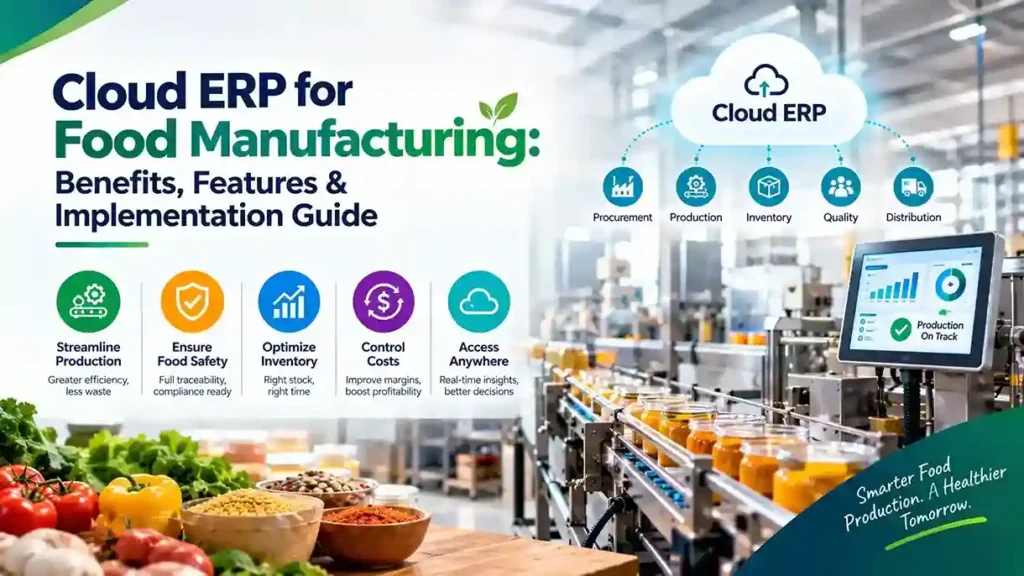
Food manufacturers operate under a unique set of pressures that general-purpose ERP systems were never designed to handle. Short shelf lives, strict allergen controls, batch traceability requirements, and volatile raw material costs demand software that understands the realities of food production—not just standard accounting and inventory.
Cloud ERP has become the dominant deployment model for food manufacturers because it combines industry-specific functionality with the scalability, automatic updates, and remote accessibility that modern operations require. This guide covers the benefits, essential features, and a practical implementation roadmap.
Why Cloud ERP for Food Manufacturing
Purpose-Built for Perishability and Compliance
Food manufacturing ERP differs fundamentally from discrete manufacturing ERP. Ingredients have expiration dates, recipes require version control, allergen declarations must be accurate across every batch, and recalls demand immediate forward and backward traceability. Cloud ERP solutions built for food handle these requirements natively, rather than through workarounds bolted onto generic systems.
Faster Time to Value
Cloud deployment eliminates the infrastructure procurement, server provisioning, and on-premise installation phases that stretch traditional ERP projects. Preconfigured industry templates for food processing can accelerate implementation further. Alithya’s FoodXpress, for example, includes over 1,000 pre-modeled business processes and 700 task guides specifically for food processing organizations running on Dynamics 365.
Automatic Updates and Continuous Innovation
Cloud ERP delivers new features, regulatory updates, and security patches automatically. For food manufacturers facing changing labeling laws, tax rules, and compliance requirements, this reduces the burden on internal IT teams and ensures the system stays current without disruptive upgrade projects.
Real-Time Visibility Across the Supply Chain
Cloud architecture enables real-time data flow from production floors, warehouses, and supplier systems. Infor reports that food and beverage companies using their cloud solutions achieve 30% faster time to market for new products and annual savings of approximately €500K from yield improvements alone.
Essential Features for Food Manufacturing
Batch and Lot Traceability
Complete lot-level traceability from raw material receipt through finished goods dispatch is non-negotiable. Leading cloud ERP systems provide forward and backward tracing that can be executed in minutes rather than days—critical during a recall event or audit.
Shelf-Life Management and FEFO
First Expired, First Out (FEFO) picking must be standard, not custom. The system should track remaining shelf life at every stage and enforce expiry-based allocation automatically.
Recipe and Formula Management
Version-controlled recipes with ingredient substitution rules, yield factors, and allergen declarations managed centrally. When a recipe changes, downstream impacts on cost, labeling, and compliance should flow automatically through the system.
Allergen Controls
Allergen data must be embedded in master data, recipe management, production orders, and labeling—not maintained in separate spreadsheets. Line clearance and changeover controls should flag risks before production begins.
Quality Management and OEE
Inspection plans, quality certificates, and batch records linked to production data. Overall Equipment Effectiveness (OEE) visibility by line and shift, with downtime, speed loss, and quality losses attributed and reported in real time.
Production Planning for Perishables
MRP configured for perishable ingredient lead times, seasonal availability, and minimum order quantities. Demand signals should feed directly into procurement and production schedules to balance over-ordering and stockouts.
Implementation Guide: A Phased Approach
Phase 1: Assessment and Planning (Weeks 1–4)
Evaluate your current system, data quality, regulatory compliance posture, and user readiness. Define which sites, processes, and compliance requirements are in scope. Identify quick wins such as batch tracking or shelf-life automation to demonstrate early value. Establish governance for data stewardship and change management.
For food manufacturers, this phase must include a thorough review of existing recipes, allergen data, and traceability requirements. Poor master data quality is the most common cause of implementation delays.
Phase 2: Design and Configuration (Weeks 5–16)
Design the future-state workflows: batch tracking, formula structure, quality processes, shelf-life logic, and warehouse operations. Configure master data including materials, formulas, products, batch parameters, and quality templates. Plan integrations with LIMS, labeling systems, retailer EDI, and IoT sensors for temperature monitoring.
A critical decision is whether to adopt standard food-industry processes or customize. Experienced implementers consistently recommend adapting to the software’s built-in best practices rather than recreating legacy workarounds.
Phase 3: Development and Data Migration (Weeks 17–28)
Build necessary extensions and integrations. Migrate formulas, supplier data, and regulatory records from legacy systems. Data migration requires preparation, cleansing, mapping, and validation—a process that takes longer when legacy data has accumulated inconsistencies over years.
Phase 4: Testing and User Acceptance (Weeks 29–40)
Conduct systematic testing including unit, integration, and user acceptance testing. Use real data to simulate realistic scenarios. Test batch creation, shelf-life calculation, FEFO allocation, and recall workflows specifically. Compliance validation should cover FSMA, HACCP, or applicable local regulations, including audit log review.
Involving subject matter experts from production and quality teams during testing identifies gaps before go-live rather than after.
Phase 5: Cutover and Stabilization (Weeks 41–48)
A parallel run of two to four weeks—running legacy and new systems simultaneously—reduces risk for food manufacturers who cannot afford production disruption. Final cutover transitions to the cloud system with legacy data archived. Hypercare support for the first two weeks post-go-live is essential for resolving issues rapidly and building user confidence.
A phased implementation approach works well for smaller food manufacturers. Platvis Holland, a frozen fish producer, implemented core modules first—sales, purchasing, production, inventory, and finance—while some processes remained partly paper-based initially. This kept the organization flexible and maintained oversight while gradually adapting to digital workflows.
Choosing the Right Platform
Cloud ERP options for food manufacturing span major platforms and Microsoft ecosystem solutions:
Microsoft Dynamics 365 delivers 85–90% of critical food manufacturing capabilities natively, with ISV extensions (such as Aptean Food & Beverage ERP or Harvest) adding specialized functionality for batch production, allergen management, and lot traceability.
Infor CloudSuite Food & Beverage offers a purpose-built industry cloud with integrated supply chain planning, PLM, MES, and trade promotion management.
SAP Cloud ERP provides deep food-specific functionality including batch management, recipe control, allergen tracking, and OEE as standard.
The right choice depends on your existing technology landscape, size, complexity, and whether you prefer a single-vendor suite or a best-of-breed approach.
Key Success Factors
Involve employees early. Platvis Holland attributes much of its implementation success to employee engagement: “It takes time and attention to help everyone become comfortable with the new system. You have to respect existing routines and then gradually introduce new ways of working”.
Set measurable KPIs before go-live. Establish baseline metrics for shelf-life waste, recall speed, compliance audit time, and production yield so you can demonstrate tangible improvement.
Test with real data. Simulated testing misses the edge cases that appear in production. Use actual recipes, actual supplier data, and actual order patterns.
Plan for change management, not just technology. Food manufacturing teams are often accustomed to paper-based or legacy workflows. Training by role and hands-on practice in a test environment determines whether the system is adopted or resisted.
Final Thoughts
Cloud ERP gives food manufacturers the traceability, compliance capability, and operational visibility that legacy systems cannot match. The implementation requires careful planning, disciplined data migration, and genuine user engagement—but the result is a platform that supports growth, reduces recall risk, and keeps pace with regulatory change.
Evaluating cloud ERP for your food manufacturing operation? Start with an assessment of your traceability requirements, recipe complexity, and compliance obligations to determine which platform and deployment approach fits your business.