
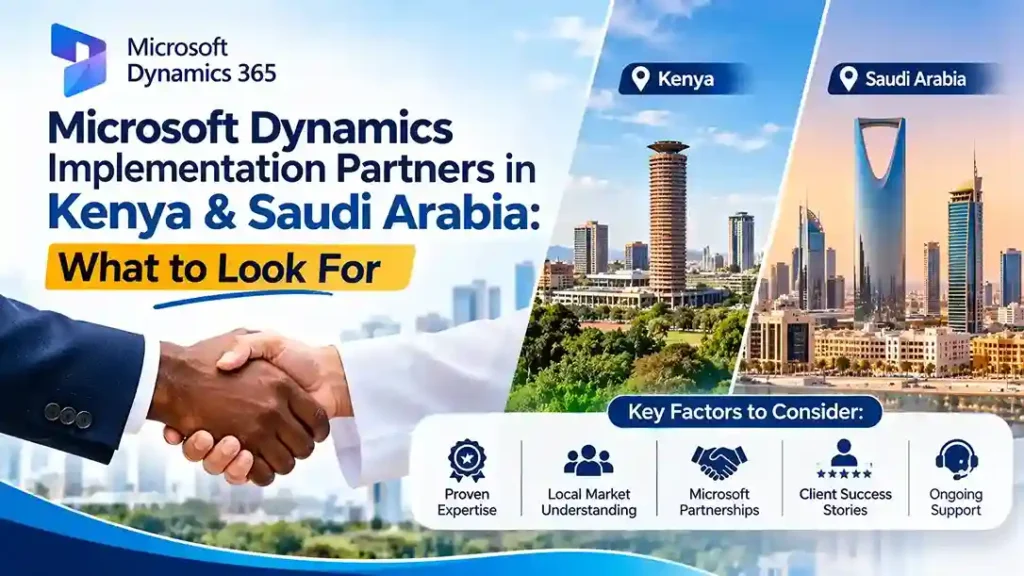
Businesses across Africa and the Middle East are accelerating their ERP modernization. Kenya’s position as East Africa’s technology hub and Saudi Arabia’s Vision 2030 transformation are driving demand for Microsoft Dynamics 365 implementations at an unprecedented pace.
But rapid demand creates a familiar problem: the supply of genuinely qualified partners lags behind. This guide explains what to look for when evaluating Microsoft Dynamics implementation partners in Kenya and Saudi Arabia—and how to avoid costly selection mistakes.
The Kenya Market: Opportunity and Complexity
Kenya has emerged as a regional technology leader, with Nairobi hosting major multinational operations and a growing ecosystem of Microsoft partners. Businesses implementing Dynamics 365 in Kenya face distinct challenges:
Regulatory requirements. Kenya Revenue Authority (KRA) tax compliance, eTIMS invoicing mandates, and local statutory reporting require partners with up-to-date local knowledge.
Multi-country operations. Many Kenyan businesses operate across East Africa—Uganda, Tanzania, Rwanda—requiring partners who understand cross-border compliance and multi-entity ERP structures.
Infrastructure considerations. While cloud adoption is accelerating, some businesses require hybrid deployment patterns that demand partner flexibility.
Local support expectations. Time zone alignment and physical presence matter for responsive support and on-site workshops.
When evaluating Microsoft Dynamics implementation partners in Kenya, verify they understand these local realities—not just D365 functionality.
The Saudi Arabia Market: Vision 2030 Transformation
Saudi Arabia’s Vision 2030 has triggered massive investment in digital infrastructure and enterprise modernization. Microsoft Dynamics implementation partners in Saudi Arabia must handle requirements that are distinctly local:
ZATCA e-invoicing compliance. Phase 1 and Phase 2 e-invoicing mandates require verified integration capability. Partners without ZATCA experience will delay your compliance timeline.
Saudi VAT and statutory reporting. Localization requirements extend beyond translation to genuine regulatory configuration.
Arabic language and Hijri calendar. User interfaces and reports must support Arabic and Islamic calendar requirements natively.
Multi-entity holding structures. Saudi family businesses and holding companies often require complex consolidation and intercompany workflows.
Partners serving both Kenya and Saudi Arabia offer efficiency for organizations operating across the two regions, but verify genuine presence in each market—not just a sales office.
What to Look For in Microsoft Dynamics Implementation Partners in Kenya
1. Verified Microsoft Designations
Request their Microsoft Partner ID and verify current Solutions Partner designations in Microsoft’s official directory. Legacy Gold Partner claims without current designations should be questioned.
2. Kenya-Specific Compliance Experience
Ask directly:
- How do you configure D365 for KRA tax requirements and eTIMS?
- Can you provide references from Kenyan businesses with similar compliance obligations?
- How do you handle multi-country East African operations?
3. Industry Experience
Kenya’s economy spans agriculture, manufacturing, financial services, retail, and technology. Choose a partner with demonstrated experience in your sector—with references to prove it.
4. Local Presence and Support
Confirm physical presence in Nairobi or Mombasa, response time commitments, and coverage during Kenyan business hours. Remote-only partners struggle with on-site workshops and urgent escalations.
5. Implementation Methodology
Request documented methodology covering discovery, configuration, data migration, testing, training, and hypercare. Partners improvising on methodology improvise on your budget.
What to Look For in Microsoft Dynamics Implementation Partners in Saudi Arabia
1. ZATCA Compliance Capability
This is non-negotiable. Ask for specific evidence of ZATCA Phase 1 and Phase 2 integrations completed, with client references.
2. Arabic Localization Depth
Beyond interface translation, confirm experience with Arabic financial reporting, Hijri calendar configuration, and Saudi statutory formats.
3. Vision 2030 Alignment
Partners supporting Saudi government-adjacent projects understand regulatory nuances and procurement requirements that generalist partners miss.
4. Riyadh or Jeddah Presence
Local presence matters for workshops, compliance updates, and escalation. Verify office locations and team composition.
5. Multi-Entity Consolidation Experience
Saudi holding companies and family businesses require complex consolidation. Ask for references from similar structures.
LS Retail Partners in Ethiopia: A Niche Worth Understanding
For retail and hospitality businesses operating in Ethiopia, LS Retail Partners in Ethiopia represent a specialized need. LS Central—the retail and hospitality extension for Microsoft Dynamics 365 Business Central—requires partners with specific LS Retail certification.
Ethiopia’s retail sector is modernizing rapidly, and businesses seeking LS Central implementations face limited partner options. Key considerations:
- LS Retail Diamond Partner status indicates the highest level of LS Retail certification
- Local presence in Addis Ababa for implementation and support
- Experience with Ethiopian regulatory requirements including tax and customs
- References from Ethiopian retail or hospitality deployments
Partners serving both Kenya and Ethiopia offer efficiency for East African retail groups operating across borders.
Questions to Ask Every Partner
Regardless of country, these questions reveal genuine capability:
- What current Microsoft Solutions Partner designations do you hold?
- How many D365 implementations have you completed in this country?
- Can you provide three references from businesses similar to mine?
- How do you handle local tax and regulatory compliance?
- What is your implementation methodology?
- Who will be assigned to my project, and what are their certifications?
- What does post-go-live support include, and at what cost?
- How do you handle Microsoft’s twice-yearly release updates?
Red Flags to Avoid
- No verifiable local references in your country
- Unclear compliance experience with KRA, ZATCA, or local tax authorities
- Expired or unverifiable Microsoft certifications
- No physical presence despite claiming local capability
- Pressure to sign before discovery workshops
- Vague support terms without defined SLAs
Why Regional Partner Selection Matters
Microsoft’s global partner network includes thousands of organizations, but capability varies enormously by region. A partner excellent in Dubai may lack Kenya-specific compliance knowledge. A partner strong in Riyadh may have no ZATCA integration experience.
Regional expertise is not a nice-to-have—it determines whether your ERP meets local regulatory requirements, whether support responds in your time zone, and whether implementation workshops happen in person or over unreliable connections.
Final Thoughts
Selecting Microsoft Dynamics implementation partners in Kenya and Saudi Arabia requires diligence beyond standard partner evaluation. Verify local compliance experience, confirm physical presence, request country-specific references, and test their knowledge of regulations that affect your operations.
For specialized needs like LS Retail Partners in Ethiopia, confirm LS Retail certification level and local retail deployment experience before committing.
Evaluating partners in Kenya, Saudi Arabia, or Ethiopia? Request designations, local references, and compliance credentials before your first discovery session.