
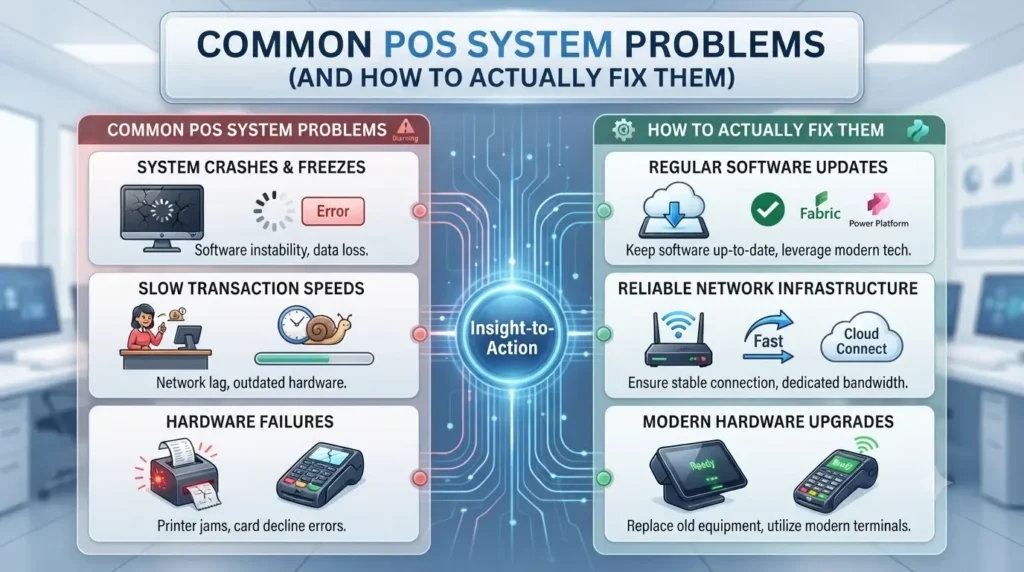
POS System Problems and Solutions for Retail
A single unencrypted Wi-Fi network shared between your POS terminals and customer guest access is one of the most common ways retail payment data gets exposed — and it’s still standard setup in a lot of small and mid-size stores. Most POS problems aren’t software failures. They’re implementation gaps that show up months after go-live, when nobody’s watching for them anymore.
Here are the five that come up most often, and what actually fixes each one.
1. Security Gaps That Go Unnoticed Until It’s Too Late
A single data breach can undo years of customer trust — and PCI-DSS non-compliance carries real financial penalties on top of the reputational damage. The fix isn’t a single tool; it’s a checklist most retailers skip at implementation:
- Separate Wi-Fi networks for POS terminals and customer/guest access — never shared
- WPA3 encryption on the POS network, not left on default router settings
- Unique, rotated passwords per terminal, not one shared login across staff
A POS platform with built-in breach detection catches anomalies — like a terminal suddenly processing transactions outside normal hours — before they become a full incident.
2. Choosing a POS System That Can’t Scale With You
Retailers often pick POS software based on sticker price alone, then discover it can’t handle multi-location reporting or real-time inventory sync once they open a second store. Reporting inaccuracy at that point isn’t a bug — it’s the system reaching its architectural limit.
Treat POS selection as infrastructure, not a one-time purchase. A platform built to handle your business at 3x its current size costs more upfront but avoids a forced, disruptive migration in 18 months.
3. No Fallback When the Internet Drops
If your POS is fully cloud-dependent and your internet connection fails, you can’t process a single transaction — not ideal during a Saturday afternoon rush. This is a design flaw many retailers only discover during their first outage.
Two fixes, not mutually exclusive: a backup hotspot connection as a stopgap, and a POS platform with offline transaction mode that queues sales locally and syncs once connectivity returns. LS Central, built on Microsoft Dynamics 365 Business Central, supports offline resilience so a dropped connection doesn’t mean a dropped sale.
4. Paying for Features You Never Turn On
Sales reporting, email marketing integration, e-commerce sync, employee management — most modern POS platforms include all of it, and most retailers use a fraction of it. That’s not a software problem; it’s an onboarding problem. Nobody walked the team through what the platform can actually do beyond ringing up sales.
An implementation partner should include a features audit 60-90 days post go-live, not just at launch, since usage patterns and business needs shift once the system is live.
5. Staff Who Never Got Properly Trained
A new POS rollout without structured training turns every shift into a slowdown — staff second-guessing screens, mis-keyed transactions, frustrated customers in line. High retail staff turnover makes this worse: every new hire restarts the same friction if training isn’t systematized.
Platforms built on familiar Microsoft interface logic — Business Central, Windows, Office — cut this ramp-up time meaningfully, because staff already know the underlying navigation patterns. Pair that with a standard onboarding checklist your team follows for every new hire, not ad hoc shadowing.
Choosing a Partner, Not Just a Platform
A POS rollout isn’t a one-time transaction — it’s the start of a long-term relationship with whoever implements and supports it. Trident Information Systems is a Microsoft Solutions Partner delivering LS Central, an end-to-end retail solution built on Dynamics 365 Business Central covering POS, inventory, merchandising, demand planning, and back-office operations in a single platform — no stitching together separate systems for headquarters and store-level reporting.
Facing one of these problems in your current POS setup? Talk to Trident’s retail solutions team about an LS Central assessment for your store or chain.
FAQ
Q: What are the most common POS system problems?
A: Security gaps from shared Wi-Fi networks, systems that can’t scale to multiple locations, no offline fallback during outages, underused features, and insufficient staff training.
Q: What happens if a POS system loses internet connection?
A: Fully cloud-dependent systems can’t process transactions during an outage; platforms with offline mode queue sales locally and sync once connectivity returns.
Q: Is LS Central suitable for multi-location retail chains?
A: Yes — built on Dynamics 365 Business Central, it unifies POS, inventory, and back-office operations across store locations from a single platform.

