
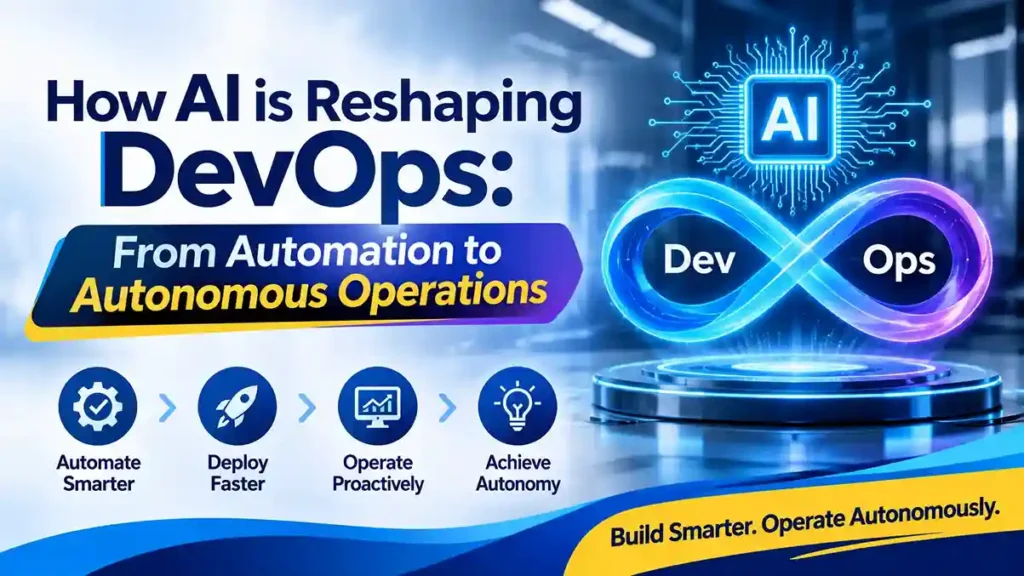
AI is reshaping DevOps by moving beyond deterministic, rule-based pipeline automation toward agentic systems that observe, reason, decide, and act on production infrastructure. Autonomous operations do not replace DevOps engineers; they shift the role toward designing guardrails, permissions, and observability for AI agents that propose and execute remediation under human governance.
Key takeaways
- Traditional DevOps automation is deterministic; agentic operations are probabilistic. A CI/CD pipeline executes predefined steps, while an AI agent may observe latency, analyze logs, identify a bad deployment, and propose a rollback—introducing both power and risk .
- Human oversight is a design feature, not a limitation. Microsoft’s Azure SRE Agent requires explicit human approval for any action that modifies the environment, by default .
- Agentic remediation extends the AIOps loop. Traditional AIOps detects anomalies and stops at notification; agentic operations add root-cause diagnosis, remediation planning, and execution with learning from outcomes .
- Platform engineering becomes more important, not less. As agents gain access to production, someone must design identity, least-privilege permissions, audit trails, and rollback mechanisms .
- Adoption is measurable but uneven. Pulumi reports that approximately 40% of tasks conducted by DevOps teams are now assigned to AI agents, according to the company’s data .
What is the difference between AI-driven automation and autonomous operations?
AI-driven automation executes predefined responses to detected signals, while autonomous operations adds a reasoning loop that diagnoses root causes and selects remediation actions. A traditional runbook might restart a failed service when a health check fails—deterministic and predictable. An agentic system observes the failure, correlates it with a recent deployment, retrieves relevant runbooks, forms a hypothesis, and proposes or executes a fix. The IEEE literature describes this shift as moving from rule-based automation, which “is no longer sufficient” for cloud-native complexity, toward systems that “anticipate errors, optimize configurations, and perform autonomous remediation” . The critical distinction is the presence of deliberation: autonomous systems do not merely react; they interpret context and choose among possible actions. This introduces stochastic behavior, which is why governance mechanisms—approval gates, role-based access control, and audit logging—become essential rather than optional .
How do agentic AI systems actually operate in production?
Agentic AI systems operate through a continuous perceive-deliberate-execute loop. The perception phase ingests structured events from observability platforms—anomalies, alerts, and telemetry signals. The deliberation phase uses a large language model to analyze context, retrieve relevant runbooks from a vector database, and correlate with past incident records to form a hypothesis about the failure. The execution phase selects and applies the appropriate tool to confirm the hypothesis or execute remediation . Microsoft’s Azure SRE Agent implements this pattern for Azure workloads: it correlates incidents with recent deployments and configuration changes, understands resource dependency chains, and can take controlled action via Azure CLI and REST APIs—but only with explicit human approval and within RBAC boundaries . Every action generates structured artifacts—investigation timelines, root-cause summaries, remediation records—that improve the agent’s performance over time .
What role does human oversight play in autonomous DevOps?
Human oversight is the mechanism that makes autonomous operations viable in enterprise and regulated environments. Microsoft’s documentation states explicitly that the Azure SRE Agent is “not automation without supervision”—for any action that modifies the environment, explicit human approval is required by default . This is a deliberate design choice, not a technical limitation. The reasoning is straightforward: AI agents are probabilistic, and the consequences of an incorrect remediation in production can exceed the cost of waiting for human review. Approval gates, scoped permissions, and comprehensive audit logs are engineering features that build trust . The more autonomy granted to agents, the more critical identity management, secrets handling, and rollback mechanisms become . Organizations that treat human-in-the-loop as a foundation rather than an obstacle report that agents free engineers from repetitive toil, allowing them to focus on higher-value reliability work .
Comparison table: Traditional automation vs. AIOps vs. autonomous operations
Choose traditional automation for stable, well-understood workflows. Choose AIOps for observability at scale. Choose agentic operations only when governance infrastructure is in place.
What does agentic code remediation look like in practice?
Agentic code remediation applies the perceive-deliberate-execute loop to security and quality alerts. GitHub’s agentic autofix for code scanning alerts, generally available as of October 2026, works across the codebase the way a developer would: it explores relevant files, generates a proposed fix, reruns CodeQL to validate that the fix closes the alert, iterates if needed, and opens a draft pull request for review . The pull request includes a summary of the fix, why it closes the alert, and the validation steps taken. Copilot Autofix for Azure DevOps similarly runs on an agentic foundation that can review and refine its proposed changes before returning a suggestion, using custom instructions defined in the repository to follow team coding standards and remediation patterns . The human remains in the loop: the engineer reviews the explanation and proposed diff before creating the pull request. This pattern—agent proposes, human disposes—is the emerging standard for agentic remediation in the development pipeline.
How Trident approaches this
Trident Information Systems approaches AI-driven DevOps through the same discipline it applies to ERP implementations: governance before autonomy. We begin by assessing whether the client’s foundational practices are in place—clear SLOs, comprehensive observability, structured operational knowledge, and disciplined change management. Microsoft’s own guidance is explicit on this point: agents amplify these investments rather than replace them, and organizations that benefit most are those that have already invested in the basics . For clients exploring agentic operations, Trident recommends a phased sequence: first, instrument observability and define service-level objectives; second, deploy AIOps for anomaly detection and alert correlation without autonomous action; third, introduce agentic assistance in non-production environments with human approval gates; finally, extend to production remediation with scoped permissions and audit trails. This sequence is slower than vendor demos suggest, but it reflects the reality that autonomous operations without governance infrastructure is a liability, not an asset.
Step-by-step: How to move from automation toward autonomous operations
- Audit your observability foundation. Agents can only reason about what the system emits. Ensure logs, metrics, and traces are comprehensive and correlated before introducing agentic tooling.
- Define explicit service-level objectives and error budgets. Agentic systems need clear targets to evaluate against; undefined reliability goals produce undefined agent behavior .
- Start with read-only agents. Deploy agents that observe, diagnose, and recommend—but do not act. Validate their reasoning against human judgment before granting any execution permission.
- Implement approval gates and scoped permissions. Every action that modifies production must require explicit human approval, with RBAC limiting which resources the agent can reach .
- Establish audit trails for every agent action. Record what the agent observed, what it proposed, what was approved, and what executed. This data improves both agent performance and organizational trust .
- Pilot agentic remediation in non-production first. Extend to production only after the agent’s recommendations have been validated against human decisions over a meaningful period.
- Design rollback mechanisms before granting execution rights. An agent that can act must be able to undo its actions safely, and humans must be able to override.
- Treat incidents as learning opportunities. Every incident should generate structured artifacts—investigation timelines, root-cause summaries, remediation records—that feed back into agent improvement .
FAQ
What is the difference between AIOps and autonomous operations?
AIOps detects anomalies and correlates signals, but typically stops at alerting. Autonomous operations extends the loop: the system diagnoses root causes, plans remediation, executes approved actions, and learns from outcomes . AIOps is a component of autonomous operations, not a synonym.
Will AI agents replace DevOps engineers?
No. AI agents automate operational tasks, but the need for engineers who design platforms, define guardrails, and govern autonomous systems increases. The role shifts from executing manual work to designing the environment in which agents operate safely .
What governance is required before granting an AI agent production access?
At minimum: explicit human approval gates for any modifying action, role-based access control scoped to specific resources, comprehensive audit logging, and tested rollback mechanisms . Without these, autonomous action is an uncontrolled risk.
How reliable are agentic remediation systems today?
Reliability depends on the quality of observability data, the specificity of runbooks, and the scope of permissions granted. Microsoft positions its Azure SRE Agent as a reliability assistant that reduces MTTR, not a replacement for SRE judgment . Organizations should validate agent recommendations against human decisions before granting execution rights.
What is the first step toward autonomous operations?
Strengthen observability and define SLOs. Agents reason from telemetry; if logs, metrics, and traces are incomplete or uncorrelated, agent behavior will be unreliable regardless of model quality .

