
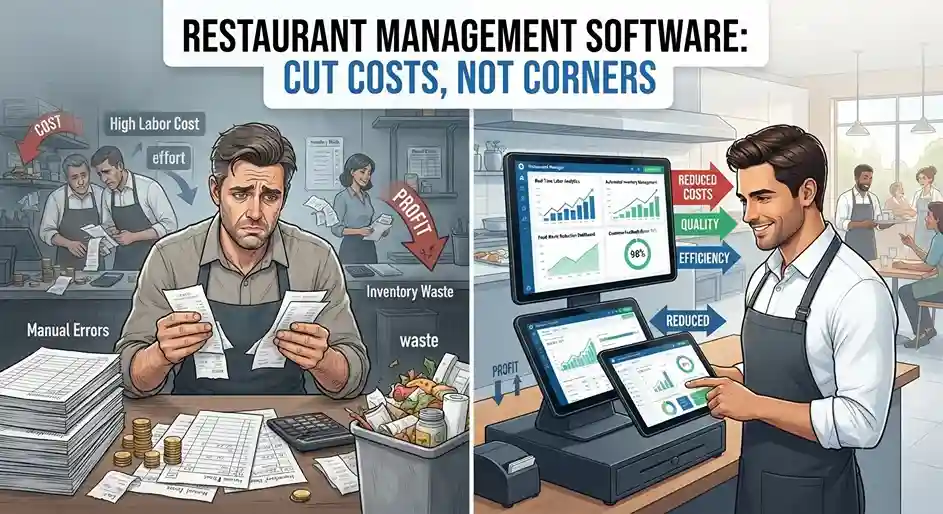
Restaurant Management Software That Cuts Real Costs
A Delhi-NCR QSR chain running five outlets recently found it was losing nearly 8% of monthly food cost to over-portioning alone — not theft, just kitchen staff eyeballing quantities instead of following recipe cards. That’s the kind of leak most restaurant owners never see, because it’s buried across five different systems: one for POS, one for payroll, one for inventory, and a notebook for the kitchen.
Margins in food service rarely exceed 6-9% even in a good year. GST compliance, rising delivery aggregator commissions (Zomato and Swiggy alone can take 18-30% per order), and unpredictable footfall make every rupee of operational waste expensive. The fix isn’t cutting staff or portions — it’s removing the blind spots between front-of-house, kitchen, and back office.
Fix Staff Scheduling With Real Sales Data, Not Guesswork
Most independent restaurants still build rosters in Excel, based on gut feel about which days are busy. A unified restaurant management system instead pulls historical POS data — by hour, day, and even weather pattern — so you schedule five servers on a rainy Tuesday instead of eight.
It also closes the gap between planned and actual hours. Biometric or POS-linked clock-ins compare scheduled shifts against worked shifts automatically, flagging overtime before it hits payroll. For a 40-employee outlet, this alone typically recovers 3-5% of monthly labor cost that would otherwise disappear into unapproved overtime.
Cut Onboarding Time in a High-Turnover Industry
Restaurant staff attrition in India regularly exceeds 40-50% annually, especially among floor staff and delivery-adjacent roles. Every new hire on a clunky, unfamiliar POS costs you order errors and slow service in week one.
LS Central, built on Microsoft Dynamics 365 Business Central, mirrors your actual menu layout on the POS screen and runs on the same interface logic as Microsoft Office — meaning staff already familiar with Windows-based tools adapt within a shift, not a week. One platform for POS, inventory, and back office also means training happens once, not three times across disconnected tools.
Speed Up Table Turnover Without Rushing Diners
Mobile POS devices that connect directly to the kitchen display system (KDS) let servers fire orders the moment they’re taken — no walking back to a terminal. Kitchen staff see tickets prioritized by prep time and urgency, not order sequence, and floor staff get a screen alert when food is ready instead of returning to check.
The same device handles conversational ordering — “extra cheese, no mayo, large fries” — cutting mis-entered orders that generate to complaints and free replacements. Faster table turns during peak hours directly increase covers served per shift without adding headcount.
Reduce Food Waste With Recipe-Level Tracking
A unified platform tracks stock against actual recipes and portions, not just raw purchase-to-sale ratios. If the bin is full of half-used vegetables or over-fried portions, the system flags the pattern before it becomes a monthly loss line. For multi-outlet operators, this data rolls up centrally, so a head office team can spot which location is over-ordering perishables and correct it — instead of discovering it three months later in a P&L review.
One Platform, One IT Bill
Running separate systems for POS, payroll, inventory, and reporting means separate licenses, separate integrations, and separate support contracts — and none of them talk to each other cleanly. A single Microsoft-based platform like LS Central consolidates this into one system, one vendor relationship, and one implementation partner who understands both the restaurant floor and the Business Central backend.
For multi-city chains across India and the UAE managing GST or VAT compliance across states and emirates, this consolidation also simplifies statutory reporting — instead of reconciling data from four disconnected tools every filing cycle.
Ready to see what a unified restaurant management system saves in your operation? Talk to Trident’s Dynamics 365 team for an LS Central assessment specific to your outlet count and market.
FAQ
Q: What is restaurant management software?
A: It’s a unified platform combining POS, inventory, staff scheduling, and kitchen operations into one system, replacing multiple disconnected tools.
Q: How does restaurant management software reduce food costs?
A: It tracks stock against actual recipes and portions in real time, flagging over-usage and waste patterns before they show up in monthly losses.
Q: Is LS Central suitable for multi-outlet restaurant chains in India and UAE?
A: Yes — it’s built on Microsoft Dynamics 365 Business Central, supporting centralized reporting across outlets alongside GST and VAT compliance requirements.

