Welcome to Trident Information Systems!
Write us to - info@tridentinfo.com
Let's Socialize

application of iot in retail

retailers employ application of iot in retail, customer interaction, monitoring of various goods and services, and inventory management. The current research concentrated on customer service, client experience, and purchase satisfaction from the customer’s point of view.
IoT (Internet of Things) technologies are becoming more prevalent to assist shops in customising the shopping experience. High-speed and low-power communication advancements help these developments.
Phone detection is made possible by IoT technologies. Dynamic pricing, personalised offers, and customised goods and services are just a few of the personalised experiences that retailers will be able to give their consumers in the future thanks to the data that is collected in-store.

Smart Retail IoT

How Does IoT Help Your Retail Business with More Advanced Customer Service?

Today’s digital transformation has given the Internet of Things a fair playground to establish itself among businesses. IoT has entered our homes and offices, which is why we expect exceptional comfort from the technology. From fast details to instant customer services, it has conquered it all. Due to all these conveniences, customers are becoming less patient and hence their demand changes rapidly. Be it retail, manufacturing, or IT services, IoT is used everywhere. Especially in retail, successful retailers are more inclined to Smart Retail IoT. They allow their customers to view the availability of products in advance, so they don’t waste their time over something that’s not even available.  To keep it even simpler, a few years ago, let’s say your microwave faced issues. You would call the executive of that brand, get in the customer service line, and wait for your turn. Then you will go ahead describing your issues and he may even transfer your call to another executive. You will end up explaining to him all over again. He will tell you ways you can fix it yourself, if you fail, they will send a technician. Would you still do it even today? Probably not. Of course, it will be one of the options, but you can straightaway talk to a bot who has the fix for your issue fed into its system.   It can send you a link to a blog to help yourself or send you common FAQs. It will even assign a technician for your job if you want. That’s how IoT is.    How Smart Retail IoT Helps Coping with Changing Customer Demands?  IoT in Retail Industry is a reliable source if you wish to gain meaningful customer insights into your customers, especially when a specific demand of theirs does not last long. This is how Smart Retail IoT changes the game:   Data-Driven Customer Insights  The user can analyze Smart Retail IoT data to get a better understanding of their customers, products, and marketing strategies. They can figure out what improvement a product needs, along with its potential problems. Based on the insights received from Retail IoT Solutions, companies can personalize their approach such as recommending a complimentary service or product, especially for current customers. They can also offer special incentives for potential customers.   Combining IoT Data   By combining IoT in Supermarket data with other, preferably digital sources, marketers can get maximum advantage. For instance, a runner’s behavior as tracked in his fitness tracker may be combined with his shoe purchase history may give useful insights into when he may need a pair of new shoes. They can then personalize offers for him and send him notifications via text or email.   Connecting with Customers Using Devices   Various Smart Retail IoT devices provide a feature to directly interact with the customer. Such features are embedded to get recommendations to improve the product or services. Customers can also suggest what upgrade they would prefer. Marketers can get these insights by connecting data from IoT Application in Retail to a marketing system to blend it with other data as well and apply certain regulations from the archives of approved content.   Use IoT to Boost Your Reach   Businesses can easily use Smart Retail IoT to boost reach and enhance communication via different channels. It assists in revealing customer needs and interests. This can only happen if this IoT for Retail Industry data is confined to other customer data in a single unified database. They can then leverage it in some marketing approach such as emails or social media campaigns.   How To Create Value for Your Customers?  Just like any other technology, Smart Retail IoT too has some challenges in customer data management. However, if the businesses can unlock the insights found in the data can tap into new opportunities for understanding and interacting with customers. It makes it worth it to put extra effort into decoding Retail IoT Solutions data and formatting it for the marketers to use.    So, how to create value for your customers? You must adjust to the world of IoT. It may include planning how to manage a high volume of streaming data, even extraction, performing parsing, saving data in readable formats, and integrating it with other marketing systems for analysis and implementation.   If you want to integrate Smart Retail IoT with your existing system, you must look for a trusted service provider. Trident Information Systems integrates your IoT Solutions with your existing system so you can leverage its features and maximize your output. We specialize in IoT solutions such as Vision Intelligence System (a machine vision system for accurate quality inspection while manufacturing). asset management with RFID (radio frequency identification), Industry 4.0 – traceability solutions, parameter monitoring, web and mobile app development, In AI (Artificial Intelligence) – smart chatbot solution for reporting and analytics, NLP (Natural Language Processing), sentiment analysis, ML solutions etc. Contact us for further information. 

How Does IoT Help Your Retail Business with More Advanced Customer Service? Read More »

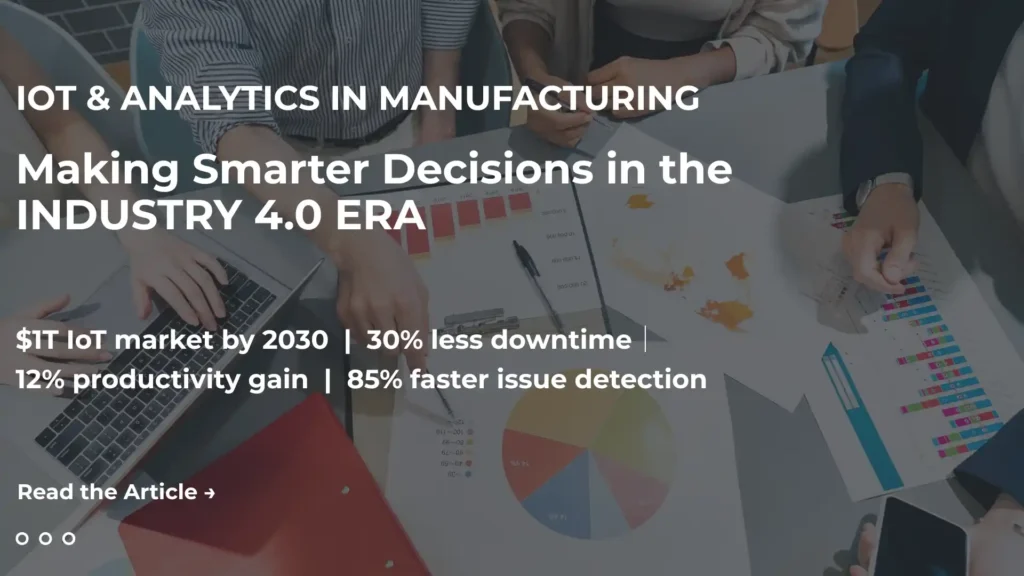
Smart factory using IoT sensors and analytics dashboards for real-time manufacturing insights.

IoT and Analytics in Manufacturing: Making Smarter Decisions in the Industry 4.0 Era

Your factory floor is generating more data than you could ever manually process. The question is — are you actually using any of it? Most manufacturers today are data-rich but insight-poor. Sensors on machines, production line monitors, quality inspection systems, and logistics trackers generate enormous volumes of operational data every single day. Yet the majority of that data either sits unused in a database or gets reviewed days after the moment when acting on it would have made a difference. That gap — between data collection and intelligent decision-making — is exactly what the combination of IoT and advanced analytics is designed to close. And in Industry 4.0, closing it is no longer a competitive advantage. It is a baseline requirement. What Industry 4.0 Actually Means for Manufacturers Industry 4.0 is not a single technology. It is the convergence of several technologies — IoT sensors, cloud computing, artificial intelligence, machine learning, and advanced analytics — working together to create manufacturing operations that are connected, intelligent, and self-optimizing. The central promise is straightforward: connect every asset, capture every data point, and use that data to make faster and better decisions — about maintenance, quality, production planning, and operational efficiency. The manufacturers who are getting this right are called Best-in-Class for a reason. They experience less unplanned downtime, higher product quality, better asset utilization, and lower operational costs than their peers. The difference is not their machines. It is how intelligently they use the data those machines generate. The Three Levels of Manufacturing Analytics To understand what IoT and analytics deliver together, it helps to understand the three levels of analytical insight available to manufacturers. 1. Descriptive Analytics — What Happened? This is the starting point. Descriptive analytics tells you what has already occurred — production volumes, downtime events, quality rejection rates, energy consumption. Most manufacturers have some version of this through their ERP or MES reporting. It is useful for understanding history. But it cannot help you prevent the next problem. 2. Predictive Analytics — What Will Happen? Predictive analytics uses historical data and machine learning models to forecast future events. In manufacturing, the most valuable application is predictive maintenance — identifying equipment that is likely to fail before it actually does. When IoT sensors on a machine detect subtle changes in vibration, temperature, or current draw that historically precede a failure, the system flags it for maintenance intervention. The machine gets serviced during a planned window. Production continues uninterrupted. The difference between a planned maintenance stop and an unplanned breakdown is enormous — in cost, in production loss, and in the cascading impact on every downstream process that depends on that machine. 3. Prescriptive Analytics — What Should We Do? This is the most powerful level — and the one that separates genuinely Best-in-Class manufacturers from the rest. Prescriptive analytics does not just tell you what will happen. It tells you what to do about it. It evaluates multiple possible responses to a predicted situation and recommends the optimal action — factoring in production schedules, parts availability, technician skills, customer delivery commitments, and cost. This is the foundation of what analysts call the virtual factory — a digital model of your production operation that continuously optimizes decisions across every function in real time. How IoT Makes All of This Possible Advanced analytics is only as good as the data it processes. IoT is what makes that data rich, real-time, and continuous. IoT sensors embedded in production equipment capture performance data — vibration, temperature, pressure, speed, current draw, cycle time — at frequencies that humans cannot monitor manually. This continuous stream of operational data feeds directly into analytics platforms. Connected quality systems capture inspection data at every production stage — surface defects, dimensional measurements, weight variations — creating a complete quality record for every batch produced. Production line monitors track throughput, cycle times, and OEE (Overall Equipment Effectiveness) in real time — giving production managers the live visibility they need to identify bottlenecks and respond before the end of shift, not at the next morning’s review meeting. Asset tracking monitors the location and utilization of tools, equipment, and WIP inventory across the factory floor — reducing the time wasted searching for assets and improving the accuracy of production scheduling. The Real Business Impact When IoT and analytics work together effectively in a manufacturing environment, the business outcomes are measurable and significant: Outcome How IoT and Analytics Delivers It Reduced unplanned downtime Predictive maintenance catches failures before they occur Higher product quality Real-time quality monitoring enables immediate corrective action Better OEE Live production visibility identifies and eliminates bottlenecks Lower maintenance costs Planned maintenance replaces emergency breakdowns Improved energy efficiency Usage patterns identified and optimized through analytics Faster decision-making Prescriptive recommendations surface the right action automatically Best-in-Class manufacturers combining IoT with advanced prescriptive analytics consistently report significant reductions in asset downtime and measurable improvements in product quality — not as aspirational projections, but as documented operational outcomes. Microsoft Azure IoT and Dynamics 365: The Enterprise Platform For manufacturers looking to implement IoT and analytics at enterprise scale, Microsoft Azure IoT Hub combined with Microsoft Dynamics 365 Supply Chain Management provides the integrated platform that makes Best-in-Class performance achievable. Azure IoT Hub connects every sensor and asset in your facility — processing real-time telemetry data from thousands of devices simultaneously and feeding it into analytics and business systems. Azure Machine Learning builds and deploys the predictive models that turn raw sensor data into actionable maintenance and quality insights. Microsoft Dynamics 365 integrates IoT alerts directly into business processes — automatically creating work orders when predictive models identify a maintenance requirement, adjusting production schedules when quality anomalies are detected, and providing management dashboards with real-time operational intelligence. Microsoft Copilot in Dynamics 365 adds a natural language layer — allowing production managers and operations leaders to query their operational data conversationally, getting instant answers to questions that previously required an analyst to answer. Where to Start The gap between a factory that collects data and

IoT and Analytics in Manufacturing: Making Smarter Decisions in the Industry 4.0 Era Read More »

Microsoft Dynamics 365 Connected Field Service dashboard monitoring predictive maintenance and service operations.

Microsoft Dynamics 365 Connected Field Service: How Industry Leaders Are Moving From Break-Fix to Predictive Service

What if your field technician could fix a problem before the customer even knew it existed? That is not a futuristic scenario. It is what Microsoft Dynamics 365 Connected Field Service — powered by IoT integration through Microsoft Azure — is delivering for industry leaders right now. And organizations that have made the switch are seeing return on investment in as little as four months. Field service has always been the moment of truth in customer relationships. The technician who arrives on time, with the right parts, with full knowledge of the customer’s history — or doesn’t — defines how that customer feels about your brand for years. But the traditional break-fix model of field service is no longer a viable competitive strategy. Customers today expect 100 percent uptime, hyper-speed service delivery, and proactive care that anticipates problems before they escalate. In an environment where competitive pressure is intensifying across every industry — from manufacturing and utilities to telecommunications and retail — field service has become a primary differentiator. The organizations winning are those that have moved from reactive to predictive, from disconnected to connected, and from legacy systems to intelligent, cloud-based field service platforms. This guide covers everything you need to know about Microsoft Dynamics 365 Connected Field Service — what it is, how it works, what real organizations have achieved with it, and how Trident Information Systems can implement it for your operation. The Field Service Revolution: Why the Old Model Is Failing From Break-Fix to Predictive: The New Standard for Field Service The break-fix model of field service — wait for something to fail, dispatch a technician, fix the problem, send the invoice — was the industry standard for decades. It worked adequately in a world where customers had limited alternatives and modest expectations. Neither of those conditions applies today. Modern customers expect continuous uptime, not reactive repairs. They expect service providers to know about potential failures before they occur — and to resolve them without disruption to operations. In industries like utilities, manufacturing, and facilities management, an unplanned outage or equipment failure is not just an inconvenience. It is a financial event, a safety risk, and a potential contract termination. The shift from break-fix to proactive and predictive service is not a trend — it is a market requirement. And it is only possible with the right connected technology infrastructure. Why Customer Experience Has Become the Frontline of Field Service Field service is no longer just an operational function. It is a customer experience function — and in many industries, it is the single most important touchpoint in the entire customer relationship. The field technician who arrives at a customer’s facility is representing your brand at its most direct and personal. What they know, what tools they have, how quickly they resolve the issue, and how well they communicate throughout the process determines whether that customer renews their contract, refers your company to others, or starts evaluating your competitors. This is why leading organizations across retail, telecommunications, manufacturing, utilities, and professional services are investing in connected field service — not just as an operational upgrade, but as a strategic investment in customer retention and competitive differentiation. What Is Microsoft Dynamics 365 Connected Field Service? Microsoft Dynamics 365 Connected Field Service is an intelligent, IoT-powered field service management solution that connects physical assets, field technicians, customer data, and service operations on a single platform — enabling organizations to shift from reactive maintenance to proactive, predictive service delivery. At its core, Connected Field Service integrates three technology layers that traditional field service solutions have always kept separate: When these three layers work together, something fundamental changes: your service operation stops reacting to failures and starts preventing them. IoT Integration: Knowing About Problems Before Customers Do The most powerful capability in Microsoft Dynamics 365 Connected Field Service is the integration with Microsoft Azure IoT Hub — which enables continuous monitoring of connected assets and automatic work order generation when sensor data indicates a potential failure. Here is what that means in practice: The result is not just faster service. It is service that prevents the problem from becoming a crisis — protecting the customer’s operations and your relationship simultaneously. Mobile-Connected Field Teams With a 360-Degree Customer View The value of IoT monitoring is only fully realized when the field technician who responds to it is properly equipped. Microsoft Dynamics 365 Connected Field Service gives every technician a complete, real-time view of the customer and asset before they arrive on site: When a technician arrives fully informed and properly equipped, first-time fix rates increase dramatically — and repeat visits, which are expensive for the service provider and frustrating for the customer, decrease proportionally. H3: Mixed Reality and the Future of Field Service Delivery Microsoft Dynamics 365 Connected Field Service also supports Mixed Reality technologies — including Microsoft HoloLens and Remote Assist — that are reshaping how complex field service challenges are resolved: Mixed Reality in field service is not yet universal — but for organizations managing complex, high-value assets in industries like aerospace, industrial manufacturing, and energy, it is rapidly becoming a standard capability. Real-World Proof: MacDonald Miller Facility Solutions Case Study Theory is valuable. Proof is better. The MacDonald Miller Facility Solutions case study is one of the most compelling demonstrations of what Microsoft Dynamics 365 Connected Field Service delivers in practice — and the speed at which it delivers it. The Challenge: Managing Complex, Interconnected Facility Systems MacDonald Miller Facility Solutions is a professional services company specializing in facilities management — a sector defined by complexity. Managing multiple interlocking, interdependent building systems across a large portfolio of client facilities, with the expectation of continuous uptime and proactive maintenance, requires a technology platform capable of integrating disparate data sources and coordinating rapid field response. Before adopting Connected Field Service, MacDonald Miller’s technicians were working without complete asset history when deployed to service calls. Work order creation and dispatch was reactive. The information needed to diagnose and resolve issues

Microsoft Dynamics 365 Connected Field Service: How Industry Leaders Are Moving From Break-Fix to Predictive Service Read More »