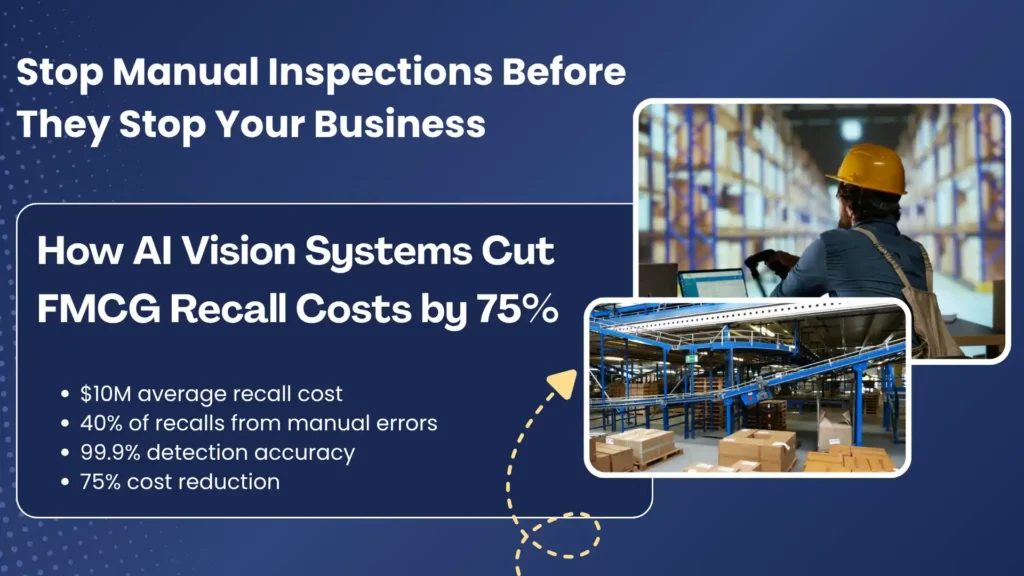
A single product recall in the FMCG sector costs an average of $10 million — and that is before factoring in brand damage, lost shelf space, and the regulatory fallout that follows. For most manufacturers, the painful irony is that the defects triggering those recalls were visible to someone on the production line. They just were not caught in time.
Manual quality inspection has been the industry standard for decades. It is also, by now, a well-documented liability. Human inspectors tire, lose focus, and cannot process the volume or speed of a modern FMCG production line. AI-powered vision systems are changing that equation — and the results are not incremental. Manufacturers deploying these systems are reporting recall cost reductions of up to 75%, with defect detection rates that no team of human inspectors can match.
Why Manual Inspection Is Failing FMCG Manufacturers
Walk into any high-speed packaging facility and you will find the same setup: workers stationed at conveyor lines, eyes scanning products as they blur past at hundreds of units per minute. It is an approach built for a different era of production.
The problems are structural, not personal. Human visual attention degrades significantly after 20 minutes of repetitive tasks — a phenomenon well-documented in industrial ergonomics research. Miss rates for subtle defects like micro-cracks, label misalignment, or underfill conditions routinely run between 15% and 25% on manual lines. At production speeds of 500 to 1,000 units per minute, even a 5% miss rate means thousands of potentially defective products entering the supply chain every hour.
The downstream costs compound quickly. A contaminated batch that clears inspection does not just create a recall — it creates a crisis. Regulatory agencies are notified, retailers pull stock, consumers lose confidence, and legal exposure mounts. The UK Food Standards Agency reported that food recalls increased by 18% between 2019 and 2023, with packaging and labelling failures accounting for nearly a third of all incidents.
Manual inspection is not just unreliable. At modern line speeds, it is functionally inadequate.
What AI Vision Systems Actually Do
The term “AI vision” covers a spectrum of technologies, but in FMCG quality control the core system is a combination of high-resolution industrial cameras, edge computing hardware, and deep learning models trained on thousands of defect and non-defect images.
The cameras capture every unit on the line — continuously, without fatigue, at full production speed. The AI model processes each image in milliseconds, comparing it against learned parameters for fill levels, seal integrity, label placement, colour consistency, and surface defects. Units that fall outside acceptable tolerances are flagged and automatically ejected before they reach downstream packaging.
What separates modern AI vision from earlier rule-based machine vision is adaptability. Traditional systems required engineers to manually define every defect condition — a rigid approach that struggled with natural product variation. Deep learning models, by contrast, are trained on real production data. They learn what a good product looks like, and they identify deviations that no one thought to programme in advance.
A biscuit manufacturer in the Netherlands, for example, deployed an AI vision system that reduced breakage-related waste by 40% and cut labelling non-conformances by 82% within six months of installation. The system identified a recurring seal defect pattern during night shifts — something that had been present for years but never surfaced through manual inspection records.
The 75% Recall Cost Reduction: Where the Savings Come From
Recall costs are not a single line item. They are an accumulation of expenses that most finance teams only fully quantify after the event. AI vision systems attack this problem at multiple points simultaneously.
Prevention at source. The most significant saving comes simply from catching defective products before they leave the facility. A defect identified on the line costs a fraction of a defect identified after distribution. AI systems operating at 99.5% or higher accuracy rates effectively eliminate the cohort of products that would otherwise generate field failures.
Reduced inspection labour. Manufacturers typically redeploy, rather than eliminate, inspection staff when AI vision is introduced. But the labour cost per unit of quality assurance drops substantially — often by 60% or more — as human oversight shifts from frontline scanning to exception management and system monitoring.
Lower regulatory exposure. Regulatory bodies including the FDA, EFSA, and the UK FSA place increasing weight on documented quality control processes during recall investigations. Manufacturers with AI vision systems can produce granular, time-stamped inspection records for every unit produced. That audit trail reduces both the scope of recalls and the severity of regulatory penalties.
Faster containment. When a quality event does occur, AI systems provide precise data on when the defect window opened and closed. Instead of recalling an entire production run, manufacturers can identify and withdraw a specific 40-minute production window. That precision alone can reduce recall volume — and therefore recall cost — by 60% to 70%.
Taken together across a mid-size FMCG operation running three or four product lines, these savings consistently produce the 75% recall cost reduction that early adopters are reporting.
Implementation Realities: What to Expect
AI vision systems are not plug-and-play. The technology is mature, but successful deployment requires groundwork that many manufacturers underestimate.
Training data quality is the most critical variable. A model trained on insufficient images will produce high false-positive rates — flagging good products as defective — and erode line efficiency. Leading vendors now offer pre-trained models for common product categories, which reduces this burden, but site-specific fine-tuning is almost always necessary.
Integration with existing line control systems — PLCs, SCADA, MES — requires engineering effort upfront. Manufacturers who treat this as a bolt-on rather than a systems integration project tend to struggle. Those who involve their operations technology team from the outset see faster time-to-value.
Typical payback periods for AI vision deployments in FMCG range from 14 to 24 months, depending on line speed, product complexity, and existing recall exposure. For manufacturers who have experienced a major recall in the past three years, that timeline often compresses significantly.
The Competitive Pressure Is Already Here
Retailer expectations around quality documentation are tightening. Major grocery chains in Europe and North America are increasingly requiring suppliers to demonstrate automated inspection capabilities as a condition of preferred supplier status. What was a competitive advantage two years ago is becoming a baseline requirement.
Manual inspection will always have a role in FMCG quality management — for organoleptic assessment, complex assembly verification, and edge cases cameras cannot reach. But as the primary control for defect prevention on high-speed lines, it has already been superseded.
The manufacturers still running manual-only inspection today are not just accepting higher recall risk. They are absorbing costs — in waste, labour, and regulatory exposure — that their AI-enabled competitors have largely eliminated.
How Trident Information Systems Brings AI Vision to Your Production Floor
Trident Information Systems connects AI-powered quality inspection directly into Microsoft Dynamics 365 Finance & Operations. Through Azure AI Vision and IoT integrations, Trident embeds real-time defect data into quality workflows, production orders, and compliance records — so inspection outcomes drive action across procurement, inventory, and finance rather than sitting in a standalone system. Whether you are building the business case for AI vision, integrating an existing inspection system with your ERP, or deploying quality automation across multiple sites, Trident brings the Microsoft platform expertise and manufacturing process knowledge to deliver it. Speak with a Trident consultant. Follow my LinkedIn page for more in-depth analyses and insights into the future of manufacturing and quality control!