Welcome to Trident Information Systems!
Write us to - info@tridentinfo.com
Let's Socialize

dynamics 365 migration

Business Central Upgrade

6 Reasons Why You Should Choose Business Central Upgrade

 Dynamics NAV (Navision) is one of the most widely used ERP solutions globally. It has established a reputation for its ubiquity and adaptability to suit a variety of enterprises and industries. However, do you think it’s time to replace your obsolete Microsoft Dynamics NAV system with a Business Central Upgrade? You would have relied on your Dynamics NAV system for years. However, you may now notice foundational fractures and rising maintenance expenditures. Therefore, you need a system that can handle more and speed up processing as your firm expands.  Why Do You Need a Business Central Upgrade?  Upgrade NAV to BC as It’s an agile and durable solution that expands your business. Therefore, It incorporates Dynamics NAV capabilities as well. Furthermore, Microsoft has invested millions of dollars in developing this technology. Moreover, they have emphasized assisting businesses in operating the way their business owners want. Evidently, this technology has developed into much more than simply an ordinary ERP platform.   Hence, with automatic updates, highly tailored software systems, and individualized add-ons the software matches the business’s every unique need.  Microsoft aspires to assist businesses via their digital changes through Business Central Upgrade. Thus, If you’re looking to Upgrade Dynamics NAV Solution, these are the top 6 reasons why Business Central is a wise, strategic choice:  #1 Business Central Is Simple to Pick Up and Use  Even with its sleek new web-based interface, Business Central still has the familiar Microsoft Office look and feel. Furthermore, it offers integration capabilities with the entire suite of Microsoft products. Therefore, Upgrading to Business Central doesn’t require a steep learning curve. Users appreciate how their personalized information presents more clearly, notably through improved dashboards and the use of graphs.  #2 It Is Easily Adaptable for Expansion  Business Central now has access to all the features of the most widely used mid-market ERP system in the world. Further, the Business Central Upgrade is smooth, and the system scales with your company. Therefore, you can put as much of it into practice right away as you’d like. Besides, you will never require another system implementation or update after this one.  #3 Automatic Upgrades Twice a Year While Your Customization Stays Intact  Dynamics 365 Business Central addresses the time and upgrading issues. Business Central  ensures the partners and customers can add third-party business apps or other customizations. Therefore, not changing the core system and not influencing the upgrade path. However, with NAV upgrades, the changes to the fundamental code must be undone before an upgrade. Thus, depending on how complicated the environment is, this could take months to finish.  #4 A Variety of Customizable Deployment Options  From private to public cloud deployment choices, Business Central offers a variety of alternatives. They are designed to integrate easily with other Microsoft apps. Therefore, users no longer need to worry about on-premises solutions’ expensive hardware, operating systems, and maintenance costs. All thanks to Microsoft’s proactive move to a cloud-based ERP system. Nevertheless, you may still install Business Central locally if you like. However, doing so may prevent you from taking advantage of premium integration with state-of-the-art Dynamics and Azure services.  #5 Business Central Incorporates Every Dynamics NAV Capability   Some people might hesitate to get a Business Central Upgrade and assume that Business Central is a very different solution. Since, it is a brand-new development platform, they perceive it to be different from NAV. For the people who create software, this might be true. Nonetheless, most of the comprehensive business code architecture and processing algorithms of NAV are still included in the Business Central Base Application. Furthermore, these features have only recently been improved, tested, and further developed over a long period.  #6 Business Central Scales with Your Business  Visual Studio, a cross-platform, open-source development environment, is the basis for Business Central’s multi-language development environment. Furthermore, with the.AL Extension for Visual Studio, developers can extend Business Central by creating specialized apps for a specific customer. For instance, AppSource, Microsoft’s ever-expanding app marketplace, allows developers to publish these apps for sale.   You must get a Business Central Upgrade, or you may lag in the competition. If you are looking for Microsoft Business Central Implementation Partner, you can Contact Trident Information Systems. We are Gold D365 Implementation Partner and LS Retail Diamond Partner. Every business is different and have different needs. Nevertheless, Trident has always satisfied customers with their excellence.

6 Reasons Why You Should Choose Business Central Upgrade Read More »

D365 Migration

Why Would You Migrate to Dynamics 365?

In a time dominated by AI and huge data, the cloud doesn’t seem very disruptive. After all, moving from on-premises hosting to the cloud like D365 Migration has long been a pressing issue and a necessary first step in any journey toward digital transformation. The epidemic has strengthened the cloud’s position in the IT stack even further. Organizations have been frantically trying to fulfill the demands of new remote workers as well as customers wanting improved digital experiences and products to deal with the same issues.   More businesses are migrating their on-premises programs to the cloud, in part as a result of incentives from Microsoft and other legacy software providers to switch to new, cloud-based versions of outdated business tools.  Why Would You opt for D365 Migration?  The cloud is crucial for business survival and growth, to start. Digital transformation objectives including integrating customer touchpoints, operationalizing data, and obtaining a 360-degree picture of the customer became a top priority because of the pandemic, according to IDC’s The Impact of Digital Transformation During Times of Change report. Without the cloud, every priority in that report collapses.  According to a poll by Algorithmia, 83% of respondents are considerably boosting their investment in AI, and 76% said that after the pandemic, AI/ML projects are more important than any other IT initiatives combined. The results also suggest that some of the individuals felt regret. Nearly a quarter of respondents said AI/ML efforts should have been a focus much sooner, and 43% said they matter considerably more than they initially assumed. The argument is that businesses require cloud services to use competitive technologies like AI/ML, IoT, and advanced analytics. When your data is spread across several platforms, it is challenging to move quickly and make wise business decisions; brands are now beginning to feel the effects of doing business without the cloud.  Benefits of D365 Migration  Remaining competitive and creating a more “agile” firm are major goals of your Dynamics 365 On Premise to Online Migration. But—if you want to focus on a few, have a look at some of the main advantages of switching to the cloud:  Organize all Data in a Single Location  No matter how many locations are involved or whether your teams are distributed, D365 Migration gives you total business insight. Organizations get more agility by utilizing reporting tools with Power BI, predictive analytics, and artificial intelligence, which enables quicker, data-driven decision-making. You’ll have a broad perspective of your entire business, your clients, and the market and competitive dynamics affecting client behavior, needs, and expectations. Additionally, you can enhance your forecasting efforts and open up new business models. Or make project management and inventory planning more efficient to reduce costs. The list continues.  Cost Reduction  When properly implemented, D365 Migration can save operational expenses for staff, supplies, warehouse space, administration, deployment, and other factors. Instead, Microsoft is responsible for upgrades, security, and general upkeep.  A Forrester Total Economic Impact analysis states that businesses that switched to the cloud were able to:  Greater Safety  Compared to on-premise ERP solutions, D365 Migration will provide more comprehensive security. Compared to most on-premises solutions and analog ones, the cloud is currently significantly more secure. Yes, there are still a lot of “hard copy holdouts.” But since the beginning of the cloud, things have changed. The fact that established juggernauts like Microsoft, IBM, and Amazon entered the cloud market and developed products for companies in the healthcare, financial services, and public sectors is one of the contributing factors. Controlling where your data is stored, who has access to it, and what resources your company is utilizing at any one time is made simpler by cloud solutions like Microsoft Dynamics 365.  Migration can increase data security and lower the risk of ransomware attacks and data breaches. Additionally, users gain from having more control over who has access to the system and how private data is handled and preserved. This is crucial now when high-profile breaches are increasingly occurring against private organizations. As a result of the high costs of getting cybersecurity management wrong, it is now very risky for businesses to handle it on their own. Hackers can enter your system and cause havoc with only one exposed endpoint or missing update.  Boost IT Resources  Existing database administration resources can be transferred to other departments within your company, where they will be better able to concentrate on brand-new goals that will boost revenue. To maximize technology investments, Trident recommends that CIOs reexamine their present use cases. They should also concentrate on finding new possibilities to invest in cutting-edge technologies that will help them in the future. Identifying new business models made possible by cloud technologies, searching for methods to enhance the customer experience, and reinvesting cost savings into new income streams are just a few recommendations made in different McKinsey research.  If you are looking forward to D365 Migration, you can contact Trident Information Systems. We are a D365 Gold Implementation Partner and LS Central Diamond Partner. For further queries, Contact Us. 

Why Would You Migrate to Dynamics 365? Read More »

How does a Vision Intelligence System Outraces Manual Defect Detection While Manufacturing? 

Quality and Productivity are the two key aspects of a manufacturing company. However, bringing them both into equilibrium has become a daunting challenge. Manufacturers desperately need a Vision Intelligence System to restore balance. A Vision Inspection System Manufacturers assist with meeting dynamic customer demands and keeping up with the quality requirements.   Manual Defect Detection in Manufacturing, on the other hand, is insufficient to deal with current market dynamics. It becomes next to impossible to get productivity and quality complementing each other. It is prone to setbacks such as:   The inefficiency of human eyes to detect minute defects.   Inability to identify differences in similar spectrums of colors.   Too much workforce is needed to detect defects manually.   A rather costly approach.   Crowded floor space may cause staff to bump into each other.   Delayed reporting can lead to defective pieces passing through the conveyor.  A Vision Intelligence System is capable of abolishing each of these hindrances and providing a seamless quality inspection. Trident Information Systems has designed a technology called Vision Intelligence System. It is specifically for manufacturers. It digitally detects defects of manufactured items right on the conveyor, demanding low or no human interference.   How Does Trident’s Visual Quality Inspection Work?  Trident’s Machine Vision Inspection is a solution that digitally does everything a human inspection does, but more efficiently.   Identifies Minute Defects  This Visual Defect Detection System catches even minute defects such as small dents, scratches, breaks, burrs, chips, and so on. Human eyes may get tired, and miss these faults sometimes, or due to lack of focus, the outcome could be similar. It is faster and more efficient than a human, hence delivering results with more accuracy.  Presence/ Absence of Components   It can also identify the absence or presence of a component while manufacturing. For Instance, during FMCG production, it can identify small animals, dust, stone, and any other component that is not supposed to be there. In addition, it can also detect missing items. E.g., it can easily identify missing bolts, nuts, screws, etc.   Color Monitoring  Human eyes can sometimes miss judging certain colors, but this Vision Intelligence System does not. It can precisely monitor colors and only lets those pieces pass which has an acceptable color range than what is standardized. Color monitoring ensures uniformity among items produced.   Dimension Quality   Vision Intelligence System also ensures a dimensional uniformity among all the items. In human inspection, the chances for faulty dimension quality are higher. A Visual Quality Inspection, however, precisely monitors the dimensional quality of a product. It checks if all the bottles are properly capped and sealed. It detects any thorns in the packaging too.   Printing Accuracy   Apart from color monitoring, it also identifies if printing is accurate, the colors match the standards, and the logo is professionally printed. It also inspects if the labels are mentioned within the assisted dimensions.  How Does it Work in the Favor of Your Business?  Trident’s Vision Quality Inspection, also known as Vision Intelligence System, outweighs common manual inspection challenges and provides a better, faster, smoother, and optimized defect detection.   Accurate and Faster Defect Detection   With machine handling your defect detection, you can expect a more accurate defect detection. Even little scratches, dents, burns, etc. which are generally missed by human eyes, this Machine Vision System catches them right away. In addition to being accurate, it is also faster than your traditional inspection. It quickly catches the defect and commands to discard it, hence leading only pieces to pass through.   Prompt Reporting   In inspection by man, reporting can be delayed, and surplus time is given for defective pieces to blend with the accurate items. A Machine Vision System flashes it on the associated monitor as soon as a defect is identified.  Boosted Productivity   Faster and more accurate detection with low to no human interference leads to boosted productivity. You will not have to hire new staff as you can use your current staff on other productive tasks which they would get the time for earlier. For instance, assigning packaging work to more staff if you do not have automatic packaging technology.   Empty Floor Space  No human interference leaves floor space empty. With plenty of free space, the chances of staff bumping into one another and getting into clashes diminish.   Trident’s Vision Intelligence System is crafted specifically for manufacturers. We serve glass, steel, laminate, FMCG, automotive, and pharmaceutical manufacturing industries. Contact us for further information. 

How does a Vision Intelligence System Outraces Manual Defect Detection While Manufacturing?  Read More »

What Makes Azure Your Ultimate Cloud Server? 

Microsoft Azure Debuted in 2010, and since then it has used worldwide virtualization at Microsoft Data Centers. It offers up to 600 different services and is a leading brand in Infrastructure as a Service and has led to noticeable growth. Azure was fabricated to test, build, and manage application services via Microsoft data centers. Nowadays, Microsoft Cloud Azure is a growing cluster of integrated services and applications focusing on a seamless work environment It is a perfect match for small businesses. It has now become an integral part of the smooth work experience.  Azure supplies some unique benefits that deserve acknowledgment. It has also managed to outrace its competition by great lengths. Its more flexible and scalable capabilities make it the first choice of the user.   How Microsoft Azure Outraces Competition?  Azure supplies unmatched capabilities. Hence, the competition could not stay intact before it. Some clouds like AWS have similar IaaS capabilities for virtual machines, storage, and networking. However, Azure has no match in PaaS abilities. Given below are some of the features Microsoft Cloud Azure provides the best.   PaaS Capabilities   Microsoft PaaS provides the developers an environment, building blocks, and tools to build and deploy Microsoft Cloud Services. Furthermore, Azure Cloud also provides the vital Microsoft Azure DevOps connections which are critical for the managing, controlling, and monitoring of these applications. Azure PaaS takes care of your infrastructure behind the scenes.   .NET Suitability   One of the most useful benefits of Microsoft Azure is its .NET capabilities. It has an upper hand over its competitors when it comes to the .NET programming language. Azure has been successfully created and perfected to work smoothly with old and new applications with the .NET programming framework. Furthermore, it is easier to move your Windows App to Microsoft Azure Cloud as compared to its competition.   Security Benefits   Microsoft Azure Cloud is tailored following Security Development Lifecycle (SDL), a top industry-leading assurance process. It delivers Azure security to the heart. Your personal data and services enjoy guaranteed security when they are on Azure Cloud. Microsoft was the primary cloud vendor whom European Union’s data protection authorities approved. They were alone the first to receive the latest international standard for cloud privacy.   Hybrid Solutions   Where many of the competitors are testing their hybrid solutions, Microsoft Azure has had its hybrid capabilities fallen into place. It effortlessly integrates data centers to the Azure Cloud. It also provides easy mobility between the public cloud and on-premises.   Unlike most of the competitors, one can create hybrid apps on Azure using the available resources in data centers at the MS Azure Hosting Provider. You can also access a massive range of hybrid connectors which includes Virtual Private Networks (VPNs), Content Delivery Networks (CDN), catches, and Express Route Connectors to boost the performance and usability.   Connected Ecosystem   Azure provides an integrated ecosystem for building, testing, and deploying Azure Cloud Apps. It is up to the client how he prefers the application development to be. Furthermore, open development languages add more to the flexibility of Microsoft Cloud Azure. Further, ready-made services such as mobile, web, and media in addition to templates and APIs can work as a catalyst for Azure Application Development.   Why Do Businesses Primarily Pick Microsoft Cloud Azure?  The RightScale survey broke out; many businesses prefer to use Microsoft Cloud Azure for its excellent PaaS and IaaS. It enables various flexible business-friendly features which makes it the primary choice for most businesses.   You Can Integrate Azure Smoothly with Other Microsoft Tools  Most businesses rely on Microsoft services such as Office 365, Outlook, SharePoint, Teams, and so on. Cloud Services in Azure easily integrated with these tools providing persistent processing. In addition, Azure Cloud Services uses the same virtual machines as Windows and Linux, which businesses use on-premises. Organizations that have always had a challenging time integrating and coordinating their disparate systems must opt for Azure. It provides a fresh integration capability which saves time and money.   You Can Partner with Industry Leaders  According to a survey by The Virtualization Practice, a bulk of users mentioned Microsoft’s Image as a trusted industry leader. Thus, this was a major consideration they took while deciding to merge with Azure Cloud. It was also reported that Microsoft is the primary preference among Fortune 500 companies. The Steller’s image was driven by widely used tools such as Skype, Xbox, Bing, and so on. The rationale was simple since Microsoft tools are trusted, and Azure makes sense too.   You can customize your Solutions to Meet Your Specific Requirements  Another major reason that fosters Microsoft’s image as one of the most convenient solutions is its ability to use to fit your business. For instance, implementing Azure’s IaaS services allows the user to pay only for the services they use. In addition to it, PaaS allows you to design and develop applications without having to pay for the underlying infrastructure expenses. Therefore, you can tailor your cloud software to meet your business requirements without fuss.   Get Robust Open-Source Analytical Support  You can leverage managed SQL and NoSQL data services by assurance, followed by embedded support. Thus, you can access deeply dug insights to understand your business better and strategize better ways to improve your business productivity. Furthermore, you can also access Azure’s analytical tools such as HDInsight. According to Microsoft, it is the only completely managed Apache Hadoop feature which enables the user to optimize open-source analytical clusters for Hive, Spark, MapReduce, HBase, Storm, Kafka, and Microsoft Server backed up by a 99.9% SLA.   You Get an On-going Stream of New and Exciting Releases   Azure often updates its offerings and provides new services to its users. For instance, one of its releases was Azure Advisor, which provides tailored recommendations suiting the individual user’s needs. Further, a combination of two more functionalities; Site Recovery and Azure Data Backup aids businesses to build cost-efficient and robust business longevity and disaster recovery plans. Azure Disaster Recovery Plays a vital role in the same.   How Does Azure Benefit a Business?  Azure

What Makes Azure Your Ultimate Cloud Server?  Read More »

Things to Consider While Choosing Smart Manufacturing Software for Apparel Industry  

The apparel industry is one of the most dynamic industries of all time since fashion changes in the blink of an eye. Sometimes, keeping up with the overwhelming rate of specific regulations, dizzying standards, and ever-changing customer preferences get on the manufacturer’s nerves. Adopting advanced Apparel Manufacturing Software can help your business become more flexible, adaptable, and focused. However, in the pool of advanced software, it might get a little tricky to pick out the best option.   Apparel Manufacturing might be prone to certain issues such as frequently changing production planning, insufficient information, high lost time due to operator absenteeism, longline setting time, and so on.   Thus, we will discuss some technological essentials Apparel Manufacturing Software must have through this blog’s medium.   How to Choose Ideal Apparel Manufacturing Software?   It can be a bit challenging to look for ERP Software for Garment Manufacturing. Therefore, there are certain factors you need to take care of when choosing one. Getting technical support for apparel manufacturing can outthrow the maximum obstacles you may stumble upon with traditional manufacturing management. Make sure you consider the factors given below before finalizing them:   Go Beyond Supply Chain Management  The supply chain includes sourcing, scheduling, transportation, warehousing, and so on. Thus, it plays an essential role in manufacturing. However, it is important to note that the process extends to sales, production management, product data management, customer relationship management, and IT as well. This means you need to look beyond supply chain management to find ERP Software for Garment Manufacturing Company. Since all these disciplines play a vital role in running a manufacturing organization and picking the right solution, you must consider every aspect of your business before making the final decision.   Seek Advice from Internal Experts  Gather a team of experts within your business to execute the selection process. Staff that are responsible for managing ERP projects can guide better to the must-haves to overcome the challenges. Each team member must be specialized in their field and must possess a thorough understanding of the ongoing apparel manufacturing process. They must also recognize the consequences of events taking place in one department over other departments. Without thorough research, ERP selection may lack certain features.   Ask IT Department   The IT department plays a pivotal role in implementing the Best Software for Garment Manufacturing since they will be responsible for its maintenance. Another thing that needs consideration is change management. Some IT workers might resist change to an extent. It is important to accept and embrace change during the transit period.   Choose the Right Implementation Partner   This is one of the most important Apparel Manufacturing Software selection aspects. Choosing the right implementation partner is as important as choosing the right Apparel Manufacturing Software. Since a partner is expected to stick around for at least five years ahead, this portion must not be taken casually.   Make sure you check your prospect solution provider’s customer reviews. Consider up to three industrial references and compare their experiences. Also, make sure they have relevant experience in the industry. one such example is Trident Information System, a Microsoft Gold Partners since 2004, who have served various business ventures so far.   Microsoft Dynamics Business Central: Your All-in-One Manufacturing Solution.   Microsoft Dynamics is one of the most renowned Apparel Manufacturing Software. You can effectively manage your production: bills of Orders, production orders, supply planning, and capacity requirement planning. Flexible features and real-time data help you make more meaningful decisions that directly affect the outcome of your business.   Bills of Materials   Your Bills of Material impacts warehouses, transportation fleets, and containerships. The Dynamics NAV Manufacturing Bills of Material is a robust and easily maintained feature due to its unique functions. For Instance, new routings designs enable routing and bills of material comparison. It also allows independent functioning for assigning labor to purchase orders, tracking labor posts, requisitioning POs to BOMs (Bill of Materials) running in Dynamics NAV.   Production Orders   You can easily manage production orders and forecast consumption against manufacturing data within the Apparel Manufacturing Software. After creating a new production order, they can easily calculate the net requirements. The production order platform consists of traditional planning tools that do not prefer automatic planning.   Demand Forecasting   You can make forecasts per item. Input demand forecast per product more conveniently. The system computes the forecast data and generates production and purchase orders comparing them with inventory level and requirement planning parameters.   Machine Center Allocation  While working with Dynamics Business Central Apparel Manufacturing Software, you can add machine center modules that are designed to take care of a machine production unit. You can plan and manage capacity from two perspectives: a synthesized perspective for work centers and a comprehensive view of machine centers. This feature enables the users to save additional manufacturing data, like set-up times and scrap percentages within the system.   Agile Manufacturing   Through Business Central’s interactive planning and tracking, you can design rush orders, make last-minute design changes, and make exceptions. Users can add certain manufacturing capacities, specific production order routing and make better replenishment strategies. You can easily view each load and task via individual capacities.   Looking for an Implementation Partner? Pick Trident!  Trident Information Systems have been implementing software services for a couple of decades. Maneuvering Microsoft’s flexible and robust services coupled with our diligence; we have managed to gain a massive clientele. After winning multiple awards, we claimed Microsoft’s and LS Retail’s Gold partnership.   Our Credentials Comprise  Microsoft Dynamics President Club winner from Microsoft, 2011.  Gold-certified partner for Microsoft Dynamics, Ongoing.  Strategic Partner to Microsoft for Azure IoT (Internet of Things).  Vertical Add-On development for Logistics and Transport.  One of the top 5 strategic partners to Microsoft for Dynamics AX in Retail in India.  Expertise in verticals of Retail, Construction & Real Estate, Manufacturing & Logistics.  Add-on Developed for HR & Payroll for MBS Dynamics NAV (Dynamics NAV Partner in India).  Trident Information Systems is a Gold Microsoft Dynamics Implementation Partner. Our team of experts have managed to maintain a robust track record. Our services exceed Indian borders.

Things to Consider While Choosing Smart Manufacturing Software for Apparel Industry   Read More »

Retail ERP and e-commerce integration dashboard managing inventory, orders, and online sales.

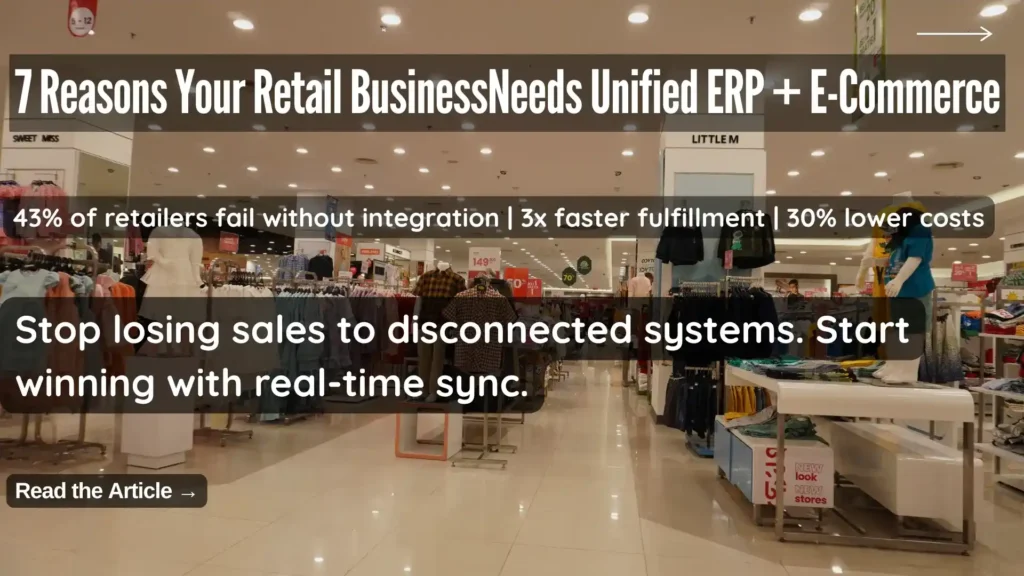
7 Reasons Your Retail Business Needs a Unified ERP and E-Commerce Integration Solution

Here is a scenario that will feel familiar to most retail operators: a customer visits your website, sees a product marked as available, drives to your store to buy it, and finds out the shelf is empty. Your website still shows it in stock. Nobody knows why. Or this one: a loyal customer who buys from you in-store every week places their first online order — and receives a “welcome, new customer” email. No recognition of their purchase history. No loyalty points applied. No sense that the business they have been giving you for two years means anything in the digital channel. These are not technology failures. They are integration failures — and they happen every day in retail businesses running separate, loosely connected systems for their physical stores and online channels. The solution is retail ERP and e-commerce integration — specifically, a retail-oriented integration solution designed from the ground up for the way retail businesses actually operate, rather than a generic middleware tool that treats your retail operation like any other business. This article covers the seven concrete reasons why retail-specific ERP and e-commerce integration delivers outcomes that generic solutions simply cannot match — and what to look for when evaluating your options. Why Separate Retail Systems Are Now a Competitive Liability Brick-and-mortar retail is not dead — but purely physical retail without a connected online presence is becoming increasingly rare. Today’s retail customer moves fluidly between channels. They discover products on social media, research them on your website, check availability through your app, visit your store to see them in person, and expect to complete the purchase on whichever channel is most convenient at that moment. Research consistently shows that 81% of consumers use mobile devices as part of their shopping research — and the majority of purchasing journeys now involve at least two channels before a transaction is completed. For retail businesses, every additional sales channel represents a potential revenue stream. But it also represents a new source of operational complexity — unless every channel shares the same data, the same inventory, the same customer records, and the same pricing. When they do not, the experience falls apart. And in a market where customers have endless alternatives, an experience that falls apart drives them to a competitor without a second thought. The Real Cost of Running Disconnected ERP and E-Commerce The cost of disconnected retail systems is distributed across every channel, every function, and every customer interaction — making it easy to underestimate until you try to measure it: Why Generic Integration Tools Fall Short for Retail Many businesses attempt to solve the integration challenge with general-purpose middleware tools — platforms designed to connect any two applications regardless of industry. Generic integration tools can technically connect a retail ERP with an e-commerce platform. The problem is that retail has specific operational requirements — BOPIS fulfilment logic, zip-code-based inventory routing, loyalty program data synchronization, multi-currency retail pricing rules — that generic tools are not built to handle natively. The result is months of expensive custom development to configure a generic tool for retail-specific scenarios, followed by ongoing maintenance overhead every time either connected system updates. A retail-specific integration solution — or better, a unified retail platform — delivers all of this functionality out of the box. 7 Reasons to Choose a Retail-Specific ERP and E-Commerce Integration Reason 1: Consistent Products and Pricing Across Every Sales Channel The most fundamental requirement of a unified retail operation is consistency — every channel showing the same products, the same prices, and the same promotions at the same time. When your product catalog, pricing structure, and promotional mechanics live in your ERP and distribute automatically to every connected channel, consistency is structural — it happens automatically rather than requiring manual synchronization. A retail-specific integration solution enables: For retailers managing hundreds or thousands of SKUs across multiple channels, centralized product management is not just a convenience — it is a necessity. Reason 2: True Omnichannel Fulfilment — Buy Anywhere, Deliver Anywhere The modern retail customer expects to complete their shopping journey on their own terms — and that means the fulfilment model needs to be as flexible as they are. Buy Online, Pick Up In-Store (BOPIS) is now a baseline expectation for omnichannel retailers — customers order online and collect from their preferred store, combining the convenience of online shopping with the immediacy of in-store collection. But executing BOPIS reliably requires real-time integration between your e-commerce platform, your ERP, and your in-store systems. A retail-specific integration solution enables the full range of omnichannel fulfilment scenarios: Each of these scenarios requires real-time data sharing between the e-commerce platform, the ERP, and store-level inventory — which only a retail-specific integration solution delivers reliably. Reason 3: Real-Time Inventory Visibility Across Every Location Inventory accuracy is the operational foundation on which everything else in omnichannel retail depends. Without accurate, real-time inventory data across every location, BOPIS fails, online availability is unreliable, and customer trust erodes. A retail-specific integration solution delivers inventory visibility that generic tools cannot: The business impact of real-time inventory accuracy extends beyond customer experience. Buyers make better purchasing decisions. Markdowns are more targeted. Overstock and out-of-stock situations are identified earlier and resolved faster. Reason 4: Unified Customer Data Across Digital and Physical Channels A customer who has shopped with you for five years should feel known — regardless of which channel they use. Their purchase history, preferences, loyalty status, and contact information should follow them seamlessly across every interaction with your brand. This only happens when your ERP and every connected channel share a single customer database — updated in real time by every transaction, regardless of where it occurs. A retail-specific integration solution delivers: Reason 5: A Single Loyalty Program That Works Everywhere Loyalty programs are one of the most powerful customer retention tools available to retailers — but only when they work seamlessly across every channel a customer uses. A loyalty program that earns points in-store but cannot redeem them online,

7 Reasons Your Retail Business Needs a Unified ERP and E-Commerce Integration Solution Read More »

Turn prospects into engaged customers with intelligent sales and marketing

[vc_row][vc_column][vc_column_text] The selling landscape is undergoing fundamental changes, many of them driven by the effects of B2B customers’ experience as everyday consumers. Many retailers have created personalized, nearly immersive, online experiences for each customer. Consumers shopping for goods and services continually experience fresh and delightful interactions, from highly customized offers and recommendations to frictionless channels to 24/7 interactions. Using Microsoft Dynamics 365 for Marketing and Microsoft Dynamics 365 for Sales organisations are improving  their profit margins. The impact of B2C on B2B Today’s B2B buyers have high expectations, and those expectations will not be met if B2B buyers are accustomed to sophisticated consumer interactions in their personal lives. Executive B2B buyers are not impressed by marketing driven by large, relatively impersonal data analysis that leads to inconsistent and conflicting interactions or sales outreach that doesn’t cater specifically to their needs at the right time. The source of the problem may be largely invisible to the companies perpetuating this issue. Many organizations believe themselves to be customer-centric, while their buyers may not agree. That’s a significant disconnect. Clearly, B2B has much to learn from B2C companies. Customer experience – the rewards for getting it right Many B2C organizations have strategically embraced modern technologies like customer data platforms (CDP) and artificial intelligence (AI) to gain a 360-degree view of their customers and follow through on those insights to optimize customer engagement. The rewards for getting this engagement right are substantial. Many buyers are willing to pay more for a better customer experience. In terms of the potential benefits a great experience can have on sales success, a McKinsey study reported that organizations can expect: 10-15 percent lower customer churn 20-40 percent increase in the win rate of offers Up to 50 percent lower service costs Take a new approach B2B companies must move away from their legacy approaches based on large, relatively impersonal data analysis and move to solutions that unify relationship data across the full customer lifecycle. That way, they can gain insights that help build credibility and trust with buyers. They can run multi-channel campaigns to increase sales-ready leads, create personal experiences, and use guided process and AI to anticipate and respond faster to customer needs. They can build the ongoing, high-quality relationships that are necessary for long-term success. Four principal goals Turning prospects into engaged customers is a process. In order to achieve these goals, organizations must focus on 4 key priorities: Nurture more demand Personalize buyer experiences Build relationships at scale Make insight-driven decisions Each of these drives results by using deep reservoirs of data in making technology feel more human. Nurture more demand Relying only on conventional, basic email marketing as the primary source of leads is simply not effective enough. In fact, the more focused and demanding the customer universe is, the more essential it is to gain deep insights into what those customers expect. Northrop & Johnson,  a leading global yacht brokerage, competes for multi-million dollar customers using technology its industry has been slow to adopt. Using Microsoft Dynamics 365 for Marketing has created a decided competitive advantage: Vital insights into their customer base have helped to drive a 70 percent increase in charter sales. In any industry, companies need to generate leads across multiple channels, nurture large numbers of leads while prioritizing each one, and use data-driven insights to deliver leads that are sales-ready. Nurturing more demand is critical to growth. Personalize buyer experiences It’s time to end friction, inconsistencies, and the “do you know who I am?” part of the customer experience. Companies can acquire a holistic view of buyers, predict buyer intent, and orchestrate a connected, personalized journey for customers. In an era where guests have more choices than ever for leisure and entertainment, Tivoli delights its guests by using Dynamics 365 Customer Insights to stay one step ahead of expectations and transform the guest experience. With its deeper understanding of guests, it can add new chapters to its long tradition of imagination and innovation. Build relationships at scale Mutually beneficial relationships don’t simply happen with more data. Companies need to build credibility to establish and grow relationships with customers. Together, Dynamics 365 and LinkedIn enable the company to have increased information about, and impact on the sales relationships that are added to its sales pipeline, even as that pipeline experiences exponential growth month over month. Make insight-driven decisions Here’s where sales and marketing can truly align: utilizing data to uncover insights that lead to better-informed decisions throughout the sales process. This can improve performance, empower employees, and enable the company to gain increasingly effective strategic insights. With more than 1,500 pubs serving guests throughout the UK, Marston’s launched a business transition by bringing together guest data that was scattered across multiple systems into Dynamics 365. With their locations’ guest data now unified, Marston’s will gain a complete view of guests, which can be harnessed to generate customer satisfaction and strategic insights. This approach helps drive improved performance throughout the company, including the opportunity to empower employees – an often-overlooked aspect of a company’s success. Aligning sales and marketing: The intelligent way to succeed It’s possible to create exceptional experiences, drive more qualified leads, and increase revenue if an organization has the vision, process, and technology to harness all the data available. This requires high-level technology with well-defined business goals and sales and marketing applications fueled by keen intelligence. We have a compelling offering to accomplish just that with Microsoft Dynamics 365. Get in touch with our representative to request a demo for Microsoft Dynamics 365 for Sales & Microsoft Dynamics 365 for Marketing Blog Reference : https://cloudblogs.microsoft.com/dynamics365/bdm/2019/09/19/turn-prospects-into-engaged-customers-with-intelligent-sales-and-marketing/[/vc_column_text][/vc_column][/vc_row]

Turn prospects into engaged customers with intelligent sales and marketing Read More »

Slash costs in your restaurant with the right software system

[vc_row][vc_column][vc_column_text]How do you manage costs in your restaurant business? Are you operating as efficiently as you could be? We know how difficult it can be to maintain optimal efficiency and make money in a time of razor-thin margins and intense competition. By their very nature, restaurants are characterized by predictable, seasonal factors as well as by unpredictable ones, including changing customer preferences and fluctuating running costs. But there are ways to get a better handle of your business, helping you to plan ahead more effectively, become leaner and reduce costs in the process. For many restaurant owners, the answer lies in choosing a modern unified technology platform that provides a complete overview of your business operations from Point of Sale (POS) to back office. Indeed, research by the National Restaurant Association in the US found that over 80% of restaurants are turning to technology like online ordering and reservations and restaurant analytics to help them run their business successfully and efficiently. The same report found that four in five restaurant operators agreed that: Technology helps increase sales Technology makes their restaurant more productive Technology provides a competitive advantage. If you’re in two minds as to whether a restaurant management system could help your business grow, rather than simply cost you money, here are some specific areas in your business where the right technology can make a real difference: Optimize staff management If your staff schedules are currently handled manually, in spreadsheets or even on paper forms, you could be missing out on a trick. Staff management software has the capabilities you need to ensure rosters correspond with table bookings and helps you plan for the right amount of labor you need. The result is optimized schedules, which means you don’t have too many employees at work during quiet periods, and yet you have enough on hand to see you through the busy times. If you select a unified system for your restaurant, the staff management functionality can be part of the same platform used to manage the rest of your business. This allows you to make truly informed decisions using historic sales data and drilling down by location, day of the week and time to see patterns emerging and better determine when you will be busy or quiet. Another factor to consider is how you can use the software to keep track of your budgets and make sure you’re not paying out more than you should be. We know how difficult it can be to check and confirm the hours worked by each of your employees, especially when you are likely dealing with so many. But a staff management system can automate this for you, confirming actual hours worked are the same as those planned and highlighting any discrepancies for you to follow up on, minimizing errors and costs. With the functionality to analyze how much you are spending by employee, work code, shift and role, you can compare actual costs and performance against your business plan, and minimize unnecessary extra expenses, such as overtime. Simplify staff training In this industry, we know that workers tend to be transient – maybe you have lots of students or temporary workers on your payroll. High staff turnover can be a real pain point and loss maker for your business, especially as recruiting and training staff is both time consuming and costly. But there are ways technology can help you control this better, and reduce the costs and pain of getting new staff on board. If the systems you use are intuitive and easy for all employees to understand, you won’t have to spend as long training them on how to use them in the first place. Some retail management systems allow you to set up your POS so it mirrors your menu, making it far simpler for staff to find their way around while also helping to reduce mistakes. To simplify training even further, it could pay off to choose a system that uses a logic your staff is already familiar with. The LS Retail restaurant solutions, LS First and LS Central, are built on well-known Microsoft technology. This means new employees can be up and running quickly, as any experience with Microsoft software such as Office or Windows means they already know where to find menus and information in the system. Having one enterprise-wide platform, rather than multiple software solutions strung together, also means you only need to train your staff up once. This not only saves time and cost but gives you greater flexibility too. If you need to move staff from the bar to the restaurant floor, you can do so with ease. No extra training required to use a separate system; no time wasted. Increase table turnover and order value Is your restaurant floor running as smoothly as it could? There are some steps you can put in place to subtly speed up the process, allowing you to serve more customers without making your diners feel rushed. Mobile POS devices are a great way of doing this. As they connect your servers directly to the kitchen, kitchen staff can act on orders as soon as they are taken at the table, speeding up food preparation. Your waiters can get an alert on their POS devices when orders are ready, and they can also take payments on the device as soon as diners are ready to leave – no waiting for card readers or an available cash register. If you select the right mobile POS, your staff can also handle conversational ordering, where they take orders in the same way that customers reel them off – extra cheese on their burger and no mayo, with large chips, for example. Everything can be quickly inputted into the POS, speeding up service time and reducing errors. At the same time, because staff have all menu information right in front of them, they can improve their upselling potential by suggesting upsell items and upgrades as they take orders. Streamline kitchen operations A unified platform complete with a kitchen management system could help your restaurant serve up food more quickly and efficiently than ever. In the kitchen, having Kitchen Display System (KDS) screens connected to the

Slash costs in your restaurant with the right software system Read More »

How can Trident’s cloud platform manage your restaurant effortlessly?

[vc_row][vc_column][vc_column_text]Mortality in restaurants is a fact with several young firms shut down. What if the software could transform how restaurants are running by offering profound insights for more profit? Trident’s cloud-based restaurant management solution makes it possible by concentrating on advancing the bottom line and back-of-house productivity. Trident takes into consideration all facets of restaurant management, including Inventory Management, costing of food and beverage, purchase orders, Table Management, Billing System, Point Of Sale, Vendor Planning, Price Monitoring, Costing of Food, Menu Management, and Reporting/Analytics. Still uncertain of restaurant management technology premised on the cloud? Like the idea, but don’t know where to start? Don’t worry, we’ve covered you up. Below we will discuss how Cloud-based restaurant management software transforms the industry for seven reasons: 1) – Access information anywhere  The mobile in your pocket or a laptop with a web browser and internet access are all you need to get started. Simply download the web site’s mobile app or account. To use the app you don’t need to be in the office, live with the hassle of VPNs or private networks. 2) – No more hefty long contracts Why tie-up with a long, costly technology vendor contract and have technology that may soon be out of date? On-site technology requires long-term investments, contract service, and a much higher Total Ownership Cost. The food industry is highly unpredictable, with frequent restaurants open and close. If you’re just beginning, you probably won’t be able to commit to fall tens or even hundreds of thousands of rupees on new technology. Restaurant management technology focused on the cloud removes the need for a big upfront investment and the lower monthly cost helps you to show the ROI from day one. 3) – Flexible Payments  When cash flow is a problem for your corporation (which is a concern for most businesses), then flexible terms of payment is a big thing. You charge for your software-as-a-service (SaaS) with cloud-based restaurant management technology. For example, both month-to-month and yearly contracts are provided by some vendors. When part of the contract you are charging for, the latest technology, new functionalities and updates, infrastructure improvements, etc. are all included. 4) – Scale The advantage of SaaS is that depending on your requirements, you can simply and quickly scale up or down. Open a new site, insert your current contract and get up and running before the end of the day. You can add users, integrations, locations, new features, etc. with just a few clicks. No technician’s visits. No long cycles of implementation. No significant investment to store servers in hardware or storage. 5) – Integration with POS System The ability to easily integrate with other applications is one of the strongest strengths of cloud-based restaurant management systems. Through APIs and other methods of integration, the cloud-based restaurant management technology can communicate with each other, share the data, and provide smarter, quicker, and simpler than ever before insights through stores and systems. 6) – Security  Cloud computing is much safer than data stored on your computer or an internal database. It has advanced security checks such as two-factor authentication for logging in, deterrent controls to alert potential hackers about protections, preventive controls which make accessing the cloud information more difficult for unauthorized users, and detective controls to react to intrusion events. If anything ever occurred to your restaurant’s servers – like a flood, a fire, or a theft, you may not see that data again. Restaurant software based on the cloud often comes with built-in backup and redundancy. 7) No need of It professionals If you are on-premise managing legacy systems, you need to understand what you’re doing. From routing, safety, restoration, debugging, and so on, nobody can go into a database office and start ripping cables. You don’t need to employ an IT professional with cloud-based restaurant management technology. All you need is access to the provider of internet and software that is committed to supporting and guaranteeing your excellence. Microsoft Gold partner Trident Information Pvt Ltd grants all of the above-mentioned advantages. For getting all the advantages you can contact our experts on https://tridentinfo.com/contact/ and add a query on our website. [/vc_column_text][/vc_column][/vc_row]

How can Trident’s cloud platform manage your restaurant effortlessly? Read More »

Don’t let your retail system destroy your holiday season – LS Retail

Holiday season trading is big business for retailers. As retailers up their efforts to draw in more shoppers and take full advantage of “the most wonderful time of the year,” it pays off to be prepared. NRF expects retailers to hire between 530,000 and 590,000 temporary workers during the holiday season, and to spend millions of dollars on window displays and marketing. But many forget one critical aspect that can make the difference between a profit-making and a loss-making season: the status of their technology. From slow e-commerce sites to out-of-stock scenarios, here are some disastrous but all-too-common seasonal-related problems that retailers face, what causes them, and what can be done to prevent them. Issue #1: Your technology can’t sustain the high volume of transactions/increased workload The cause: Tech outages can be extremely costly – but for many retailers, they are a familiar nightmare. A study by LogicMonitor found that 96% of organizations have experienced IT-related disruptions, and 10% of organizations have had 10 or more outages in a three-year period. Common causes of down systems include network failure, usage spikes, human error, software malfunction, hardware failure and third-party outages. An increasingly common cause of outages are disconnected legacy software systems. “One of the issues for some retailers is the fact that systems are, in fact, a patchwork of different technologies and functions added over time,” Neil Saunders, managing director of GlobalData, said to RetailWire. “As the demand put on them increases, they occasionally fall over. For others, it can be about capacity – which is why a lot of retailers have failures at peak times such as Black Friday.” The solution: Retailers should look to replace their technology siloes, which are complex to maintain and costly to support, with a single retail system. A unified system can provide them with a complete overview of their business and all its data. On top of that, the technology is delivered by a single provider, which means full support, and simpler and quicker upgrades. “The solution is unified commerce, one version of software servicing all channels,” retail industry thought leader Ken Morris said in the RetailWire roundtable. “Until retailers wake up and embrace this vision, we will continue to see these types of outages as it is almost impossible to keep this multi-tiered Frankenstein’s Monster running without more people or less complexity.” Issue #2: Part of your system goes down, and you can’t promptly pinpoint which part, or you don’t have the resources to fix it quickly The cause: Again, the cause are ageing, disconnected systems unable to communicate with each other, with unsupported hardware and software. Outdated tech will complicate the day-to-day running of your organization and put a strain on your resources. On top of that, if a part fails, it can be extremely hard to identify where your system is down. Without knowing what to fix or when the disconnection happened, how can you get your system back up and running, and minimize disruption to your business? One of our clients, discount fashion retailer Gallo Clothing, faced this exact scenario one Christmas eve – its busiest sales day of the year. The store was full of shoppers when suddenly the cash registers stopped working. Gallo’s systems had stopped communicating with each other, but where had the glitch happened? The company couldn’t identify and fix the problem straight away, so managers instructed staff to process all transactions manually. With cashiers forced to write every item and price and calculate the total for every single shopper down, each sales transaction became painfully slow, and the queues grew longer and longer. Customers began to complain, and others left the store to shop elsewhere. Some never returned, unwilling to give the business another chance. The solution: Retailers no longer need to put up with unreliable, siloed software systems that threaten the smooth running of the business. But they must be willing to invest in their future, rather than patching up old systems and hoping they won’t fail when they need them most. “Retailers have spent years not spending enough on technology and building a robust future-proof architecture,” roundtable panelist Oliver Guy said to RetailWire. The good news is that modern, unified commerce technology platforms aren’t as expensive as retailers may think, and they can also deliver a fast return on investment. Gallo Clothing now uses LS Retail technology as the foundation for its businesses. Not only has it not experienced any issues since the implementation of the solution, but it has also achieved record profits. The company says it’s because the system is so fast and efficient. Gallo’s president told us: “In the years since implementing the LS Retail software, we’ve seen more customers, sold more products and had much shorter lines.” Issue #3: You can’t react fast enough to customer demand, and end up disappointing customers with out-of-stock items The cause: Out of stock items are one of consumers’ biggest gripes. They’re also hugely damaging to a retailer’s bottom line. The “Out of stock, out of luck” study by global research and advisory firm IHL Group found that retailers are missing out on nearly US$1 trillion in sales because of out-of-stock items. And almost a third of shoppers ended up turning to Amazon when the product they wanted wasn’t in stock at their local store Many retailers admit that the reason they experience out-of-stock scenarios is because they don’t have a complete view of their inventory, their data is unreliable, and they lack the tools to analyze their data and make accurate forecasts. The solution: You can no longer get by with running weekly or even daily reports to keep track of their business. Today, you need a real-time view –  especially during busy trading periods. Luxury fashion retailer Club 21|Armani Exchange gained this visibility when they upgraded their financial, admin, warehouse management, buying & merchandising, CRM and POS systems to a single software environment. Clare Vella, retail director, told us about the first Black Friday after implementing their new LS Retail software. “It was 10pm on Friday evening. We were watching the sales hourly, and one store was seeing an enhanced level of

Don’t let your retail system destroy your holiday season – LS Retail Read More »