Welcome to Trident Information Systems!
Write us to - info@tridentinfo.com
Let's Socialize

dynamics 365 support company

Reduce supply chain disruptions with AI, IoT, and mixed reality

Disruptions in global supply chains have significantly increased over the last decade, fueled by a myriad of triggers ranging from trade wars, demand surges from social marketing, natural disasters, and most recently, the recent COVID-19 pandemic. Updates to Microsoft Dynamics 365 Supply Chain Management in the 2020 release wave 1 help organizations proactively transform every aspect of manufacturing and supply chain operations to reduce disruptions. These new and updated capabilities drive automation and reduce downtime using IoT and mixed reality, and provide the agility to re-plan production in real time to dynamically changing demand. In fact, the agility enabled by Supply Chain Management is currently being leveraged by a consortium of major UK industrial, technology, and engineering businesses from across the aerospace, automotive, and medical sectors that has come together to produce medical ventilators for the NHS. Reducing the risk of supply chain disruptions As the threat of disruptions increase, companies are pressured to ask if the supply chain is ready for the next event, pushing them to build a more resilient supply chain to ensure business continuity for them and their customers in the most cost-effective manner. More companies will start buffering for risks and move from a “Just-in time” mentality to a “Just-in case” mentality. Factories will need to transform rapidly to adapt to change, serving a wider range of products produced in smaller batches with lower set up time, faster throughput, and the ability to quickly respond to fluctuating demand and customer expectations. Companies are likely to move from single supplier to multi-supplier and single location to multi-location models for mission critical parts even if it is cost prohibitive in order to reduce the impact of supply chain disruptions. To reach this optimal state of agility and delivery speed, manufacturers need to adapt every aspect of the supply chain to enable tools, equipment, and people to become instrumented, interconnected, and intelligent—a state of persistent adaptive learning and optimization as more data is available to tighten links between manufacturers, suppliers, and customers. The latest release from Dynamics 365 Supply Chain Management enables customers to reach this optimal state by proactively transforming their manufacturing and supply chain with predictive insights and intelligence from AI, IoT, and mixed reality—across planning, production, inventory, warehouse, and transportation management—to maximize operational efficiency, product quality, and profitability. Train workers faster with integrated mixed reality learning experiences Dynamics 365 Supply Chain Management is now integrated with Dynamics 365 Guides to help mainstream mixed reality for manufacturing. Companies can deliver a faster ROI by getting the workforce trained sooner with fewer trainers and with an interactive learning experience. Workforce efficiency can skyrocket with step-by-step instructions that guide employees to the tools and parts they need and how to use them in real work situations, available at a glance on a Microsoft HoloLens device that keeps their hands free to do the work. Dynamics 365 Guides can not only eliminate costly errors in production but also improve workforce safety. Companies can significantly reduce asset downtime by making asset maintenance skillset-agnostic and avoid costly waiting time for a specific expert to perform maintenance on an asset. The guides are extremely easy to author and do not require any coding. A guide can be authored by simply writing the step-by-step instructions on a PC followed by picking and placing the holographic parts and inbuilt icons on the machine where the work is happening. Introducing Dynamics 365 Guides for HoloLens 2 Dispatch the right resources at the right time Dynamics 365 Supply Chain Management is now integrated with Microsoft Dynamics 365 Field Service. Customers can significantly reduce downtime of geographically dispersed mission critical assets by automating field service operations so that the right resources—workforce, machines, parts, and tools—are available at the right place, at the right time, to proactively maintain them. Companies can improve the overall equipment effectiveness (OEE) of their geographically dispersed mission critical assets by performing predictive maintenance based on real-time performance data from IoT and field data from Dynamics 365 Field Service. Traditionally, disparate systems hinder the ability to accurately forecast demand for critical and expensive parts frequently used in both service and new production. Due to lack of forecasting for service demand, companies constantly take parts from production to fulfill the service demand, and vice versa, to deliver good customer service. This often creates a shortage for new production and significantly impacts on time delivery to new customers. As a result, the company is unable to deliver a delightful customer experience on both fronts. This integration will eliminate the need for disparate systems and significantly improve the forecast accuracy of these mission-critical parts due to real time tracking in the service supply chain. Seamlessly integrate IoT capabilities Dynamics 365 Supply Chain Management now offers out-of-the-box IoT capabilities that leverage Microsoft Azure IoT Hub to connect signals from mission-critical assets with business transaction data. Manufacturers can improve uptime, throughput, and quality by proactively managing shop floor and equipment operations with a real-time view of their entire production and stock. This will significantly reduce costly downtime of business-critical equipment by performing predictive maintenance before disruptive failures occur. There is no coding required to implement these out-of-the-box IoT scenarios on your manufacturing floor today. Dynamics 365 Supply Chain Management and IoT Intelligence customer spotlight with Majans Improve on-time delivery with real-time production planning The Planning Optimization Add-in for Dynamics 365 Supply Chain Management enables companies to improve on-time delivery by performing production planning in real time, accounting for dynamically changing customer demand, material availability, and capacity constraints across multiple sites and warehouses. It also enables customers to improve inventory turns by right-sizing inventory levels based on dynamically changing customer demand and capacity constraints. This helps eliminate excess and reduces slow moving inventory. Planning Optimization Add-in for Retail and Distribution is available and Production planning is currently in preview.

Reduce supply chain disruptions with AI, IoT, and mixed reality Read More »
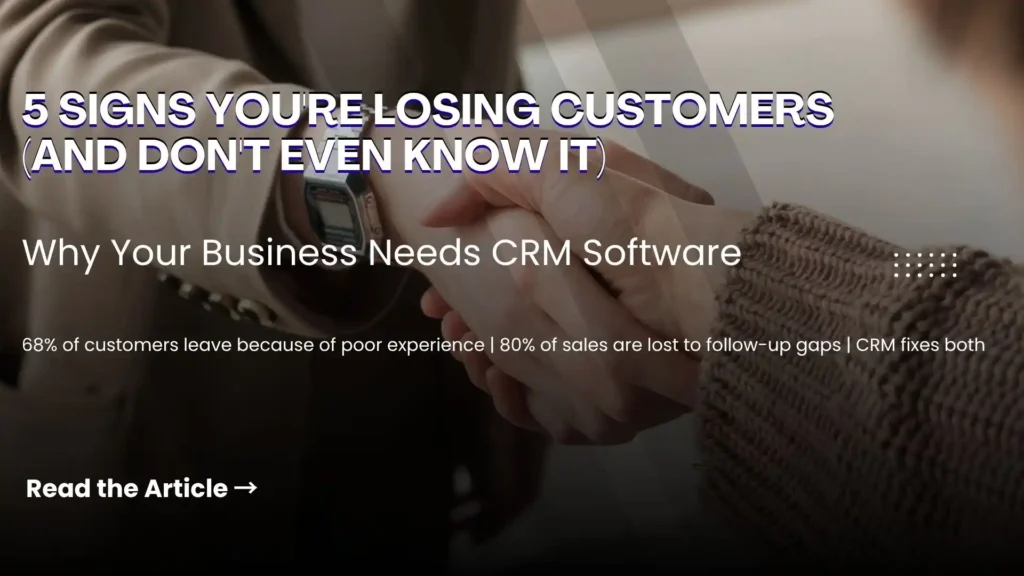
Business team using CRM software to manage sales, customer data, and communication workflows.

5 Clear Signs Your Business Needs CRM Software in 2026

Here is a question most business owners ask too late: at what point does managing customer relationships in spreadsheets, email inboxes, and memory become a liability rather than a system? The honest answer is — sooner than you think. Customer Relationship Management (CRM) software is not just for large enterprises with complex sales teams. It is for any business that wants to grow its customer base, retain the customers it already has, and make sure no opportunity falls through the cracks. The challenge is recognising when the moment has arrived. Here are five clear signs that your business needs CRM software — and why Microsoft Dynamics 365 is the platform most businesses choose. What Is CRM Software and Why Does It Matter? CRM software is a centralised system that manages every interaction between your business and your customers — from the first marketing touchpoint through the sales cycle, the initial purchase, ongoing service, and renewal. Done well, CRM gives every team member a complete, real-time picture of every customer relationship. Sales knows what marketing has sent. Customer service knows what sales has promised. Management knows exactly where every opportunity stands. Without CRM, this information lives in individual inboxes, personal spreadsheets, and people’s heads — and every time someone leaves the business, some of that knowledge leaves with them. 5 Signs Your Business Needs CRM Software Now Sign 1 — You Are Losing Leads Without Knowing Why Leads come in through your website, social media, phone calls, and referrals. But if you are managing them manually, some of those leads are simply not being followed up — because they were logged in the wrong place, assigned to the wrong person, or forgotten during a busy week. A CRM captures every lead automatically, assigns it to the right team member, sets follow-up reminders, and tracks every interaction. Nothing gets lost. Every opportunity gets the attention it deserves. If you have ever discovered a warm lead that was never followed up weeks after it arrived — your business needs CRM. Sign 2 — Your Marketing and Sales Teams Work in Silos Marketing generates leads. Sales closes deals. But when these two teams work from different systems and different data, the handoff between them is where opportunities die. Marketing does not know which leads converted. Sales does not know which campaigns generated their best prospects. Neither team can make decisions based on the complete picture — because that picture does not exist in any single place. CRM creates a shared view of every customer and every lead — so marketing can see which campaigns produce sales-ready prospects and sales can engage leads with full context on their marketing journey. The result is better targeting, higher conversion rates, and a measurable improvement in revenue. If your marketing and sales teams regularly blame each other for pipeline problems — your business needs CRM. Sign 3 — You Cannot Easily Create Quotes and Track Invoices For businesses that sell through a quotation process — professional services, manufacturing, technology, or any B2B operation — the ability to create, track, and follow up on quotes directly impacts how quickly deals close. A CRM with a built-in quoting and invoicing module connects the entire opportunity-to-cash process: If your team is manually creating quotes in Word documents and tracking them in a spreadsheet — your business needs CRM. Sign 4 — Customer Service Issues Are Falling Through the Gaps Customer service quality is directly tied to information quality. When a customer calls with a problem, the speed and accuracy of the resolution depends on whether your team can instantly see their complete history — what they bought, when, what issues they have had before, and what was promised. Without CRM, this information is scattered across email threads, support tickets, and different team members’ notes. The customer ends up repeating themselves. Issues take longer to resolve. Satisfaction drops. CRM centralises customer service management: If customers regularly complain about having to repeat their issue to multiple people — your business needs CRM. Sign 5 — You Cannot See How Your Business Is Really Performing Good management decisions are built on good data. But if your sales pipeline lives in a spreadsheet, your customer data is in email, and your service records are in a helpdesk tool — getting a clear, current picture of business performance requires manual compilation that takes hours and is outdated the moment it is finished. CRM provides real-time dashboards and reports that give every level of the organisation instant visibility: If your management team regularly makes decisions based on instinct because the data is too hard to access quickly — your business needs CRM. Why Microsoft Dynamics 365 CRM Microsoft Dynamics 365 is one of the world’s most widely adopted CRM platforms — and for good reason. It covers every scenario described above in a single, unified platform: lead management, marketing automation, sales pipeline, quoting and invoicing, customer service, and real-time analytics — all connected on the same data model. Key advantages over standalone CRM tools: Why Trident Is India’s Trusted Dynamics 365 CRM Partner As a certified Microsoft Dynamics 365 partner, Trident Information Systems has helped businesses across sales, marketing, manufacturing, retail, and professional services in India implement CRM solutions that close the gaps described in this article. Our CRM implementations are configured around your specific sales process and customer management requirements — not a generic template. Ready to find out how CRM software can transform your customer relationships? Book a free Dynamics 365 CRM assessment with Trident today. For more insightful content and industry updates, follow our LinkedIn page.

5 Clear Signs Your Business Needs CRM Software in 2026 Read More »

Redefining shopping excellence with an unified E-commerce solution

[vc_row][vc_column][vc_column_text]Over the last decade, the retail sector has experienced enormous change and transition. Many have suggested that conventional brick and mortar retail is dying and that for the everyday needs, consumers switch entirely to online platforms. However, this is not the case. As per a survey from the National Retail Federation, since 2010 retail storefronts in the US have continued to expand at approximately 4 percent annually along with the consistent double-digit growth of online shopping. Almost all of the top 50 online retailers have brick and mortar stores, as well. Although progress in e-commerce tends to outpace physical stores, the rate of progress in physical retail outlets is still much higher. E-commerce is also not a stand-alone medium in most cases but used in combination with conventional and new platforms to meet consumer needs such as buying online pick up in-store or Click and Collect. Physical outlets are still a big part of consumer spending patterns, but with this, we also have seen that consumer priorities have changed around shopping. Trident is offering Retail ERP Software for an outstanding commerce experience that helps in gaining maximum profits. Gone are the days when store employees are the only experts in information about goods. Consumers already have greater access to product details, price clarity, and accessibility. This means that retailers have to look at customer engagement across all platforms to make sure that their enterprise is capable of delivering on these recent high requirements. E-commerce will no longer be a major differentiator for retailers in the next few years, but will instead allow integrated retail trade to compete in the ever more challenging customer needs worldwide. So Trident ( dynamics 365 partner) & solution dynamics 365 for marketing not confined to e-commerce, but aims to streamline the process of unifying consumer shopping experiences through an end-to-end business framework that puts together e-commerce, in-store, back office, and call centre. Let’s discuss furthermore how Dynamics 365 for marketing solution helps retailers meet those dominant business requirements. 1)- Grant Excellent and Customized Consumer Experience Consumer experience is not only one of the top growth factors in the retail sector, but according to the recent survey by Microsoft and Forbes, 33 percent of retail managers are also considered a great business priority. The main task is to identify what constitutes outstanding customer experience for each individual business, as expectations of customers differ by micro-vertical retail, product category, and consumers themselves. It is up to the retailers to better define how their marketing commitment aligns with the experience. When customer experience is established, retailers need to be able to deliver on this commitment by providing technology that allows customer engagement in the next generation and does not limit their ability to evolve and build differentiating consumer experience. As per the report by Microsoft and Forbes, providing customized shopping has become increasingly popular and over 49 percent of customers aged between 18 and 24 stating they are more likely to purchase from retailers offering custom shopping experiences. The aim of personalization is to form a bond between both the retailer and the consumer by delivering goods and/or services across all retail channels based on past interactions. It enhances the relationship to an encounter more similar to an interaction with a trustworthy friend or partner than a simple transaction. There is a significant technological dependence to reach this next stage of customization. Networked and real-time visibility into consumers and activities are needed by retailers. Dynamics 365 put together all facets of customer interaction through e-commerce, call centre and in-store as well as simple incorporation into new channels to enable retailers to gain a holistic customer perspective. Couple this with out-of-the-box integration with Dynamics 365 Consumer insights and retailers can not only deliver AI-driven suggestions based on customer shopping history, likes, and patterns but also provide store agents with tools for presenting the customer’s 360-degree view and facilitating rich interaction throughout the selling journey.  2) Omni Channel Experience    Nowadays Customers expect to be able to purchase anywhere they want, and by whatever platform. Retailers also acknowledge the importance of Omni channel as one of their top three priorities, with 47 percent of Microsoft and Forbes survey executives rating this. Most retailers are still struggling in having an Omni channel experience because of the complexity of internal infrastructure and disconnected or fragmented systems. Trident’s Dynamics 365 NAV makes it much easier to offer a native Omni channel solution for retailers, as it was built in the cloud. 3) Flexibility An integrated solution is important not just for customers to engage and shop in retail, but also for how a unified solution can allow first-line employees to take part better and make sure ideal operational efficiencies across your supply chain. Dynamics 365 for marketing offers retailers the ability to streamline their operations with enriched knowledge that characterizes their business. Employees at the store can gain greater information and insight into stock availability, cross-application support for task management, as well as trade analytics that enable managers to monitor performance and insights to help them make informed decisions.[/vc_column_text][/vc_column][/vc_row]

Redefining shopping excellence with an unified E-commerce solution Read More »

What Considerations Should be taken into Account when Implementing the New ERP for Food Manufacturing?

[vc_row][vc_column][vc_column_text]Usually, the decision-making process for ERP for Food Manufacturing is long and complex. From deciding which functionality is most vital to your business, to choosing a system that will make rapid and meaningful changes, it may seem daunting to decide on the appropriate ERP solution for your organization. But don’t worry, Microsoft gold partner Trident got you covered. As we have 20+ years’ experience and  implemented ERP food manufacturing various satisfied customers like Haldirams, Nik Bakers, etc. Through sharing tips on how to pick and incorporate the right food production ERP solution for your food company, we will make the decision-making process of implementing an appropriate ERP for food manufacturing a bit easier for your organization. 1) – Food Specific Approaches Tons of ERPs and business solutions are available to choose from. But as a food manufacturer or supplier, you should understand that it is complex to manage a food business effectively and comes with its own set of unique complexities. Many of the integrated software systems in the marketplace for small to medium-sized enterprises provide the functionality you would expect for sales, acquisitions, operations, accounting and inventory management only. But what about the extra features distinctive to food manufacturing? Once you settle on a standardized ERP solution, ask yourselves how much modification and flexibility a food-specific system will have to go into implementing the following characteristics: Food safety and compliance Manufacturing and quality Recipe development and management Food recall and trace-ability 2) – Functionality Recalling that not all food businesses run in the same manner is also relevant. A supermarket bakery operates much differently than a manufacturing frozen food, and a meat processor will have a completely different set of software specifications than a broad line dealer. So where are you going to start? Try to address the features and functions that your existing system currently lacks. Create a “wish list” of elements that would make operations run better if you had them in the spot. From there, you can filter a lot of ERP providers and can concentrate on only those solutions that are suitable for your organization. 3) –  Easy to Use Suppose: at your job you’re a warehouse worker or a machine technician. Now your management team has decided to introduce a new software platform throughout the organization, and you are responsible for learning it as soon as possible (and as precisely as possible). Too much load, right? Moving from manually managing stuff or from a legacy system to a fully integrated ERP solution can be terrifying for everyone in the company. The accounting department now needs to learn how to use a new system to enter figures and run calculations. The QA department now has a new way to set up quality controls and audits. If a new process is too complex, your staff might feel frustrated, disheartened, and underappreciated. Look for an ERP running on a system that is probably already familiar with most of your workforce (such as, for example, Microsoft Dynamics) 4) – Customer Support Working with a vendor of an ERP solution is so much more than just buying and using the product to run your business. The ERP solution is implemented, which usually takes five to nine months, and then continued support and facilities will proceed across your software’s life cycle. It is therefore essential to ensure that the ERP you choose is assisted by a team of people who are committed to ensuring that you are successful. This means for the food industry you need experts who are not only professionals in software but also food specialists. You wouldn’t recruit somebody to work in your warehouse that wasn’t a good choice, correct? Think the same way about the people who are working for your ERP provider. Because they are also responsible for your business ‘ success. It is easy to get confused as there are too many ERP for food manufacturing service providers, so remember to remain vigilant and consistent with what you want to get out of your solution. Selecting the right ERP means choosing software to help you enhance food security, simplify efficiency or productivity and handle the progress of the enterprise. If you still have any doubts left in your mind then you can contact to Trident’s ERP for food manufacturing providers on https://tridentinfo.com/contact/[/vc_column_text][/vc_column][/vc_row]

What Considerations Should be taken into Account when Implementing the New ERP for Food Manufacturing? Read More »