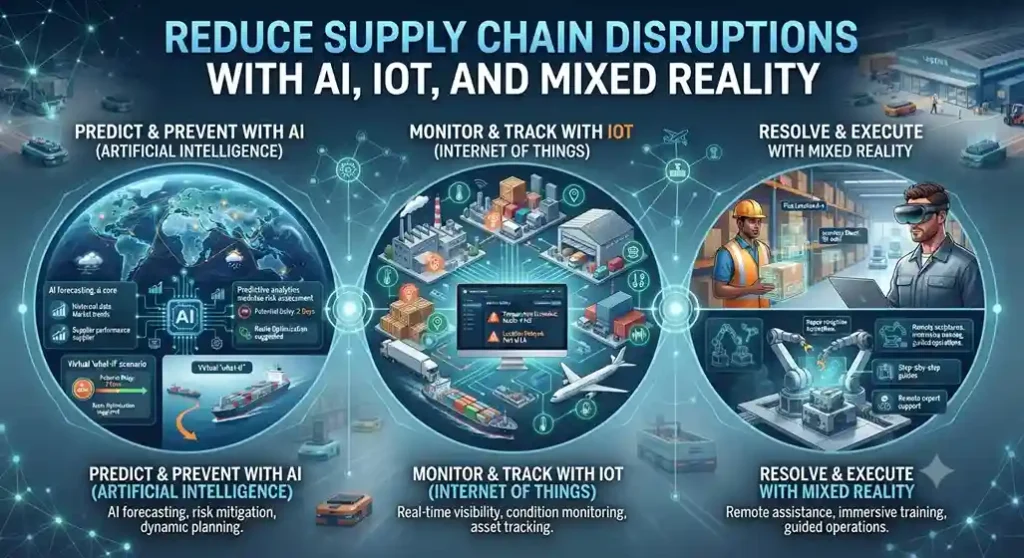
Reduce Supply Chain Disruptions With AI, IoT, and Mixed Reality
Supply chains built on single suppliers and single locations don’t survive contact with real-world disruption — port closures, geopolitical trade shifts, or a single supplier’s factory going offline can stall production for weeks. [Flag: insert a recent disruption stat relevant to your audience’s industry — e.g., percentage of manufacturers reporting supplier delays in the past 12 months.] The response isn’t more inventory sitting idle; it’s a supply chain that senses problems early and reconfigures itself before they cascade.
That’s the shift Dynamics 365 Supply Chain Management is built around — replacing static, just-in-time planning with predictive, adaptive planning powered by AI, IoT, and mixed reality across production, inventory, and warehouse operations.
From “Just-in-Time” to “Just-in-Case” Planning
The single-supplier, single-location model was optimized for cost, not resilience. When one link breaks, the entire chain stops. Manufacturers are now deliberately building in redundancy — multiple suppliers and locations for mission-critical parts — even where it costs more, because the cost of a stalled production line consistently outweighs the premium paid for supply flexibility.
This shift also demands shorter production runs. Factories need to serve a wider range of products in smaller batches, with lower changeover time between runs. That requires planning systems that recalculate in near real time as demand shifts, not systems that lock in a monthly production plan and treat disruption as an exception to manage manually.
Predictive Planning Instead of Reactive Firefighting
D365 Supply Chain Management applies AI-driven demand forecasting across planning, production, inventory, warehouse, and transportation management — so a shift in demand or a supplier delay triggers a re-plan before it becomes a stockout. IoT sensor data from equipment feeds directly into this loop, flagging machine performance drift or maintenance needs before a breakdown takes a production line offline unexpectedly.
For manufacturers running multi-location operations across India, UAE, or East Africa, this matters more than it might in a single-plant setup — a delay at one facility needs to trigger an automatic reallocation check against inventory and capacity at other sites, not a phone call three days later.
Cut Training Time With Mixed Reality Guidance
One of the more underused levers in supply chain resilience is workforce agility — how fast you can get a new or reassigned worker productive on unfamiliar equipment. D365 Supply Chain Management integrates with Dynamics 365 Guides, delivering step-by-step, hands-free instructions through a HoloLens device, walking workers through exactly which tool and part to use at each step of a task.
This does two things for resilience specifically. First, it makes equipment maintenance skillset-agnostic — you’re no longer waiting on one specialist who knows a particular machine, because any trained worker can follow the holographic guide. Second, it shortens the ramp-up time when you need to redeploy staff to a different line or location during a disruption, which is exactly when you can’t afford a multi-week training cycle.
Guides are authored without code — someone writes the instructions and places holographic markers directly on the machine where the work happens, which means your own team can build and update guides as processes change, not wait on an external developer.
What This Means for Your Operation
Resilience isn’t a single feature — it’s the combination of predictive planning that reduces reaction time, IoT visibility that catches problems before they cause downtime, and a workforce that can be redeployed without retraining bottlenecks. Manufacturers evaluating this shift should look specifically at how their current ERP handles multi-location inventory visibility and whether production re-planning happens in real time or requires manual intervention.
[Flag: insert a client example or case study reference here if available — a specific implementation outcome carries more weight than a general capability claim.]
Considering a resilience-focused upgrade to your supply chain platform? Talk to Trident’s Dynamics 365 Supply Chain Management team about what a multi-location, AI-driven planning setup looks like for your operation.