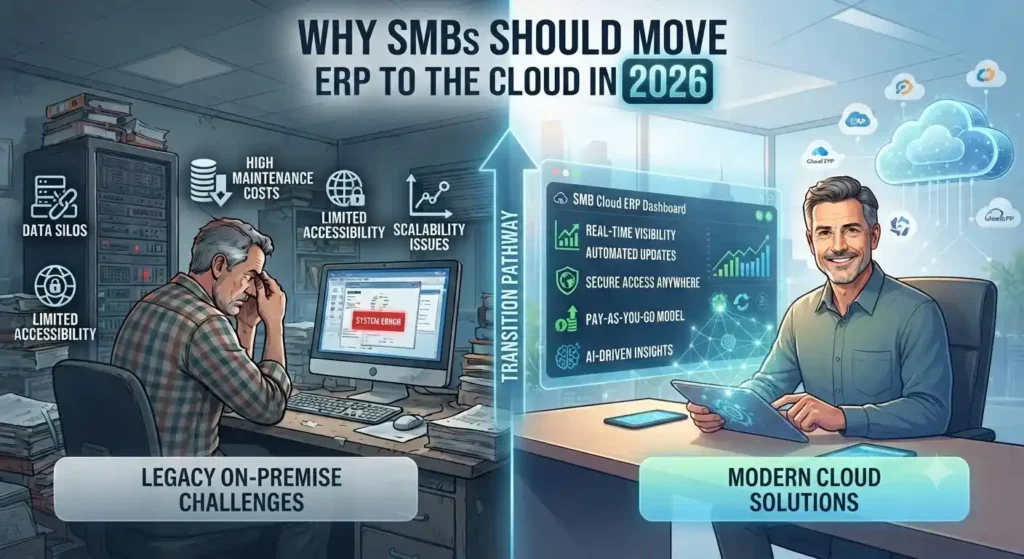
Why SMBs Should Move ERP to the Cloud in 2026
Roughly 44% of small businesses now run meaningful cloud infrastructure, and that number keeps climbing. But most of that adoption is email and productivity tools — not the ERP system running finance, inventory, and operations. That gap is where SMBs quietly lose money every year.
The Real Cost of Staying on Legacy ERP
Companies spent 40% of their IT budgets in 2025 just keeping legacy systems running — patching, maintaining, and working around software that was outdated the day it was installed. That’s not investment; it’s maintenance debt with no return. Every year an SMB delays ERP migration, that wasted spend tends to grow, not shrink, because the gap between legacy capability and modern cloud ERP keeps widening.
Global public cloud spending is projected to hit $723.4 billion in 2025, up from $595.7 billion the year before — a jump driven largely by core workloads shifting into the cloud, not just email. ERP is where legacy costs compound fastest, which is exactly why it’s driving so much of that growth.
Predictable Costs Instead of Capital Surprises
The CapEx-to-OpEx shift is the change SMBs feel first. Instead of a large upfront hardware and licensing spend followed by unpredictable maintenance bills, cloud ERP runs on subscription pricing tied to actual usage.
For Microsoft-centric SMBs, this gets stronger. Azure Hybrid Benefit lets businesses that already own Windows Server or SQL Server licenses apply them toward cloud costs, cutting Azure VM costs by up to 40-55% compared to standard pay-as-you-go pricing. If your SMB already runs Microsoft 365 or Windows Server, that discount alone changes the ROI math on a Dynamics 365 migration.
Security Concerns Are Backwards Now
The instinct to keep ERP on-premises for “control” doesn’t hold up anymore. Modern cloud platforms often deliver stronger security, better uptime, and greater scalability than most SMBs can achieve running their own infrastructure. Built-in compliance frameworks and dedicated provider security teams cover ground most SMB IT teams can’t staff for — a real constraint for a five-person IT department juggling help desk tickets and server patching at the same time.
Scalability Without the Hardware Gamble
Legacy ERP forces a bet: buy enough server capacity for growth you haven’t hit yet, or underprovision and hit a wall mid-quarter. Cloud ERP removes that bet. Resources scale with actual transaction volume, seasonal demand, or headcount growth, with no hardware refresh cycle every three to five years.
What This Means for a Dynamics 365 Decision
For SMBs already in the Microsoft ecosystem, this isn’t a “should we move to the cloud” question anymore — it’s a “why are we still running Dynamics NAV or an on-prem F&O instance in 2026” question. The path to Dynamics 365 Business Central or Finance & Operations keeps the interface logic staff already know, while shifting cost structure, security posture, and scalability all at once.
Still running ERP on-premises or on an older Dynamics NAV instance? Talk to Trident’s Dynamics 365 team about what a cloud migration looks like for your cost structure and timeline.
FAQ
Q: Is cloud ERP more secure than on-premises ERP for SMBs?
A: Often yes — cloud providers invest in dedicated security teams and compliance frameworks most SMB IT departments can’t match in-house.
Q: How much can SMBs save moving ERP to Azure?
A: Businesses with existing Windows Server or SQL Server licenses can save 40-55% on Azure costs through Azure Hybrid Benefit.
Q: What’s the cost of staying on legacy ERP systems?
A: Organizations spent roughly 40% of their 2025 IT budgets just maintaining legacy systems — spend that delivers no new capability, only upkeep.