Welcome to Trident Information Systems!
Write us to - info@tridentinfo.com
Let's Socialize

Microsoft Dynamics 365 partner

Business team evaluating CRM software dashboards and customer management features.

How to Choose the Right CRM Software for Your Business: 5 Criteria That Actually Matter

Choosing a CRM is one of the most important technology decisions your business will make — and one of the easiest to get wrong. Not because CRM software is complicated. But because there are hundreds of options, every vendor claims to be the best, and the criteria that matter most for your business are rarely the ones that feature prominently in a product brochure. The wrong CRM creates problems that compound over time: sales teams who do not use it because it does not fit their workflow, data that is siloed rather than shared, reports that take hours to generate manually because the system cannot produce them automatically, and a growing maintenance burden every time your business needs to do something slightly different from what the CRM was configured to handle. The right CRM, on the other hand, becomes the operational backbone of your business. It gives your sales team the context they need to close deals. It gives your marketing team the data they need to run campaigns that actually convert. It gives your service team the customer history they need to resolve issues on the first contact. And it gives leadership the real-time visibility they need to make confident strategic decisions. So how do you tell the difference before you commit? This guide covers five practical criteria for evaluating any CRM — the questions to ask, the red flags to watch for, and what great actually looks like at each stage of the decision. Why Choosing the Wrong CRM Is More Expensive Than You Think The Real Cost of a Poor CRM Decision Most businesses focus on the upfront cost when evaluating CRM software. That is understandable — it is the most visible number. But it is rarely the most significant one. The real cost of a poor CRM decision shows up over 12 to 36 months: Research by Gartner consistently shows that CRM failure rates remain high — not because of the technology, but because of poor selection and implementation decisions. Getting the selection right is the most important part of a successful CRM project. What a Great CRM Actually Does for Your Business Before evaluating specific platforms, it is worth being clear about what you are actually buying. A CRM is not just a contact database. At its best, it is a system that: With that benchmark in mind, here are the five criteria that determine whether a CRM actually delivers on these promises for your business. 5 Criteria to Evaluate Before Investing in Any CRM Criterion 1: Accessibility and Scalability — Can It Grow With You? Why this matters: A CRM that is difficult to access or that creates barriers to daily use will not be used consistently. And a CRM that cannot scale as your team grows will need to be replaced — at significant cost and disruption — at exactly the moment your business is growing fastest. What to evaluate: Cloud vs on-premises Cloud-based CRM software is the clear choice for most businesses in 2026. It eliminates the hardware investment and maintenance overhead of on-premises deployment, provides automatic updates and security patches, and enables access from any device with an internet connection. On-premises deployment may still be appropriate for organizations with specific data residency or compliance requirements — but for most businesses, the flexibility, lower upfront cost, and reliability of cloud CRM significantly outweighs any on-premises advantage. Multi-device access Your sales team works from wherever their customers are — offices, client sites, airports, coffee shops. Your CRM needs to work in all of these environments — on desktop, laptop, tablet, and mobile — with a consistent, properly optimized experience on each device. A CRM that only works well on a desktop computer is not a field sales tool. It is an office administration tool. The two are very different. Scalability — adding users without headaches As your team grows, adding new users to your CRM should be straightforward and cost-effective. Evaluate: Microsoft Dynamics 365 advantage: Dynamics 365 is a cloud-native platform with native iOS, Android, and Windows apps — providing consistent, full-featured access across every device. Licensing scales from small teams to enterprise organizations, with role-based access configuration that ensures every user sees exactly what they need. Criterion 2: Beyond Sales — Does It Cover Your Whole Business? Why this matters: Many CRM systems were originally built as sales tools — and they remain primarily sales tools, with bolt-on modules for marketing and customer service that feel like afterthoughts. When your CRM only handles part of the customer relationship, the data gaps between functions create the inconsistent experiences that frustrate customers and reduce team effectiveness. What to evaluate: End-to-end customer journey coverage The best CRM platforms follow the customer through the entire relationship — from the first marketing touchpoint through the sales cycle, the initial purchase, ongoing service interactions, and renewal or upsell opportunities. Ask each vendor: can a customer service agent see the complete sales history for a customer they are supporting? Can a salesperson see the support tickets a customer has raised before they call? Can marketing see which customer segments have the highest lifetime value, based on sales and service data? If the answer requires custom integration work, that is a yellow flag. Marketing automation integration Modern CRM platforms include — or natively integrate with — marketing automation tools that capture leads, run nurture campaigns, score prospects based on engagement, and hand qualified leads to sales with full context on their journey. Evaluate the depth of this integration: is marketing data visible to sales in real time, or does it sync on a schedule? Can marketers segment audiences based on sales stage and customer service history, or only on marketing engagement data? Customer service and support coverage If your business provides ongoing support to customers, evaluate whether the CRM includes case management, SLA tracking, knowledge base management, and multi-channel service capabilities — or whether these require a separate system. Microsoft Dynamics 365 advantage: Dynamics 365 is a full customer

How to Choose the Right CRM Software for Your Business: 5 Criteria That Actually Matter Read More »

Business intelligence dashboard displaying real-time analytics, KPIs, and organizational insights.

5 Reasons Business Intelligence Should Be at the Heart of Your Organisation

Here is a question worth sitting with: how many decisions does your business make every week based on gut instinct rather than real data? For most organisations, the honest answer is — more than it should. Not because the data does not exist. It does. It sits in spreadsheets, CRM systems, ERP platforms, and finance tools across your organisation. The problem is that it is scattered, siloed, and impossible to see clearly as a whole picture. Business intelligence (BI) is what changes that. It connects your data, organises it into meaningful insights, and puts the right information in front of the right person at exactly the right moment. Here are five compelling reasons why BI should be at the heart of every modern organisation — and why 2025 is the year to make it a strategic priority. What Is Business Intelligence and Why Does It Matter Now? Business intelligence is the technology, processes, and tools that transform raw organisational data into clear, actionable insights. It covers everything from interactive dashboards and real-time reports to advanced analytics and predictive modelling. In today’s digital-first environment, business leaders face a paradox — they have more data than ever before, yet feel less certain about the decisions they are making. BI resolves that paradox. It turns data overload into decision-making clarity. 5 Reasons Every Organisation Needs a BI Strategy 1. Make Smarter, Faster Business Decisions Data is not the same as intelligence. A business manager can be surrounded by reports and spreadsheets and still have no clear picture of what is actually happening — because the data is fragmented, delayed, and inconsistent across systems. BI changes this fundamentally. It creates a single, unified source of truth — pulling data from every corner of your organisation into one place and presenting it clearly through real-time dashboards. Instead of waiting for someone to compile a weekly report, you see exactly where your business stands right now. The result is better decisions, made faster, with genuine confidence behind them. 2. Supercharge Sales and Marketing Performance Sales and marketing teams are most effective when they work from the same data — and when that data tells them exactly where the opportunities are. For sales teams, BI identifies trends in customer behaviour, highlights the accounts most likely to convert, surfaces upsell and cross-sell opportunities, and quantifies pipeline performance in real time. No more guesswork about where to focus time and effort. For marketing, BI makes campaign performance immediately visible — showing which channels, messages, and audiences are delivering results, and which are wasting budget. Teams can adjust campaigns mid-flight based on real evidence rather than waiting for a post-campaign review. When both teams work from the same BI platform, the alignment between sales and marketing improves dramatically — and so do the revenue results. 3. Eliminate Inefficiencies and Boost Productivity Every organisation has processes that consume more time and resources than they should. The challenge is that inefficiencies are often invisible — buried in the day-to-day routine and never questioned because “that is how we have always done it.” BI makes inefficiencies visible. It identifies bottlenecks in production workflows, reveals where time is being lost in sales cycles, highlights which processes are underperforming against targets, and automates the routine reporting tasks that consume hours of management time every week. The productivity gains from a well-implemented BI strategy are felt across every department — from customer service and operations to finance and product development. 4. Improve Data Quality and Accuracy Across the Business When data lives in separate systems — a CRM here, an ERP there, a spreadsheet somewhere else — inconsistencies multiply silently. The same customer appears in three systems with three different records. Sales figures differ between the finance report and the sales report. Nobody is sure which number to trust. This is not just an inconvenience. Poor data quality leads to wasted marketing spend, missed sales opportunities, flawed forecasts, and brand damage from miscommunication with customers. BI addresses this at the root. By centralising data and creating a single validated source of truth, it surfaces inconsistencies and gaps that would otherwise remain hidden — improving the accuracy and reliability of every business decision that depends on data. 5. Deliver a Measurable, Business-Wide ROI Every investment decision your organisation makes should have a measurable return — and BI investment is no different. The good news is that the ROI from a well-implemented BI strategy tends to be both significant and multi-dimensional. Better decisions lead to more revenue. Eliminated inefficiencies reduce costs. Improved data quality reduces waste. Smarter sales and marketing generates higher conversion rates. Together, these improvements compound — creating a measurable uplift in business performance that justifies the investment many times over. Organisations that treat BI as a strategic priority consistently outperform those that do not — not because they have access to different data, but because they use their data more intelligently. What Business Intelligence Looks Like in Practice The best BI implementations are not complex IT projects. They are practical, accessible tools that become part of how people work every day. A sales director starts each morning with a dashboard showing pipeline health, conversion rates, and this week’s revenue forecast — updated overnight from live system data. A marketing manager checks campaign ROI in real time — adjusting spend toward channels that are converting and pulling back from those that are not. A CEO reviews a single consolidated view of company-wide performance — financial, operational, and customer — in one place, in minutes rather than hours. This is what BI enables. And with modern cloud-based platforms, this level of insight is accessible to organisations of every size. How Microsoft Power BI Delivers All 5 Benefits Microsoft Power BI is one of the world’s most widely adopted business intelligence platforms — and for good reason. It connects natively to Microsoft Dynamics 365, Azure, Excel, SQL databases, and hundreds of third-party data sources — bringing all your organisational data into one unified analytics environment. Interactive dashboards

5 Reasons Business Intelligence Should Be at the Heart of Your Organisation Read More »

7 Steps to Implement ERP in a Right Way

[vc_row][vc_column][vc_column_text]Enterprise Resource Planning (ERP) systems are utilized by businesses looking to manage their business functions within a centralized and integrated system. ERP is commonly used by companies working within the supply chain to help keep track of all the moving parts of manufacturing and distribution. ERP can be utilized by several different industries including those in Retail, Logistics, Manufacturing, Hospitality, etc. ERP is really important for any organization, it could act as a backbone of any company but you have to keep a lot of things to take full advantage from your ERP which we will discuss in below context. Steps to Implement ERP  1- Finding objective and scope Before ERP implementation recognizing the objective and scope of implementing ERP is very important. You should ask yourself a question that “What should ERP be implemented for” and the Key Performance Indicators (KPI) have to be analysed. You should not focus only on the present objective but you also have to keep in mind the future objectives as well, which enables your business to accommodate changes in your future. As per Panorama’s study, 61.1% of ERP implementations take longer than expected and 74.1% of ERP projects exceed the budget. Blurry definition of the ERP requirement is the main cause of a long time and over budgeting. For that you should know the scope of implementing ERP, the ERP demand list should be generated depending on budget and core necessity. 2- Selecting ERP Vendors In this competitive environment, the election of the ideal product is important to achieve productivity gains. There are over 500 ERP applications in the market. While selecting the perfect ERP application for your business, you should know the vendor’s previous projects, industry vertical and experience. 3- Monitor Foundation  According to Mint Jutras, 23% are unable to grow their business as quickly as they would like and believe this to be because they lack the tools they need in their current ERP system. The infrastructure on which the software will operate has to have the expanse of scalability along with options to update as per the demand. Such a requirement should not be limited. 4- Make Employees Ready for ERP Big changes in any organization could also lead to the retention of employees, this could immensely influence the growth rate of a company, therefore management should involve their employees and develop them psychologically to clarify the critical questions like – HOW will ERP help an organization to rise? OR How would ERP enhance productivity? OR How would an ERP automate back-office functions and save time? A couple of brainstorming sessions will build employees’ confidence and prepare them to welcome the good change with open arms. 5- Technology & Knowledge Transfer  21% of ERP implementations fail to give significant business benefits. The causes vary, beginning with inappropriate customization occurring from ill-trained personnel operating data to the solution. Training is the most important aspect of the ERP software implementation process. It assures there are fewer issues and higher success, especially when ERP is implemented for the first time in the company or when the platform is changed from one ERP solution to another. Decent use of technology and a useful knowledge transfer, along with proper training should be considered. 6 – Testing  According to a Panorama Research study, 40% of ERP implementations cause major operational disruptions after go-live; therefore, proper testing is necessary before implementation. In the testing phase, improvising can be done keeping core objectives in mind simultaneously. Testing is an important phase of the implementation process, which takes care of system and user acceptance testing. 7 – Maintenance Once the ERP solution is properly-checked and implemented, it is the time to go live. After going live you your ERP needs continuous maintenance and updating to avoid any glitches and irregularities. It is a continuous process, not a one-time event. Now the question is out of 500 ERP applications right now in the market, which one is the best to choose?? Trident (Microsoft ERP partner) ERP Software Solutions are one of the best ERP software providers in, India. Our ERP analyses your business individually before coming with an efficiency offer in order to meet the best needs of your business. We provide customized ERP software solutions in cloud & web based environment, which is our strongest value propositions. Our ERP consists of various building blocks, which enables businesses to choose modules according to their exact needs and integrate all of their key processes into a single solution.[/vc_column_text][/vc_column][/vc_row]

7 Steps to Implement ERP in a Right Way Read More »

Cloud Kitchen Business Model: What It Is, Why It Works, and How to Make It Succeed

Imagine running a restaurant without paying for expensive interiors, premium high-street locations, or a large front-of-house team. No waiters. No dine-in tables. No investment in fancy décor. Just a kitchen focused entirely on preparing food while orders arrive through online delivery apps. That is the power of the cloud kitchen business model. Also known as ghost kitchens, dark kitchens, or delivery-only restaurants, cloud kitchens have transformed the food and beverage industry over the last few years. What started as a niche concept has now become one of the fastest-growing business models in the restaurant industry. In India alone, thousands of entrepreneurs, restaurant chains, and food startups are operating cloud kitchens successfully across major cities and smaller towns. The reason is simple — customer behavior has changed. People now prefer convenience, fast delivery, digital ordering, and variety over traditional dine-in experiences. Apps like Swiggy and Zomato have made food delivery a daily habit, creating the perfect environment for cloud kitchens to thrive. But while the model sounds attractive, success is not automatic. Many cloud kitchens fail because they underestimate operational complexity, delivery dependency, food consistency challenges, and technology requirements. To build a profitable cloud kitchen, businesses need the right strategy, systems, and execution. This guide explains exactly what a cloud kitchen is, why the model works, the challenges involved, and how to make it successful. What Is a Cloud Kitchen? A cloud kitchen is a food business that operates without a dine-in facility. Customers place orders online through food delivery apps, websites, or mobile apps, and the food is prepared in a centralized kitchen purely for delivery or takeaway. Unlike traditional restaurants, cloud kitchens focus entirely on food production and order fulfillment. Since they do not require expensive dining spaces or prime commercial real estate, operational costs are significantly lower. A single cloud kitchen can operate: For example, one kitchen may simultaneously run: All from the same infrastructure and kitchen staff. This flexibility makes cloud kitchens highly scalable and cost-efficient compared to traditional restaurants. Why the Cloud Kitchen Model Works Lower Startup Costs Traditional restaurants require huge upfront investments in interiors, furniture, signage, and prime locations. Cloud kitchens eliminate most of these expenses. Businesses can start operations from smaller commercial kitchens or even shared kitchen spaces, reducing setup costs dramatically. Faster Expansion Opening a traditional restaurant in multiple cities requires heavy investment and long timelines. Cloud kitchens can expand much faster because they only need kitchen infrastructure and delivery coverage. Brands can test new markets quickly with lower financial risk. Higher Focus on Operations Traditional restaurants divide attention between dining experience and kitchen efficiency. Cloud kitchens focus entirely on: This operational focus often improves efficiency and profitability. Rising Online Food Delivery Demand Food delivery is no longer a trend — it has become a permanent customer habit. Busy lifestyles, smartphone usage, and delivery platforms have created massive demand for online food ordering. Cloud kitchens are built specifically for this digital-first market. Different Types of Cloud Kitchen Models Independent KDS A single food brand operates from one kitchen and handles online orders directly through delivery apps or its own website. Best for: Multi-Brand KDS One kitchen operates multiple virtual brands targeting different customer segments and cuisines. For example: This increases revenue potential without additional infrastructure investment. Aggregator-Owned KDS Platforms like Swiggy or Zomato may provide ready-to-use kitchen infrastructure that brands can rent and operate from. This reduces setup complexity for new businesses. Shared Kitchen Model Multiple food businesses share one commercial kitchen facility while operating independently. This model lowers operational costs and is ideal for startups testing the market. Challenges of Running a Cloud Kitchen While KDS offer huge advantages, they also come with challenges that many businesses underestimate. Heavy Dependence on Delivery Apps Most cloud kitchens rely heavily on Swiggy, Zomato, or other aggregators for customer acquisition. These platforms charge high commissions, which can impact profitability. Businesses must eventually build direct customer relationships through loyalty programs and their own ordering channels. Intense Competition Customers browsing delivery apps compare dozens of restaurants instantly. Cloud kitchens compete not only on food quality but also on: Standing out requires strong branding and operational consistency. Food Quality During Delivery A dish that tastes amazing inside the kitchen may not arrive in the same condition after 30 minutes of delivery. Packaging becomes extremely important for maintaining: Operational Complexity Managing multiple brands, online orders, inventory, kitchen staff, and delivery coordination can quickly become chaotic without proper systems in place. This is why technology plays a critical role in cloud kitchen success. Technology Needed for a Successful Cloud Kitchen Cloud kitchens run on technology. Without the right systems, businesses struggle with delays, inventory issues, and inconsistent operations. POS & Order Management System A centralized POS system helps manage: Solutions like Microsoft Dynamics 365 Business Central and LS Central help cloud kitchens automate operations while improving visibility across multiple brands and locations. Inventory Management Food costs can destroy profitability if inventory is not tracked properly. Inventory systems help businesses: Kitchen Display System (KDS) Digital kitchen display systems replace paper tickets and improve order accuracy and kitchen efficiency. Analytics & Reporting Cloud kitchens depend heavily on data-driven decisions. Reporting tools help identify: How to Make a Cloud Kitchen Successful Choose the Right Location Even though customers never visit the kitchen, location still matters. Kitchens should be close to high-demand delivery zones to ensure faster delivery times. Focus on a Strong Menu KDS menus should be optimized for: Complicated dishes with long prep times often reduce operational efficiency. Build a Recognizable Brand Branding matters even in delivery-only businesses. Strong logos, packaging, social media presence, and customer experience help cloud kitchens stand out from competitors. Prioritize Customer Reviews Online ratings directly impact visibility on delivery apps. Consistent food quality and reliable service are critical for maintaining positive reviews. Use Data to Improve Operations Successful KDS constantly analyze sales, customer preferences, delivery times, and food costs to improve performance and profitability. Final Thoughts The cloud kitchens business model is reshaping the restaurant

Cloud Kitchen Business Model: What It Is, Why It Works, and How to Make It Succeed Read More »

Enterprise Software Solution for Retail, Hospitality & Manufacturing

[vc_row][vc_column][vc_column_text]An organization consists of various departments like Marketing, Finance, Operations Management, Human Resource and IT. So no matter what the size of the company, it becomes difficult for a company to unify or manages its data. Therefore all companies prefer ERP systems to manage their day-to-day activities to follow the business status comfortably and the same goes for the hospitality, retail, and manufacturing industry. For any business in hospitality, retail, and manufacturing, be it bar services, some steel industries or some food court, maintaining all becomes critically important if they want to boost their profits. In the below context, we will discuss how ERP benefits the Hospitality, Retail, and Manufacturing industry.[/vc_column_text][/vc_column][/vc_row][vc_row][vc_column][vc_column_text] Trident’s ERP Benefits 1) Real-Time Data Organization data is dynamic, it varies every day and every company needs a real-time insight on their data so that any change will be reflected uniformly across all the units of an organization. ERP can solve this problem as ERP is all about information. It explores and scatters real-time information to all the relevant units, leaving no scope for error or delay. 2) Point of Sale System A point-of-sale (POS) terminal can be connected to other terminals and a server at another location. It can be expanded with handheld devices wireless linked to the remote area. You can trace several operations in beneficial ways and customize it as your requirements vary over time. 3) Customer Management ERP plays a significant role in customer management and maintenance. You can order the purchase history of customers and choose the most productive ones, offering them reward points or gift vouchers. The customer history gives you an idea of customer practices that enables you to promote accordingly. ERP also assists you to resolve customer complaints promptly.[/vc_column_text][/vc_column][/vc_row][vc_row][vc_column width=”1/2″][vc_column_text] 4) Employee Management Employee management is the main advantage of using ERP in any industry. Apart from the challenges of maintaining data of several employees in any industry, the geographical restrictions make it more difficult. ERP helps in the management of employees through an integrated system. Primary employee details are saved in the ERP system, along with real-time information like shift timings, work hours, their work, etc. All of this helps in managing the employees more efficiently and making interaction with them easier.[/vc_column_text][/vc_column][vc_column width=”1/2″][vc_column_text] 6) Inventory Management ERP saves the data of individual product details so that we can know exactly what is presently in your inventory and which items are out of stock or going to be out of stock. It also traces the expiry date, temperature, etc. and helps in demand forecasting. We have seen the benefits of ERP, now you must be wondering which ERP software is best to use ? Trident’s Dynamic NAV ERP is easy-to-use software, which helps the recording and processing of multiple financial transactions and processes. It is outlined to overcome inadequacy and heighten your organizational productivity. This ERP software for the Hospitality, Retail and Manufacturing industry is easy to learn, scalable and requires low maintenance.[/vc_column_text][/vc_column][/vc_row]

Enterprise Software Solution for Retail, Hospitality & Manufacturing Read More »

Microsoft Dynamics 365 Supply Chain Management dashboard tracking inventory, logistics, and operations.

Microsoft Dynamics 365 Supply Chain Management: How to Connect, Optimize, and Future-Proof Your Entire Supply Chain

Think about how your supply chain works today. Raw materials arrive — hopefully on time, hopefully in the right quantities. Production is planned — hopefully matching actual demand. Finished goods move to warehouses — hopefully with accurate inventory records. Orders are fulfilled and delivered — hopefully within the window your customers expect. The problem with a supply chain built on “hopefully” is that it becomes visible in the worst possible moments: the stockout that loses you a major order, the warehouse error that sends the wrong product to the wrong customer, the demand spike that catches you under-prepared, or the supplier failure that creates a production shutdown nobody saw coming. Microsoft Dynamics 365 Supply Chain Management replaces “hopefully” with certainty — connecting every function in your supply chain on a single intelligent platform, powered by real-time data, AI-driven forecasting, and automated processes that respond to change faster than any manual system can. From inventory management and demand forecasting through warehouse operations, transportation, procurement, and quality control — Dynamics 365 Supply Chain Management gives organizations the unified visibility and operational control to run a supply chain that is not just efficient today, but resilient and adaptable for whatever tomorrow brings. This guide covers the full scope of what Dynamics 365 Supply Chain Management delivers — the core capabilities, the business benefits, and how Trident Information Systems implements it for organizations across India. What Is Supply Chain Management and Why Does It Need Modernizing? Supply chain management encompasses every process involved in getting a product from raw material to customer — procurement, production planning, inventory management, warehousing, transportation, and order fulfilment. When these processes work together seamlessly, organizations can deliver products faster, at lower cost, with higher quality and greater customer satisfaction. When they do not — when each function operates on its own system, its own data, and its own timeline — the gaps between functions become the primary source of supply chain cost, delay, and risk. The Real Cost of an Outdated Supply Chain in 2026 Supply chain inefficiency is not abstract. It shows up in measurable, bottom-line costs that compound over time: Post-pandemic supply chain disruption has made these vulnerabilities more visible and more costly than ever before. Organizations that invested in supply chain technology before the disruptions were significantly better positioned to adapt — and those that did not are catching up under pressure. What a Modern, Connected Supply Chain Actually Looks Like A modern supply chain does not just move goods from A to B more efficiently. It anticipates, adapts, and learns. It uses AI to predict demand before it becomes obvious. It uses IoT to monitor assets and inventory in real time. It uses automation to execute routine decisions instantly, freeing human judgment for the decisions that actually require it. Microsoft Dynamics 365 Supply Chain Management is the platform that makes this possible — connecting every supply chain function on a single system, with real-time data and embedded intelligence that transforms reactive operations into proactive, resilient ones. How Microsoft Dynamics 365 Supply Chain Management Works A Single Platform Connecting Every Supply Chain Function The foundational design principle of Dynamics 365 Supply Chain Management is unification. Rather than operating inventory management, warehouse management, transportation, and procurement on separate systems that exchange data through scheduled integrations — Dynamics 365 connects all of these functions on a single platform and a single data model. This means: When every function operates from the same data, the decisions made in each function are automatically informed by the context of every other function. That alignment — which manual systems and siloed applications can never reliably achieve — is the foundation of supply chain competitive advantage. Built on Microsoft Azure: Cloud-Native Supply Chain Intelligence Microsoft Dynamics 365 Supply Chain Management is built on Microsoft Azure — providing the cloud infrastructure, data processing, and AI capabilities that modern supply chain intelligence requires: Core Capabilities of Microsoft Dynamics 365 Supply Chain Management 1. Intelligent Inventory Management Inventory management is the function where supply chain technology delivers some of its most immediate and visible business impact — because inventory is both a major cost driver and a direct enabler of customer satisfaction. Microsoft Dynamics 365 Supply Chain Management transforms inventory management from a reactive, manual process into an intelligent, automated one: The business impact of intelligent inventory management is direct and measurable: lower safety stock requirements, fewer stockouts, reduced carrying costs, and better cash flow — all without sacrificing service levels. 2. Advanced Warehouse Management Your warehouse is the operational heartbeat of your supply chain — and how efficiently it operates directly determines your ability to fulfil orders accurately, quickly, and cost-effectively. Microsoft Dynamics 365 Supply Chain Management includes a comprehensive advanced warehouse management system (WMS) that gives operations teams the tools to optimize every movement of goods through the facility: 3. End-to-End Tracking and Traceability In industries where product quality, safety, and regulatory compliance are critical — pharmaceuticals, food and beverage, medical devices, chemicals, electronics — the ability to trace every product through every stage of the supply chain is not a nice-to-have. It is a legal and commercial requirement. Microsoft Dynamics 365 Supply Chain Management provides comprehensive end-to-end tracking and traceability: 4. AI-Powered Demand Forecasting The most expensive supply chain decisions are made in response to demand — how much to produce, how much to stock, what to order from suppliers. When those decisions are based on accurate demand forecasts, costs are minimized and service levels are maximized. When they are based on inaccurate forecasts or gut instinct, the result is either costly overstock or damaging stockouts. Microsoft Dynamics 365 Supply Chain Management integrates with Azure Machine Learning to deliver AI-powered demand forecasting that goes far beyond traditional historical averaging: The business impact of accurate demand forecasting compounds across the supply chain: lower safety stock requirements, better supplier order timing, more efficient production scheduling, and higher service levels — all simultaneously. 5. Warehouse and Material Handling Automation As warehouse operations scale, the efficiency

Microsoft Dynamics 365 Supply Chain Management: How to Connect, Optimize, and Future-Proof Your Entire Supply Chain Read More »

Microsoft Azure security dashboard monitoring cyber threats, cloud protection, and data backup.

Microsoft Azure Enterprise Security: How to Protect Your Business Data Against Cyber Threats, Outages, and Data Loss

Here is a question that should make every IT leader uncomfortable: if your organization suffered a significant cyberattack at 9am tomorrow morning, how confident are you — genuinely confident — in your ability to recover? Not hopeful. Not fairly confident. Genuinely, documentably confident — because you have tested your recovery plan, you know your Recovery Time Objective, and you know that your backup data is clean, current, and accessible even if your primary environment is completely compromised. If that confidence is not there, you are not alone. And the stakes have never been higher. Ransomware attacks on enterprise systems are increasing in frequency, sophistication, and financial impact. Data breaches are exposing sensitive customer and commercial information at a scale that would have seemed extraordinary just five years ago. And regulatory consequences — financial penalties, reputational damage, and operational disruption — are following those incidents with increasing severity. Microsoft Azure enterprise security is the answer to this challenge — providing an integrated, multi-layered security, backup, and disaster recovery architecture that gives organizations the genuine confidence that their data is protected, their systems can recover, and their business can keep running through whatever the threat landscape throws at them. Azure is not simply a cloud platform with security features added. It is a platform that was engineered with security as a foundational design principle — built on customized hardware with security controls embedded at every layer, defended by 8,500 dedicated security professionals globally, and continuously updated by AI systems analyzing trillions of security signals every single day. This guide covers every dimension of Microsoft Azure’s enterprise security capability — backup, disaster recovery, threat protection, identity management, compliance, and the AI-powered intelligence that makes Azure one of the most secure enterprise cloud environments available in 2025. Why Enterprise Data Security Has Never Been More Critical The Evolving Cyber Threat Landscape in 2026 The cybersecurity threat environment that enterprise IT teams face in 2026 is qualitatively different from what it was even three years ago. The combination of increasingly sophisticated threat actors, AI-powered attack tools, and an expanding attack surface — created by hybrid work, IoT proliferation, and multi-cloud environments — means that traditional perimeter-based security is no longer sufficient. The numbers make the challenge concrete: For Indian enterprises specifically, the implementation of the Digital Personal Data Protection (DPDP) Act 2023 adds a regulatory dimension to data security — with penalties for inadequate data protection that create financial risk alongside the operational risk of a breach. The Three Questions Every IT Leader Must Be Able to Answer In a security incident, there are three questions that separate organizations that recover quickly from those that do not: 1. “Is our data safe and intact?” This requires confidence in your backup strategy — that every critical system is backed up, that backups are tested and restorable, and that backup data is isolated from the primary environment so that an attack cannot encrypt both simultaneously. 2. “How long will it take to recover?” This requires a defined, tested Recovery Time Objective (RTO) — the maximum acceptable time between an incident and the restoration of normal operations. Organizations without a tested DR plan frequently discover that their actual recovery time is orders of magnitude longer than their assumed one. 3. “What did we lose?” This requires a defined Recovery Point Objective (RPO) — the maximum acceptable amount of data loss measured in time. An RPO of four hours means you can afford to lose up to four hours of transaction data. An RPO of zero means you need real-time replication to a secondary environment. Microsoft Azure provides the infrastructure, services, and tools to answer all three questions confidently — with documented SLAs backing every commitment. Microsoft Azure: The Enterprise Cloud Security Platform Microsoft Azure is the world’s second-largest cloud platform — serving hundreds of thousands of enterprise organizations globally, including many of the world’s most security-sensitive institutions: government agencies, financial services organizations, healthcare systems, and defense contractors. This trust has been earned through a security architecture that is genuinely different from what most organizations can build independently. How Azure’s Security Architecture Is Different Azure’s security architecture is built on a principle that Microsoft calls assume breach — designing every system on the assumption that a breach may occur, and engineering to minimize the impact, detect it quickly, and recover rapidly. This principle drives every layer of Azure’s security design: Azure’s Global Security Infrastructure: Scale and Expertise The security investment Microsoft makes in Azure is simply not replicable by most organizations building their own security capability: Azure Backup: Never Lose Critical Business Data Again Data loss is one of the most devastating events an organization can experience — and in 2025, it is also one of the most preventable. Azure Backup provides enterprise-grade data protection for on-premises workloads, cloud-based applications, and Azure virtual machines — with the automation, scalability, and reliability that enterprise backup requires. What Azure Backup Protects Azure Backup provides comprehensive protection for virtually every workload in your enterprise environment: Key Azure Backup Capabilities Offload on-premises backup infrastructure Azure Backup eliminates the need for on-premises backup hardware, software, and the ongoing management overhead that comes with it. Your backups go directly to Azure’s cloud storage — with Microsoft managing the infrastructure, the replication, and the retention — while you retain full control over backup policies and recovery operations. For organizations still running tape-based or legacy backup solutions, Azure Backup represents a fundamental simplification — lower cost, lower management overhead, and dramatically better reliability. Automated backup management Configure backup policies once — frequency, retention period, consistency requirements — and Azure Backup executes them automatically. No backup job monitoring, no failed job alerts going to an already-overloaded IT team. Backups happen on schedule, and exceptions are flagged automatically. Pay-as-you-use storage model Azure Backup uses a consumption-based pricing model — you pay for the backup storage you actually consume, not a fixed capacity you have to provision upfront. As your data volumes grow, backup storage scales automatically — with

Microsoft Azure Enterprise Security: How to Protect Your Business Data Against Cyber Threats, Outages, and Data Loss Read More »

Microsoft Dynamics 365 dashboard managing manufacturing operations, production, and supply chain performance.

Microsoft Dynamics 365 for Manufacturing: How It Transforms Operations and Drives Profitability

Every manufacturer faces the same pressure: produce more, faster, at lower cost — without compromising quality. Meeting that demand with disconnected systems, manual processes, and limited supply chain visibility is not just difficult. It is becoming impossible. The manufacturers pulling ahead in 2025 are those who have replaced fragmented tools with a single, intelligent ERP platform that connects every function of their operation. Microsoft Dynamics 365 for manufacturing is that platform. Built for the complexity of modern manufacturing — from production planning and supply chain management to asset monitoring, quality control, and financial reporting — Dynamics 365 gives manufacturers the real-time visibility, automation depth, and data-driven intelligence to operate at their best. Here are five ways it makes that happen. Why Manufacturing Businesses Need a Modern ERP in 2026 The Real Cost of Outdated Manufacturing Systems Running a manufacturing business on legacy ERP systems — or worse, on spreadsheets and disconnected tools — creates hidden costs that compound over time. Production schedules that do not reflect real material availability. Supply chain decisions made without current data. Asset failures that were not predicted. Quality issues caught too late. Financial reports that take days to compile. Each of these is a cost. Together, they represent the difference between a manufacturing operation that competes effectively and one that is perpetually behind. Microsoft Dynamics 365 addresses all of them — in a single, cloud-native platform that connects every function of the manufacturing business from one unified data model. 5 Ways Microsoft Dynamics 365 Transforms Manufacturing 1. Smarter Supply Chain Operations Supply chain complexity is the defining operational challenge for most manufacturers. Sales data, supplier performance, order fulfilment status, product quality metrics, and logistics information all need to be visible simultaneously — and acted on in real time. Dynamics 365 brings all of this together on one platform. By connecting your business data, supply chain data, and external inputs like demand signals and logistics tracking through built-in artificial intelligence and machine learning, it enables manufacturers to: The result is a supply chain that is proactive rather than reactive — and that is a fundamental competitive shift. 2. Intelligent Asset Management Unplanned equipment downtime is one of the most expensive events in any manufacturing operation. When a critical machine fails without warning, the cost is not just the repair — it is the lost production, the missed delivery commitments, and the knock-on disruption to every downstream process. Dynamics 365 enables manufacturers to move from reactive maintenance to predictive maintenance. By combining the ERP with IoT-connected sensors on production equipment, you can: The business impact is direct: more uptime, lower maintenance costs, and longer asset lifespans. 3. Faster Innovation and Shorter Time to Market In manufacturing, speed to market is a competitive weapon. The faster you can develop a new product, refine a production process, or respond to changing customer requirements — the more market share you can capture before competitors catch up. Dynamics 365 gives product development and operations teams the real-time data visibility they need to innovate faster: Shorter development cycles. Faster process refinement. Quicker response to market changes. These are tangible competitive advantages — and they are built on data visibility that Dynamics 365 makes possible. 4. Turn Business Data Into Competitive Advantage Modern manufacturing generates enormous volumes of data — from production equipment, quality systems, supply chain transactions, and customer interactions. Most of this data is either underused or completely ignored. Dynamics 365 changes that. Its built-in AI and analytics capabilities — powered by Azure Machine Learning and Microsoft Power BI — transform operational data into actionable business intelligence: Manufacturers who use their data effectively make better decisions, faster. Dynamics 365 is the platform that makes this possible — without requiring a dedicated data science team. 5. Increase Profitability Across the Operation Every improvement above contributes to the same outcome: higher profitability. Less downtime means more productive hours. Better supply chain management means lower procurement costs. Faster time to market means more revenue captured. Better quality control means fewer returns and less rework. Smarter use of data means fewer costly mistakes. Dynamics 365 equips manufacturers with the tools to eliminate waste, reduce errors, serve customers better, and operate more efficiently — all of which flow directly to the bottom line. Key Features of Dynamics 365 for Manufacturing Feature What It Delivers MRP and production planning Align materials, capacity, and schedules in real time IoT asset monitoring Predictive maintenance and real-time equipment visibility Quality management In-process checks, batch traceability, compliance documentation Warehouse management Optimised storage, directed picking, real-time inventory Demand forecasting AI-powered planning that anticipates market changes Financial management Real-time cost visibility across every production process Power BI dashboards Live KPI reporting for every level of the organisation Real Results: What Manufacturers Achieve With Dynamics 365 Manufacturers implementing Microsoft Dynamics 365 through Trident consistently report measurable improvements: Why Trident Is India’s Trusted Dynamics 365 Manufacturing Partner As a certified Microsoft Dynamics 365 implementation partner, Trident Information Systems has helped manufacturers across India — spanning discrete manufacturing, process manufacturing, and mixed-mode operations — implement ERP solutions that deliver real, measurable outcomes. Our manufacturing implementations cover everything from production planning and supply chain integration to IoT asset management, quality control, and Power BI analytics — configured for the specific requirements of your operation, not a generic template. Ready to transform your manufacturing operation with Microsoft Dynamics 365? Book a free manufacturing ERP assessment with Trident today — and discover exactly where connected intelligence can deliver the most immediate value for your business. For more insightful content and industry updates, follow our LinkedIn page.

Microsoft Dynamics 365 for Manufacturing: How It Transforms Operations and Drives Profitability Read More »

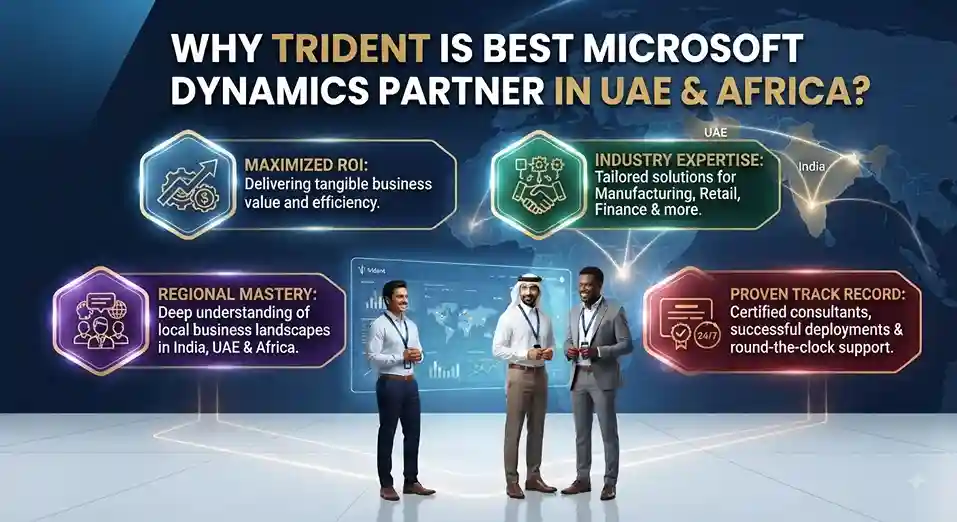
Trident is best ERP Implementation Partner in India, UAE & South Africa, Read How?

Trident is an award-winning, gold-certified ERP Implementation Partner in India. For many years, we’ve successfully enabled numerous organizations not only in India but also in South Africa (Microsoft ERP partner in South Africa) and UAE(Microsoft ERP partner in UAE) to digitally transform with ERP and grow their businesses. Our clients span several industries, from non-profit organizations and associations to professional service organizations and commercials businesses, including Retail, Education, Logistics, Hospitality, E-commerce, Real Estate and Contracting & Manufacturing. 5 Reasons why Trident is most desirable ERP implementation partner 1) Sound Track Record A significant constituent to weigh when choosing an ERP partner is whether the company you’re examining has a strong track record or not and TRIDENT will not let you down with this one because it is NAV partner in India and ERP partner in South Africa, so it has successfully worked with leading organisation from Retail, Hospitality, Manufacturing, Oil & Gais Distribution, Duty Free, Government, etc,. Industries worldwide. 2) Sufficient Resources Trident has sufficient technical & functional resources (i.e., 150+ Resources). Trident has previous experience dealing with companies of any size and scope even If you’re a global company don’t worry as Trident is Nav partner in India, Microsoft ERP partner in UAE and Microsoft ERP partner in South Africa so we have sufficient resources that can handle global ERP implementations and we had handled the big scale companies earlier also. We reliably meet goals through: Our locations and own resources in UAE, India & Africa Process and solution know-how with Microsoft Dynamics ERP NAV & AX plus Dynamics 365 installations with between 20 and several thousand users International consulting expertise for Microsoft Dynamics NAV & AX plus Dynamics 365  roll-outs Our certified project management process model, which has been proven many times in practice The Microsoft Dynamics® Sure Step method Certified and experienced project managers, technical & functional consultants and developers Our own high-quality standards 3) Knowledge of your industry – In addition to having a strong track record in general, your ERP implementation partner should have a great track record within your industry. As Trident is Microsoft ERP Implementation Partner in India so we keep this thing into consideration while implementing an ERP system and we know that the more the software suits the methods you already have, the less you’ll have to change your business, and therefore, the less costly and time-consuming that will be. 4) Well Recognised and Awarded Microsoft has awarded us certifications in many areas – as backed up by our numerous Gold and Silver competencies. These qualification ratings in the Microsoft Partner Program show customers what they can expect solid advice and reliable implementation 5)  Agile methodology for software development Trident also focusses on fresh information to come to light during the implementation process. We may have some ideas previously and change them over time and it’s important that we are able to adjust the software/implementation process in acknowledgment to the fresh demands and be adaptable based on varying situations.

Trident is best ERP Implementation Partner in India, UAE & South Africa, Read How? Read More »

AID for Retailers : Trident’s Ls Retail Solution

[vc_row][vc_column width=”1/2″][vc_column_text] Problems faced by Retailers With the advance in technology, many retailers are facing mounting pressure to make their business model effective and efficient so that it can stand with the market of intense competition. Nowadays customers have become smarter because of the concept of digitalization, they have endless choices at their fingertips, they have a voice and they can post a review—and one in five consumers do, therefore, with the advancement in technology it is critical for businesses to gain insight into their customers’ needs in order to deliver experiences that build lasting relationships[/vc_column_text][vc_column_text] Solution by Trident’s LS Retail Trident is a global consulting firm that empowers organizations around the world to digitally transform and grow their businesses. Our expert consultants offer strategic consulting, implementation services, support, and managed services and pre-built software solutions that help our clients innovate and reinvigorate customer, employee, partner and supplier experiences and processes using Microsoft Dynamics 365, ERP, CRM, Business Intelligence and related Microsoft cloud solutions and with the help of them it provides Ls retail which can solve almost every problems of retailers. First, we should know what is Ls retail?[/vc_column_text][/vc_column][vc_column width=”1/2″][vc_single_image image=”6950″ img_size=”full”][/vc_column][/vc_row][vc_row][vc_column][vc_column_text]Trident Retail Solutions based on cloud, mobility, social media and analytics provide the means to keep shoppers loyal.  Solutions deliver the flexibility needed to implement new business models; expand private labels; engage buyers online, and better manage transportation and delivery. Store management, inventory, merchandising, demand planning and all the back-office functions that you would expect to find at head office are available in LS Retail. Ls Retail can assist your business with the following: [/vc_column_text][/vc_column][/vc_row][vc_row][vc_column width=”1/2″][vc_column_text] Economical and Efficient Executing LS NAV you get the benefits of having one fully integrated retail platform, creating genuine savings on IT costs including software administration, moreover streamlining the way you manage IT by having a simplified solution that benefits your business: Lessen the time on data cleaning for various sources Lessen errors and inconsistency across your data Boost efficiencies in pricing and stock visibility Expand business and retain customers LS Nav can modify your sales plan and help your marketing strategies by building demand generation from unlike customers and supporting living customers through: Innovative upsell and cross-sell functionalities Customized loyalty programs improving the customer experience Sewn promotions for sales campaigns Automatic coupons, gift card, and promotional offers managements [/vc_column_text][/vc_column][vc_column width=”1/2″][vc_single_image image=”7213″ img_size=”full”][/vc_column][/vc_row][vc_row][vc_column width=”1/2″][vc_single_image image=”7216″ img_size=”full”][/vc_column][vc_column width=”1/2″][vc_column_text] Expand perimeters and guard living sales LS Nav will assist you to get control and optimize operations through a number of modules, which will help you: Magnify staff functions and enhance customer assistance Lessen costs on inventory management Secure your business on loss and fraud Lessen the need for markdowns Manage vendor and supplier performance Multiply your profits and meet targets Optimize your inventory and replenishment By controlling your inventory in an optimal way, LS Nav can help you: Free up working capital Lower inventory levels by up to 35% Lessen workload through automation: Replenishment can be done automatically or manually Diminish markdowns Confront fewer stock-outs Quicker return on investment [/vc_column_text][/vc_column][/vc_row][vc_row][vc_column width=”1/2″][vc_column_text] POS Your consumers require fast register processing, LS Nav’s innovative Point of Sale (POS) system offers them a quick and error-free experience wit. The POS terminals are simple to set up and maintain and support the use of both keyboard and touch screen equipment. You can immediately obtain your transactions and sales events directly through POS because of the real-time data replication system and process. Conscious Design and Online Shopping Make your customers your priority. Today your customers are online shoppers and demand an online app, you need to put them first. Through LS Mobile and Ecommerce you can handle customers with tailored offers, customer loyalty programs, click incentives,  and enticing product information through the omni-channel.[/vc_column_text][/vc_column][vc_column width=”1/2″][vc_single_image image=”7217″ img_size=”full”][/vc_column][/vc_row]

AID for Retailers : Trident’s Ls Retail Solution Read More »