Welcome to Trident Information Systems!
Write us to - info@tridentinfo.com
Let's Socialize

partnersource business center

ERP Software for eCommerce

How can Charity Retailers Select the Right POS and Unified Software Solution? 

Making the move or upgrading to a new version of Retail POS System or ERP Software for eCommerce affects every area of a retailer’s company. It can be much worse for charity merchants, who must account to their patrons for their running expenses. They must be able to justify any additional investments made to meet the increasing administrative load they currently confront, even if it is one of their largest expense centers.  But there is no longer a choice to do nothing. Charity merchants cannot afford to cling to antiquated procedures and outdated technology as they struggle to stay viable and deal with issues like multi-channel stock management, retaining supporters, and obtaining the largest gifts from frugal customers. The most discerning understand that the proper Retail POS Systems and Retail ERP software may relieve their pain. Several well-known charities, like Sue Ryder, Ten Thousand Villages, and the Royal Horticultural Society (RHS), have made the switch.  Ralph Larcombe, the manager of Sue Ryder’s EPOS systems in the United Kingdom, stated that the organization’s sole purpose in being there was to make money to fund its healthcare department and do good deeds. Therefore, getting value for their money was crucial to them when choosing a new IT system.  Sue Ryder chose to upgrade to the most recent version of LS Retail Software Solution. Their trustees reviewed the business case to ensure that the initiative would produce the anticipated return on investment (ROI). The organization is now benefiting from automated replenishment, improved data administration, intelligent reporting, and a simplified till that requires less training for new volunteers in terms of saving money and time.  How can ERP Software for eCommerce Manage Every Aspect of Your Charity Retail Store?  You will eventually lose sight of which parts of your business are doing well and which aren’t if your data is stored in silos across many databases and your channels don’t connect. Because of this, charity retailers want ERP Software for eCommerce that gives them a clear picture of their data, complete control over their business, and real-time data on goods, sales, and customers for all of their physical and online stores.  LS Retail Management Software is now used by the UK charity RHS to power several retail sites. The software is used by the corporation to handle its supply chain, sales orders, order fulfillment, and finance for its retail and sales operations. RHS is equipped with all the tools necessary to manage:  Retail Activities throughout the garden centers.   Finances, except charitable finances.   Inventory, e-commerce sales, gifts, and books.   Events.   Data on products, customers, and sales.  How Does it Help You Manage Volunteers and Employees?  Charity shops by definition have a high worker turnover rate. The majority of retailers often use volunteers of various ages, who must be recruited, employed, instructed, and managed. Therefore, having cutting-edge Retail Point of Sale Systems that is simple to use, need little training, and can simply organize employee schedules is a priceless tool for your nonprofit organization.  A straightforward and easy-to-use Point of Sale System was important to Sue Ryder when choosing a new retail system.  EPOS Systems Manager Larcombe remarked, “Having a till that is straightforward, transparent, clean, and easy to use, is of enormous importance to us. After a brief 45-minute training session, the volunteers at the Sue Ryder stores—some of whom are seniors without any prior retail experience—can use the till with ease. Our volunteers may practice without actually doing transactions in the training mode on the LS Retail till, and they often pick it up pretty fast.”  How Strong Business Analytics and Embedded Power BI can Provide Better Visibility?  Do you fully comprehend what is occurring throughout your network of charity shops? Data analytics may be useful, especially for the price and assortment optimization, if you want to quickly identify the goods and places that are generating the most money and where you should take action. Although you may add these sophisticated features to your Retail Management System, it is more cost-effective to have them integrated into the ERP Software for eCommerce as opposed to using a separate software solution that you’ll need to operate, pay for, and keep up to date.  Managers at Ten Thousand Villages now have far better visibility into what is happening thanks to clever ERP Software for eCommerce and a centralized source of data. They can act on opportunities and fix problems in real-time, even on the busiest retail days, thanks to a Power BI dashboard that pulls data straight from the Retail ERP. Hence improving sales performance.  Today, a lot of charity retailers work with ERP Software for eCommerce such as LS Retail Software Solution. If you want to implement this solution, you can Contact Trident Information Systems. We are Microsoft Dynamics 365 Gold Partner and LS Central Diamond Partner. With a strong track of accomplishments of 22+ years, we have partnered with various renowned businesses across the world.  

How can Charity Retailers Select the Right POS and Unified Software Solution?  Read More »

AX to D365 Upgrade

Why Should You Upgrade from Dynamics AX to Cloud? 

Relying on outdated technology pushes you back in the race. You become incompetent and your rivals make money out of it. Many businesses postpone upgrades as they feel uncomfortable shifting to modern technology. However, little do they realize that they are pushing themselves back. Businesses working with AX fear the same discomfort and tend to postpone the AX to D365 Upgrade.  One of the major reasons why it is recommended to Upgrade AX to D365 Finance and Operation is the end of its lift support. Many of the AX versions are already out of support and a few have extended support till January 2023. Hence, it is best to hurry up and Upgrade AX to D365.  Other Reasons for AX to D365 Upgrade   Lack of suitability for large-size businesses. It may not even be a good match for small-sized businesses either.   Despite being comprehensive, its dependency on partner channels and ISV may add time to the deployment, hence increasing the total cost of ownership.  Software as a Service (SaaS) and cloud ERP options have a limited reach which can increase costs if partners are hosting the software.  Hence, it is clear that AX is not suitable for every business size, unlike Microsoft Dynamics 365 Finance and Operations. It is not as scalable as a growing business may need and may even become expensive at times.   Dynamics 365 Finance and Operations is both cloud-based and on-premises. Hence, you can choose the solution you prefer. However, cloud-based solutions are more convenient, flexible, and agile. For instance, in an on-premises solution, your data is backed up in a local server, when you feel like increasing your storage, you will have to install a new server from scratch. But in the cloud, all you have to do is push command and your storage shall increase. Furthermore, it is easier to manage cloud storage than a local server.   Other benefits you can experience with Microsoft Dynamics 365 Finance and Supply Chain include:   High-end Security: D365 ensures high-end security from hacking, malware, viruses, and other threats. Contrary to the old beliefs, the cloud has now become more secure than ever as its credentials are continuously monitored and attacked by Microsoft 24/7. With over 3000 security experts by Microsoft, you can assure bank-level security.   Low Cost of Ownership: When you no longer have to invest in hardware, maintenance, service management, staff training, and upgrades, imagine how much you are saving. With AX to D365 Upgrade, your cost of upgrade with a limit to testing and validation, hence removing every other IT-centric work. You do not even have to re-train your staff after an upgrade except for new features if any.   Remote Accessibility: one of the major benefits of AX to D365 Upgrade is its remote accessibility. Upgrading to a cloud-based platform allows accessibility on any device. Since your business apps are standardized by Microsoft, they can function seamlessly with a single sign-on and are integrated out of the box.  Effortless Latest Version Installation: As soon as you leap to the cloud, any subsequent platform will be automatically updated every three months. The application on the other hand will update every six months. Dynamics 365 provides update reminders from 7, 15, 30, and 90 days before the upgrade. You can even postpone upgrades by 12 months from the release date. Minor upgrades take place without disrupting your business operations, and for major updates, you will be updated prior.   No/Low Training Required: Since Microsoft uses the same functionalities, you do not have to spend much time learning the software. You can start working right away and boost efficiency at the same time. The core business logic you use has been transferred to Dynamics 365 Finance and Operations, but the interface is updated.   Adaptability: AX to D365 Upgrade gives you enough flexibility to mix match apps and personalize your experience while increasing profitability. The best part is that the user experience of these apps is equally intuitive. For instance, you can leverage sales and field service along with Dynamics 365 Finance and Operations providing the ultimate growth platform.   Upgrade Dynamics AX to D365 and ensure the most agile, flexible, and secured features. If you wish to for an upgrade, you can Contact Trident Information Systems, a Microsoft Dynamics 365 Gold Implementation Partner and LS Central Diamond Partner. 

Why Should You Upgrade from Dynamics AX to Cloud?  Read More »

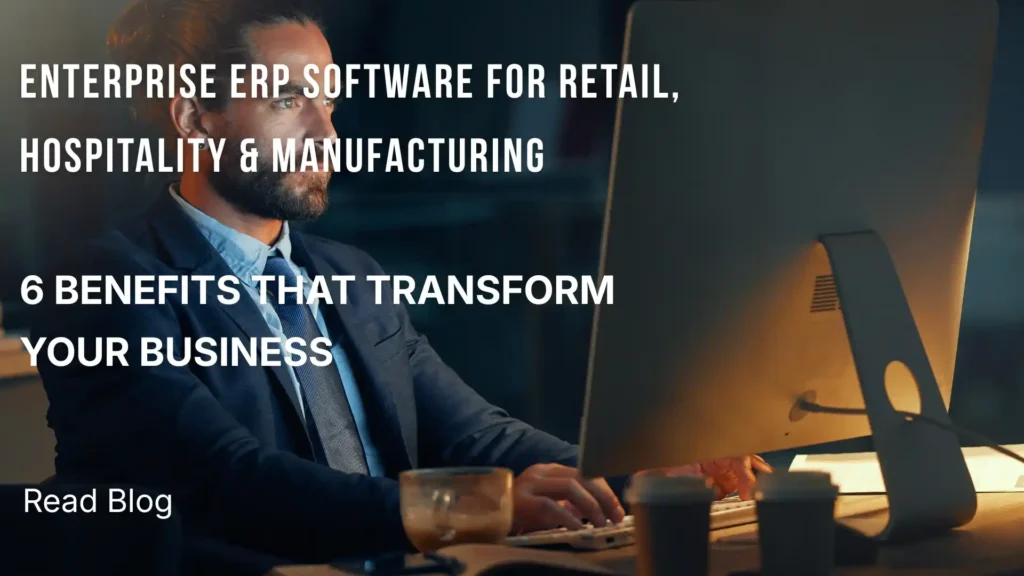
Enterprise ERP software dashboard managing retail, hospitality, and manufacturing operations.

Enterprise ERP Software for Retail, Hospitality & Manufacturing: 6 Benefits That Transform Your Business

Running a business in retail, hospitality, or manufacturing means managing a constant flow of moving parts — staff schedules, customer orders, inventory levels, supplier deliveries, and financial transactions — all happening simultaneously, every single day. When those moving parts are managed through disconnected systems — a spreadsheet here, a separate POS there, a standalone HR tool — the gaps between them create errors, delays, and blind spots that cost real money. Enterprise ERP software brings everything together. One platform. One source of truth. Every department — finance, operations, HR, sales, and customer service — working from the same real-time data. Here is how ERP transforms operations specifically in retail, hospitality, and manufacturing — and why Microsoft Dynamics 365 Business Central is the platform Trident recommends. Why Retail, Hospitality, and Manufacturing Need ERP Most These three industries share a common challenge: high operational complexity at every level. A retail chain manages hundreds of SKUs across multiple locations. A hotel or restaurant balances reservations, kitchen operations, staff rotas, and customer satisfaction simultaneously. A manufacturer coordinates raw material procurement, production scheduling, quality control, and order fulfilment — often across multiple sites. Without a unified system connecting all these functions, management is reactive. With the right ERP, it becomes proactive — with real-time visibility that enables better decisions at every level of the organisation. 6 Key Benefits of ERP for Retail, Hospitality and Manufacturing 1. Real-Time Data Across Every Department Business data changes constantly. Inventory levels shift with every sale. Staff schedules update daily. Customer orders flow in around the clock. Financial positions move with every transaction. Without real-time visibility, managers make decisions based on yesterday’s data — and the gaps between systems mean different departments often work from different numbers. ERP solves this fundamentally. Every transaction updates the central system instantly — so whether you are checking stock levels, reviewing sales performance, or approving a purchase order, you are always working from current, accurate information. No delays. No discrepancies. No guesswork. 2. Integrated Point of Sale In retail and hospitality, the POS system is the heartbeat of the operation. Every sale, every order, every payment flows through it — and what happens to that data after the transaction determines how well the rest of the business functions. A standalone POS that does not connect to inventory, finance, and customer management creates manual work and data silos. An ERP-integrated POS changes everything: For retail chains and multi-outlet hospitality businesses, this integration is particularly powerful — giving head office a live view of every location’s performance without waiting for manual reports. 3. Smarter Customer Management Your customers are your most valuable asset — and your ERP should help you treat them that way. An ERP system captures complete customer profiles: purchase history, preferences, communication records, loyalty points, and service interactions. This data enables: In hospitality especially, knowing your guest’s preferences before they arrive is a powerful differentiator. In retail, personalised offers based on real purchase data consistently outperform generic promotions. ERP makes both possible at scale. 4. Efficient Employee Management Managing staff across retail stores, restaurant shifts, or manufacturing shifts — potentially across multiple locations — is one of the most operationally demanding functions in any of these industries. ERP centralises employee management in one system: When employee data is connected to operational data, managers can make faster and fairer staffing decisions — and compliance documentation is always complete and current. 5. Streamlined Inventory Management Inventory management is the operational function where ERP delivers the most immediate and visible impact — particularly in retail and manufacturing. Without a connected inventory system, businesses either over-order (tying up cash in excess stock) or under-order (losing sales to stockouts). Neither is acceptable in competitive markets. ERP provides: For manufacturers, ERP takes this further — connecting inventory management directly to production planning and supplier procurement, ensuring materials are always available when production needs them. 6. Unified Financial Management Every operational decision has a financial consequence — and ERP connects the two in real time. Rather than waiting for month-end reports compiled manually from multiple systems, ERP gives finance teams live visibility into revenue, costs, margins, and cash flow across every business unit. Invoices are matched automatically. Budget variances are flagged immediately. Financial close processes that once took days are completed in hours. For multi-entity businesses — retail chains, hospitality groups, or multi-site manufacturers — ERP consolidates financial data across all locations into a single, accurate picture that leadership can act on immediately. Why Microsoft Dynamics 365 Business Central Microsoft Dynamics 365 Business Central is the modern, cloud-native evolution of Dynamics NAV — one of the most widely deployed ERP platforms in retail, hospitality, and manufacturing globally. It delivers all six benefits above in a single, integrated platform — with the added advantage of: Whether you are running a single restaurant, a retail chain, or a manufacturing facility, Business Central scales with your operation — without platform replacement as you grow. Why Trident Is India’s Trusted ERP Partner As a certified Microsoft Dynamics 365 Business Central partner, Trident Information Systems has helped businesses across retail, hospitality, and manufacturing in India implement ERP solutions that deliver measurable results — from initial assessment through go-live and ongoing optimisation. Ready to unify your business on one intelligent platform? Book a free ERP assessment with Trident today.

Enterprise ERP Software for Retail, Hospitality & Manufacturing: 6 Benefits That Transform Your Business Read More »